Table of Contents
Get our free local reporting delivered straight to your inbox. No noise, no spam — just clear, independent coverage of Marblehead. Sign up for our once-a-week newsletter.
The Marblehead Municipal Light Department board heard detailed plans for a proposed five-megawatt battery storage system and reviewed a draft policy for voluntary payments to the town at its Nov. 24 meeting.
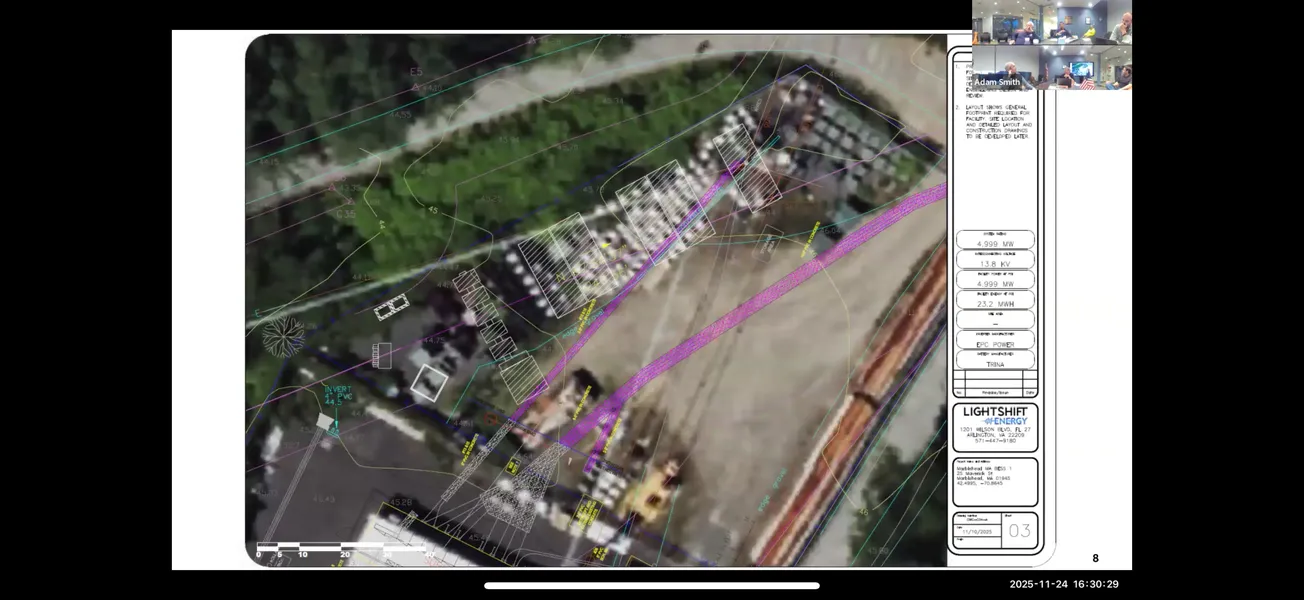
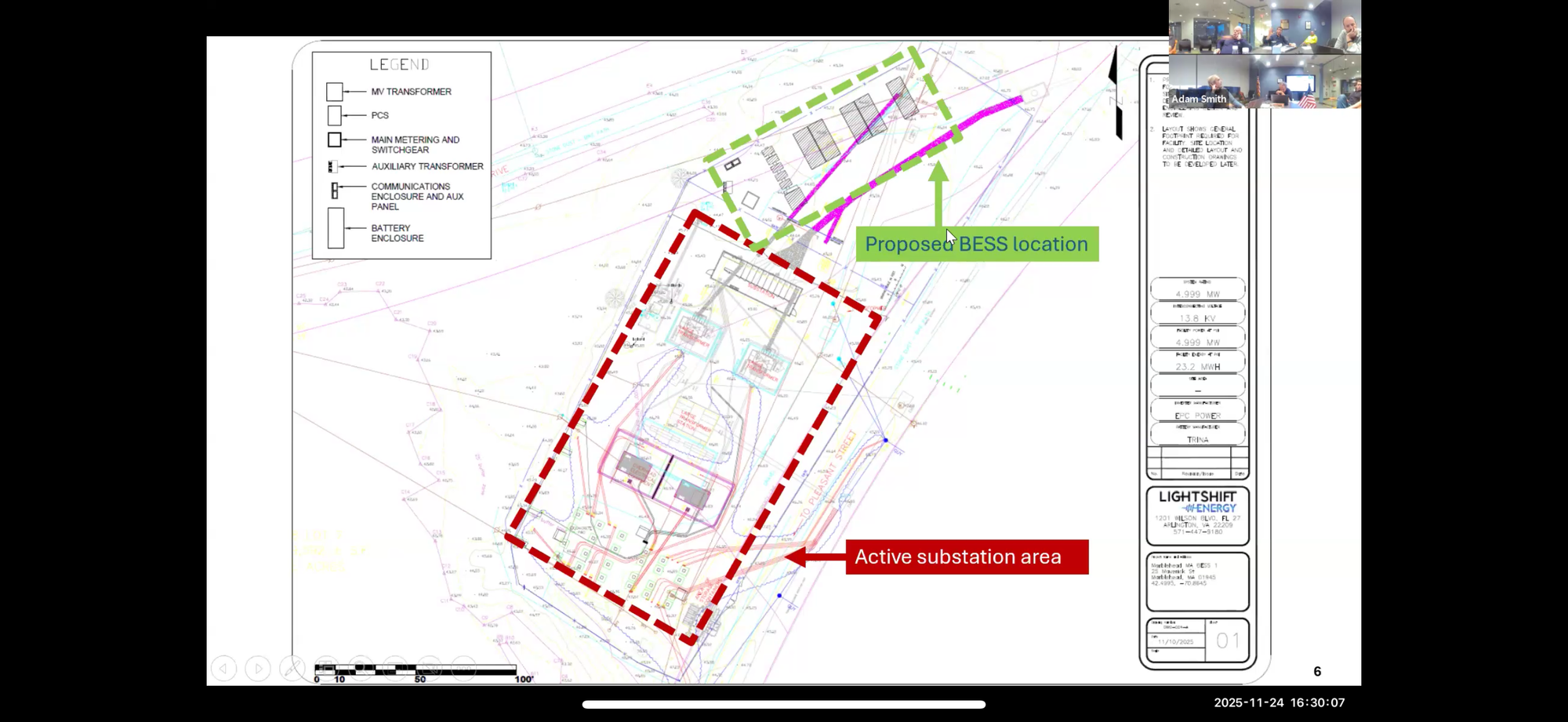
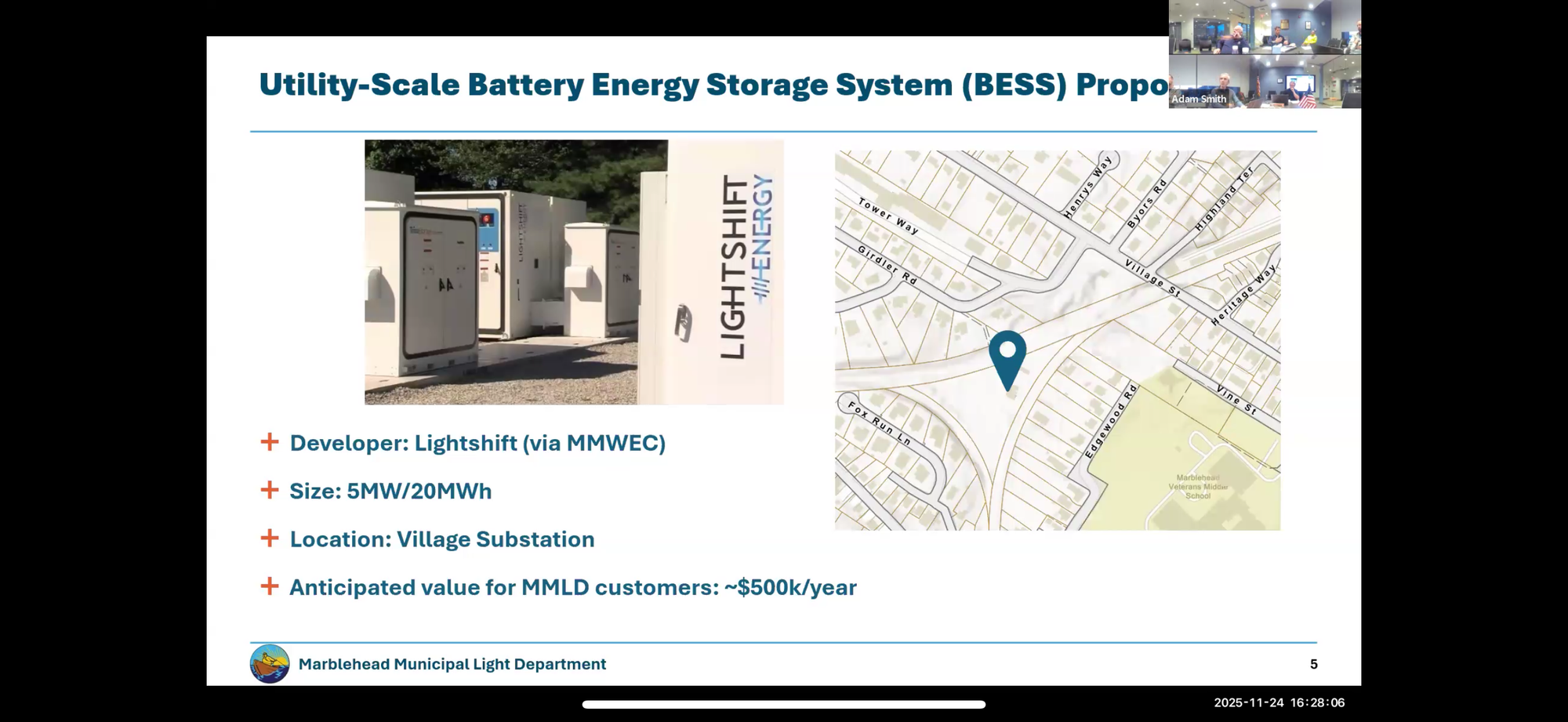
General Manager Jonathan Blair presented an update on negotiations with LightShift Energy to develop a lithium-ion battery at the Village 13 substation. Blair said he expects to bring a formal proposal to commissioners for a vote within the next month or two.
“This is probably the closest thing we have to shovel-ready for developing one of these in the next two-year time horizon,” Blair said. “We don’t have to do it, but as we saw from our summer peak load and what we’ve seen from financial performance, our load is growing.”
The proposed system would store four hours of electricity at five-megawatt capacity, dispatching during peak demand periods to reduce the department’s contribution to regional transmission and capacity charges. Blair said the battery would target both the annual summer capacity peak and 12 monthly transmission peaks throughout the year.
Under the structure Blair outlined, LightShift would assume all upfront construction costs, estimated at roughly $1 million per megawatt for a total project cost around $5 million. The developer would also handle ongoing operations, maintenance and eventual decommissioning.
“We really have no upfront capital costs, no O and M throughout the lifespan and no end of life obligation to restore the site,” Blair said. “It’s all on them.”
The 20-year energy storage service agreement would split revenue roughly 50-50 between the developer and the department. Blair projected total value of approximately $1 million annually, yielding about $500,000 in savings for ratepayers.
That revenue would come primarily from reducing peak demand charges, though LightShift could also capture value through energy arbitrage and ancillary grid services like frequency regulation. The company would control dispatch under normal conditions but the department could reclaim the battery during emergencies.
Commissioner Matt Harrington asked why the department wouldn’t build and own the system outright. Blair estimated independent development would cost roughly $5 million with ongoing expenses for market monitoring and dispatch, plus liability for any thermal events and end-of-life disposal.
“There’s a lot of reasons why having this type of arrangement may be better, particularly for our first foray into this kind of investment,” Blair said.
The proposed location sits within the existing fence line at Village 13, currently used for transformer storage. Blair said transformers would likely relocate to the Tidd Way site, which has been under consideration for various uses.
Blair noted several municipal utilities in Massachusetts have installed similar systems through the same procurement process, including Reading, Wakefield, Sterling and Rowland. The arrangement was developed through the Massachusetts Municipal Wholesale Electric Company, the joint action agency that provides power supply services to public utilities.
In lieu of taxes policy
The board also spent time reviewing a draft policy that would establish a formula for voluntary payments in lieu of taxes. The proposal would calculate annual transfers at $3.60 per megawatt-hour of electricity sales, with a floor of $360,000.
Board Chair Jean-Jacques Yarmoff emphasized the payments remain strictly voluntary under Massachusetts law and must come from year-end surplus after covering all operating costs, debt service and the statutory return on net plant.
“By law, we cannot bake it into the rates,” Yarmoff said. “If the surplus exists, that is it. If it does not exist, then MMLD may have to adapt.”
The department paid the town $360,000 this year, up from $330,000 transferred annually from 2020 through 2024. Yarmoff presented analysis showing Marblehead’s payments align with peer utilities statewide, with most systems clustered between $2 and $5 per megawatt-hour.
The formula-based approach aims to provide budget predictability for both the utility and town while tying payments to electricity consumption. Yarmoff said that alignment supports the town’s decarbonization goals, which depend on increased electricity use as residents shift from fossil fuels.
“Aligning the objectives of the town and the light department seemed to be worthwhile,” Yarmoff said.
The board plans to vote on the policy at its December meeting after commissioners review the draft.
Resident Albert Jordan used public comment to oppose the town’s pursuit of Green Communities designation, arguing the utility should fund municipal energy efficiency improvements directly rather than hire staff to pursue state grants.
“I would rather see you give a couple $100,000 to the town out of the regular ratepayers and keep the money right in town,” Jordan said.
Jordan also urged commissioners to resist pressure from selectmen, who have discussed recommending the utility participate in the state program.
Blair announced the department will close at 12:30 p.m. Wednesday for Thanksgiving and remain closed through the weekend, though emergency crews will remain available. He also presented a proposed 12-month planning calendar organizing future board meetings by topic, including peak demand management in January and rate planning in February.
If you’ve read this far, you’re the kind of reader who makes our work possible. The Marblehead Independent publishes local reporting in full for everyone — no paywalls, no algorithms, no outside owners — because we believe a town is stronger when its journalism is open to all. But our reporting is only possible because some readers choose to support it.
If you value having a reporter — sitting and listening through long public-power meetings, digging into financials, and explaining how decisions affect Marblehead — please consider becoming a member today.
🟦 Click here to become an Independent member
🟦 Click here to make a one-time contribution
Be Independent, with us.