Table of Contents
Get our free local reporting delivered straight to your inbox. No noise, no spam — just clear, independent coverage of Marblehead. Sign up for our once-a-week newsletter.
After years of uncertainty, the future of Marblehead’s former Coffin School is starting to take shape, with new documents revealing sharply different visions for the long-vacant property.
Responses to the town’s October request for information — released as promised by Marblehead Community Development and Planning Director Brendan Callahan following last week’s listening session — outline the first full picture of what’s at stake: a detailed affordable-housing proposal from Harborlight Homes, competing municipal claims for cemetery space, energy storage and recreation, and the zoning decisions that will ultimately determine whether any development can proceed.
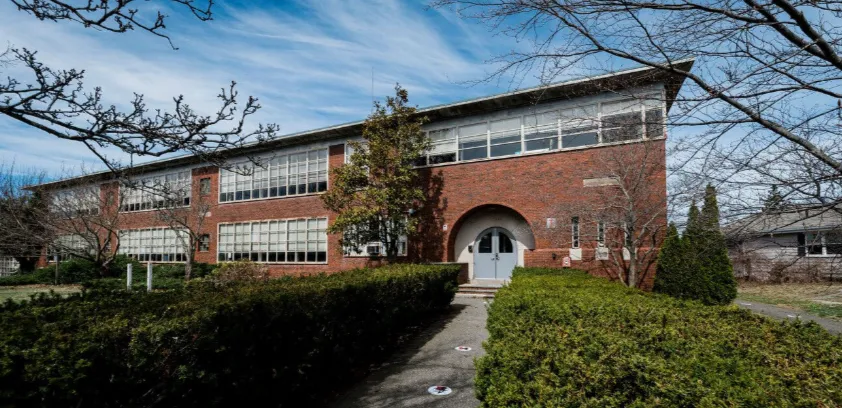
Harborlight Homes, a Beverly-based nonprofit housing developer, submitted the only formal redevelopment proposal, outlining a 40-unit affordable apartment complex that would preserve the historic 1948 school building while adding new construction. The proposal includes 14 one-bedroom units designed with seniors in mind, with the remainder split between two- and three-bedroom apartments targeting families and working-age adults.

The development would demolish the existing annex and construct a new two-story residential wing fronting Turner Road. Architecture firm SV Design created conceptual plans showing the project would maintain the 35-foot height limit and existing setbacks to blend with surrounding single-family homes while incorporating residential detailing and sloped roofs on new construction.
“They were proposing to retain the main structure, the main school building,” Community Development and Planning Director Brendan Callahan said in the documents. “They were going to remove the annex building and then the concept had the second building up front on Turner Road.”
The site plan allocates space for 80 parking spaces at two per unit, conforming to current zoning requirements. The design includes raised-bed gardens, play areas and open space for residents. Harborlight indicated a portion of the 3-acre site could remain as town-owned public parkland. The developer also proposed potentially adding four first-time homebuyer townhouses along Susan Road if funding becomes available, bringing the total unit count to 44.
$28M project targets multiple funding sources
Development costs are estimated between $28 million and $32 million. Construction expenses include demolition of the annex building, abatement of hazardous materials and environmental remediation, complete historic renovation of the existing 1948 building, construction of the new residential wing and fit-out of 40 housing units and common spaces. All mechanical, electrical and plumbing systems would be replaced.
The 1948 building contains approximately 26,000 square feet of finished space and is assessed at $3.39 million. A capital needs assessment identified $260,848 in critical repairs and $991,098 in 20-year capital needs.
Harborlight outlined seven potential funding sources: federal and state Low Income Housing Tax Credits, federal and state Historic Tax Credits, state Executive Office of Housing and Livable Communities housing programs, local funding through HOME and the Marblehead Affordable Housing Trust Fund, Federal Home Loan Bank Affordable Housing program grants, solar tax credits and conventional mortgage debt.
The proposal indicates ongoing operations and maintenance would be self-sufficient, funded entirely by rental income without requiring additional capital from the town. Operating and replacement reserves would be established to ensure consistent long-term operations.
Membership powers accountability. Decisions about places like the former Coffin School shape neighborhoods for generations. Independent, member-funded reporting ensures residents know what’s being proposed — and what’s at stake. Click here to become an Independent member
The project would require zoning changes, as the current single-residence zoning district does not permit multifamily housing. Harborlight proposed several regulatory pathways: 40R “Smart Growth” zoning, which provides state-funded incentive payments for rezoning and unit creation; 3A MBTA Communities zoning; a special permit process; or a Chapter 40B comprehensive permit process through the Zoning Board of Appeals, which would bypass Town Meeting approval.
“Our goal would be to comply with existing zoning as much as possible (height, setbacks, parking, etc), and seek relief only on use, to allow multi-family development,” Harborlight wrote. “We are open to whichever zoning mechanism is best for the town.”
The developer emphasized multiple sustainability features. The project would install high-efficiency electric heat pumps for heating and cooling, provide EV charging stations and install historically accurate, high-performing windows. Rooftop solar panels would generate renewable energy, and drought-tolerant landscaping would limit or eliminate irrigation needs.
Harborlight recently completed its first LEED Gold certified building at Maple Woods in Wenham and is preparing to break ground on its first Passive House certified project in Hamilton. The organization’s portfolio includes more than 700 units across 11 communities with more than 300 homes in its development pipeline.
The nonprofit emphasized its long-term ownership and management model, conducting all property management and maintenance in-house. Each property includes a Resident Service Coordinator who assists residents in accessing healthcare, food assistance, transportation and other services.
“We’re not looking at the make a quick buck,” Callahan said. “We’re definitely looking at the community needs.”
Harborlight indicated in its proposal that its properties pay municipal property taxes, estimating the project would generate between $50,000 and $70,000 annually for Marblehead. However, as a 501(c)(3) nonprofit organization, the actual tax status of the development would likely depend on its financing structure and could involve payments in lieu of taxes rather than full property tax assessments. The development would add 40 units to the state’s Subsidized Housing Inventory, raising Marblehead’s affordable housing percentage from 3.85 percent to 4.2 percent.
Housing Authority seeks partnership role
The Marblehead Housing Authority submitted a letter proposing a partnership role rather than direct property acquisition, acknowledging it lacks resources to purchase the property independently but could strengthen a developer’s proposal through four functions.
First, the authority proposed a co-ownership partnership to increase eligibility for state funding available exclusively to housing authorities. Second, it offered to serve as property manager, citing high performance scores in state reviews.
Third, the authority proposed managing waitlist advertising, tenant selection and tenant certification for affordable units, noting it currently manages statewide waitlists totaling thousands of applicants.
Fourth, the authority outlined its capacity to provide resident services. The Housing Authority currently operates on-site supportive living programs through state partnerships, all-inclusive social service coordination and an economic mobility program for families.
The authority requested officials incorporate additional scoring criteria rewarding proposals that include the agency as a partner, arguing its local connection and experience make it a valuable collaborator.
Municipal departments express competing interests
The Cemetery Department submitted a letter expressing interest in the property for future burial space, noting it has communicated this need to town administration for 12 years.
“The property’s close proximity to Waterside Cemetery makes it an ideal candidate for future burial space,” cemetery commissioners wrote in their April letter.
Other municipal expressions of interest proposed alternative public purposes. The Marblehead Light Department suggested battery energy storage systems. The Recreation and Parks Commission suggested establishing a dog park. The Community Development and Planning Department proposed temporary boat storage to generate interim revenue during the disposition process.
Membership strengthens neighborhood journalism. When redevelopment proposals land, residents need clear, factual reporting. Your support gives Marblehead reliable coverage on decisions that change daily life. Click here to become an Independent member.
Harborlight identified several barriers to redevelopment. Zoning represents the primary hurdle, requiring a collaborative approach between town officials and the developer. Traffic concerns and fire department access present operational challenges. Potential hazardous materials and environmental issues could affect project costs and timelines.
The developer requested additional information to support a fully developed request for proposals, including comprehensive environmental studies, hazardous materials assessments, existing conditions surveys and floor plans of existing buildings.
Harborlight recommended the town continue specifying preference for affordable housing in any formal request for proposals and clarify desired additional uses such as public parks or open space.
Officials will evaluate input from the November 14 listening session alongside the responses. A second community engagement session is planned for early December, after which the Community Development and Planning Department will present formal recommendations to the Select Board.
The Select Board holds final decision-making authority on the property’s disposition. Any zoning changes required for development would need approval at town meeting. The property has been vacant since 2021 and transferred from the School Committee to the Select Board in May 2025.
A QUICK PITCH: Help us keep covering the big decisions shaping Marblehead’s neighborhoods
The future of the former Coffin School is more than a real-estate question — it’s a choice about housing, zoning, public assets, town finances and how Marblehead meets long-term community needs. And because whatever happens on this site will directly affect the neighbors who live around it, as well as the broader community, residents deserve clear, accessible reporting that explains each option before decisions are made. Stories like this — where municipal departments, developers, regulations and competing visions intersect — take careful, sustained coverage to make sense of. That’s what The Marblehead Independent is here to do: follow the documents, track the proposals and keep residents informed at every step.
We’re a small, reader-powered newsroom with no corporate owner and no nonprofit board. It costs just $80,000 a year to operate The Independent — enough to attend the meetings, analyze the proposals, verify the facts and report on the land-use and housing decisions that will shape Marblehead’s future. If this story helped you understand the town and issue better, consider monthly contribution or a one-time gift that directly funds more local public-interest journalism.
🟦 Click here to become an Independent member
🟦 Click here to make a one-time contribution
Be Independent, with us.