Table of Contents
Get our free local reporting delivered straight to your inbox. No noise, no spam — just clear, independent coverage of Marblehead. Sign up for our once-a-week newsletter.
Asked Friday which project a state Green Communities grant might help pay for, Sustainable Marblehead advocate Michele Bell answered almost before the question was finished: Abbot Public Library.
“I mentioned it only because everybody likes the library,” Bell said.
The library is one possible destination for money unlocked by a vote the five-member Marblehead Municipal Light Commission has scheduled for 4 p.m. Tuesday at 80 Commercial St. and on Zoom. The agenda lists “Membership in Green Communities: Board discussion, vote.”
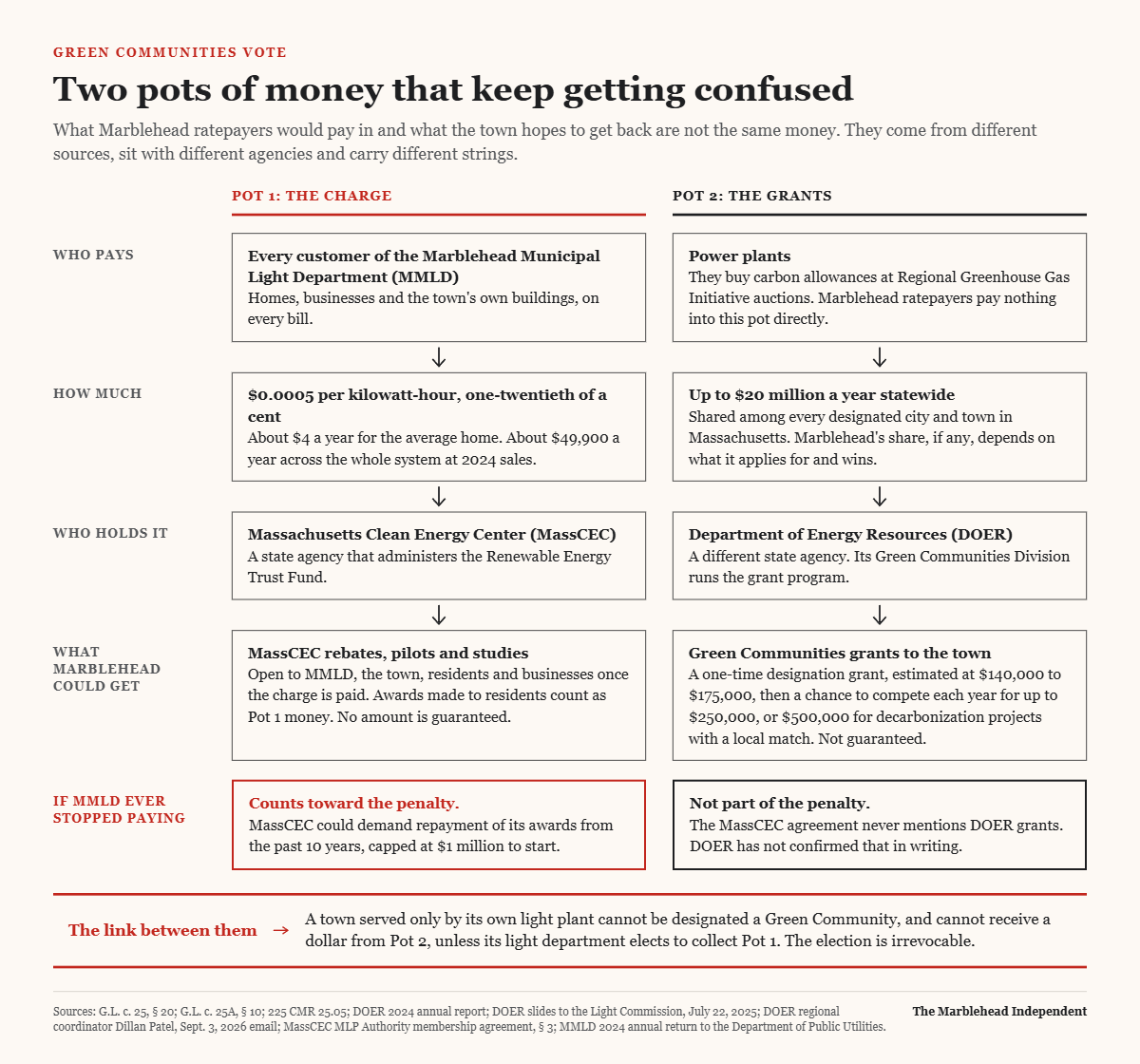
A yes vote would commit the Marblehead Municipal Light Department to collect a state renewable energy charge of $0.0005 per kilowatt-hour, or one-twentieth of a cent, from every customer. At 2024 sales, that is about $49,900 a year systemwide, or roughly $4 for the average residential customer.
Green Communities vote
What the renewable energy charge would cost you
The charge is $0.0005 per kilowatt-hour. Drag the slider to your household's annual electricity use.
Per year
$4.02
Per month
34 cents
Every additional 1,000 kWh a year adds 50 cents. The charge would appear as its own line on the bill; MassCEC says it cannot be folded into rates.
The same charge, five ways
Across Marblehead, at 2024 sales
Joining requires an agreement with the Massachusetts Clean Energy Center, which administers the trust fund and sets the consequences if MMLD later stops collecting the charge. Only the Light Commission can make that election.
“The light board never has to ask the town to raise rates, it just does its own thing,” Sustainable Marblehead advocate Eileen Mathieu said.
The commission left Sept. 1 without a vote. Since then, the potential cost of a breach has become clearer.
Contract ties breach to MassCEC awards
Commissioner Mike Hull cited an agreement making the light department and town jointly liable for a default, but that language applies to multitown light plants. Marblehead would use a separate form placing the obligation on MMLD alone.
A default could trigger repayment of qualifying MassCEC trust-fund awards, generally capped at $1 million. Awards at least 10 years old are excluded.
That agreement does not cover Green Communities grants issued by the state Department of Energy Resources. DOER regional coordinator Dillan Patel wrote Sept. 3 that the two funding streams are separate.
“There was a misunderstanding,” Mathieu said. People assumed that if Marblehead won Green Communities grants over a decade, “then we’d be liable for that, but we’re not.”
The contract supports that distinction, though DOER has not publicly addressed the breach question in writing. MMLD also has not publicly identified which agreement form it would sign.
Savings could outlast the grants
Once designated, Marblehead would receive a one-time grant estimated at $140,000 to $175,000, then could compete annually for grants of up to $250,000. Building decarbonization projects can receive up to $500,000 with a local match. None is guaranteed.
“We’re all excited about getting the grants, but what they’re going to do is save us money year in year out,” Mathieu said.
The town’s Energy Reduction Plan shows the argument. About $170,600 in controls, lighting and plug-load work at Brown School is projected to save $26,100 a year. Two Village School measures costing a net $224,725 are projected to save $54,173 annually, most of it in natural gas.
Marblehead could pursue those projects without Green Communities status; designation would add state money toward the upfront cost. At Abbot Public Library, about $1.5 million in proposed setpoint, ventilation and window work carries a payback of more than 20 years.
“The costs are not insignificant to do some of these projects, and Green Communities will not be able to pay all of it,” Mathieu said.
Eight years to Tuesday
Sustainable Marblehead first raised Green Communities with the commission in 2017. In 2018, Town Meeting adopted the Stretch Energy Code under an article titled “Stretch Code Adoption for Green Communities Designation,” while MMLD searched for an exception that would let Marblehead qualify without charging all customers.
That July, the commission said it would wait for a federal solar study before deciding.
A 2022 memo from then-Commissioner Lisa Wolf said MMLD had “rejected” the charge, citing “‘in perpetuity’ payments” and its “regressive nature.” No such vote appears in commission minutes.
The effort revived in 2024, then stalled after voters repealed Marblehead’s Section 3A multifamily zoning, which DOER said would block grant payments. Town Meeting adopted a new overlay 881-82 on May 4, and the Select Board voted unanimously Aug. 26 to support completing the Green Communities application.
General Manager Jon Blair ran Ipswich’s light department when that town joined the trust in 2019. Ipswich pays roughly $55,000 a year.
In a Sept. 11 email, Blair wrote that the program stood at “a net loss of $70k” when he left in 2023, then noted Ipswich received grants of $167,000 and $500,000 in 2024 and 2025. State records also list a $200,000 award in 2021.
Blair’s takeaway was the need for “early, frequent, and perpetual pursuit of grant funding to make the Green Communities program make sense.”
BEFORE YOU GO … Our reporting remains free and open to all. It is sustained by readers who choose to support it — by contributing so that routine, document-based local reporting continues without paywalls or promotional framing. Right now, 124 readers support The Marblehead Independent with monthly or annual contributions. Click here to become an Independent member.