Table of Contents
Get our free local reporting delivered straight to your inbox. No noise, no spam — just clear, independent coverage of Marblehead. Sign up for our once-a-week newsletter.
Monsignor Timothy J. Moran had just come from the cemetery.
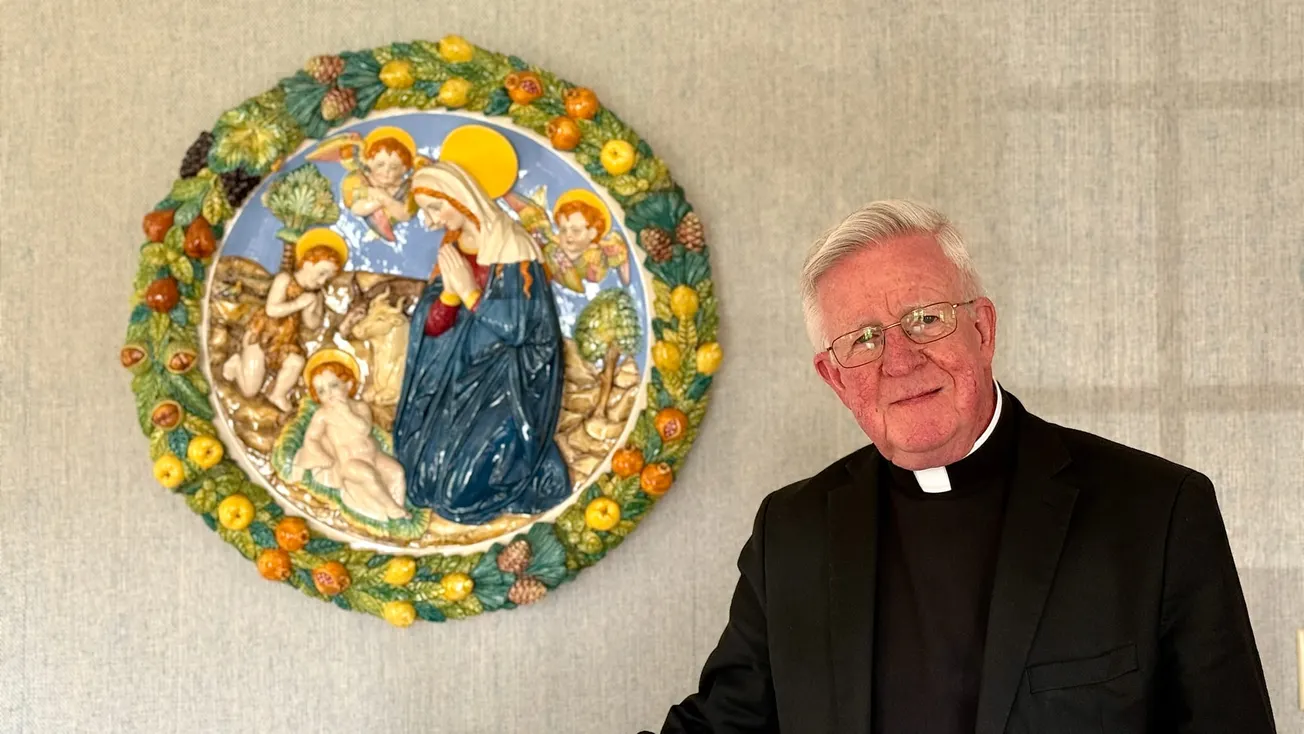
At 2 p.m. Friday, he sat at a long wooden table in the rectory conference room at Our Lady Star of the Sea, his black clerical suit still carrying the weight of the morning’s burial.
Behind him hung a Della Robbia Nativity — the Madonna over the infant Christ, encircled by lemons, pomegranates and pine cones.
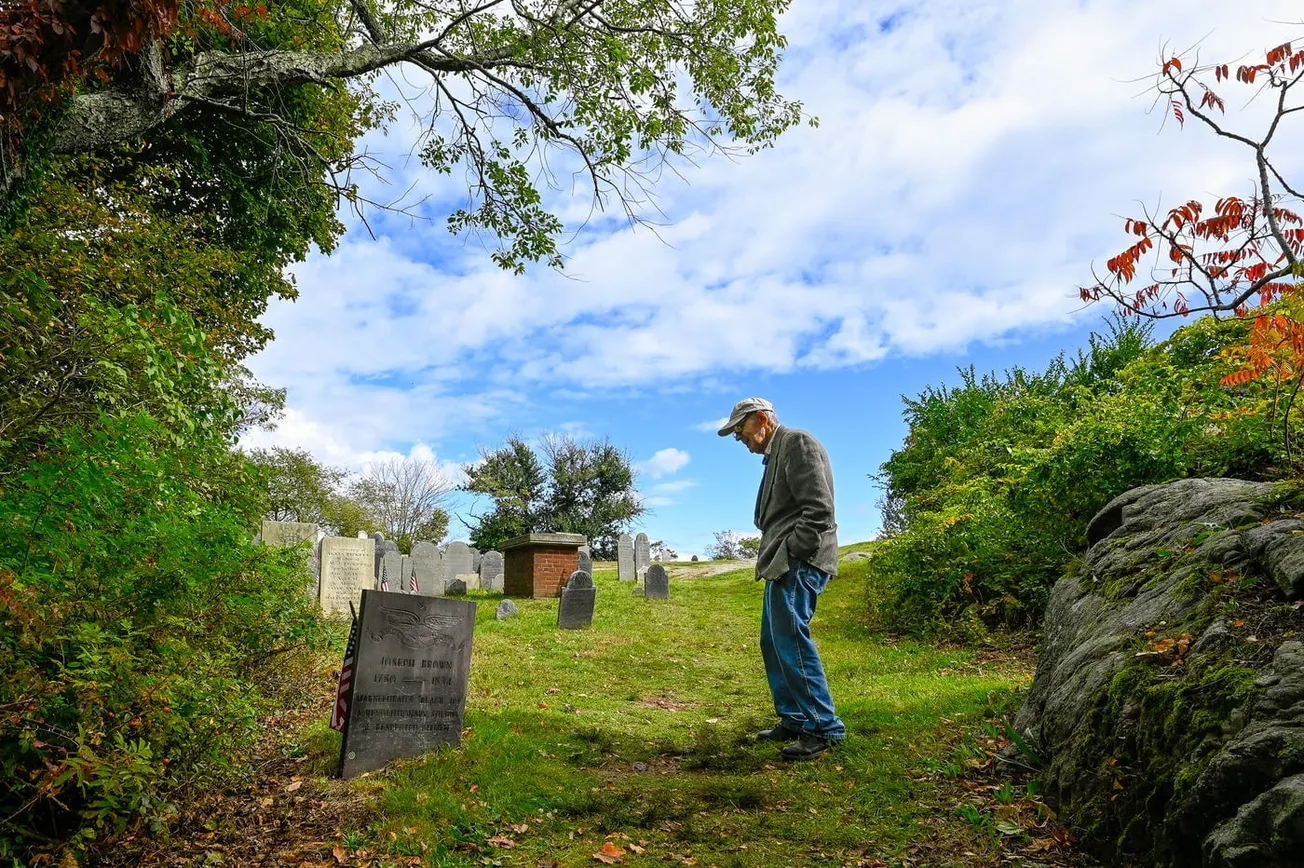
Only that morning, Moran had stood at Star of the Sea Cemetery, committing a parishioner to the earth. Days before that, he had prayed beside her hospital bed in Salem. By then, she could not open her eyes. She could not speak. But as Moran prayed, he said, he could tell she was still with him.
Her closed eyes punctuated the prayer.
Moran, 75, is pastor of the only Catholic parish in town, and on July 10, he will mark 50 years as an ordained priest. The parish will celebrate the milestone on June 14 with an 11 a.m. Mass of Thanksgiving at the church, followed by a reception at the Jeremiah Lee Mansion.
He grew up roughly 40 miles south of Boston, in Hanson, in a small rural parish set among the cranberry bogs near Ocean Spray’s headquarters. Blue-collar. The kind of place where a boy could be sent into the bogs to learn how to work a wooden hand rake. He was an altar boy from grade school and a religious education teacher by sixth grade. Mass was still said in Latin then; he and the other boys learned the responses by sound first, the rhythm of the old dialogue between priest and server gradually becoming language they understood. “To God who gives joy to my youth,” he can still say without thinking.
Becoming a priest
His older brother was the one people thought might enter the seminary. The brother worked at the church, knew the priests and their friends, drifted easily into their orbit. Moran was the skeptic of the family. He could see what worked in the parish and what didn’t, and he said so. When he finally told his family, the summer after he had already accepted a place at Boston College, that he had instead enrolled in the seminary, they were not entirely surprised. They were a little annoyed. He had been the critic.
His father, a Boston firefighter, had sustained an injury early in his career and never fully recovered. He died at 51 of later complications during Moran’s last year of college.
The vocation came in a couple of quiet prayers in the back of the church, prayers Moran did not think much of at the time but kept returning to afterward. He was good at math. He was good at science. The uncle he was named for was an architect, and as a boy he liked building things. He could imagine other futures.
What stopped him was a question. Does the world need another bookkeeper? Does the world need another architect? What does life most need?
He landed on an answer he has not since revised. “I think it’s the spiritual health of one another,” he said. “I think that’s the thing that most needs attention. It still does today.”
Four years of Latin in high school. Three more in college. Four at St. John’s Seminary in Brighton for philosophy, then four in Rome at the Pontifical North American College, studying theology at the Jesuits’ Gregorian University. He refused to drift through any of it. Each year he asked himself whether he had reason to begin the next. “I didn’t want to just get on the conveyor belt and go,” he said. “And that worked out really well for me.”
What the seminary really asked of him was something more interior. “To be consistent and to be honest with oneself,” he said. Most people, he said, spend a lot of their lives playing games with themselves — uncertain about their strong points, their weak points, whether they can forgive themselves, whether they can love themselves. Only when a person is honest about that, he said, is he ready to serve anyone else.
He was ordained July 10, 1976, the year of the U.S. bicentennial, at the small country church in Hanson where he had once served as an altar boy. Cardinal Humberto Medeiros came down to do it.
He spent three years as parochial vicar at St. Mary’s in Holliston. Then Medeiros invited him to dinner. Moran expected to be asked about doctoral studies and a future teaching post at St. John’s. Instead Medeiros asked whether he would consider entering the Pontifical Ecclesiastical Academy, the Vatican’s diplomatic school. He told Moran he thought he should say yes. He gave him a couple of days. Moran said yes.
Out into the world
What followed took him out of the Archdiocese of Boston for roughly a decade. The Gregorian’s law faculty was the last in the world still teaching in Latin; his professors lectured in it and he sat his exams in it. He served at the nunciature in New Delhi. He served in Germany. He helped prepare two of Pope John Paul II’s most consequential foreign journeys — the 10-day visit to India in February 1986 and the Edith Stein beatification trip to Germany in 1987.
He came to know Mother Teresa during the India years and later visited her in a hospital in La Jolla, California, when she was sick with heart problems, and again in Rome. What he saw was not the long interior darkness her papers would reveal after her death. “She was indefatigable,” he said. “Work, work, work, work.” Whatever else was there, he said, you wouldn’t have known.
He sat with Sister Lucia, the surviving Fatima visionary, at a time when whether the pope had properly consecrated Russia to the Immaculate Heart of Mary was a matter of public dispute. What he took from her was not theology. It was poise. “She was not caught up in the fray at all,” he said. “Just her steady sort of assurance that she was at peace with how things were going.”
He saw John Paul II close enough to see both versions of him. The man before crowds — charismatic, commanding, in charge of any room — was not quite the man inside the room. “Personally, he was much more quiet, much more withdrawn,” Moran said. In private the pope would be “quite probably sitting over, talking one on one.” One morning in Delhi, Moran came down to breakfast and found that only he and the pope were at the table.
He sat across from him over eggs.
What he came home to, by stages — 21 years as pastor of St. Joseph Parish in Medway, then Marblehead since September 2020, when Cardinal Sean O’Malley sent him — was the work the global stage had always been sitting on top of. Homilies. Hospital visits. Funerals. Confessions. Religious education. The bills. The parish food pantry. The Caring Meals Ministry. The Saturday morning Mass devoted to Our Lady that he restarted. A Creation Care Team he established. The phone calls in the night.
On Aug. 16, 2022, at Abbot Hall, he was sworn in as chaplain to the Marblehead Fire Department. He has since given the invocation at the swearing-in of new firefighters, at the June 2025 fallen firefighters memorial and at Memorial Day prayers at the Star of the Sea Cemetery. Mostly he waits. He meets with members of the department when they want to come and see him. He offers moral support. He shows up.
The son of the Boston firefighter who never came back from his injuries became the priest who prays with firefighters.
What he tells them
Ask him how to talk to someone who loves the Catholic Church and was wounded by the abuse scandal and the answer is careful. The response, he said, has to be honest and gentle. The point is not to explain. The point is not to repair. “It’s not something you can fix,” he said. “You can’t be in the fix-it mode or explain it away.”
Real presence, he said, requires being willing to suffer with the wounded person, slowly, on their schedule. “You have to be able to share that pain in order to be really present,” he said. “And that’s not an easy thing to do, especially if you haven’t had such a thing in your own life.” What he refuses to do is rush.
He still studies about an hour each morning. The first thing he does is pull up the day’s text. He looks at the Greek. He looks at the Hebrew. He reads what the commentators have said. He reviews what he himself has preached on the passage before, and then he keeps looking until he finds something new. After 50 years of preaching, he said, he has not failed yet.
The goal is not to deliver a tidy thought package. “My aim is to say something in such a way as to invite them to think,” he said. “I don’t see myself as a conveyor of fully formed ideas.”
He has been asked, over a long career, what makes a priest. The answer he gives is not really about priesthood. It is about vocation generally, and about a question.
“What good thing most needs to happen in this world to make it a better place?” he said. Or: “What good thing does God most need done in this world to make it a better place?” Your answer, he said, will be shaped by what you are good at, what interests you, how you think, what your experiences have been.
That, he said, is your vocation. “The good thing that needs most to be done will require pretty well everything you’ve got to give,” he said. “And that’s not a bad thing.”
When he was a boy in Hanson he asked the question and his answer was the spiritual health of others. He has spent 50 years answering it: in Latin classrooms in Rome, at a breakfast table in Delhi, at a hospital bed in La Jolla, at a hospital bed in Salem, at the altar in Marblehead, where the words of consecration mean more to him every time he says them.
“This is my life made a gift to you” is how he hears those words now. He has spoken them in his own voice tens of thousands of times. They mean more, he said, because he has seen more of life. Because by the third visit, when the woman in Salem could no longer open her eyes, he could still tell that she was there. Her eyes punctuated the prayer.
If this helped you understand the life and work behind one Marblehead pastor’s 50-year vocation, please consider supporting the reporting that makes room for stories like this. We have 116 readers making recurring contributions, and we’re trying to reach 175 by July; today, one more membership moves that goal closer while keeping The Independent free and locally accountable. 🟦 Become a member here.