Table of Contents
Get our free local reporting delivered straight to your inbox. No noise, no spam — just clear, independent coverage of Marblehead. Sign up for our once-a-week newsletter.
Six of the 16 positions funded by Marblehead’s $15 million operating override were filled or covered as of October, according to a report Select Board Chair Dan Fox presented Wednesday.
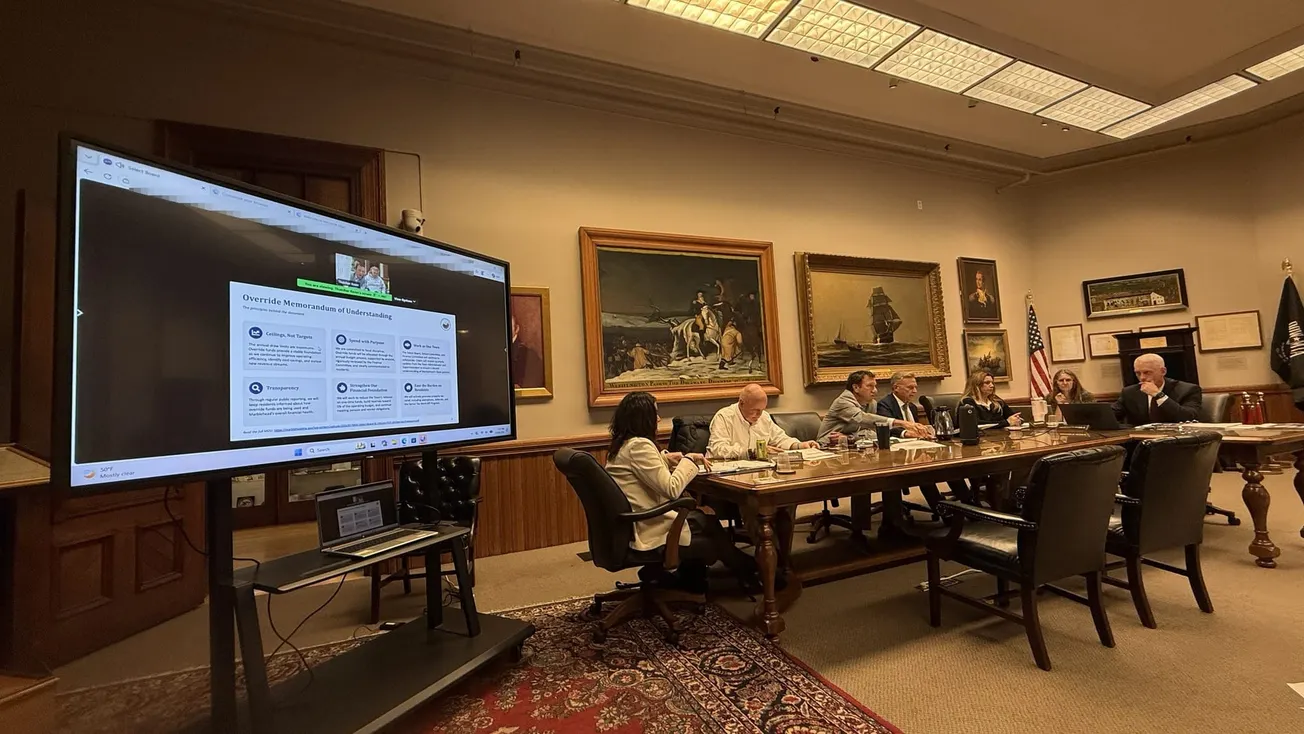
The presentation, given during the Select Board meeting, covered the first quarter of fiscal 2027, which ended Sept. 30. It showed most departments spending in line with the calendar, with restored cuts taking the biggest piece of the $4.3 million the town is drawing this year. Tax bills due Feb. 1 will reflect the new rate, including the override.
The agreement Marblehead leaders signed before voters approved the override June 9 calls for quarterly briefings for the chairs of the Select Board, School Committee and Finance Committee. Fox told the Independent on Tuesday that he looks forward to showing residents what the town has been working on and how it is using their money.
At the meeting, Fox called transparency “the big T word” and said regular public reporting is meant to keep the public informed. “That’s why we’re doing this,” he said. He added that he hopes to give residents “more updates more often to show you how our funds are being used.”
The deck opens with the principles behind the memorandum of understanding, dated April 7. The annual draw limits are “ceilings, not targets,” it says, and override money is meant to give the town a stable footing while it looks for savings and new revenue. For fiscal 2027, the cap is $4,296,718, all of it for municipal departments. The schools draw nothing until fiscal 2028.
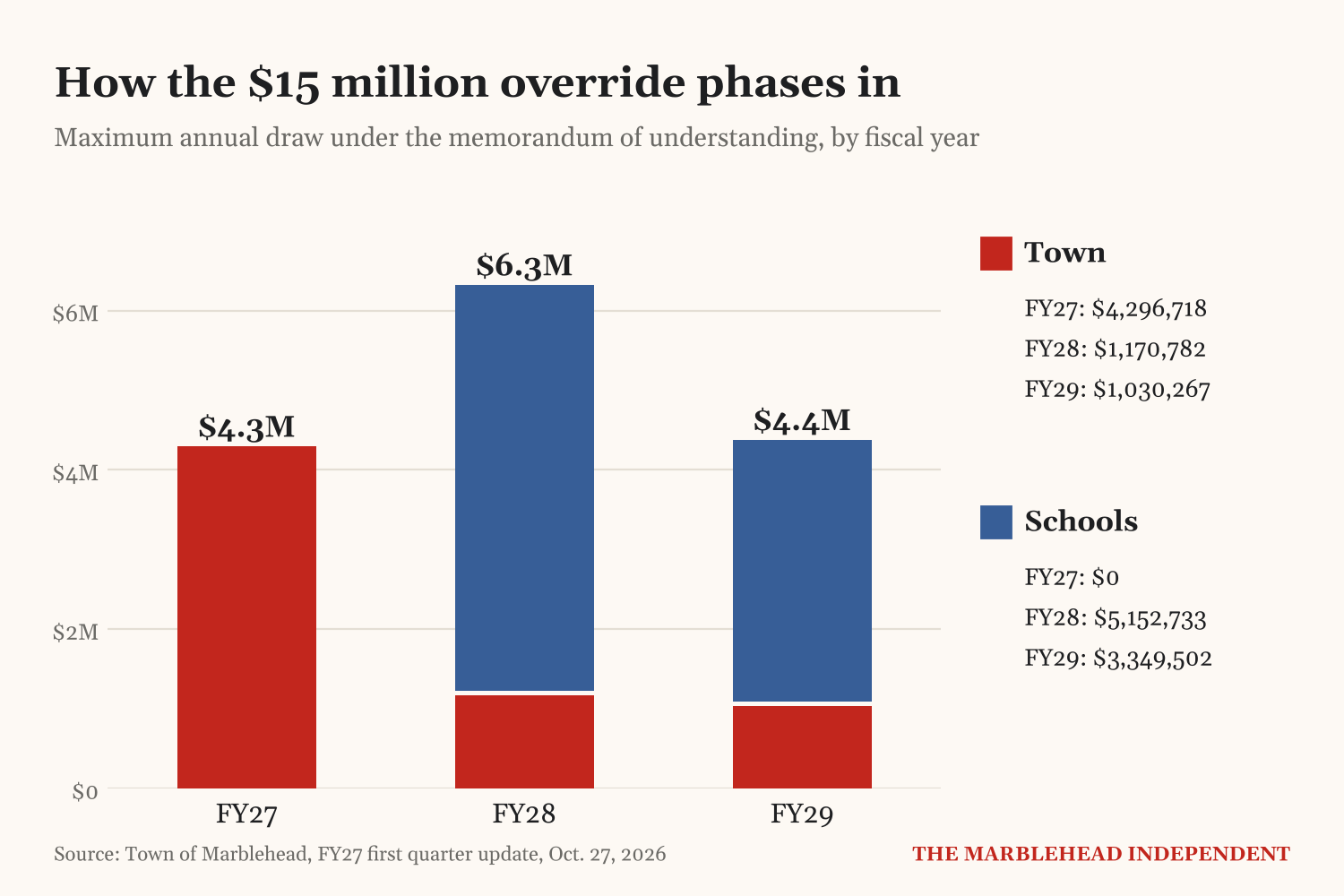
Adding that amount to the $98,822,778 approved at Town Meeting produces a revised general fund budget of $103,119,496, according to the deck. The figure excludes debt service, state assessments and enterprise funds. The separate trash collection override replaced a fee already in the budget, so it did not add to the total.
Where the money is going
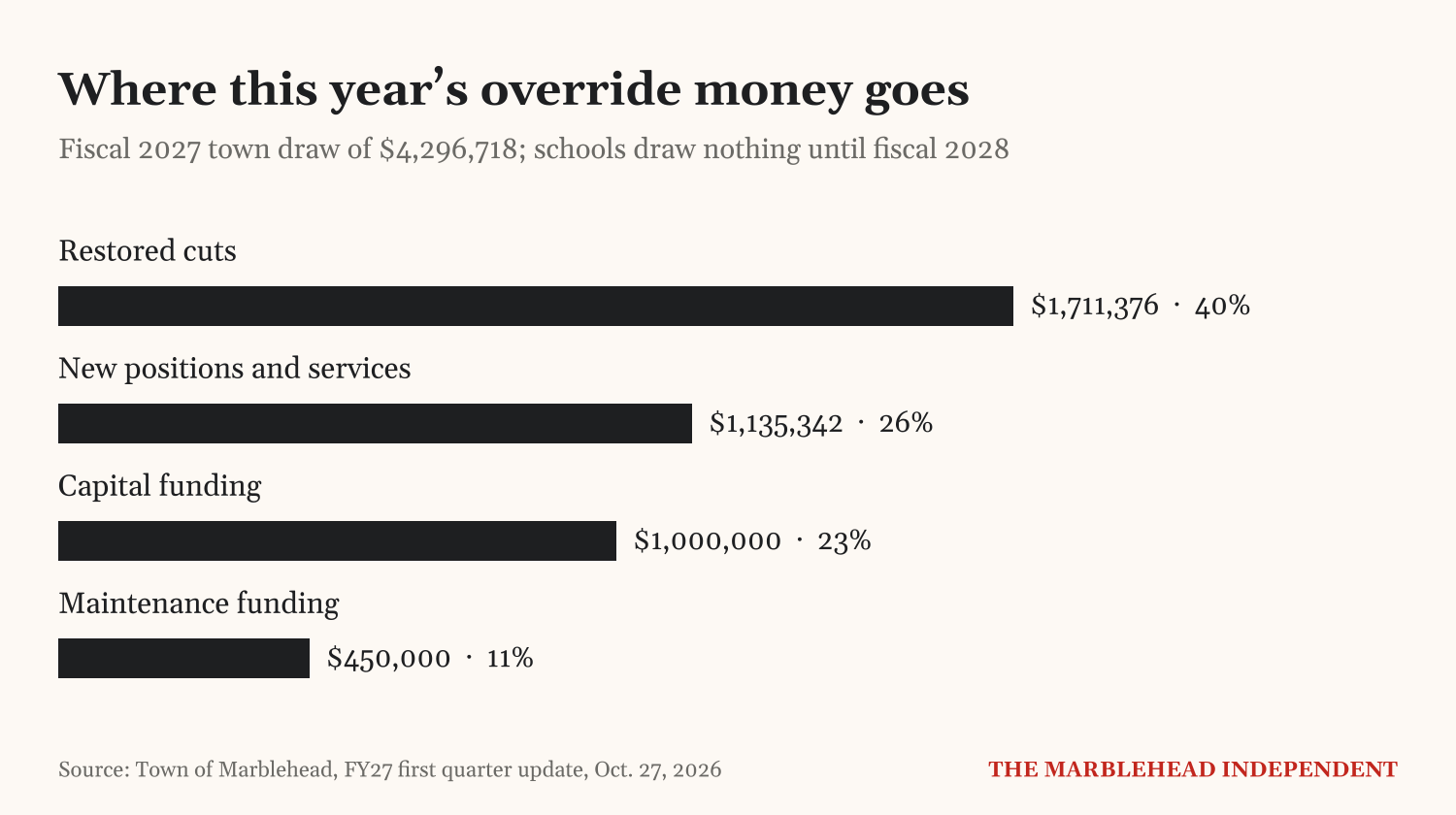
Restored cuts account for $1,711,376, or 40 percent of the $4,296,718, led by $699,779 for Abbot Library salaries and materials. New positions and services take $1,135,342, including $296,000 for four firefighters and $150,000 for an information technology director.
Capital work gets $1 million, covering alternative bids at Mary Alley, police and fire building improvements and school projects such as gym lighting at the Veterans and Village schools and playground shade at the Brown School. Maintenance gets $450,000, including $276,000 for facility maintenance, $112,000 for a facilities maintenance manager not yet hired and $50,000 for annual Rail Trail upkeep.
The school projects come out of the town’s share; a separate school building capital fund does not start until fiscal 2029, Fox said. The Mary Alley add-on bids include new windows for about $200,000, a sprinkler system and removal of the bridge to the medical building. “If we didn’t do it now, it’s going to cost us a lot more in the future,” he said.
Fox said the steady capital money, which replaces the town’s reliance on free cash, means the town “can really plan consistently and act a lot more proactively.” Next comes a long-term capital plan looking out 10 years, he said.
Six of 16
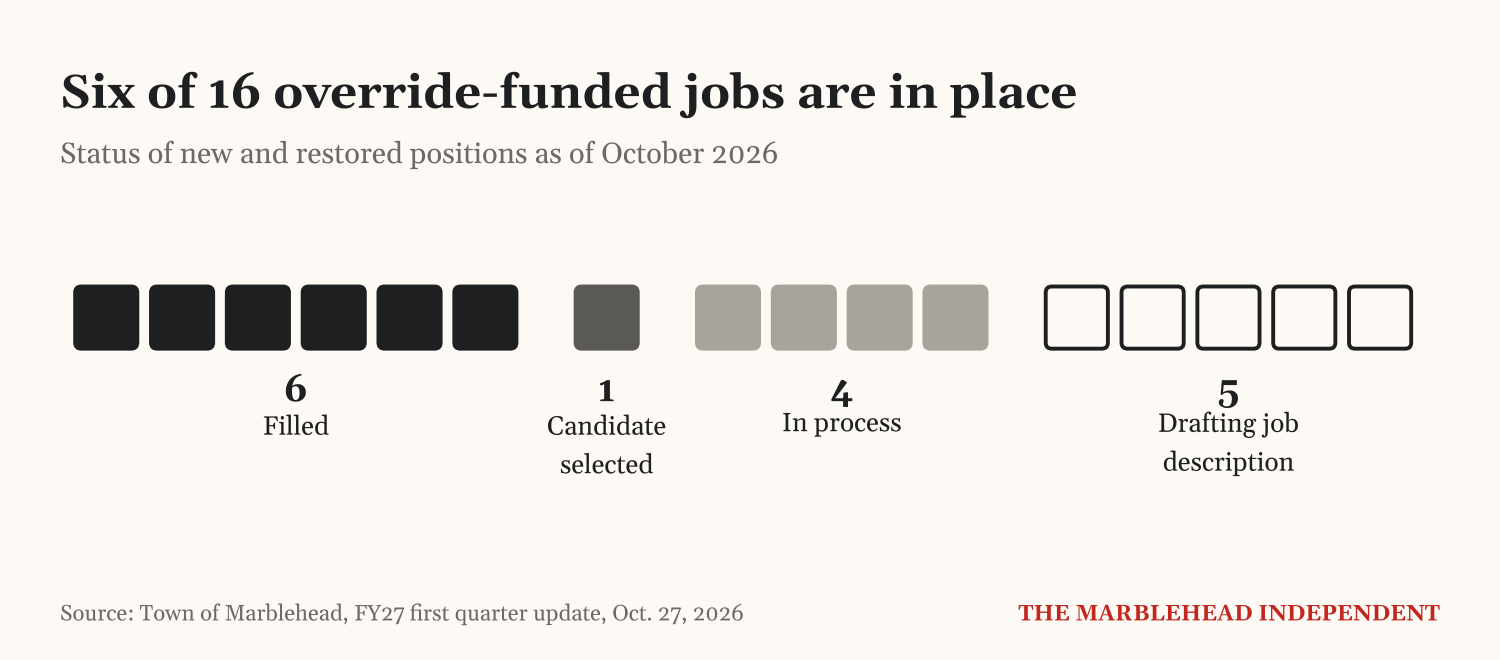
As of October, six of the 16 override-funded positions were filled or covered, according to the deck. Two firefighters started Aug. 6. A police officer is in the academy. The Department of Public Works filled a heavy equipment operator job, and the library hired a part-time custodian in September. The $70,000 budget analyst job was never filled; the town accountant took on those duties for a stipend the deck does not specify.
A candidate for information technology director is undergoing a background check. Two more firefighters, a second police officer and a part-time library assistant are in the hiring process. Five jobs remain at the job-description stage, among them a grant revenue and development coordinator the deck credits with a key role in bringing in new grant money.
Fox said six hires “may seem like we are a little behind here,” but that the town is being “very thoughtful” about how it spends the money and whom it hires.
Spending through September
Most departments tracked with the calendar. Public safety had spent $3.1 million, or 24.7 percent of its $12.6 million annual budget. The School Department had spent $5.3 million, or 11.1 percent of $47.6 million, because teacher payroll drops in summer. Public works and facilities sat at $970,000, or 13.1 percent of $7.4 million, with the new trash contract starting in October and override-funded DPW jobs still open.
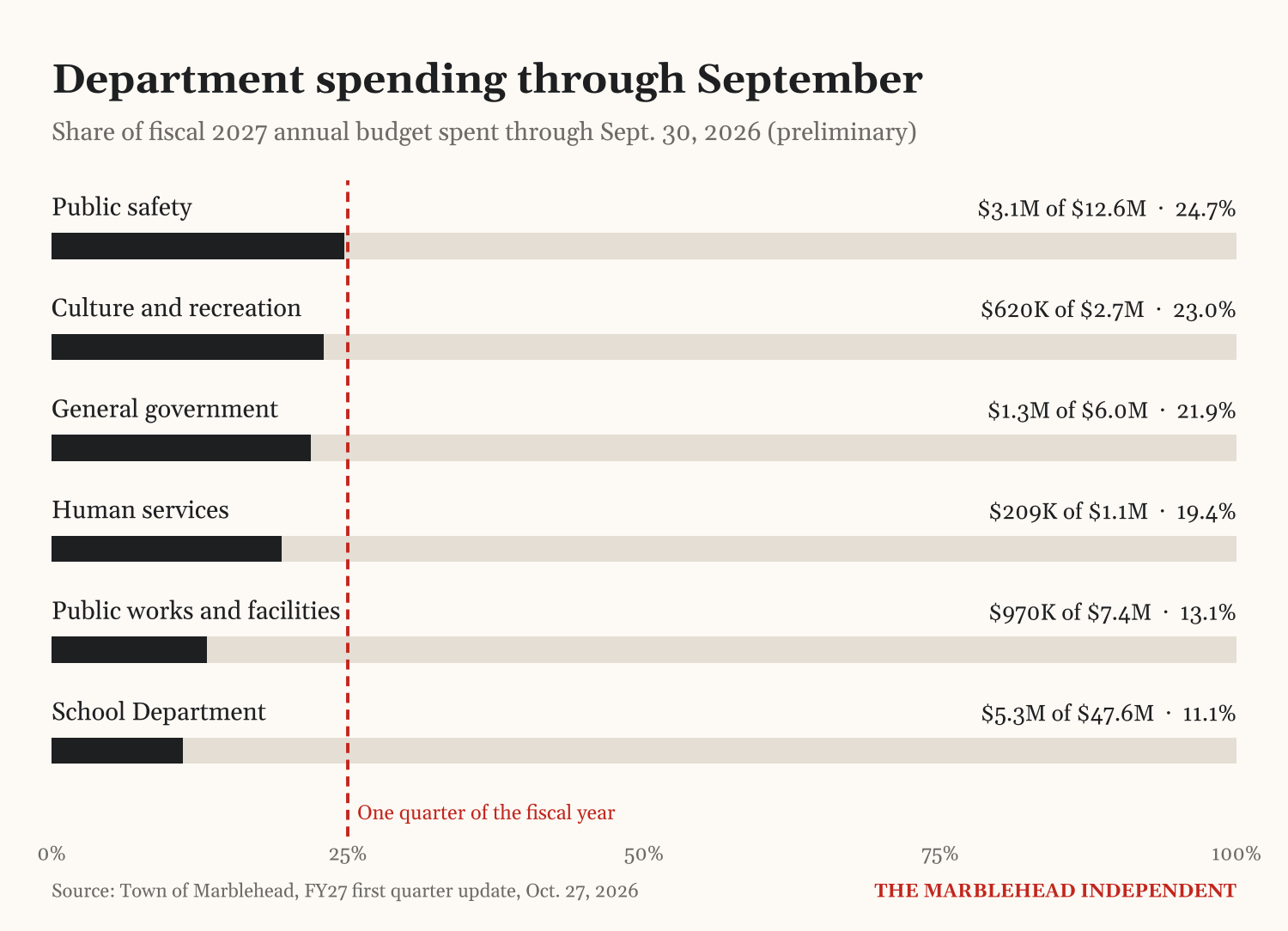
Other general government spending ran ahead at $11.5 million, or 46.4 percent of $24.8 million, because the $5.8 million retirement assessment and reserve transfers are paid in full up front. Health insurance costs are up 11 percent from the first quarter of last year, according to the deck, which calls the increase expected but does not provide the prior-year figure needed to translate it into dollars.
Health insurance spending stood at 24.1 percent of its budget through September, Fox said. “I know we’re doing really well,” he said, adding that the town is staying within its budget and, in many places, under it.
The deck flags three areas to watch: Fire Department overtime and injury pay, cash reconciliation under the new treasurer and vacancies in the Community Development Department.
Fox said the Fire Department has three fewer firefighters than a year ago, after two retirements and a resignation, so even with its two new hires it is down one, and some firefighters are out injured. Overtime “continues to be a little high,” he said.
The Select Board plans to interview finalists and choose a new town administrator Nov. 4, Fox said, with Town Administrator Thatcher Kezer retiring Dec. 31. Recruiting a town finance director will begin once that contract is signed. On the school side, Kristin Morello, the district’s assistant business manager for two years, becomes finance director in November, and the superintendent of finance and operations position is being eliminated.
The savings listed so far are modest. Employees with other coverage can leave the town health plan for $4,000 a year as individuals or $8,000 for families, which the deck estimates nets the town about $5,000 and $18,000 per participant. The DPW is also absorbing Rail Trail maintenance and public trash can collection, a shift the deck describes as more efficiency than savings.
Fox said revenue details will come in the next report, in January, and asked the board what to change.
Select Board member Jim Zisson suggested future reports show staffing goals for police and fire, so residents can see that some hiring only replaces departures, and track local receipts such as interest income and large purchased services such as legal costs. “I have to say this first time through, we knew it wouldn’t be perfect, but this is actually very good,” Zisson said.
“I’m more than pleased with the product,” Select Board member Erin Noonan said.
Bigger bills in February
The first two fiscal 2027 tax bills were estimates at last year’s rate. The bills due Feb. 1 and May 1 will reflect the new rate, including the $4.3 million override and the $2.2 million trash collection override, plus a true-up for the first two quarters.
“Plan ahead,” Fox said. “Expect your bills Feb. 1 and May 1 to be higher than your first two.”
Applications for the new means-tested senior property tax exemption are due Nov. 30. The Council on Aging and the Assessor’s Office will hold an information session from 12:30-2:30 p.m. Thursday at the Jacobi Community Center.
Fox said Tuesday that residents need not wait for his slides. The town’s Marblehead Open Finance portal, reached through the “Follow the Money” link, already shows more.
“In reality, my report tomorrow will be out of date compared to what people can get online,” he said.
BEFORE YOU GO … Our reporting remains free and open to all. It is sustained by readers who choose to support it — by contributing so that routine, document-based local reporting continues without paywalls or promotional framing. Right now, 132 readers support The Marblehead Independent with monthly or annual contributions. Click here to become an Independent member.


