Table of Contents
Get our free local reporting delivered straight to your inbox. No noise, no spam — just clear, independent coverage of Marblehead. Sign up for our once-a-week newsletter.
Snowbanked paths and frozen headstones framed a lantern-lit gathering Saturday evening as residents and reenactors climbed Old Burial Hill in 15-degree weather to mark the 229th anniversary of the death of Gen. John Glover, one of the town's most consequential Revolutionary War figures.
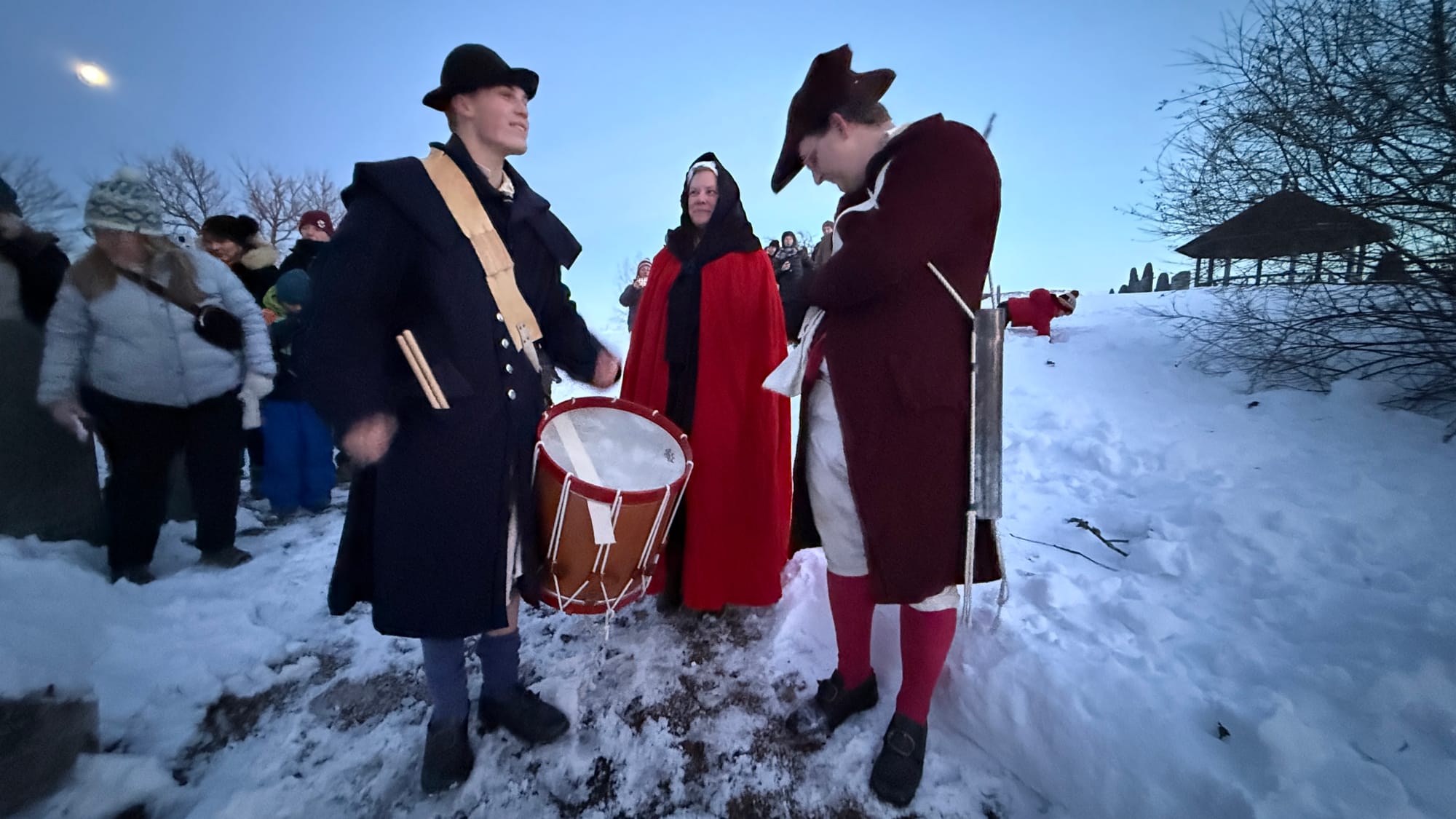
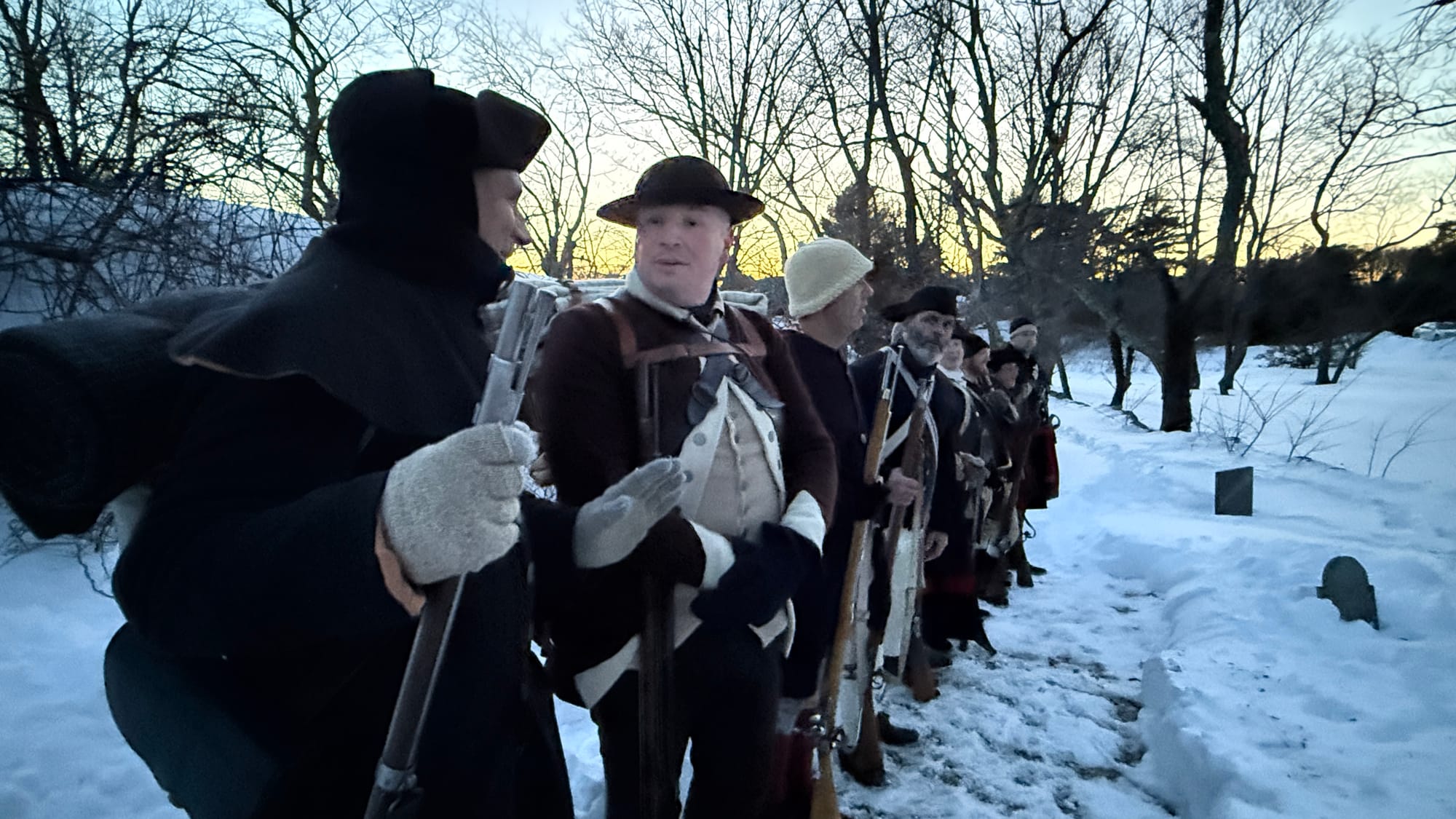
The annual march, held near the Jan. 30, 1797, anniversary of Glover's death, drew participants bundled against the bitter cold. Some carried lanterns while others followed the steady beat of a field drum as members of Glover's Marblehead Regiment assembled at the general's tomb.
Capt. Larry Sands addressed the crowd, acknowledging both longtime attendees and newcomers who came to support the Save the Glover campaign, which seeks to preserve Glover's historic farmhouse.

"If you haven't been here before, it invariably is one of the coldest days of the year," Sands said.
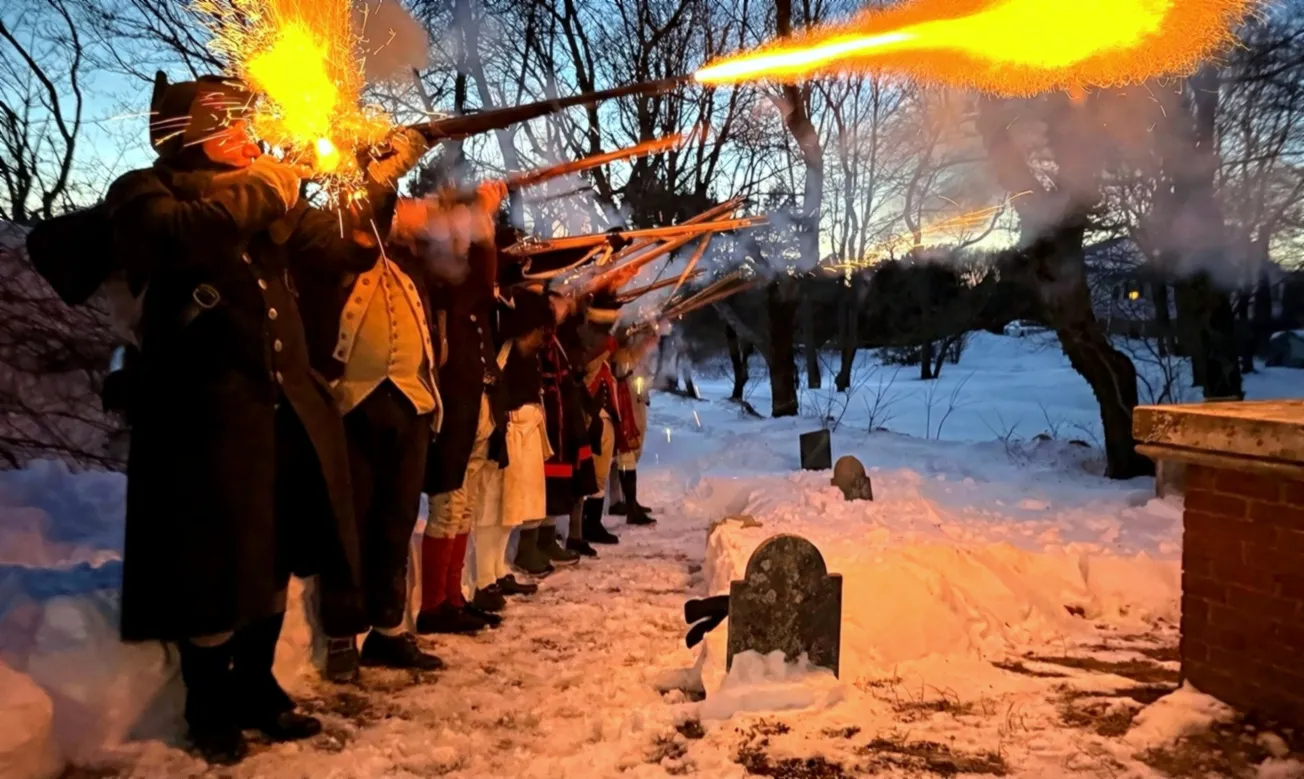
The ceremony featured a brief program of remarks followed by three musket volleys and a return march toward Glover Square, where the regiment fired three additional volleys at Glover's former home.
Sands described Glover as a product of Marblehead's maritime culture rather than a member of the colonial elite.
"He was a cordwainer, a fisherman, a merchant and a community leader," Sands said. "Yet when the colonies called for resistance, he stepped forward with the same resolve that defined the seafaring people of Marblehead."
Glover raised and led the Marblehead Regiment, which Sands characterized as unusually diverse for its era.
"An integrated group of sailors, fishermen, free Black men, Native Americans, Jewish residents and immigrants, in an era when such unity was rare," Sands said. "Glover's regiment embodied the very ideals the revolution claimed to fight for."
Sands focused on the pivotal year of 1776, when the Continental Army faced potential collapse. After the Battle of Long Island, the army was exhausted, outnumbered and trapped on Brooklyn Heights.
"It was Glover and his Marbleheaders who ferried Washington's army across the East River under cover of darkness without losing a single man," Sands said. "That night saved the revolution."
Months later, Gen. George Washington again relied on Glover's men during the famous Christmas night crossing of the Delaware River, which preceded the surprise attack on Hessian forces at Trenton, New Jersey.
You’re able to read this work free because 98 readers make it possible through monthly and annual contributions — and we endeavor to reach 100 members by Jan. 31 to keep this journalism strong. Click here to become an Independent member.
"Without that crossing, there would have been no surprise victory, no surge in morale, and perhaps no continuation of the war," Sands said.
Sands emphasized that Glover's legacy rested as much on character as battlefield skill, describing a leader who earned loyalty through competence, courage and fairness.
"He never sought fame, he never claimed credit," Sands said. "Yet history remembers him because his actions spoke louder than any self-promotion ever could."
Following aprayer, a lieutenant commanded the regiment through three musket volleys that echoed across the hilltop cemetery. The crowd then offered three cheers for Glover before beginning the march back toward town.
The ceremony took place during preparations for the nation's semiquincentennial and renewed local interest in preserving Glover's farmhouse. Sands urged those gathered to see Glover's story as a reminder of what ordinary citizens can achieve in extraordinary times.
"So today, we honor General John Glover, not just as a military leader, but as a symbol of what ordinary citizens can achieve when they commit themselves to a cause greater than their own lives," Sands said.