Table of Contents
Get our free local reporting delivered straight to your inbox. No noise, no spam — just clear, independent coverage of Marblehead. Sign up for our once-a-week newsletter.
The Marblehead Finance Committee on Monday endorsed a $122.7 million fiscal 2027 operating budget for the May 4 Town Meeting, advancing what officials described as a level-services spending plan that closes a $7.2 million deficit through deep staffing cuts, a new curbside trash funding mechanism and a sharp reduction in the use of free cash.
Meeting in a warrant hearing that stretched across more than 30 articles, the committee made recommendations on most items with financial implications but deferred action on the two override articles, the fire union contract and a benefits-amendment article.
That leaves some of the biggest fiscal questions facing voters unresolved until a second warrant hearing April 27.
Committee Chair Alec Goolsby said this year’s budget was shaped by a collision of falling revenue and rising fixed costs.
“Some have called this year the perfect storm, and I sort of agree,” Goolsby said. “But at the same time, I don’t want to sit up here and say that it was surprising.”
Available revenue for the shared town and school operating budget is roughly $600,000 lower than last year, Goolsby told the committee.
“One would think with Prop. 2 1/2 in play that you’d always have increases of revenue,” he said.
Instead, he said, a $1 million drop in local receipts and a $2 million reduction in the use of free cash have offset growth in property tax revenue.
Goolsby said the decline in local receipts was “largely driven by decrease in amounts invested, as well as a decrease in interest rates, along with estimates for local receipts with respect to excise taxes.”
Under Article 22, free cash appropriated to reduce the tax rate would fall to $5 million from $7 million a year ago, with another $360,000 transferred from electric surplus.
Town Administrator Thatcher Kezer said the move away from free cash is intentional.
“It is bad practice to use free cash to run the operating budget,” Kezer said. “And again, when I rolled in three and a half years ago, we were using $10 million to supplement the operating budget.”
Kezer said reducing that reliance has become a policy goal.
“It’s more of a matter of policy that we’re trying to reduce the reliance on free cash within the operating budget,” he said. “And then what free cash we do generate goes to our reserves, and it goes to our capital programs, which is a more appropriate use of free cash.”
After a detailed reallocation of shared costs such as health insurance and pensions, Goolsby said the town side of the budget faces a gap of about $4.1 million and the schools a gap of about $3.2 million.
To close its share, the municipal side is eliminating about 22 full-time positions, 18 or 19 of them currently filled, from a general-fund workforce of roughly 185 employees.
The library alone is losing 8 1/2 positions.
“The library has taken significant cuts on the town side,” Goolsby said. “We’re talking about eight and a half FTEs cut from the library. That’s going to significantly reduce services in terms of days that the library can be open.”
The schools, according to Goolsby, have identified about $1.7 million in cuts so far, including 14 positions, with another $1.5 million still to be detailed by the School Committee.
A central piece of the town’s plan to close the deficit is curbside trash collection, historically funded within the operating budget.
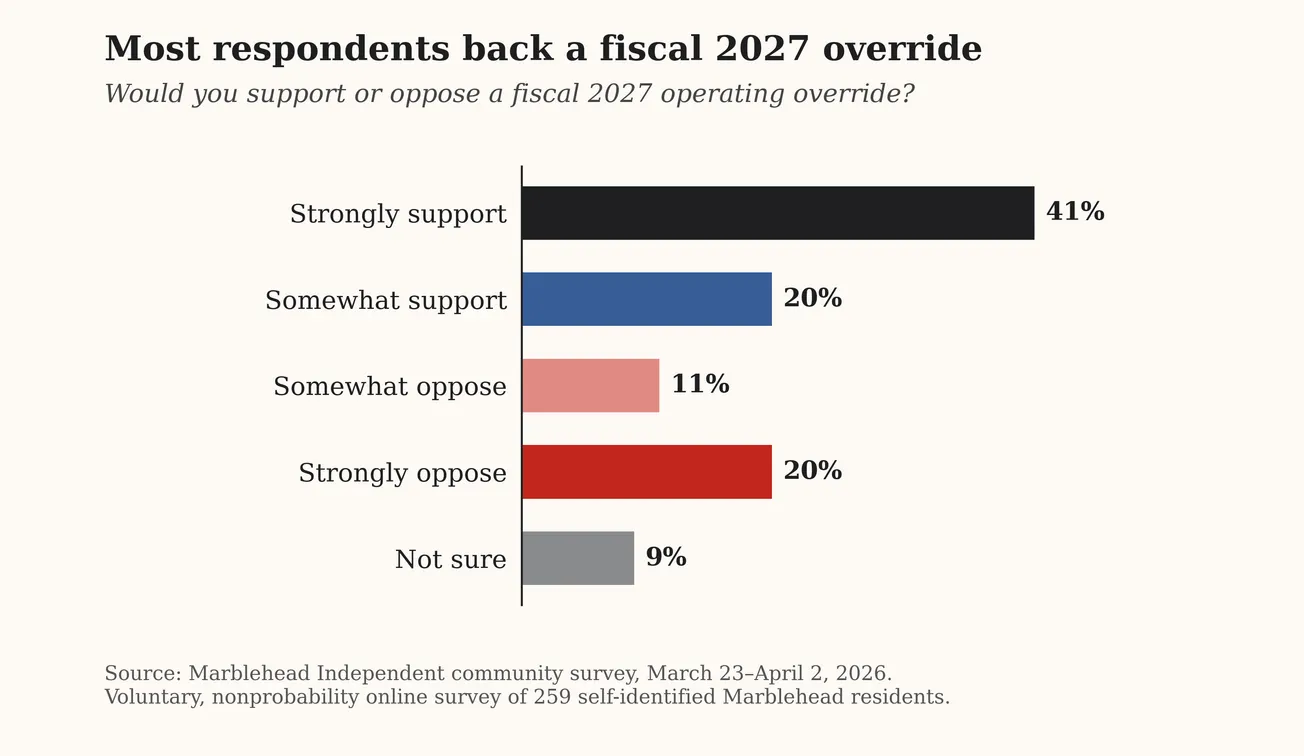
The Select Board is asking voters to approve an override of about $2.2 million to keep the service in the levy. If that override fails, a user fee already established would instead fund collection.
Goolsby said the town pulled the cost of curbside collection out of the main operating-budget equation because the alternative would have required even steeper cuts.
”If the town were to make cuts to address that in a different way, if it didn’t pull that out of the general fund, that 12% number was probably closer to 25%,” he said, referring to the share of town-side positions that otherwise could have been affected.
The committee deferred recommendations on Articles 28 and 29, the override articles, until its April 27 hearing.
On the spending side, the committee unanimously recommended approval of $60,145.29 in unpaid fiscal 2025 bills under Article 6 and $524,067 in lease purchases under Article 9, with $236,077 from the waste revolving fund and $287,990 from free cash.
Members also recommended $25,000 for walls and fences under Article 11 and $200,000 for stormwater construction under Article 12, both half of last year’s appropriations.
DPW Superintendent Amy McHugh warned that the reductions would delay needed work on coastal infrastructure, including seawalls along the causeway and Front Street.
“This article is where we do have a lot of work for sea walls and fences to go up,” McHugh said.
She said an updated engineering evaluation alone is expected to cost about $80,000.
“That’s just for them to be able to tell us what condition they’re in,” Goolsby said during the exchange.
McHugh said actual wall repairs could range widely.
“There’s a whole report,” she said. “They range from a couple hundred thousand to a million for some of the repairs here.”
She said the reduced appropriation may be manageable for one year, but only by postponing larger needs.
“We’ll make it through this year,” McHugh said of the stormwater account. “But we just want to make sure everyone realizes that this is every year — this should be increased.”
The committee also recommended $2.4 million from water retained earnings and $2.1 million from sewer retained earnings under Article 13 for system construction, and it endorsed Article 14, authorizing the Water and Sewer Commission to enter a $3.5 million interest-free Massachusetts Water Resources Authority loan for water distribution improvements.
McHugh said the MWRA loan authority is partly about timing.
“We’re hoping that we’ll be able to extend our loan, which is 0% interest, over 10 years,” she said.
Under Article 7, the committee recommended a higher cap on the commercial waste collection revolving fund than originally proposed, raising it by $232,402 to provide a cushion against uncertainty in the new annual trash fee.
The total maximum spending across all departmental revolving funds was set at $4.2 million.
Finance Committee Vice Chair Molly Teets said the increase was meant to give the town more room if assumptions around the fee prove off.
“This is just the maximum that you can spend, right?” Teets said. “So does it make sense to maybe increase this so that we have some cushion?”
A 3% cost-of-living adjustment was recommended for administrative employees, traffic supervisors and seasonal and temporary personnel under Articles 15, 16 and 17, effective July 1.
The town clerk’s annual compensation under Article 18 was set at $97,460.
The committee also recommended approval of Article 21, appropriating $749,920 as Marblehead’s assessment for the Essex North Shore Agricultural and Technical School District.
But members raised concerns about future increases tied to a new lottery-based admissions system that will expand the number of Marblehead seats.
“This is what they voted,” Kezer said of the fiscal 2027 assessment.
But he and Goolsby both suggested the larger concern is what comes next as seat allocations change.
“I don’t think I have much issue voting this year’s number,” Goolsby said. “But I’m interested in monitoring this and seeing if there’s ways for Marblehead to maybe protect itself a bit.”
Several articles were left without recommendations, including the MBTA-related multifamily overlay zoning article, the accessory dwelling unit amendment and a proposed ban on cryptocurrency ATMs.
On the zoning article tied to MBTA compliance, Kezer said the town has already felt the cost of inaction.“We’ve identified over the last year or so, upwards of almost $4 million in grants that we’ve not been able to receive,” Kezer said.
On the proposed cryptocurrency ATM ban, Kezer said the article was intended as a preventative step.
“As of right now, it has been a problem in a number of communities,” he said, describing scams and misuse tied to the machines.
Articles on the fire union contract, administrative benefit amendments and the repeal of the planning and community development department were tabled until April 27.
Town Meeting opens May 4.
BEFORE YOU GO … Our reporting remains free and open to all. It is sustained by readers who choose to support it — by contributing so that routine, document-based local reporting continues without paywalls or promotional framing. Right now, 101 readers support The Marblehead Independent with monthly or annual contributions. Click here to become an Independent member.