Table of Contents
Get our free local reporting delivered straight to your inbox. No noise, no spam — just clear, independent coverage of Marblehead. Sign up for our once-a-week newsletter.
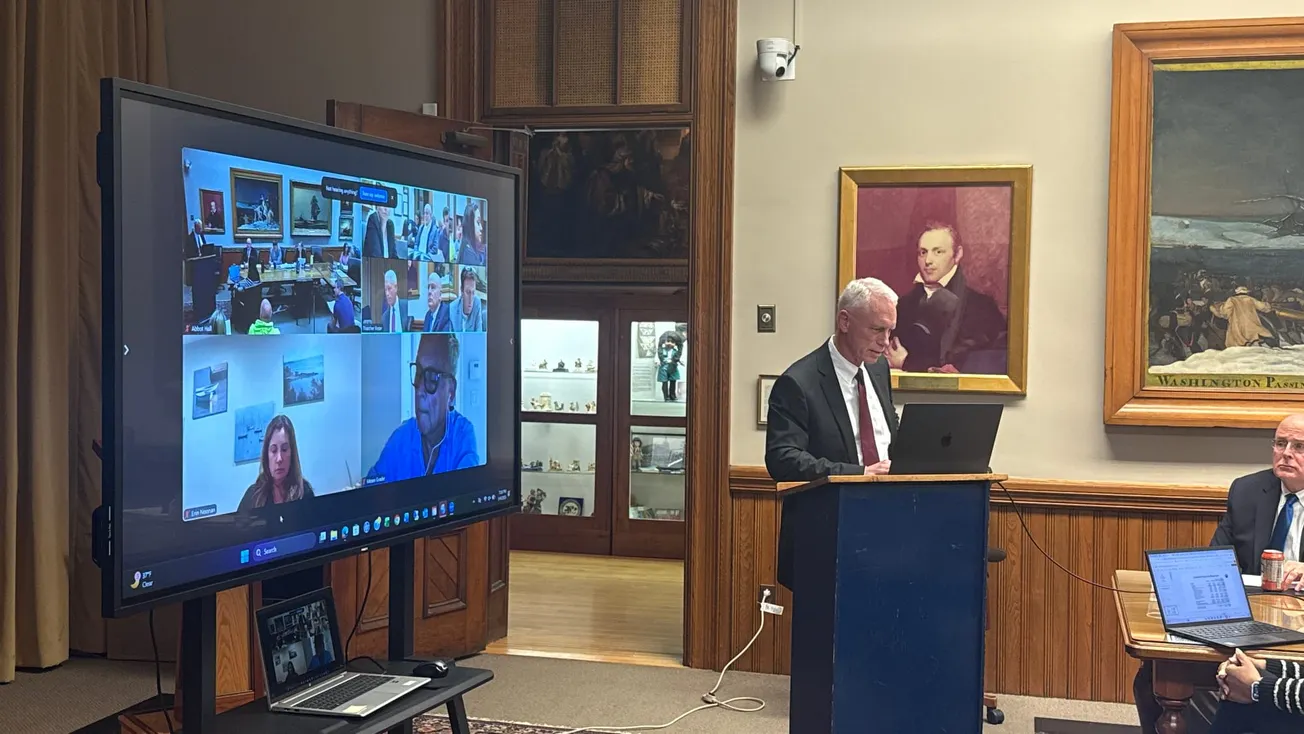
Town Administrator Thatcher Kezer on Wednesday told the Select Board that balancing Marblehead’s fiscal year 2027 budget without new revenue would require shuttering six municipal departments and eliminating 56 positions — and presented a second path built around a household trash fee and additional school budget cuts as an alternative.
The presentation, co-authored by Chief Financial Officer Aleesha Benjamin, follows an earlier State of the Town address. Revenue projections have changed little since then, with free cash consolidated entirely into the operating budget and slight adjustments reflecting updated local aid figures from the governor.
“No change in dollars,” Kezer said, “just it’s going to apply all to the budget.”
Total projected revenues for FY2027 — excluding debt exclusion — stand at approximately $101 million, a decline of roughly $2.1 million, or 2.1 percent, from the FY2026 budget of approximately $103.3 million. The levy limit is set at approximately $77.8 million, with $5 million in free cash directed to the operating budget.
Scenario A: Shuttered departments, 56 jobs cut
Scenario A represents a traditional approach: collecting requests from department heads and schools built on level funding plus increased obligations, then cutting to fit available revenues. Officials determined $7.7 million in total cuts were needed — $5.7 million on the town side and more than $1.9 million from schools.
The human cost is severe. Kezer said the town was forced to prioritize departments that protect life and property and cut everything else.
“We had to defund six departments,” he said. “Under Scenario A, if that were to become the approved budget, we would have to shut the doors on our community development, planning, cemetery, health department — except for the health agent, which is required by law — Council on Aging, library, recreation and parks.”
Five departments would be fully eliminated; the Health Department would be reduced to one state-mandated position. Fifty-six positions would go unfunded out of a town workforce of 185 to 190, including one chief procurement officer, one police officer, one vacant firefighter, two in the Department of Public Works, six in cemetery, three in health, six in Council on Aging, 23 in library, eight in Recreation and Parks and five in Community Development and Planning.
Kezer addressed a question he said comes up regularly — whether staffing growth has driven the crisis.
“Our budget challenges that we’re facing are not a result of huge increases in the number of employees,” he said. “It is driven by health costs, inflationary costs, trying to keep our employee salaries at the market rate.”
Scenario B: Trash fees, school reductions and a narrower path
Scenario B moves certain costs off the tax base to restore the departments Scenario A would eliminate. Kezer framed it as a starting point, not a final plan.
“These are proposals that will be reviewed and deliberated on at a later time,” he said. “What we tried to do is come up with some proposals that help us to reduce the structural deficit and maintain municipal services.”
The first action is a household trash fee. Just over $2 million would be defunded from the general fund, compelling the Board of Health to establish a fee structure for contracted trash services.
“All these services are based on a contract,” Kezer said. “In order to have a contract signed, it has to have a revenue source. So that is the mechanism that is being proposed.”
Spread across approximately 8,000 households, the fee works out to approximately $255 per year, or about $21 per month and $64 per quarter. Residents qualifying for tax exemptions would be eligible for discounts; others could opt out using the existing sticker program. By comparison, shifting the full cost of Waste Department services — approximately $3.7 million — to a fee would cost households roughly $465 per year.
“We’re not asking for that one,” Kezer said. “We’re asking for the limited scope of the services be moved to a fee-based system.”
The second component requires the school department to absorb its proportional share of rising benefit costs. All employee benefits are budgeted on the town side but cover both workforces, with roughly 62 percent of employees on the schools side and 38 percent on the town side. Schools have already cut $1.9 million from their FY2027 budget; their total estimated share of the structural deficit is $3.5 million. An additional $1.5 million reduction is being requested.
“Instead of having additional funds that we’re splitting, it’s splitting the deficit that we’re faced with in equalizing it between the two sides,” Kezer said.
Under Scenario B, total cuts reach $7.9 million — $4.4 million on the town side and $3.4 million from schools — with 20.5 full-time equivalent positions affected rather than 56. The library’s future is uncertain under either path. Abbot Public Library board chair Gary Amberik told the board that the part-time staffing model proposed for the library under Scenario B is not sustainable long term and that the library would likely close by Dec. 1, 2026 regardless — compared to July 1 under Scenario A. Even so, $1.4 million remains unfunded on the town side.
“That would probably be the starting point of conversation of what we want to consider for an override strategy,” Kezer said.
Health insurance rates, override options still unresolved
A Group Insurance Commission vote on health insurance rates scheduled for Thursday adds further uncertainty. The budget carries an 11 percent rate increase assumption, down from 15 percent. If the commission votes as low as 7.5 percent, that would narrow the gap under either scenario.
“The numbers will change as we roll forward, because all these factors are continuously changing on us,” Kezer said.
Board members expressed broad support for Scenario B. Select Board member Erin Noonan, participating remotely, was direct.
“My vote would be for us to proceed with Option B,” she said. “The option A would dictate would be devastating to town services.”
Noonan called the trash fee a reasonable ask and noted the town’s transfer station gives residents a practical opt-out option. She cited research by Finance Committee member Molly Teets showing fee-based systems are commonplace among municipalities with transfer stations.
Select Board member Moses Grader, also participating remotely, called Scenario B creative but cautioned residents to understand what it represents.
“I think the town of Marblehead should understand that this is a kind of shift off of an approach that the town has formally voted to appear in the tax base,” Grader said. “I don’t think it’s controversial, but I think it’s something that may be an element of debate as we go forward on our override strategy.”
Grader offered context on the budget’s limited flexibility, noting that of the approximately $47.8 million town-side FY2026 budget, roughly $21 million went to benefits alone, leaving approximately $27 million in discretionary spending.
He also called for a formal policy governing how revenue increases and deficits are divided between the town and schools, replacing what he called the annual horse trading that has historically governed that relationship.
Select Board chair Dan Fox acknowledged the weight of both options.
“None of these decisions are easy,” Fox said. “Even 10 percent is huge, and a lot of departments are being affected hugely.”
Fox said he could support the school reduction methodology but stressed it must work symmetrically — any savings from lower health insurance rates must flow back to the schools proportionally. He also said he would not support asking the schools to absorb cuts while pursuing a separate override.
“I don’t feel comfortable asking to take a hit here and then to ask them to go on their own,” Fox said.
He closed by noting a silver lining.
“One really positive thing that I’ve taken from this process is the collaboration that’s happening across this town, across committees, across departments,” Fox said. “And that gives me hope.”
Board member Jim Zisson reminded those present that the figures cover only general fund expenses and that enterprise funds — including water and the harbor — carry their own budgets. He suggested the presentation would benefit from annotations to help residents follow where specific cost shifts appear in the budget tables. Benjamin confirmed the figures were correct but acknowledged the format could be clearer.
The board indicated consensus around Scenario B, with a formal vote expected after exact numbers are finalized. A public hearing is scheduled for March 19, when override options are expected be presented too.
BEFORE YOU GO … Our reporting remains free and open to all. It is sustained by readers who choose to support it — by contributing so that routine, document-based local reporting continues without paywalls or promotional framing. Right now, 101 readers support The Marblehead Independent with monthly or annual contributions. Click here to become an Independent member.