Table of Contents
Get our free local reporting delivered straight to your inbox. No noise, no spam — just clear, independent coverage of Marblehead. Sign up for our once-a-week newsletter.
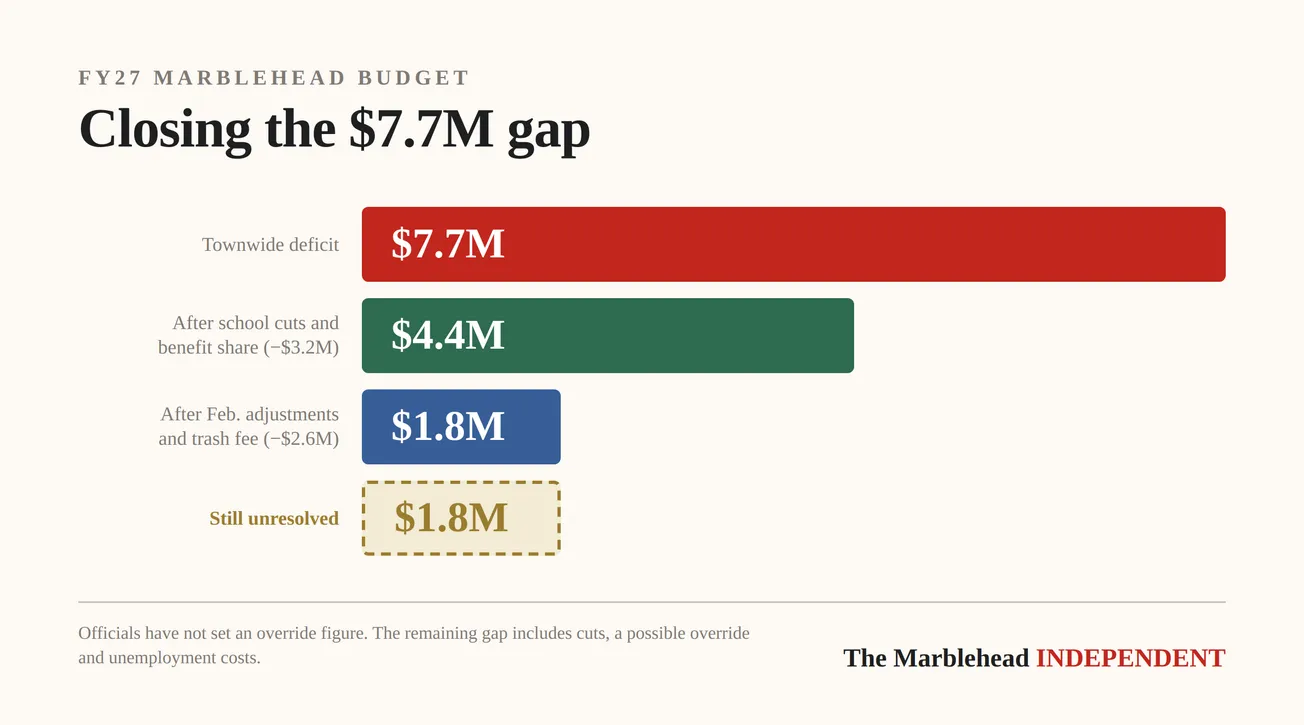
Marblehead’s budget gap is no longer a fight over spreadsheets alone. Town officials say they are still trying to close roughly a $4.6 million hole on the municipal side — closer to $4 million once updated health insurance estimates are applied — even after asking the schools to absorb about $1.5 million more in cuts as part of a wider townwide deficit of about $7.7 million.
That leaves Marblehead with a set of unusually concrete choices: shift roughly $2 million in trash costs onto residents through a user fee, or make another round of reductions affecting town staff, the library and senior services or seek an override that would soften some of those losses.
This reporting took hours of sitting through Finance Committee and School Committee meetings, pulling town and school budget documents, checking scenario spreadsheets and reducing a shifting FY2027 picture into numbers residents could actually follow. That work stays free to read because 103 contributors already give monthly or annually to support independent Marblehead reporting, and they do it so budget choices like these are documented in plain terms. If you’ve been meaning to help sustain this kind of accountability reporting before Town Meeting season moves deeper into spring, now is a good time to join them. 🟦 Become a member here.
At Monday night’s Finance Committee meeting, Chair Alec Goolsby tried to give structure to a debate that has often arrived in fragments — one set of numbers at the Select Board, another at the School Committee and a growing sense among residents that the severity of the cuts was either not fully understood or not fully believed. His presentation did not resolve the budget. It did something more basic: it laid out, in plain terms, what officials say the town is actually facing.
What the committee described was less a dispute over individual line items than a system straining against its own rules. Marblehead expects to have about $96.5 million in net available revenue after abatements, state-aid offsets, warrant articles, a snow-and-ice reserve and the Essex Agricultural School assessment are backed out. The requested operating budget, by contrast, is roughly $104.2 million. The gap is being driven by the familiar combination of constrained revenue growth under Proposition 2½, declining local receipts and rising fixed costs, especially benefits. Last year, the town used $7 million in free cash to help balance the budget. This year, officials say that figure will be closer to $5 million, exposing a structural mismatch that had been softened, but not solved, the year before.
Goolsby’s central argument was that the shortfall should not be treated as a negotiation between the schools and the rest of town government. Instead, he said, it should be assigned according to the actual cost structure of the town.
What’s driving the deficit?
“It shouldn’t be a negotiation between town and schools as to how much the schools are going to get versus how much the town’s going to get,” he said. “We really should look at a townwide deficit and identify what’s driving that deficit.”
That framing led to one of the meeting’s most revealing findings: Once shared costs such as pensions, active employee health insurance, retiree health insurance, life insurance, Medicare reimbursements and other post-employment benefits contributions are allocated to the people who actually drive them, the schools account for about 63 percent of the town’s functional spending, not the roughly 51 percent suggested by the school operating budget alone.
That calculation, Goolsby explained, helps explain why the schools are being asked to cut further even after already making reductions to reach a level-funded budget. Finance officials said the district had already found about $1.7 million in savings. Under the town’s proportional framework, though, the schools’ remaining share of the broader deficit still came to roughly $1.5 million.
That does not mean finance officials are arguing the schools are bloated. Finance Committee Vice Chair Molly Teets pointed to recent state data showing Marblehead’s teacher-student ratio is almost exactly in line with the Massachusetts average and that per-pupil spending is about 4% below the statewide average. Enrollment has fallen over the last decade, she said, but staffing has also declined, and the district has already consolidated schools to capture efficiencies.
On the town side, the scenarios remained stark. In the first, where the schools stayed at last year’s spending level and the town absorbed the cuts on its own, Goolsby said Marblehead would need to cut about $5.3 million from municipal departments, the equivalent of roughly 50 to 60 general-fund positions, or about 30 percent of the town-side workforce. In the second, with the additional school cuts but no trash fee, the town would still be looking at about 40 positions lost, or roughly 22 percent of the workforce. The third scenario — assuming both the school reductions and a shift of about $2 million in curbside trash costs out of the general fund and onto a user fee — would still leave about 18 positions on the line, or roughly 10 percent of the workforce.
Those numbers were not abstract in Goolsby’s telling. He described a list of possible losses that ran through the town’s day-to-day operations: clerical positions in Town Hall, planning staff, custodians, police, public works, the Council on Aging and the library. In the more severe versions, he said, the list could include a grants coordinator, finance and clerk’s office staff, one or more custodians, a police officer, positions at the Council on Aging, reductions to library staffing, a recreation groundskeeper and additional cuts across DPW and waste operations.
In the presentation shown to the committee, officials said one scenario could mean reduced service in the town clerk’s office, the loss of a finance position, a possible loss of the school resource officer, reduced availability of meeting space and custodial upkeep, and fewer resources for planning and grant writing. Recreation and parks services would also be affected, including the removal of public trash pickup from 157 barrels across town. Public works cuts could leave rail trail maintenance at risk and strip about $60,000 from pothole asphalt funding, forcing the town to rely on a revolving fund that officials said was not a sustainable answer.
In the committee’s more severe versions, some departments did not merely shrink — they disappeared.
“Those aren’t scare tactics,” he told the committee. “These are all real.”
In other words, the debate is no longer about whether Marblehead will feel the cuts. It is about where the town chooses to absorb them — in staffing, in services or in how residents pay.
Trash fee preserves more municipal jobs
In Teets’ shorthand, the proposed trash fee has become important for one simple reason: it would save 22 positions. That is the paradox at the center of the debate. A politically unpopular fee is being considered not because it lowers the underlying cost of waste and recycling, but because shifting roughly $2 million off the tax-supported budget changes who pays and preserves more municipal jobs.
Teets told the committee her review of statewide data suggested Marblehead’s service model is unusually generous and unusually expensive. Only about 10 percent of the 351 Massachusetts communities offer both curbside trash pickup and drop-off service, she said, and roughly 80 percent do not fund waste services through property taxes alone. In other words, the trash fee would not be creating a new cost so much as moving an existing one into a more visible place.
The meeting’s clearest example of how small changes can produce disproportionate effects came from the library. Library Director Kimberly Grad told the committee that the library’s budget is governed by state certification thresholds that do not behave like most departments’ budgets. A gradual funding cut does not simply mean fewer hours or fewer staff. If the municipal appropriation falls too far, she said, the library risks losing certification, access to the NOBLE network, interlibrary loans, databases and other systems that allow it to function.
“The library is a very different department,” Grad said. “It’s an institution. It’s more like a school for a town.”
Grad said the library would need about $310,000 in restored municipal funding just to remain eligible to seek a waiver from the state. Without that threshold funding, she argued, the result is not reduced service but effective closure.
“In most departments, a reduction in funding results in a gradual, linear decrease in service,” she said. “But in the library, this triggers an immediate, catastrophic loss of our certification.”
She pushed the point further, arguing that what is at stake extends well beyond one building.
“No one’s going to agree to serve our patrons,” Grad said of losing access to the NOBLE system. “You can’t just go to Swampscott or Salem. The NOBLE system will shut us out completely.”
For now, the override remains the largest unanswered piece. Finance Committee members made clear that an override could soften some of the losses now embedded in the working scenarios, but no figure had yet been attached to it Monday night. That uncertainty hung over the meeting. So did a second, quieter question: What happens next year?