Table of Contents
Help shape future polling in Marblehead by joining The Independent’s poll panel. You’ll get occasional, anonymous surveys on local issues so our reporting reflects what people in town actually think. Participation is optional and fully anonymous. Click here to join the Independent’s polling panel.
Respondents to a Marblehead Independent poll expressed a wide range of views on a proposal to center the town’s new MBTA Communities zoning district on Tedesco Country Club, showing a narrow but measurable edge in favor of the approach — and clear divisions beneath it.
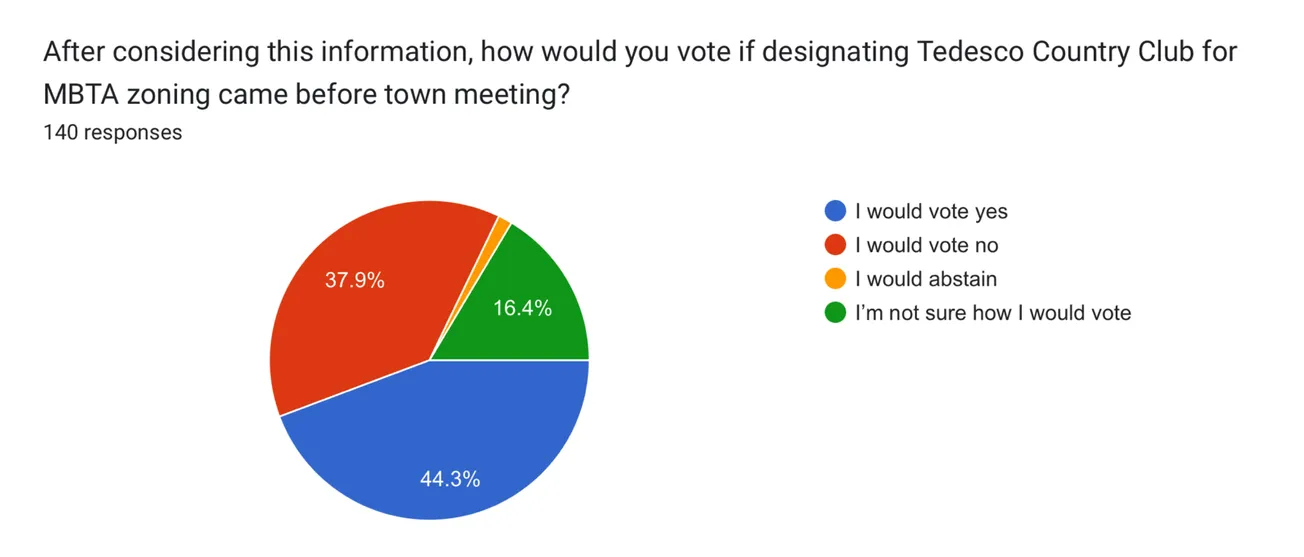
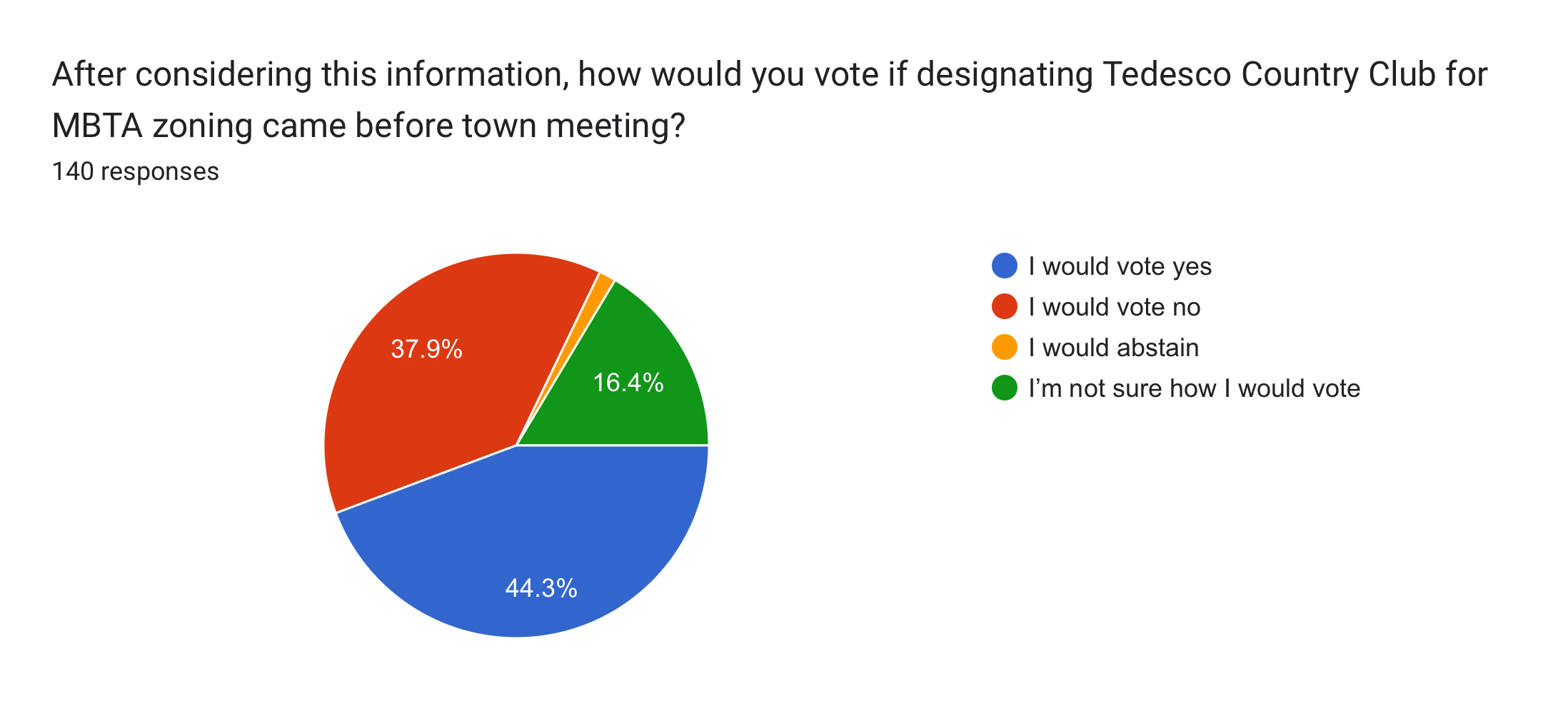
The Marblehead Independent’s non-scientific “Tedesco Country Club MBTA Zoning Poll,” which collected 141 responses between Nov. 14 and Dec. 9, found that 44.3 percent of respondents said they would vote yes if a Tedesco-based MBTA zoning plan came before Town Meeting. Another 37.9 percent said they would vote no, while 16.4 percent said they were not sure how they would vote. Only 1.4 percent said they would abstain.
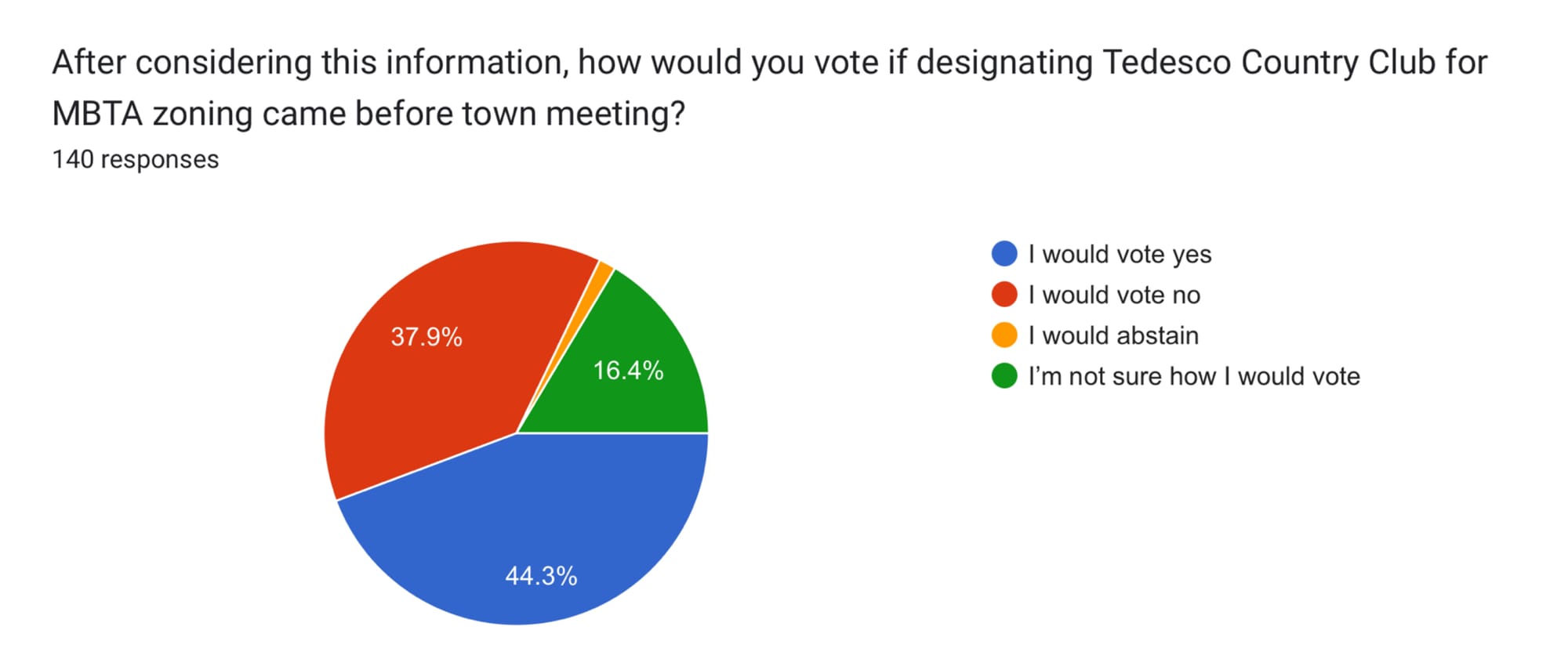
That breakdown — nearly a six-point gap between the yes and no blocs — suggests a community that is not united behind the proposal but may be leaning toward supporting it if it becomes the town’s primary path to regaining compliance with the MBTA Communities law.
Officials argue Marblehead’s noncompliance with the law has already cost the town access to state grants. Since voters repealed the town’s zoning plan in July, Marblehead has been shut out of more than $2.8 million in state funding applications, including projects for Abbot Hall improvements, rail trail design, coastal resilience work and downtown parking studies. Town officials have warned that continued noncompliance could jeopardize additional federal grants requiring state matching funds, including an $11.6 million port infrastructure project.
How people see the “paper compliance” strategy
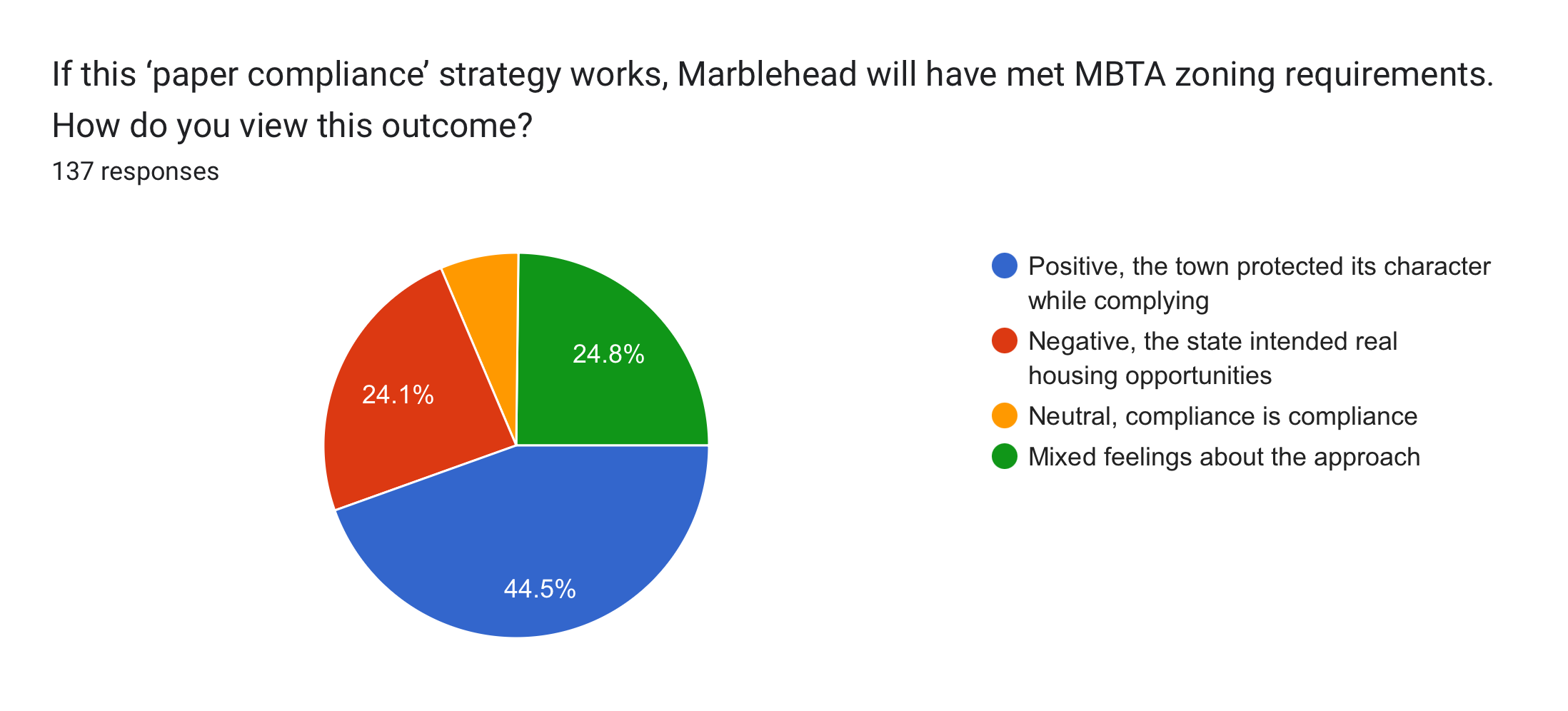
Another key question asked residents how they view the outcome if Marblehead meets MBTA requirements using a site where development is considered unlikely. Here, respondents split into four distinct groups based on 137 responses:
• 44.5 percent called the outcome positive, saying the town protected its character while complying.
• 24.1 percent called it negative, saying the state intended real housing opportunities.
• 24.8 percent reported mixed feelings about the approach.
• 6.6 percent said they were neutral and viewed compliance as compliance.
In other words, nearly half the respondents saw “paper compliance” as a constructive middle ground, while just under a quarter objected to a strategy that they believe sidesteps the law’s intent. The remaining third were ambivalent or neutral about whether the approach serves the town’s interests or the state’s housing goals.
You’re able to read this poll because 62 Marbleheaders chose to fund the reporting behind it. It costs about $80,000 a year to keep this newsroom open, and nearly all of it goes directly to the meeting coverage, data work and local reporting you’ve used this fall. We’re working toward 100 members by Dec. 31 so we can plan next year’s coverage with confidence. If you’ve been meaning to join, becoming a monthly or annual member today truly helps. 🟦 Click here to become an Independent member.
Supporters vs. skeptics: two very different readings of Tedesco
Poll responses show two broad mindsets taking shape among Marblehead residents.
Among residents who lean supportive, many selected options describing Tedesco as a “smart way to comply without real impact” and a strategy that avoids placing multifamily zoning “on top of existing neighborhoods.” Those respondents often cited character preservation, concerns about traffic and a desire to avoid repeating the divisive Pleasant Street and Tioga Way debates of 2024 and 2025.
Several respondents in this group wrote that they viewed the Tedesco proposal as a pragmatic solution that meets state requirements while minimizing disruption to residential areas. Some said they preferred a low-probability site over one that could generate immediate development pressure in established neighborhoods.
Skeptics, however, focused on the opposite point: Tedesco is unlikely to generate actual housing. Many respondents said Marblehead should zone areas “where housing could realistically be built,” viewing a Tedesco-centered map as a missed opportunity or an avoidance of the law’s purpose.
Comments from this group emphasized that the MBTA Communities law was designed to create housing opportunities, not simply to check a regulatory box. Some respondents said they worried that a paper-only approach could invite future state scrutiny or require Marblehead to revisit the issue again in coming years.
A rare point of agreement: Most believe housing at Tedesco won’t be built
One question asked respondents how likely they think it is that actual development would occur at Tedesco if the site is zoned for MBTA compliance.
Here, respondents from across the spectrum largely converged. A clear majority said development was “very unlikely, the site is safe.” Many others said it was “somewhat unlikely, but there’s risk.” Only a small share chose “fairly likely” or “very likely.”
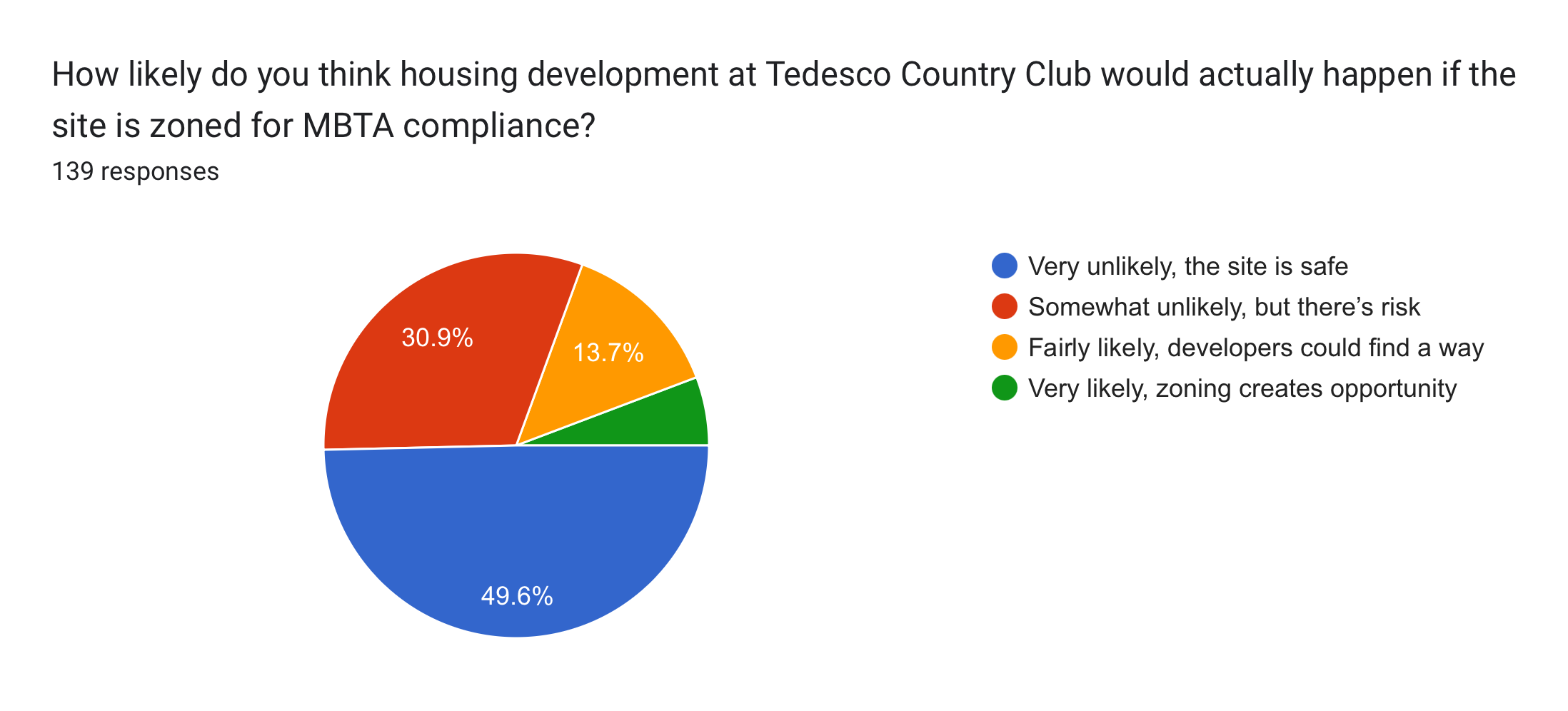
The perception that Tedesco is a low-probability development site is driving much of the support — and much of the criticism. Supporters see that low probability as protection. Opponents see it as evidence the town is not fulfilling the law’s intent.
How people think Marblehead should meet the MBTA law
When asked how the town should approach its MBTA obligation generally, respondents fell into several camps. A significant share favored “using low-risk sites like Tedesco for paper compliance.” Others preferred “zoning areas where housing could realistically be built.” A sizeable middle group said they needed more information before forming an opinion.
The diversity of responses suggests that even among residents who follow the issue closely, there is no consensus on what compliance should look like or whether the town should prioritize character preservation, housing creation or some combination of the two.
The political headwinds visible in the data
Even among respondents who said they would vote yes at Town Meeting, many indicated their support was conditional. Comments stressed wanting assurances about design rules, the need for clear public information and a desire for Marblehead to consider additional sites in the future if the law remains in place.
Meanwhile, several “no” voters said their opposition was not to Tedesco per se but to the idea of “checking a box” without creating opportunities for young families, downsizers or workers to actually live in town. Some respondents in this group said they would support a different plan that included more realistic development sites or a broader mix of locations.
The poll also captured frustration from residents who said they felt caught between state mandates they disagree with and local officials trying to navigate an impossible political situation. Several respondents wrote that they wished Marblehead had more flexibility under the law or that the state would allow smaller towns to pursue exemptions.
Town officials proceed with state review
While respondents debated the poll questions, town officials advanced the Tedesco-centered concept to the Executive Office of Housing and Livable Communities. Community Development and Planning Department Director Brendan Callahan and Town Planner Alex Eitler said the revised map was submitted on Dec. 2 for a preliminary compliance review.
Planning Board member Marc Liebman said officials deliberately sought state feedback first.
“We realized that we don’t want to present this” publicly until the state confirms the concept can work, he said, noting that the plan may be revised after public outreach.
Under the proposal, Marblehead’s primary MBTA district would encompass all of Tedesco Country Club’s land, along with a small slice of the Glover 40R district. Only one of last year’s controversial sites — Broughton Road — remains in the plan. Pleasant Street and Tioga Way have been removed.
A preliminary ruling from the state is expected in early January. If the state agrees the concept is viable, Marblehead will begin formal public meetings, present full maps and craft final bylaw language for a potential May 2026 Town Meeting vote.