Table of Contents
Want the key town stories without the noise? Sign up for our newsletter for clear weekly updates on boards, budgets and what’s changing in Marblehead — no spam. Sign up for our once-a-week newsletter.
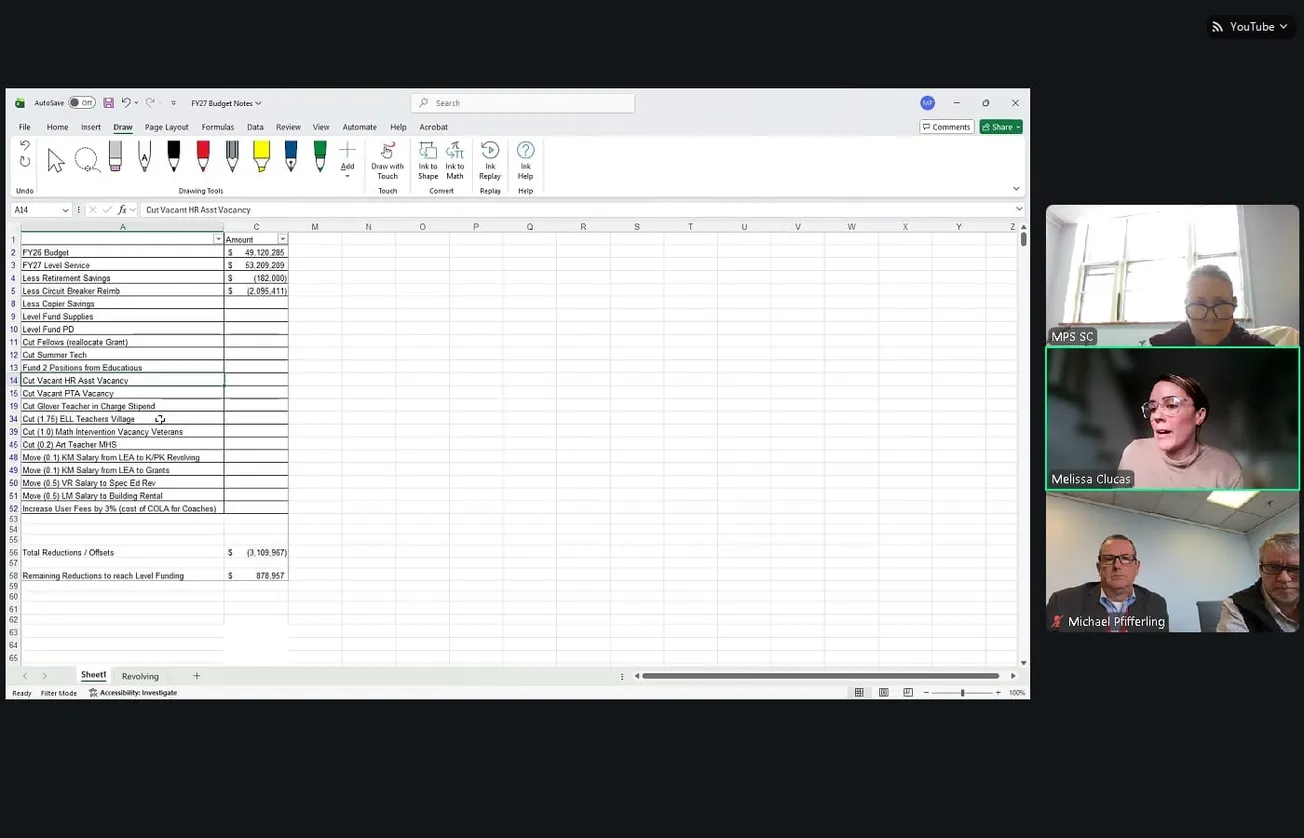
The Marblehead School Committee Budget Subcommittee reviewed a $1.7 million gap between current spending and projected costs for fiscal year 2027 during a meeting Jan. 5, with administrators reporting they have reduced that shortfall to roughly $879,000 through a combination of unfilled vacancies, operational shifts and fund reallocations that do not immediately affect classroom instruction.
The gap reflects the difference between level funding, which maintains the current year’s budget total, and level service, which accounts for contractual salary increases, rising special education costs, utility expenses and other fixed obligations. Without additional revenue or further reductions, the district will need to cut nearly $900,000 from operations to balance the budget.
You’re able to read this because 76 Marblehead neighbors — parents, retirees and local professionals — chip in with recurring monthly or annual support. The Independent runs on about $80,000 a year, with roughly 95% going straight to journalism, and we’re working to reach 100 members by Jan. 31 so we can keep showing up for meetings like this. If you’ve been meaning to support local reporting, joining today helps. Click here to become an Independent member.
Where the cuts came from
Assistant Superintendent Michael Pfifferling said the district started with a $1.7 million delta between the fiscal year 2026 appropriation of $49.1 million and the $53.2 million needed to maintain current services. That figure does not include revolving accounts or grants.
“Through offsets and reductions, we were able to get that $1.7 million down to about $850,000 to $879,000,” Pfifferling said. “This is no impact on education right now. If we go further, it’s going to impact either education or other funding sources.”
The reductions announced Jan. 5 include eliminating positions that have remained vacant all year, such as a human resources assistant, a physical therapy assistant at Glover Elementary School and a math intervention teacher at Veterans Middle School. The district also plans to eliminate 1.75 English learner teacher positions at Village Elementary School based on declining enrollment in that population.
Additional savings come from reallocating portions of several administrative salaries to revolving accounts and grants, including moving half the assistant facilities director’s salary to the building rental account and a portion of the assistant business manager’s salary to prekindergarten and kindergarten revolving funds.
Pfifferling emphasized the district has also tapped $2.1 million from its circuit breaker reserve account, which reimburses districts for high-cost special education placements, and applied roughly $182,000 in savings from staff retirements.
Superintendent John Robidoux said administrators met individually with each building principal to review staffing, enrollment and program needs before identifying potential cuts.
“We started with all the vacancies that we know we have, and then we looked at whether we need to fill these vacancies or not,” Robidoux said. “Having done that exercise, it got us down to this point.”
Next round of decisions
Robidoux cautioned that reductions beyond the $879,000 would require different conversations.
“Those cuts are going to start affecting classroom sizes, start affecting instructional materials and resources,” Robidoux said. “The next round of reductions and efficiencies are going to start having broader impacts on education.”
The budget challenges come as the district experiences sustained enrollment decline. District enrollment has fallen by 487 students since the 2018-19 school year, dropping from 3,051 students to 2,564 students in 2024-25, according to enrollment data presented to the School Committee in December by Assistant Superintendent Julia Ferreira. That represents a decline of about one out of every six students enrolled six years ago. The local trend mirrors broader demographic shifts statewide. The U.S. Department of Education projects Massachusetts public schools will enroll about 40,000 fewer K-12 students by 2030 than today — a systemwide contraction equivalent to losing the combined enrollment of several mid-sized districts.
School Committee member Melissa Clucas asked administrators to provide data showing how student needs have changed even as enrollment has declined districtwide.
Robidoux said special education staffing has remained relatively stable despite slight enrollment decreases because the complexity and intensity of student needs have increased.
“The numbers of students have declined, but the needs of students are such that the ability for us to reduce the staffing in much of the areas, especially in special ed, is negligible, because it’s going to be more detrimental to the students,” Robidoux said.
Clucas said the committee would need clear documentation of those trends before presenting the budget to the full School Committee and finance committee.
“We do need to kind of lead with the data to support that in whatever way we can,” Clucas said.
The subcommittee plans to meet with finance committee liaisons Jan. 29 before presenting a recommended budget to the full School Committee Feb. 5. Administrators have until Jan. 26 to finalize their budget proposal.
School Committee member Jenn Schaeffner said the district must be prepared to explain its staffing decisions in detail.
“What I really want is what does it cost for us to deliver what we actually need,” Schaeffner said. “What do we need based on the students that we have today and where we expect that to look like moving forward.”
The subcommittee also discussed whether to pursue an override article, though no decision was made Jan. 5.