Table of Contents
Get our free local reporting delivered straight to your inbox. No noise, no spam — just clear, independent coverage of Marblehead. Sign up for our once-a-week newsletter.
When Finance Committee Chair Molly Teets learned that a friend in town was struggling, she decided to do something about it. She benchmarked 20 Massachusetts communities, wrote a home-rule petition for a property tax break aimed at the seniors who need it most and saw it pass at the 2025 Town Meeting and then in the Legislature. This summer, Teets and the Assessor’s Office, with help from citizen volunteers Jeanne Lambkin and Christine Nuccio, developed and communicated the application process. With crucial approvals from the Select Board and the Board of Assessors, applications are now available for the Marblehead Means-Tested Senior Citizen Property Tax Exemption.
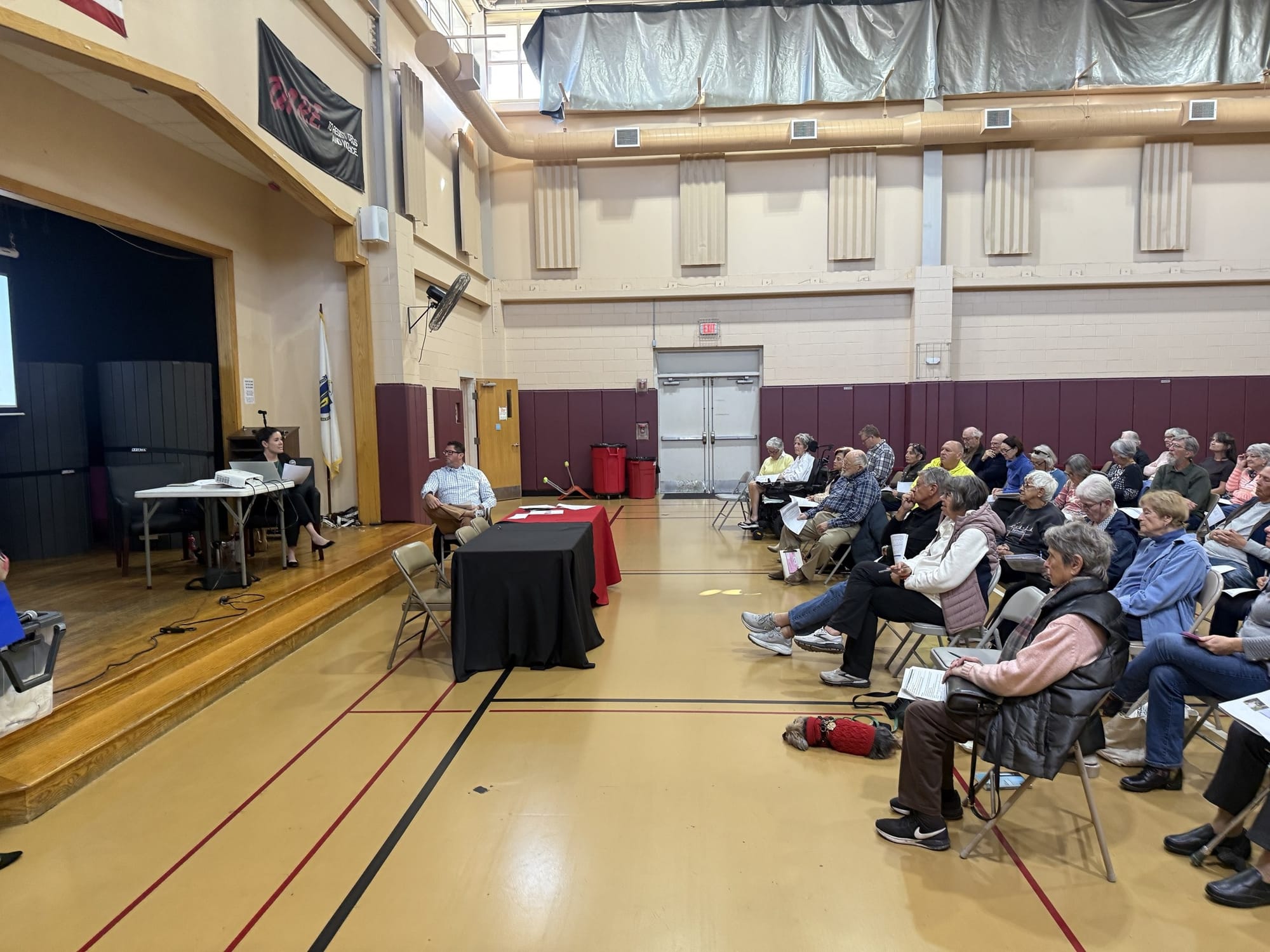
On Thursday afternoon, the initial seed of providing some property tax relief to longtime residents became a reality for about 70 people as applications and instructions were provided at a workshop jointly sponsored by the Council on Aging and the Assessor’s Office. Applications and workshop materials are available on the Assessor’s Office website, and an MHTV recording of the workshop will soon be available.
The program has gone from abstract concept to law to something residents can apply for. Gov. Maura Healey signed the home-rule act, Chapter 67 of the Acts of 2026, on April 29, nearly a year after Town Meeting approved it, and in July the Select Board set the income limits and the second-home rule.
Along the way, the Assessor’s Office, which will run the program, got behind it: Assistant Assessor Todd Laramie, Administrative Assessor Leandro DiFilippo and Senior Clerk Viktorija Babrauskaite. At a Council on Aging forum in May, Laramie said, “We have no idea ... how many people are going to apply, and we are learning too.” On Thursday, Laramie, Babrauskaite and DiFilippo joined Teets and Lambkin at the front of the room and took residents’ questions one by one.
Teets and Lambkin led attendees through the form section by section, asking residents to treat this year’s application as a shared learning experience and to suggest improvements. Laramie stressed that the Assessor’s Office is ready to help people with any questions: “When in doubt, apply.” Laramie and Teets also stressed the importance of submitting applications by the Nov. 30 deadline.
How the exemption works
The local exemption builds on the state’s senior circuit breaker, a refundable income tax credit worth up to $2,820 for tax year 2025. Both programs aim to keep a senior’s property taxes plus half of annual water and sewer costs at or below 10 percent of income. When the state credit falls short of that goal, the town supplements up to $2,000 for eligible applicants. The program also has a total cap of $200,000. If approved awards total more than $200,000, exemption amounts will be proportionally reduced. Teets estimated that roughly 100 residents might qualify based on initial research. Everyone is eager to see what actually happens in the program’s first year. Laramie said interest in the program has been high.
“We’ve had a ton of calls of people saying, ‘Yeah, I’d like to get involved with that new locally adopted exemption,’” Laramie said. The program, he said, is meant for “a tight group of people that are in the most need of it.”
To qualify, applicants must have been 65 by Dec. 31, 2025, and any co-owner must be at least 60. Applicants must have owned and lived in a Marblehead home as their primary residence for at least 10 years, and its assessed value cannot exceed $1,291,507, the town’s fiscal 2027 average single-family assessment. Income must fall under $75,000 for single filers, $94,000 for heads of household or $112,000 for joint filers. Applicants cannot own a second home and must have applied for the state credit.
The requirements are intended to deliver these benefits to longtime residents with the greatest need. Renters cannot apply, nor can people who own a second home. Some applicants may need to wait to apply in future years if their co-owner is not yet 60. Others may be ineligible due to their assessed property value exceeding the town average stipulated on the application. The act has neither a hardship provision nor an appeal process.
At the workshop, Teets walked through hypothetical cases. A homeowner with a $750,000 home and $40,000 in income pays $6,420 in property taxes; adding $800 for half her water and sewer bill puts her housing costs at 18 percent of income. The full state credit brings that total down to $4,400, still $400 above the 10 percent mark, so the town would cover the $400.
A second homeowner with $45,000 in income received a partial state credit of $1,864, which alone met the target. He would get nothing from the town. Teets told attendees that anyone who received less than the full $2,820 from the state should not expect a local exemption.
She urged residents to confirm their tax preparers file the state’s Schedule CB, calling the circuit breaker “a much bigger, much much bigger program than what Marblehead could ever offer.”
Residents who never claimed the state credit can still file amended returns, but Teets said the state shut off electronic filing about a week ago, leaving paper submittal as the only option. A response may not arrive before Nov. 30. Even so, she said, recovering a missed state credit, which could be up to $2,820, while gathering paperwork for Marblehead’s new program would be “a win for this program.”
What applicants need
Applicants need no more than four documents: proof of age for each owner, such as a driver’s license or birth certificate; a copy of their 2025 state income tax return, including Schedule CB; trust documents if the home is held in a trust; and the completed application.
The nine-section form is paper only this year and can be picked up at the Assessor’s Office or downloaded from its website. Two key figures come straight off tax forms: the circuit breaker credit from line 44 of the state return and qualifying income from line 9 of Schedule CB. Assessed value can be found through the assessor’s online property data, on the actual fiscal 2026 real estate tax bill rather than the preliminary bill, or by calling the office.
“The numbers we’re asking for here do not need to be calculated; they need to be copied,” Lambkin said. With documents in hand, she added, “an hour is a generous estimate of what it should take to complete the application.”

Questions from the floor
Attendees asked about trusts, co-owners and deceased spouses. DiFilippo told a widow to list herself as the owner, mark her status as single and attach a copy of her husband’s death certificate.
One resident who owns a small lot next to her house asked whether it counts as a second home. Teets said the Board of Assessors will decide. DiFilippo added, “Where you live, where the place you go home at night is your domicile.”
Laramie said applications will be time-stamped when they arrive and checked for completeness at the counter, with staff following up later. Approval notices are expected in February or March, and credits will appear on fourth-quarter tax bills.
Laramie, who recently marked two years in Marblehead, previously worked in Hamilton and Wenham, which have similar programs.
“This is a learning curve for all of us,” he said. “We’re going to do our best to be patient, and hopefully you guys can do the same with us.”
How to apply
Applications are available at the Assessor’s Office in the Mary Alley Municipal Building, 7 Widger Road, and on the assessor’s website. Questions can go to the office at 781-631-0236 or assessors@marbleheadma.gov, where Laramie, DiFilippo or Babrauskaite will answer.
Questions about the senior tax work-off program go to the Council on Aging at 781-631-6225.