Table of Contents
Get our free local reporting delivered straight to your inbox. No noise, no spam — just clear, independent coverage of Marblehead. Sign up for our once-a-week newsletter.
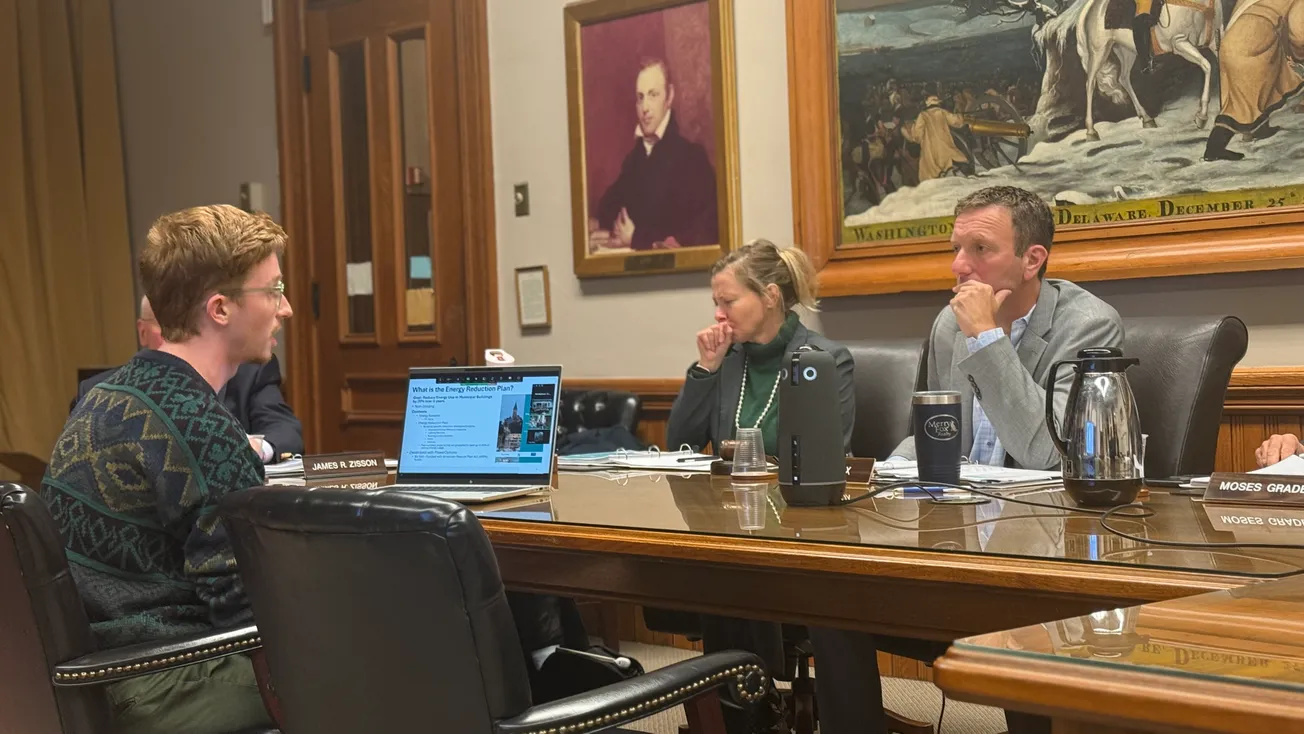
On Wednesday night, the Select Board heard a detailed presentation on the town’s new Energy Reduction Plan, a required step toward joining the state’s Green Communities Program, but learned that even if designated, Marblehead cannot access hundreds of thousands of dollars in grant funding until it complies with separate state housing law.
The plan, developed by PowerOptions using $9,500 in federal pandemic relief funds, establishes a nonbinding goal to reduce municipal energy consumption by 20% over five years using fiscal year 2024 as a baseline. That year, town buildings and vehicles consumed 62,442 million thermal units of energy — roughly the amount needed to power more than 600 average Massachusetts homes for a full year — and produced 3,796 metric tons of carbon dioxide equivalent, about the same annual emissions as 850 gasoline-powered cars.
Designation possible, but funding frozen over zoning
But the state Department of Energy Resources confirmed to Sustainability Coordinator Logan Casey that while Marblehead can be designated, grant funds will be withheld until the town complies with the MBTA Communities Act, which requires zoning for multifamily housing near transit. Voters repealed a prior compliant MBTA-zoning plan 3,642-3,297 in a July 8 referendum, and plans are underway to bring a new proposal to the 2026 Town Meeting.
Select Board member Erin Noonan expressed frustration with the situation.
“I hope that people in the community that voted against or didn’t have enough information to be informed can take stock of all of the actual revenue loss,” she said. “And it’s a shame that we, and I will say it, we had a campaign of active disinformation and fear mongering that I frankly find it shameful that we are one of a handful of communities
She continued: “It’s heart wrenching being on this side of the table, and people thought we didn’t know what we were talking about. When we said this was going to happen, we were told, ‘No, they’re lying. They don’t know what they’re talking about. We’re not losing this money.’ There’s real consequences. Elections have consequences, and people need to really show up and know what they’re voting for.”
Green Communities designation would make Marblehead eligible for grants totaling $150,000 to $175,000 initially, with competitive rounds offering $250,000 for standard efficiency projects or up to $500,000 for full electrification work. The state has designated 299 of Massachusetts’ 351 municipalities.
A difficult spot
The funding freeze also places the Marblehead Municipal Light Commission in a difficult spot. To qualify for Green Communities status, the department must adopt a renewable energy charge on all customer bills — typically about $5 to $6 per household annually — a state requirement designed to help communities build the capital needed for local efficiency projects.
But with state grant dollars currently blocked, light commissioners have questioned whether it is fair to impose a new fee when residents cannot yet benefit from the program. Some have expressed concern about adding costs to ratepayers without a clear timeline for resolving the town’s MBTA Communities noncompliance.
The hesitation has left Marblehead in a bind: the town cannot access Green Communities money until both the zoning issue is settled and the renewable energy charge is in place. Casey said the situation underscores the complications of being a municipal light plant community navigating a new state policy landscape.
“We are the test case, unfortunately,” Casey said regarding the withheld funds. “This is new, and it’s also kind of complicated by the fact that we do have a municipal light plant.”
Schools emissions represent lion’s share
Schools account for 61% of total municipal emissions, primarily from Marblehead High School, Veterans Middle School and Village Elementary School, Casey told the board. Buildings overall represent 82% of baseline consumption, with vehicles contributing 15%.
“It was the first time I was seeing the whole municipal and schools data in a town wide view,” Casey said in an interview prior to the Select Board meeting. “I don’t know if anybody’s gotten that perspective into schools because [the town’s various departments] pay their utility bills independently.”
The plan outlines near-term efficiency measures with payback periods under two years, including adjusting heating setpoints, optimizing ventilation, upgrading to LED lighting and reducing equipment schedules. Longer-term strategies call for heat pump installations, deep energy retrofits and rooftop solar arrays with potential capacity of 1.9 megawatts across five school buildings.
If fully implemented, the measures could reduce annual energy usage by up to 45%, Casey said, though reaching the required 20% threshold depends heavily on school building improvements and converting roughly six light-duty vehicles per year to electric or hybrid models.
“These projects that are outlined are projected to save us 25% of our annual energy usage if we implement every single one of them,” Casey told the board. “And you know, obviously it will be over a couple of years.”
Town Administrator Thatcher Kezer said the town has been unable to pursue certain state grants — many of them competitive — because of its MBTA Communities noncompliance. One example is the Community Transit Grant Program, which funded shuttle vans for the Council on Aging. The program provides 80% state matching funds for vehicle replacements and supported more than 5,100 rides for 200 residents last year.
Several residents urged the board to adopt the energy plan. Sustainable Marblehead Executive Director Elaine Leahy of the Green Marblehead Committee called it “good fiscal stewardship” that would lower utility costs and reduce taxpayer burden.
“This plan outlines logical, prioritized actions that help us sequence projects for the greatest financial return,” Leahy said.
The energy plan supports Marblehead’s Net Zero 2040 Roadmap, adopted in 2023, which commits the town to eliminate carbon emissions from electricity, buildings and transportation by 2040. Casey said the municipal reductions, while representing only 2% of communitywide emissions, establish a model for broader climate action.
To qualify for Green Communities, Marblehead already has adopted stretch building codes, established expedited permitting for renewable energy facilities and approved a zero-emissions-first vehicle procurement policy. The energy baseline and reduction plan complete the town’s requirements, but the School Department must also adopt the plan before the town can formally apply.
Board members discussed whether to proceed with adoption knowing grants remain inaccessible, with some suggesting the town develop alternative funding strategies while waiting for potential compliance or state intervention.
Casey said he will return to the board at its next meeting seeking formal adoption of the plan.
BEFORE YOU GO: Help us keep reporting on the decisions that shape Marblehead’s future
Stories like this one require careful, consistent local reporting. These are complicated issues, and without someone tracking the numbers, attending the meetings and explaining what each decision means for ratepayers and taxpayers, most residents would be left guessing.
The Marblehead Independent is a small, reader-powered newsroom. It costs just $80,000 a year to keep this newsroom running — enough to follow these policy debates, verify the facts and make sure residents understand what’s at stake for their town.
If this reporting helped you make sense of Marblehead’s climate goals, grant eligibility and the financial impact of local decisions, please consider supporting The Independent. A small monthly contribution or a one-time gift directly funds more journalism like this.
There’s no paywall. Everyone in town gets access. But when those who can chip in choose to do so, we can keep this work going — and strengthen it.
🟦 Click here to become an Independent member
🟦 Click here to make a one-time contribution
To Be Independent, with us.