Table of Contents
Get our free local reporting delivered straight to your inbox. No noise, no spam — just clear, independent coverage of Marblehead. Sign up for our once-a-week newsletter.
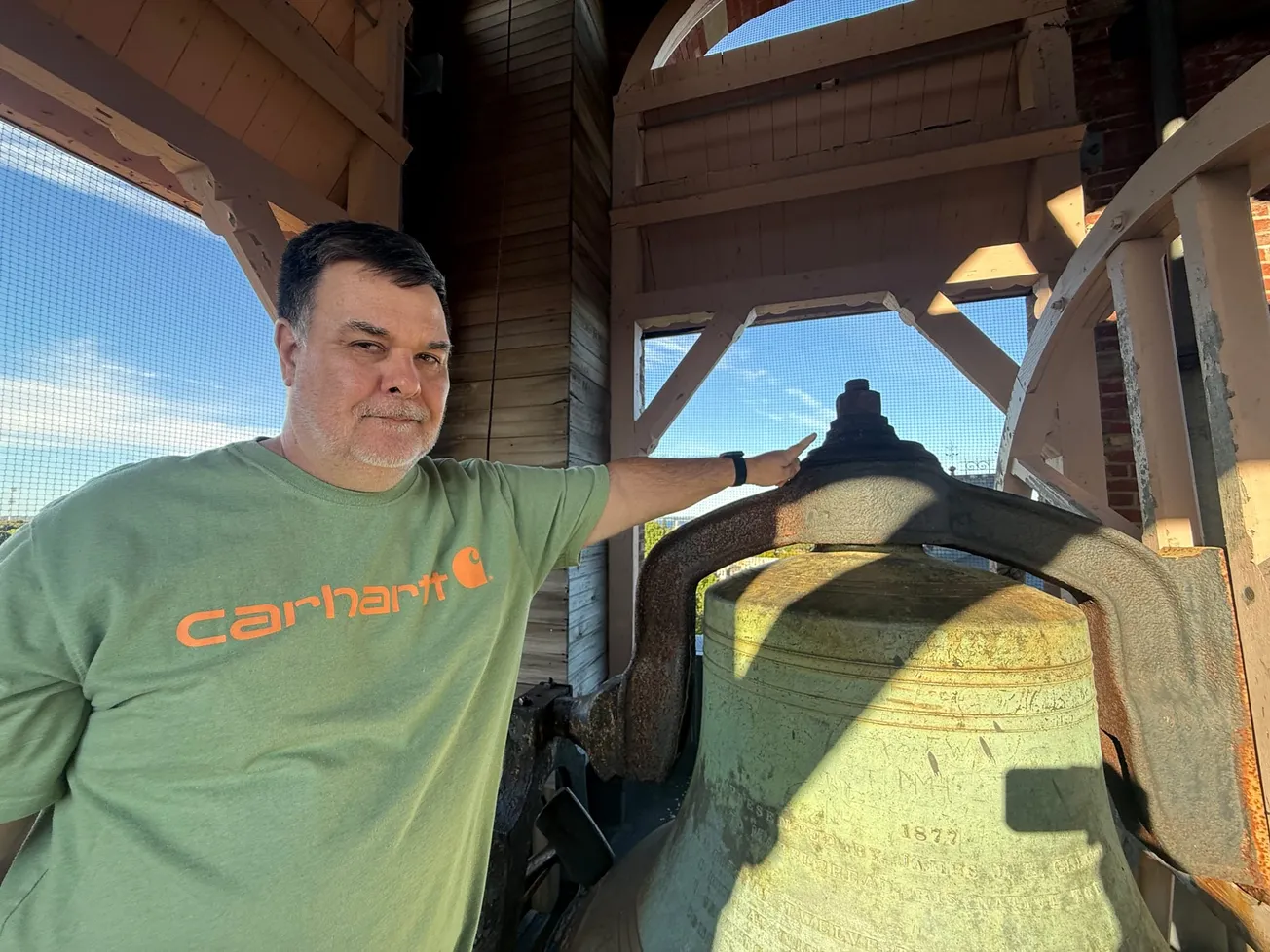
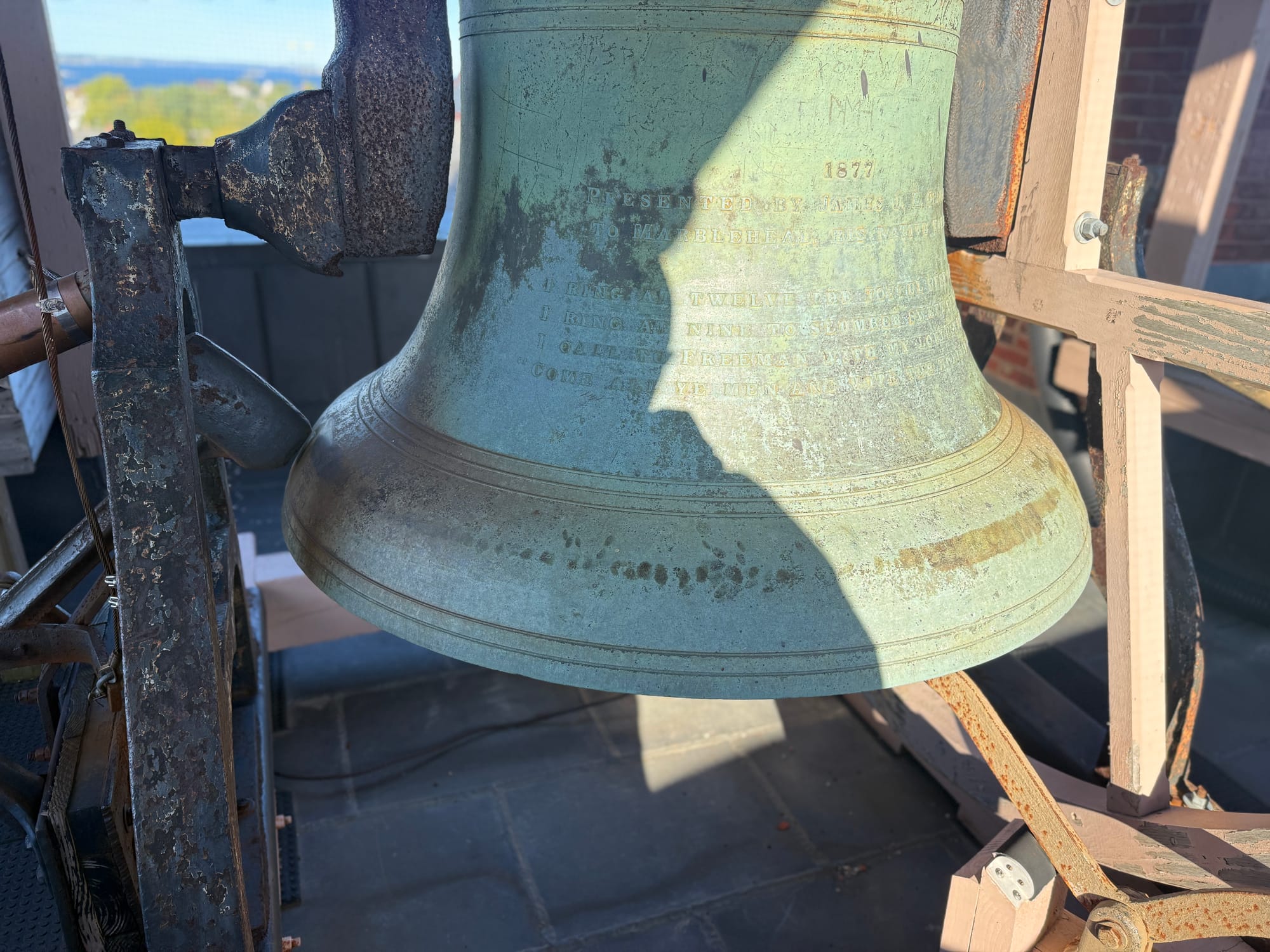
David Draves has soaked the bolt in penetrating oil. He has scraped it, put a torch to it, leaned on a 36-inch wrench and hit it with a sledgehammer. The nut on top of Abbot Hall's bell has not moved.
"It will not budge," Draves told the Marblehead Historical Commission on Sept. 17.
Draves, of 2 Churchill Road, has climbed the tower since 2007 as one of the volunteers known as cranks, who wind the tower clock and, over the years, have noticed things. What they have noticed lately is that the bell above them is in trouble, and that the repair the Select Board approved a year ago cannot physically be performed.
On Sept. 10, 2025, Fire Chief Jason Gilliland asked the board to let him coordinate rotating the bell so it would stop taking repeated blows in the same place, which he warned was causing fatigue, loss of tone and possible cracks. The board approved it unanimously. Since then Draves, other cranks and Gilliland have tried to free the top nut and failed.
Gilliland has floated cutting it off and fitting a replacement. The problem, Draves said, is the second nut underneath, the one actually holding the assembly together, and what happens to the clapper if it loosens.
"This is a professional action," Draves said. "I don't think it's worthy of us volunteers doing it."
A nut that will not move
The bell was cast by Meneely & Kimberly of Troy, New York, and arrived in town on a Monday in July 1877, hung in time to ring in the Fourth. Draves bought a copy of the founders' catalog. It states the bell has to be rotated periodically to keep it from cracking, and he said the evidence that earlier generations did so is still visible along the bell's edge.
He cannot recall a rotation since he started in 2007. Cranks whose memory of the tower runs back to 1974 cannot recall one either. By his math the clock strikes the bell 156 times a day, 56,940 times a year, which over 51 years comes to almost 3 million blows landing on the same spot.
"Who knows when it's going to crack," Draves said. "And if it cracks, then you get a whole different situation going."
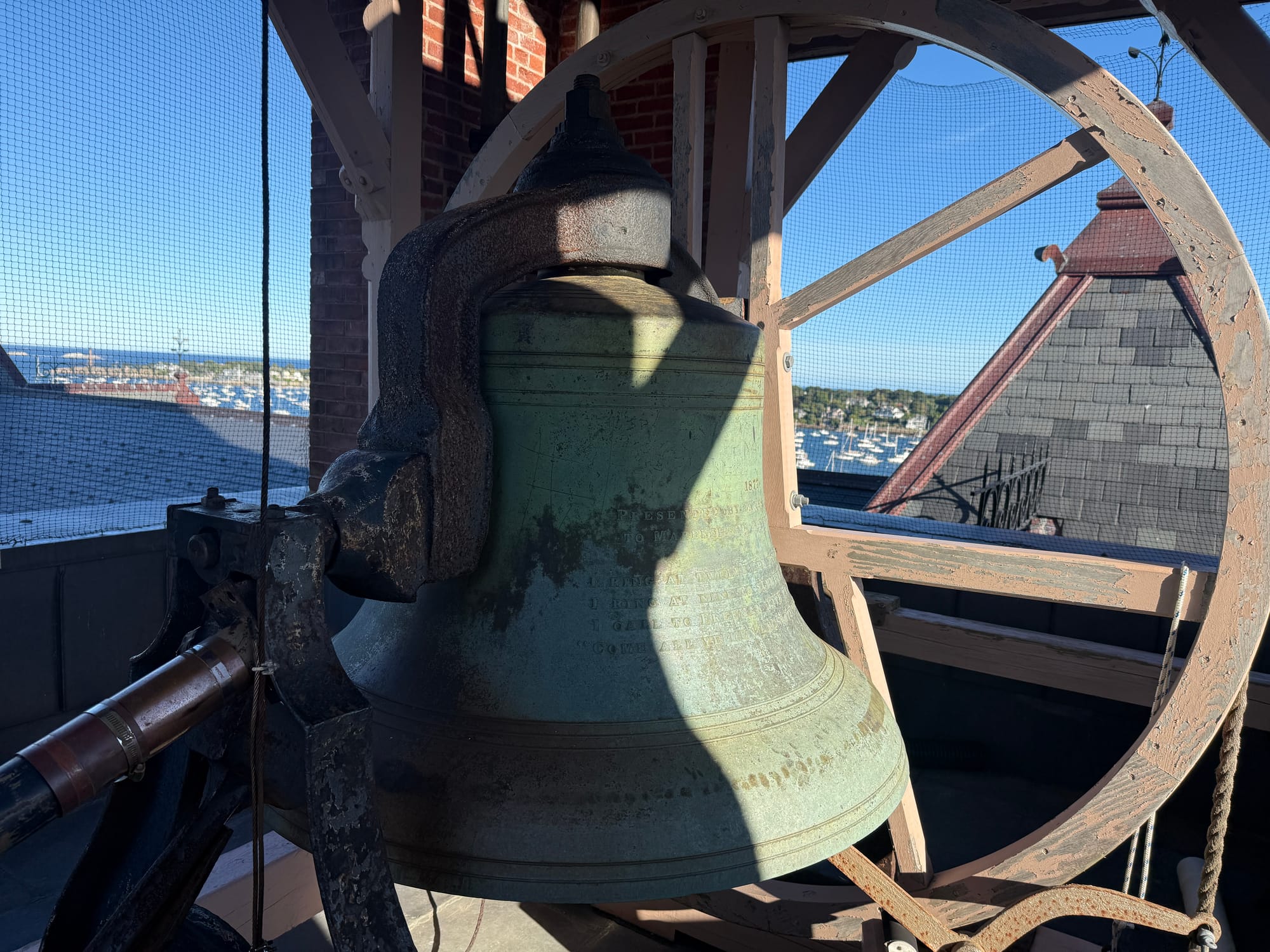
The rest of the assembly is no better. The bearings are shot. The six-by-six timber underneath is rotting, and Draves said the support bolts can be pulled straight out of it. The wooden ringing wheel was redone in 2014 and is sound, but a sliding block that trips the spring to bring it back is missing. Without it, the rope is useless. The bell is struck by hammer now, and on perhaps three holidays a year the cranks toll it with a rope rigged to a side hammer.
It has a wheel, so it swung once. It does not swing now, and nobody in the room could say when that stopped.
$48,000, and no crane
A quotation from a local company was in front of the commission. Chair Pam Peterson asked whether the figure under discussion was the $48,000. Draves said he had seen the quote only that morning and had not been involved in obtaining it. One of the cranks, he said, works for the company.
Commissioner Chris Butler, who helped circulated the document, said the vendor also recommends taking the bell down, sending it to a shop and bringing it back — and that the $48,000 does not cover the crane that would require.
"I'm not advocating that the Historical Commission spend a dime on it," Butler said. He laid out the route instead: a scope of work and a request for quotes, written by the building commissioner or by Community Planning and Development Director Brendan Callahan, then out to bid through the procurement agent.
Peterson drew the line more sharply. The commission exists to preserve town-owned property and supports that work financially when it can, she said, but this one is not theirs to authorize.
"I think the bell comes under the jurisdiction of the building commissioner," she said.
Butler agreed. "The building commissioner has overall purview on this building."
Which is the answer Draves has been chasing. He told the commission that the reason he keeps showing up at meetings is to find out who is actually responsible. Butler said Building Commissioner Stephen Cummings has been shown the material and is aware of it.
Marblehead has paid to save this building twice in recent year. Voters approved $2.47 million in 2013 to rebuild the clock tower and $8.98 million in 2018 to finish the job, more than $11 million in all. Neither scope reached the bell.
The bell is upkeep. The foundry that cast it closed about 1951, rotation is the routine step that keeps a bell from cracking, and by David Draves's count the hammer has hit the same spot roughly 2.9 million times. Abbot Hall turns 150 in 2027.
Rust in the tower
The bell was not the only thing Draves raised. The clock movement itself was last cleaned and inspected in 2011. The cranks oil the pulleys and gears themselves.
Bill Conly wanted to know why.
"Why hasn't the sprinkler system been maintained?" he asked. "That's lack of maintenance."
Butler said a company called Metro Swift used to hold that contract, back when he worked in the building. "That's been seven years," he said. "I don't know if they have a new company or what." Nobody in the room could name who inspects it now.
Conly, who spent part of the meeting on a separate grievance about which historic things in town get fixed and which do not — "we're not fixing the sidewalks downtown that are historical, but we do fix the facade blocks up in Clifton" — asked whether the bell still works at all.
It does. But it no longer rings curfew. That was a hand pull at 9 p.m., and the town stopped paying the custodian overtime to climb up and do it.
"At 9 p.m. every night," Peterson said.
"Every night," said Town Moderator Jack Attridge, who was in attendance.
Cast into the bell, beneath the date 1877, is the line the town has not heard in years: I ring at nine to slumber sweet of night.
This story took a foundry ledger in Troy, N.Y., an 1877 weight in pounds and an hour in the tower to report. Right now 122 readers support The Marblehead Independent with recurring monthly or annual contributions. Become a member.