Table of Contents
Get our free local reporting delivered straight to your inbox. No noise, no spam — just clear, independent coverage of Marblehead. Sign up for our once-a-week newsletter.
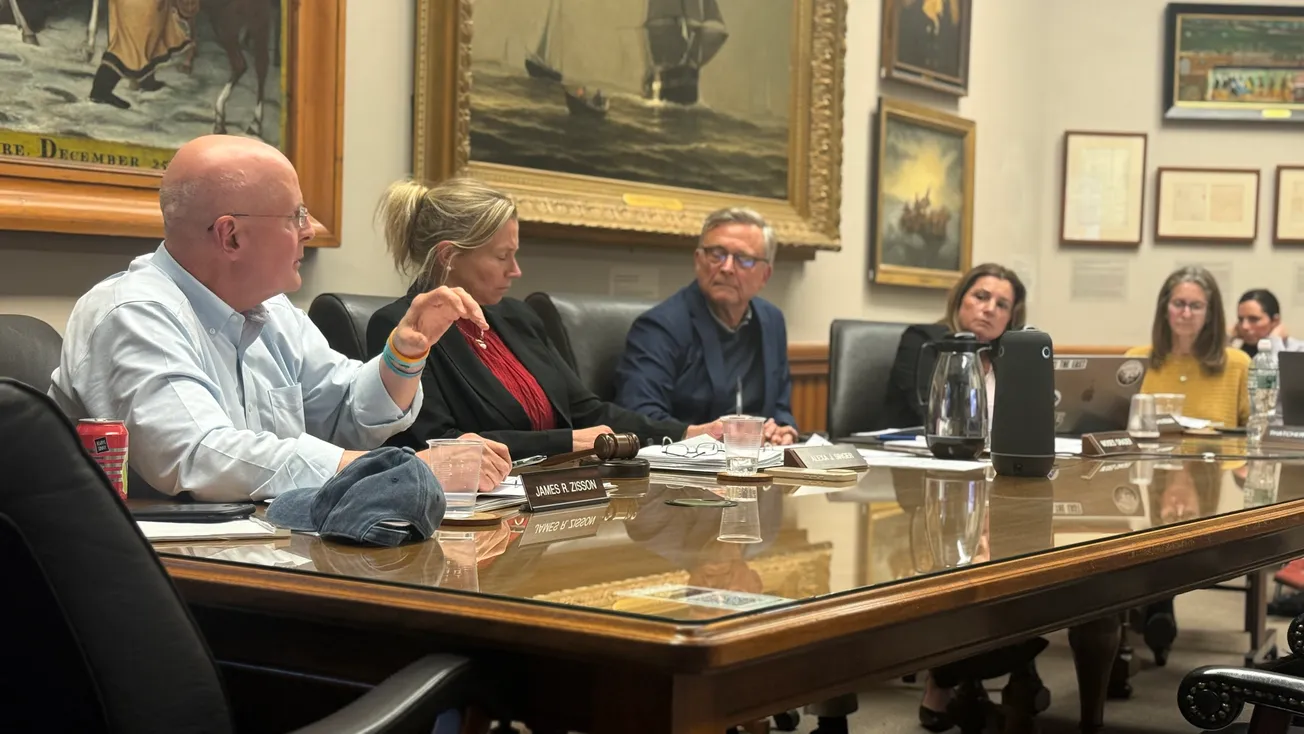
Marblehead’s Select Board voted Wednesday night to pursue a multiyear, three-tier override as well as a separate ballot question on trash funding, advancing the clearest framework yet for how the town intends to ask voters to close a $7.7 million budget gap.
The board also voted to create a working group of town and school officials to develop a unified override proposal, placing municipal and school funding under a single ballot question. The group is expected to convene next week. Town Meeting, where general overrides must first be authorized by a majority before reaching the June ballot, is about five weeks away.
The votes came after a packed meeting at Abbot Hall, where residents, union leaders and a newly formed grassroots group urged the board to move quickly and to think beyond a single year. They also came five days after the board approved a $56.6-million, balanced Select Board budget that eliminates about 18 positions, cuts $60,000 from pothole funding and puts the school resource officer back on patrol. An override is the only mechanism to reverse those cuts.
“We’re not talking about cutting and trimming,” Town Administrator Thatcher Kezer said during his presentation. “We’re talking about closing the door on a number of services.”
How the tiers work
Under the framework Kezer presented, the service-funding override would be divided into three cumulative tiers. Each builds on the one below it, and voters could mark yes or no on each independently. The highest-value tier that passes by majority vote would determine the permanent increase to the town’s tax levy.
Tier 1, labeled “restore,” would bring back services cut from the balanced budget, including a firefighter position, the school resource officer, full library staffing, custodians, a groundskeeper, Council on Aging staff and positions across finance, community development and other departments.
Tier 2, “stabilize and build,” would include everything in Tier 1 plus building maintenance funding, additional public safety and public works staffing and implementation of salary study recommendations. Kezer said a consultant found Marblehead’s salaries lag comparable communities, making recruitment difficult, a problem compounded by the town’s location at the end of a peninsula.
Tier 3, “invest and improve,” would add capital investments: $500,000 for school capital, $1 million for town capital, $400,000 for a facilities maintenance department, $208,000 for rail trail maintenance and additional firefighter and public works positions.
No dollar amounts were attached to any tier Wednesday. Kezer said the figures would be developed over the coming weeks and presented to the board at a later meeting.
The concept differs from the traditional single-question override used in many Massachusetts towns. Kezer said the statewide trend is moving toward giving voters more choices. The last time Marblehead voted on an operating override was in 2005.
Trash question
A second override question would stand alone on the ballot. The Board of Health is moving to implement a curbside trash fee of about $262 per household to cover new collection contracts, shifting about $2 million off the general fund. The override question would give voters the option of funding those services through the property tax levy instead, effectively replacing the fee.
The board voted unanimously to direct Kezer to develop the trash question as a standalone ballot item. Whether to build it around a three-year or five-year window remains unsettled. The new trash contract runs five years.
Public comment
The votes followed public comment that was overwhelmingly supportive of a comprehensive override but divided on scope and affordability.
Terri Tauro, the newly appointed layoff committee chair of the Marblehead Municipal Employees Union, IUE-CWA Local 1776, challenged the timeline, saying the budget gap was presented 53 days before Town Meeting. She warned outsourcing would not produce savings because existing union contracts require payment regardless of service changes. She also described a custodian who opened and prepared the building for the meeting and would go home afterward unable to sleep over the prospect of losing his job.
“Marblehead residents and employees are more than a budget line item,” Tauro said. “We’re a community. We’ve gotta do better.”
Matt Hooks and Kate Thompson, co-chairs of a grassroots group called For Marblehead, said they had recruited 262 volunteers in fewer than three weeks and drew 86 people to a planning call Monday night. But Hooks made clear the group’s support was conditional.
“If what’s put forth is short term, short sighted and doesn’t collectively support the town in a holistic way, that’s not something that we’ll be able to get behind,” Hooks said.
Albert Jordan, a longtime resident and regular meeting attendee, was the sharpest critic, warning against what he called a “supersize override” that would price out elderly residents living alone. He objected specifically to the trash fee, questioning the cost of administering it and the prospect of outside communities using the transfer station that Marblehead taxpayers funded.
Where the board landed
The motion for the multiyear, three-tier structure passed 4-1. Select Board members Erin Noonan, Dan Fox, Jim Zisson and Alexa Singer voted in favor. Moses Grader cast the lone dissent.
The split reflected a disagreement over format, not over whether the town needs an override. Grader advocated a menu-style approach that would group departments into functional clusters — public safety, public infrastructure and maintenance, culture and recreation — and let voters choose which service areas to fund. Zisson presented four slides outlining a version of the concept and argued it could work alongside the tiered structure. Both said the two models were not mutually exclusive.
Fox opposed the menu approach, saying it forces voters to research individual budget categories and dilutes the board’s unified message.
“I think that we swim as a town, or we sink as a town,” Fox said.
Singer cited Marblehead’s own history. In 2005, the town used a department-by-department approach. Some items passed and others did not. The result was an imbalanced budget that required a second override attempt 12 months later, this time as a comprehensive package.
Noonan, who made the main motion, called the menu approach “operationally dysfunctional” and said it was misleading to let voters believe they could selectively fund departments when the real cost drivers — health insurance and pensions — cut across the entire budget and cannot be voted on separately. She received widespread applause.
The structural math driving the crisis has not changed. Marblehead’s annual levy growth under Proposition 2 1/2 is about $2.2 million. Health insurance alone is projected at $15.8 million for fiscal 2027 after the Group Insurance Commission approved an 11.17% rate increase for active employees. The town used $7 million in free cash to balance last year’s budget but has only about $5 million available this year. The Fire Department is running forced 96-hour shifts. The police force has dropped from 32 sworn officers two years ago to 30. The Department of Public Works has shrunk from more than 30 workers to 19 over the years.
The numbers are coming. The question now is whether the structure the board chose Wednesday gives voters enough clarity to say yes.