Table of Contents
Get our free local reporting delivered straight to your inbox. No noise, no spam — just clear, independent coverage of Marblehead. Sign up for our once-a-week newsletter.
Meeting jointly with Marblehead Finance Committee school budget liaisons, the Marblehead School Committee Budget Subcommittee continued its methodical review of next year’s school spending plan this week, probing how shifting enrollment, student needs and staffing models intersect with a fiscal picture voters will soon evaluate.
The conversation unfolded over more than two hours, weaving through spreadsheets, staffing charts, live questions from elected officials and the realities that shape school finance in Massachusetts.
The meeting opened with public comment focused squarely on credibility and persuasion. Resident Sarah Fox warned that the district must reconcile its sharply declining enrollment with staffing and service requests if it expects taxpayers to support additional funding.
Fox pointed to a 216-student drop since June — “an 8% decline in less than six months” — and cautioned that without a clear explanation of how that reduction translates into resource decisions, “there is no hope for getting additional funding in this entire town.”
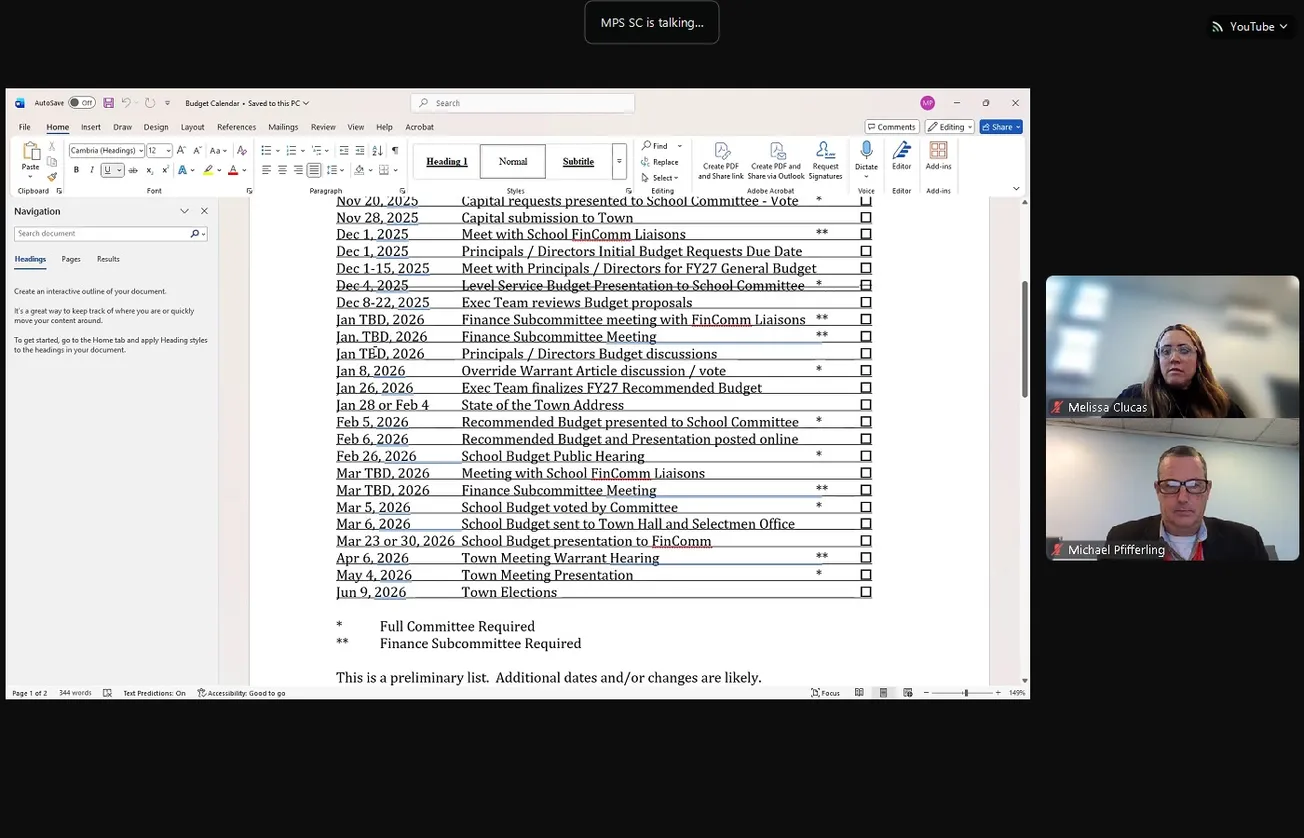
From there, subcommittee members turned to their primary task: unpacking the fiscal year 2027 planning calendar, the structure of district staffing and unknowns tied to revenue projections and the possibility of municipal overrides. The draft timeline stretches from October through April and includes budgeting work with district leadership, public hearings, School Committee deliberations and Finance Committee review before the spring warrant hearing.
For a big picture, Marblehead’s fiscal year 2026 school budget — $49.1 million, up $2.36 million or about 5% from the prior year — continues to frame the FY27 debate, with roughly $39 million, or more than 80%, committed to salaries and the rest absorbed by obligations including $3.56 million for out-of-district special education tuition, $2.58 million for contracted services, $1.92 million for utilities and $1.68 million for supplies; officials noted that special education costs have repeatedly exceeded projections, with Marblehead spending closer to $3.3 million in FY25 and $4.4 million in FY23, leaving little flexibility in the current budget and making it harder to visibly adjust staffing despite enrollment declines.
The calendar flags several unresolved variables likely to influence outcomes beyond the school side, including “Town revenue projections / School Dept share” and a joint “Town/School overview re Town and School overrides.” Members noted that uncertainty around local revenue and Proposition 2½ limits will shape every discussion that follows.
Assistant Superintendent of Finance and Operations Michael Pfifferling walked the hybrid group through a reorganized staffing spreadsheet that breaks down salaries by functional cost center: school buildings, student services, athletics, teaching and learning, facilities, technology and administration. He highlighted how roles such as classroom teachers, interventionists, special education staff, instructional assistants, administrative support, permanent substitutes and lunch monitors are distributed across schools.
Pfifferling explained the logic behind grouping salaries by service area, saying it allows committee members to “drill down a little further” and understand where staffing sits relative to student experience. The model, he said, is intended to help answer ongoing questions about what it actually takes to run schools and how staffing aligns with programs.
That framework segued into one of the meeting’s most debated topics: instructional coaching. Four districtwide coaches — experienced teachers assigned to support curriculum implementation, pedagogy and professional development — collectively represent more than $400,000 in salaries. Members asked how their value is measured and how the district determines whether the number is appropriate.
District officials said the coaching structure functions very differently from the district’s former curriculum director approach, operating in classrooms rather than centrally and providing embedded support intended to strengthen instruction. They acknowledged the difficulty of quantifying coaching impact in the way class sizes or caseloads can be measured but said the positions address needs that previous oversight systems did not fully meet.
Committee members and Finance Committee partners noted that explaining this evolution to the public will be essential, especially because Marblehead eliminated curriculum directors several years ago, briefly used stipend-funded department leads and now employs instructional coaches — a shift residents may not track without context.
Enrollment and staffing alignment dominated another stretch of discussion. Members reviewed projections by school building and grade level, using class size information to understand how dollars per pupil compare across schools. But several officials emphasized that classroom headcounts alone do not tell the full story. A smaller class may involve significantly higher student needs, they noted, while a larger class may operate independently based on student profile. Finance Committee member Molly Teets observed that class size nonetheless remains the simplest shorthand for residents to gauge what type of schooling the community values.
Teets also used the staffing breakdown to estimate that roughly one-quarter of salary spending sits in special education and student services. District officials confirmed that the proportion aligns with statewide norms, though they added Marblehead spends more than they would like on out-of-district placements and will need time to build specialized programming that can bring more students back into district.
That exchange previewed a future discussion. Officials said they anticipate an upcoming session dedicated to student services will examine evaluation trends, service demands, compliance responsibilities and the administrative load that grows when parent requests rise or state requirements expand. They argued that such data is necessary to frame why staffing remains steady even as enrollment declines.
Throughout the joint meeting, subcommittee members wrestled with the core communication problem: voters will want to see how staffing responds to declining enrollment and why anticipated efficiencies have not yet materialized. Members discussed intervening variables like caseload shifts, evolving student needs, transportation obligations and the time required to reassign, retrain or phase staffing in ways that preserve programs.
Pfifferling said his office will now run the same salary breakdown for FY27, allowing side-by-side comparisons between existing staffing and projected needs. The goal, he said, is to refine a working draft that reflects classroom realities, contractual requirements and fiscal limits.
District officials said the budget work aims to produce a plan that remains sustainable and meaningful without undermining essential student services, while offering taxpayers a transparent account of where funds go and why.
The Budget Subcommittee and Finance Committee liaisons are expected to continue analyzing staffing clusters through winter as the budget calendar advances toward the late-February public hearing, School Committee votes in early March and the April warrant hearing, where school funding requests become part of the broader town debate.
BEFORE YOU GO …
Every story we publish — including this one — is free for the community to read. What makes that possible is reader support. Given we have no printing costs, ninety-five cents of every dollar we receive goes directly to reporting in Marblehead .
If you value coverage that shows up, asks questions and holds a long memory, please become a member today.
Even $15 a month helps build the daily habit that keeps independent local news alive — a pattern shown to be the strongest predictor of long-term sustainability for local journalism.
🟦 Click here to become an Independent member
🟦 Click here to make a one-time contribution
Be Independent, with us.