Table of Contents
Explore the Select Board's full budget department by department — including what's being cut and what's being added — in our interactive FY2027 budget dashboard.
Department of Community Development and Planning Director Brendan Callahan, a Marblehead resident, came to the Select Board hearing on Thursday with a prepared statement.
"As a department head presenting a budget that doesn't include me," he told the board, his voice breaking, "it is a little disconcerting."
Then he read it anyway — every line — cataloging the 35 active projects his department oversees, the $1.9 million in grants it has secured in under two years, the $50 million in estimated construction costs it manages with a staff about to be halved. He noted that just that morning, he had secured $100,000 from the Boston Metropolitan Planning Organization for gap funding on the Marblehead Rail Trail.
"As of FY27, the department is already off to a good start," he said, of a department whose proposed budget eliminates his own position — reducing a four-person office to a vacant town planner slot and a clerk.
When he finished and returned to his seat, Kyle Wiley, executive assistant in the Select Board office, stood and gave him a hug.
The cuts turn personal
The moment distilled a hearing that ran 3 hours and 33 minutes, in which department heads came before the five-member board not to lobby for growth but to narrate their own diminishment. The town's fiscal year 2027 budget — approved unanimously at the hearing's close — totals $56.6 million across Select Board departments, up $4.8 million from FY26. Nearly all that increase is consumed by obligations no department head controls: a health insurance bill projected at $16.75 million after an 11.17% rate hike from the Group Insurance Commission, $11.1 million in debt service and an 8.6% annual increase on pension catch-up payments that will not level off until 2036.
What remains for discretionary services — the police patrols, the plowed streets, the functioning toilets — has been cut to the muscle.
Fire Chief Jason Gilliland described a department running on forced overtime and fraying morale. He is ordering firefighters into 96-hour shifts — four straight days in the station — because he cannot fill a vacancy that has been open for a year. Six personnel are out on injury. Military deployments are consuming roughly $300,000 and two positions. The headquarters boiler is 30 to 40 years old. "One person does make a difference," Gilliland said.
Police Chief Dennis King, whose department will drop from 32 sworn officers two years ago to 30, described a force at minimum manning: three officers and a supervisor per shift covering 4 square miles and more than 20,000 residents. "A car accident and a domestic — that's it," he said. "Then the shift is covered." The school resource officer, whose work King called "priceless," would be pulled back to patrol. A survey of 25 comparable departments found every one staffs at least one SRO. Marblehead would have none.
Building Commissioner Stephen Cummings, whose department lost its custodian, offered the hearing's most quotable line: "I draw the line at the toilets." Board Chair Dan Fox laughed — "That's the first time I've ever heard you draw the line anywhere" — but board member Jim Zisson pressed the point: "That snow isn't going to remove itself so an elderly person can get in the town clerk's office. What happens when you see a leak? Who chases that?"
Town Administrator Thatcher Kezer put the building stock in sharper relief. The Old Town House, one of Marblehead's most beloved public spaces, can no longer host public events because it is not ADA-compliant. "It's not a simple fix," Kezer said. "Everybody in my Marblehead loves that building."
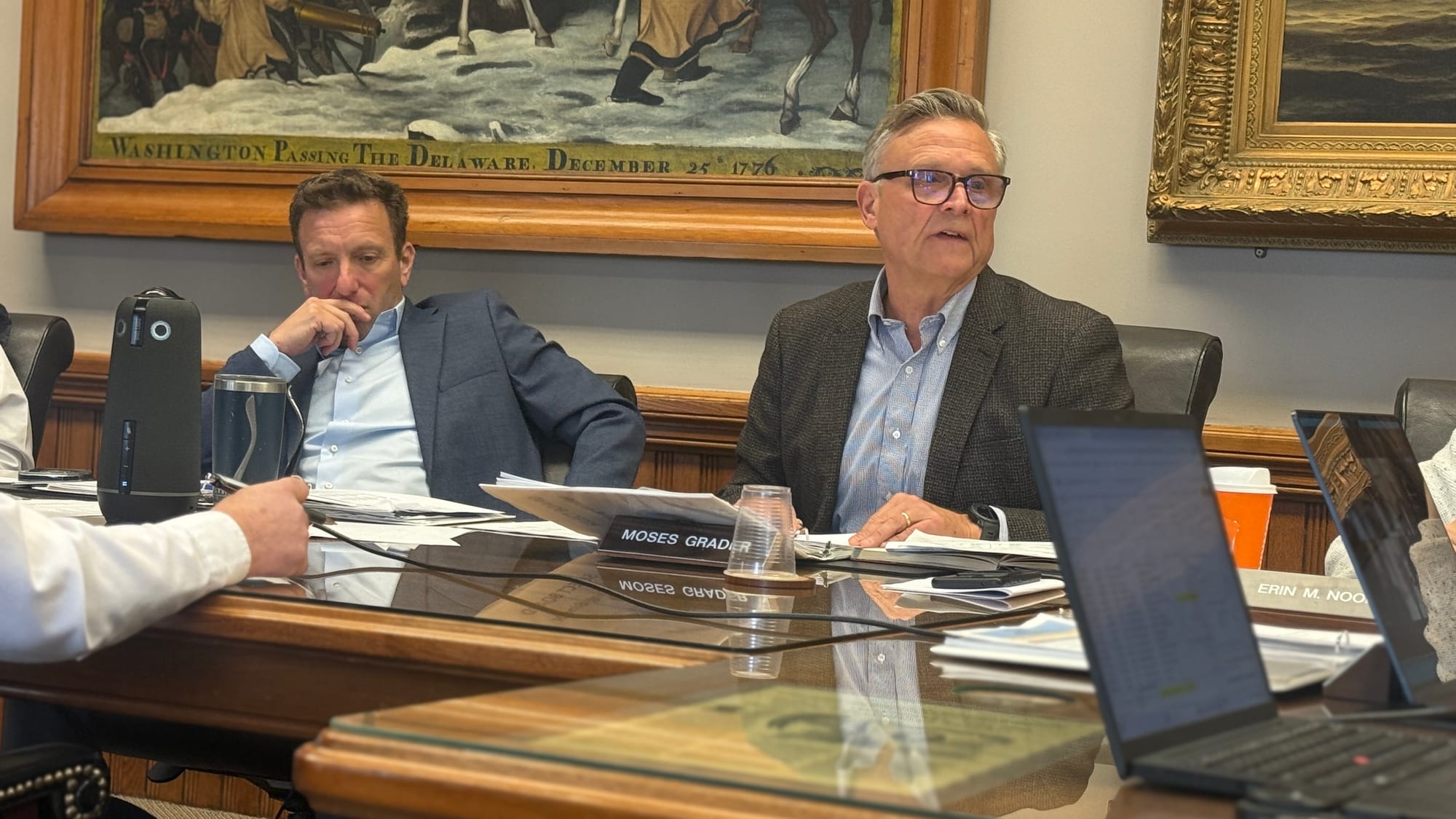
DPW Superintendent Amy McHugh described a department restructured from more than 30 workers down to 19 over the years, with every cut translating directly to unplowed streets. Lose one cemetery worker from the plow route, she said, and six or seven streets — full neighborhoods — go uncleared.
Finance Director Aleesha Benjamin, who is also serving as the town's sole IT administrator for 190-plus positions while simultaneously overseeing a migration to the Munis accounting system, described a finance operation held together by dedication and parallel processing. "It's a lot of people wearing several hats," she said. "I don't think it's sustainable."
The question turns to voters
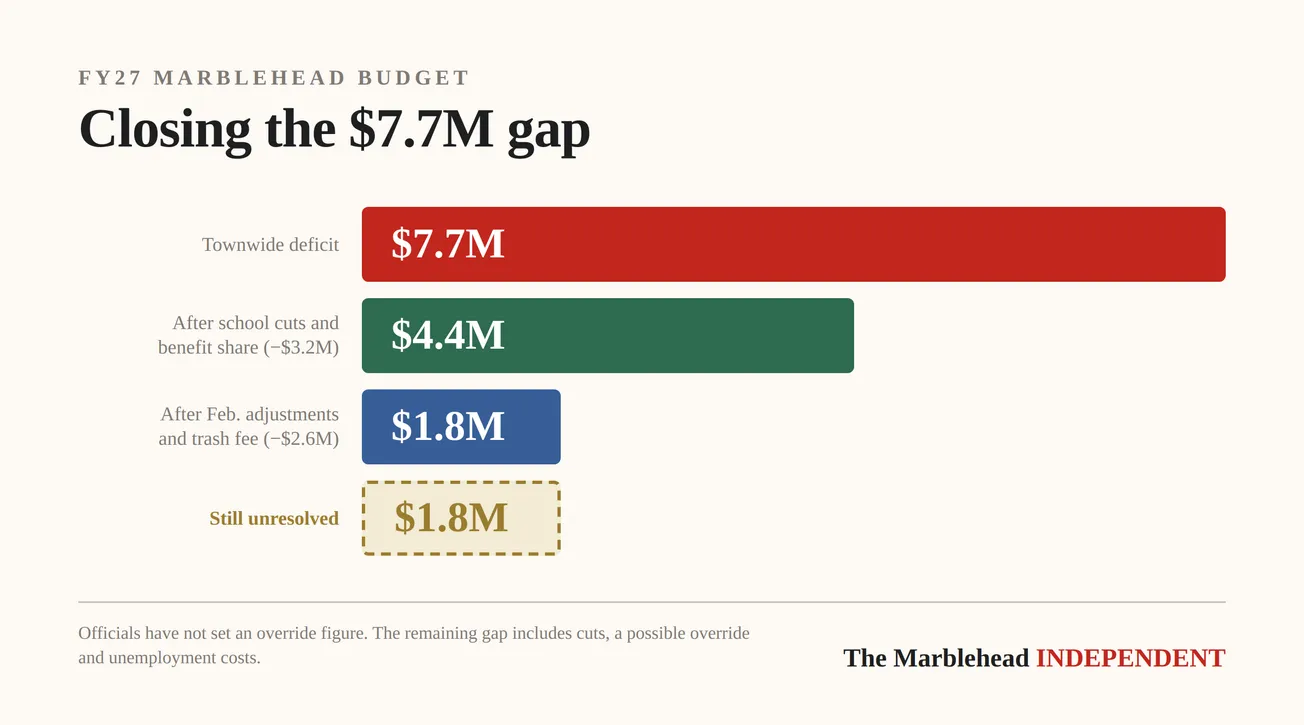
The budget the board approved reflects what Kezer called "Scenario B" — a framework that avoids the wholesale shutdown of town functions contemplated in "Scenario A," which would have eliminated roughly 56 positions, a 30% workforce reduction. Scenario B pairs targeted cuts of approximately 18 positions with a new revenue source: a curbside trash collection fee estimated at roughly $255 per household, shifting approximately $2 million off the general fund.
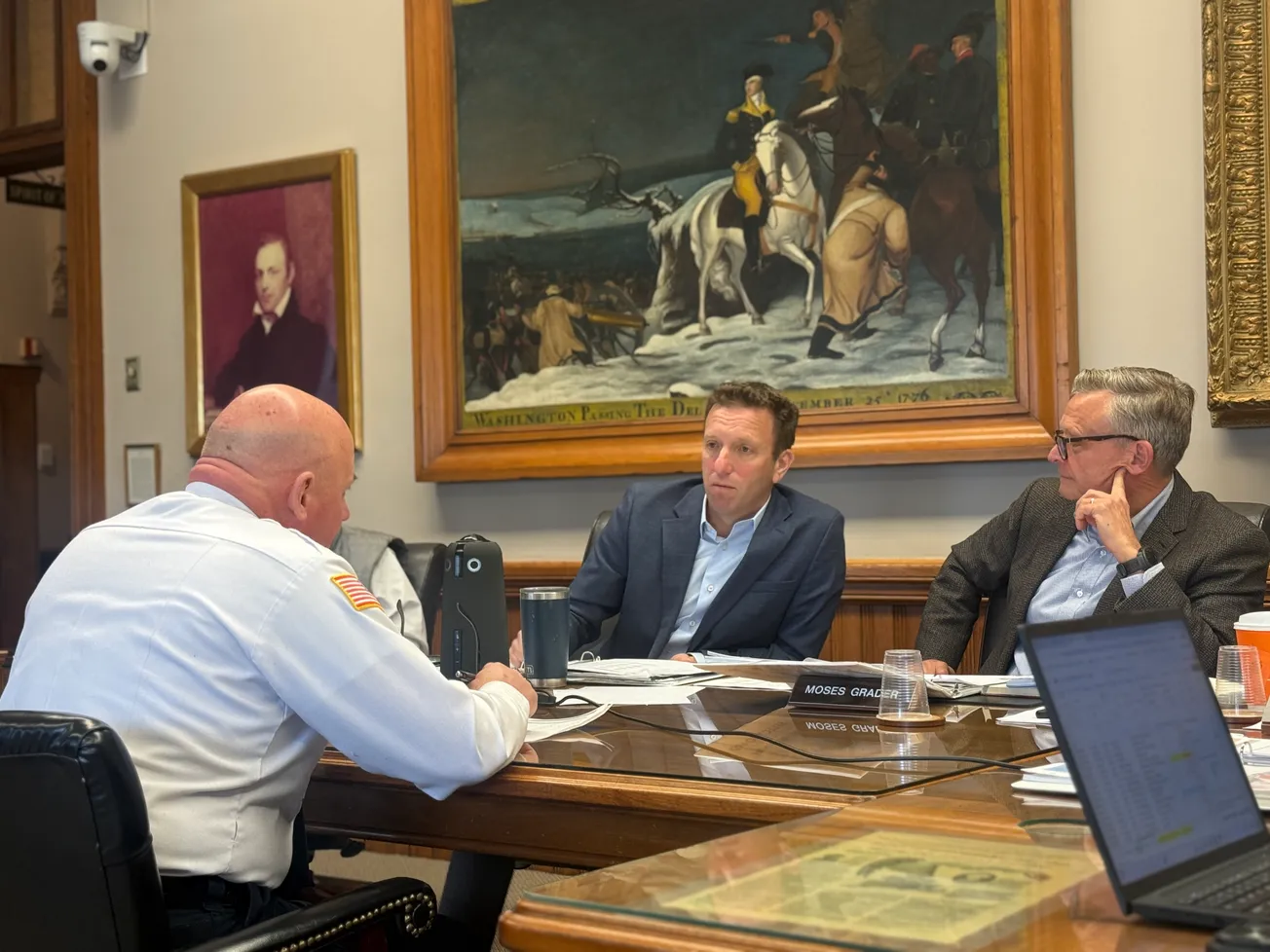
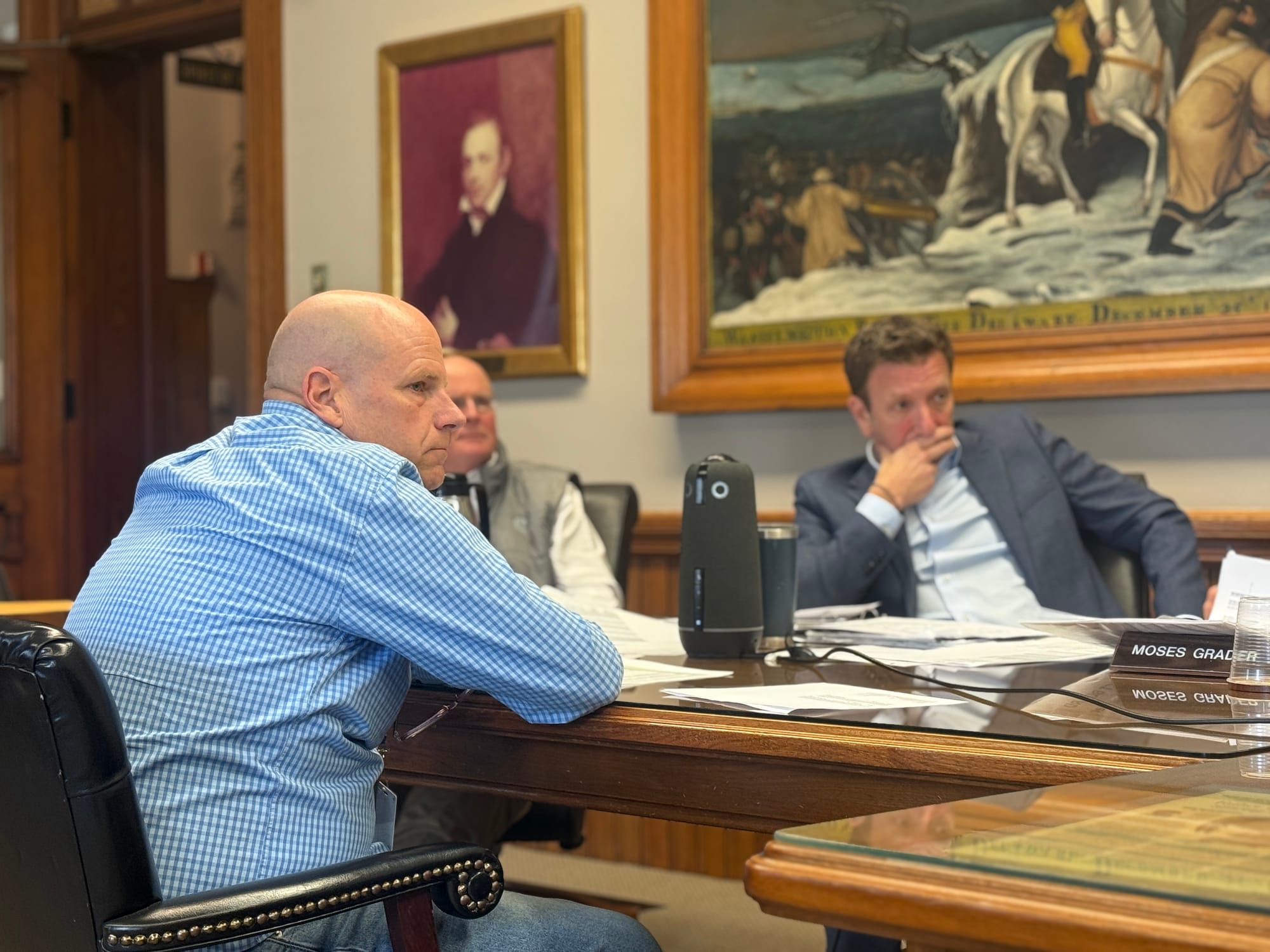
That fee — and the question of whether voters will accept it — dominated the hearing's final 20 minutes, when Select Board member Moses Grader pressed his colleagues on what he called a "moral hazard." For residents on fixed incomes, the question is not only whether town services can be preserved, but whether another household bill can be absorbed at all. And for residents skeptical of Town Meeting, the concern is not necessarily the goal of preserving services, but whether the town is presenting a full set of options before asking voters to pay more.
Grader's concern was procedural but carried strategic weight. The board, he argued, is asking Town Meeting to approve an entirely new fee program in under two months, without consideration of an alternative. His proposal: put two questions before voters. One, authorize the Board of Health to implement a trash collection fee. Two, a $2 million override that would keep trash collection in the operating budget, funded by property taxes. If the override passes, the fee gets rescinded. If it fails, the fee stands.
"I'm not passionate one way or the other," Grader said. "I just think it's where we ought to at least get the town to weigh in." His concern was that implementing the fee without a town vote risks a backlash that could torpedo the broader restoration overrides. "The risk is that if the town is like, 'We haven't had a chance to talk about it, so I'm not going to vote for this override.' We manage that risk by having another option to vote for."
The distinction matters because Marblehead's override history is brutal. An analysis of 44 years of Proposition 2 1/2 votes shows that debt exclusions pass at an 81% rate, while operating overrides fail 86% of the time. Grader's hedge — give voters a choice, let the mechanisms compete — reflects a board trying to thread a needle with the bluntest possible instrument: a June ballot.
Fox agreed in principle. "If they want it in the budget, they vote for the trash override," he said. "If that doesn't pass, there will be fees."
"One hundred percent," Grader replied. "But it's really important to clarify."
What the town can’t afford
What Grader was clarifying, underneath the parliamentary language, is the bind Marblehead finds itself in: a town whose annual tax levy growth under Proposition 2 1/2 is roughly $2.2 million, whose health insurance costs alone are growing by more than that, and whose voters have historically rejected operating overrides. The cuts are real — Callahan's position, the sustainability coordinator, the custodian, the school resource officer, a reduced DPW — but they are presented as restorable, contingent on an override strategy the board has not yet finalized.
Board member Erin Noonan, speaking to Callahan before his prepared statement, framed the stakes beyond any single position.
"This budget does not allow for any forward thinking, planning, future looking, preparedness, readiness for new challenges," she said. "We've just been constantly, for years now, sitting in this reactive, reflective place as a town. And it costs us, too."
Grader, who throughout the hearing pushed for clearer presentation of the operating budget, returned to a broader theme as the vote approached.
"We've reached a crescendo point," he said. "It's been years of cutting in the face of headwinds. Looking forward now, we've got to find ways to choose what we want to be."
The board voted unanimously and scheduled a comprehensive budget and override strategy session for the following week. As Grader noted, the town needs to understand how a budget that is up $4.8 million can still require the elimination of positions that, as Callahan demonstrated, return more in grants than they cost in salary. The answer is in the line items no one voted for: $1.65 million more for health insurance, $1.78 million more for debt service, $576,000 set aside for unemployment costs generated by the layoffs themselves. The conflict now is not only between cuts and restoration, but between two forms of vulnerability: the town's shrinking capacity to provide services and residents' shrinking capacity to pay for them.
If this helped you understand what is really happening in Marblehead’s budget, please support the reporting behind it. This story took 3 hours and 33 minutes of hearing time, line-by-line budget review, and the work of turning $56.6 million in spending, 18 proposed cuts and hard choices about services into something residents can actually use. More Marblehead neighbors are deciding that clear, independent local reporting is worth backing now, while these votes and override decisions are still in front of the town. 🟦 Become a member here.