Table of Contents
Get our free local reporting delivered straight to your inbox. No noise, no spam — just clear, independent coverage of Marblehead. Sign up for our once-a-week newsletter.
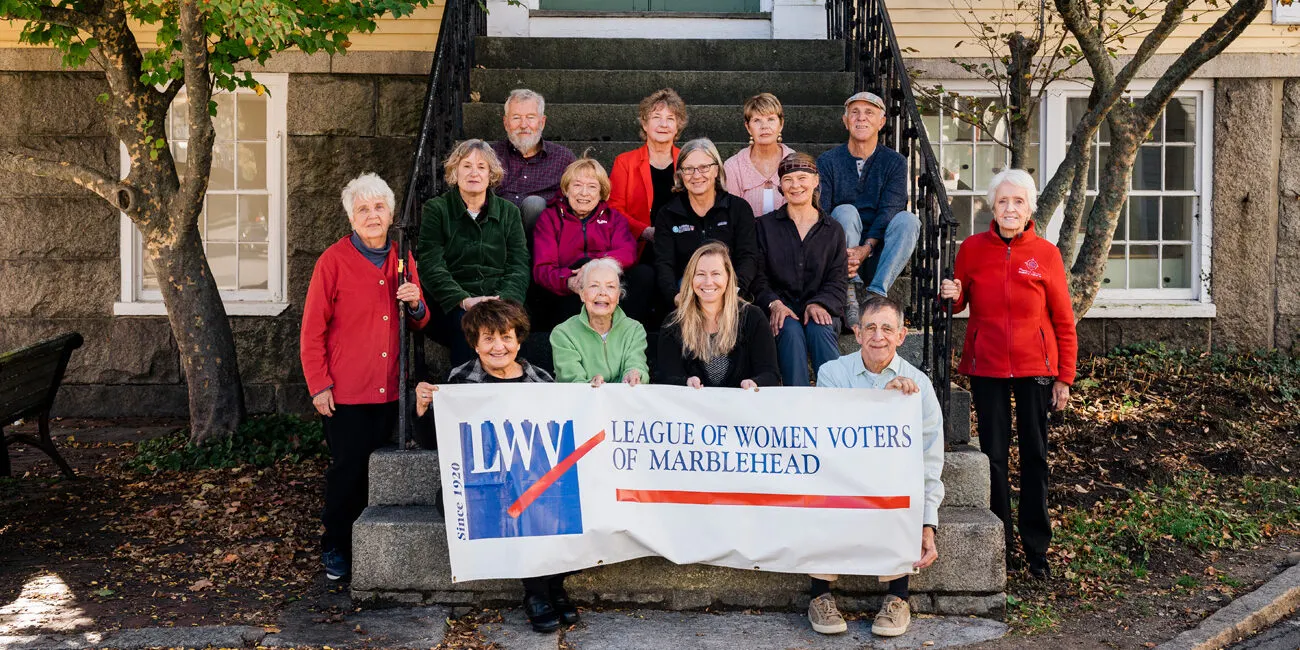
In late August, resident Bonnie Grenier announced that the Marblehead League of Women Voters was ending its Observer Corps, and the reason she gave was not fatigue or discouragement. It was that improved local coverage had begun duplicating several Observer assignments.
People who spent years watching town government have decided they can stop because other people are watching now. I am one of the people they mean. That makes this harder to write than a thank-you note ought to be, because the honest version contains a loss.
Start with what the work actually was, since the word "volunteer" flattens it. Someone had to find out when a board was meeting, which was not always simple. Get the agenda. Show up, in a room or on a screen, and stay for the whole thing rather than the interesting part. Write down who moved what, how the vote came out, what was approved, what was rejected, what was postponed until next month. Then, sometimes, call the chair afterward to check a detail before submitting the report. The League says its members occasionally spent hours on a single meeting that way. Fifteen of them did it across parts of eight calendar years, beginning in 2019, when the League describes Marblehead as a news desert, and continuing through this summer.
What they recorded is the part of town government that touches people directly. Read the Housing Authority reports and you find a tenant saying the washers and dryers had been down for two weeks and that the repair company was not showing up; another describing screaming at 4 a.m. and cigarette smoke that never stops; another saying she got the robocall about a 4 p.m. meeting at noon that same day; a Farrell Court resident saying she fell walking up the hill to the community room and needed surgery and being told signage and plantings would follow. No newspaper would have led with any of it. All of it is somebody's month.
An archive of 399 entries, unevenly filled
The surviving archive holds 399 dated report entries across 15 boards, commissions, committees and authorities. That is a count of entries, not necessarily of unique meetings, and I would rather say so than round it into something grander. The distribution tells its own story. The Board of Health accounts for 110 entries, including 28 in 2020 alone, the year when what a health board decided on a Tuesday night determined whether a beach opened, a program ran or a Town Meeting happened at all. Recreation and Parks accounts for 76. Conservation has three. Planning has eight.
That unevenness is worth dwelling on, because it is the opposite of a boast. The Corps was never a comprehensive record of Marblehead government, and the League never pretended otherwise; its recruitment page kept asking for people to take committees nobody was covering. What the archive documents is the reach of 15 residents, not the reach of a newsroom.
It is also not journalism, exactly, and the League was clearer about that than its admirers sometimes are. Observers attended, listened, recorded and summarized. They were instructed not to speak during meetings. They did not interview the person on the other side of a dispute, request documents or press an official on an inconsistency, and when their reports ran in a newspaper, readers were told plainly that the observers themselves bore responsibility for the accuracy of what they submitted. Civic monitoring with a public-information function is a clumsy phrase, but it is the accurate one.
Those limits produced something professional reporting does not. Select Board member Erin Noonan described the distinguishing quality of the reports as straight factual coverage without "angle, color or story lens," and observed that much of what they contained never appeared in news articles. That is not a compliment about tone. It is a description of a different product: a record made by someone with no story to build.
The reports also piled up, and the pile turned out to be the point. Recreation and Parks Commissioner Shelly Bedrossian called the archive "mission critical" when she was preparing to seek office, because she could read back through years of meetings and learn how the town actually functioned before she asked residents to elect her. That is a use nobody anticipated in 2019.
A news story tells you what happened last night. Seven years of dated reports tell a candidate, a commissioner, a reporter or a homeowner what an argument looked like while policy was still being made, back when nobody thought it was a story yet.
You can watch that in the record. In November, a Board of Health report captured member Tom McMahon arguing that the town's social-hosting rules had produced no citations since 2017 and saying he intended to take the enforcement question to police and the Select Board. Reporters picked it up from there, the police chief answered, and by April both newsrooms were in the room when the Essex County District Attorney Paul Tucker came to talk about youth substance use. The observation did not do the reporting. It made the reporting possible by preserving the moment the claim was made.
Why this partnership never required a debate
Since 2005 the country has lost nearly 3,500 newspapers and more than 270,000 newspaper jobs, and Northwestern University’s Medill School counted 136 more closures in the year before its most recent report. Massachusetts looks fine on a county map and is not: the state lost 60 percent of its reporters between 2013 and 2023, second worst in New England behind Connecticut. Counties are the wrong unit here anyway. We have 351 cities and towns, each with a select board, a school committee and a health board that meets whether or not anyone comes.
New Bedford is what the acute version looks like. Its daily had been hollowed out to the point that the mayor said publicly he had to beg reporters to attend his press conferences, and residents — specifically the city’s League members — began observing public meetings and then responded by helping build a nonprofit newsroom, The New Bedford Light, which went online in 2021.
Founding editor Barbara Roessner also planned to recruit and train residents to cover local meetings and pay them for it, on the model of Chicago’s Documenters program, and she was careful about what that would be. Trained residents could record who acted, what happened and how a vote came out. Reporters would still have to supply the context, the questions and the investigation. She described the two as complements, not substitutes, which is exactly the arrangement Marblehead has had since 2019 without anyone drawing up a plan for it.
My part in this predates the Marblehead Independent. Before I founded this paper about a year ago, we published the Observer Reports at the Marblehead Current, so I had already seen what changed when a resident could learn what the Light Commission did in March without having to attend in March. Continuing that arrangement with the Independent took no deliberation. The corps’ mission was bigger than any one outlet.
Rachel Barber, then the Weekly News editor in town, stated the arithmetic honestly when she thanked the volunteers for making "the meetings we can't." That is not a sentiment. It is a staffing report. No newsroom I have worked in has had enough people to cover every board that meets in this town, and the Corps understood that long before anyone thanked them for it.
So: thank you for being the Independent’s partner in cultivating Marblehead's civic life, and I mean that without decoration. The only gratitude that will matter to 15 people who spent years attending meetings is the boring kind: Keep the Independent attending the ones they no longer have to.
BEFORE YOU GO … Our reporting remains free and open to all. It is sustained by readers who choose to support it — by contributing so that routine, document-based local reporting continues without paywalls or promotional framing. Right now, 122 readers support The Marblehead Independent with monthly or annual contributions. Click here to become an Independent member.


