Table of Contents
Get our free local reporting delivered straight to your inbox. No noise, no spam — just clear, independent coverage of Marblehead. Sign up for our once-a-week newsletter.
Micah Q. Jones knows a large share of the 6th Congressional District will not vote for him no matter what he says. He puts it at 35 percent to 45 percent of the district’s voters, and he blames one letter: the “R” next to his name.
What keeps him running is a smaller number. Jones believes about 15 percent of the district is truly up for grabs, which is in part why he felt compelled to run. With no challenger in the Sept. 1 Republican primary, he has spent months courting those voters, along with the 63 percent of the district’s registered voters who are unenrolled. None of those percentages came with the voter totals they are drawn from, so they cannot be translated into vote counts.
“I think that’s a really interesting statistic that’s unique around the country … because really two-thirds of the district are not happy with either party so there’s something to be said about that,” Jones said in an interview with the Marblehead Independent.
Jones, 38, faces Democrat Dan Koh on Nov. 3 for the seat held by U.S. Rep. Seth Moulton, who gave it up to challenge U.S. Sen. Ed Markey and lost in the Sept. 1 primary. No Republican has held a U.S. House seat in Massachusetts in three decades, and the Cook Political Report rates the district Solid Democratic.
Raised in a divided household
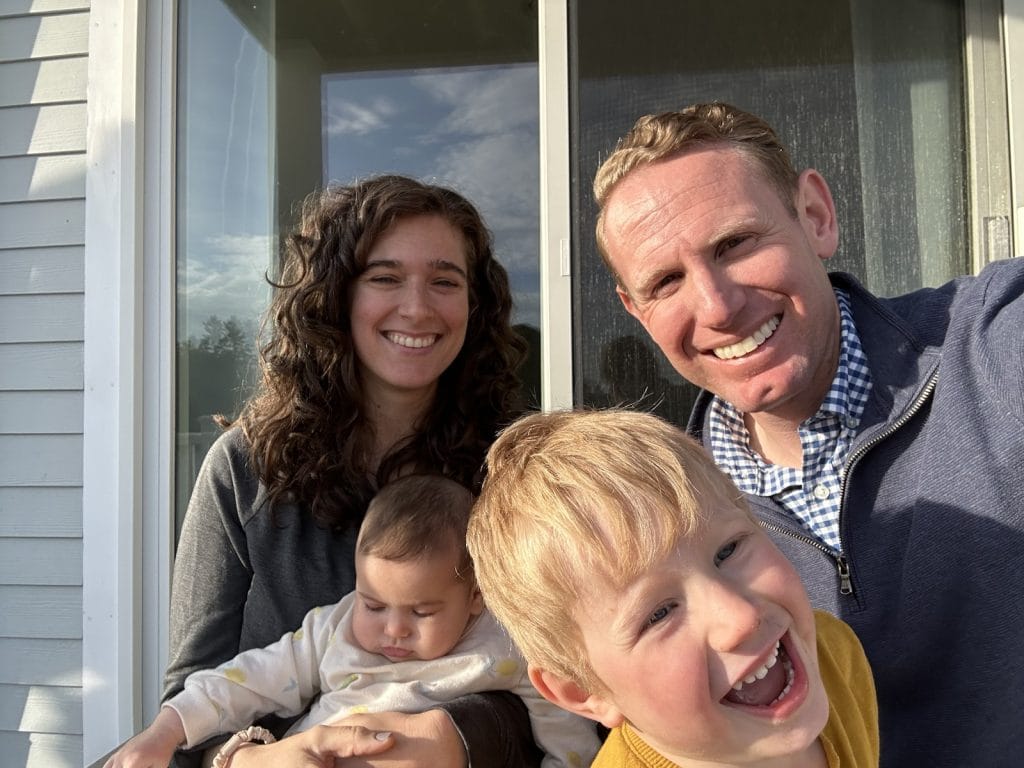
Jones is a veteran, a lawyer and a former Democrat. He calls his wife, Marissa, a saint for supporting the run and credits their two children, a 3-year-old son and a daughter who turns 1 next month, for sharpening his reasons for running.
He has lived in Essex since 2020 but grew up in Santa Clarita, California, in what he wryly calls a divided household. His mother, a college librarian, was a registered Democrat. His father, an Army veteran who spent 25 years with the Los Angeles Police Department, was a registered Republican.
“Even though they canceled each other’s votes out, they always encouraged my younger brother and me to form our own political opinion, be involved in the political process, and most of all to vote,” he said. “And that’s something I feel so strongly about.”
From the Army to the courtroom
After graduating from the University of California San Diego in 2010, Jones put off law school to join the Army. He was commissioned in 2011 and spent most of his more than five years in uniform as an infantry officer with the 82nd Airborne Division at Fort Bragg, North Carolina.
During a 2014-2015 tour in Kabul, Afghanistan, he served as aide to the brigadier general overseeing North Atlantic Treaty Organization’s rule-of-law mission, according to a 2017 fellowship profile. He earned the Bronze Star Medal and left the Army as a captain in 2016.
He moved to Massachusetts, graduated from Northeastern University School of Law in 2019 and practiced securities enforcement and litigation at the Boston office of Morgan Lewis, where he also ran a pro-bono practice for veterans. He gave up the practice in February to run.

From JFK Democrat to Republican
For eight years, Jones called himself a JFK Democrat. He said he admired President John F. Kennedy’s record on public service, civil rights and free-market economics, and his view that America is a force for good in the world. Kennedy’s line “Ask not what your country can do for you — ask what you can do for your country” has always been his guidepost, he said.
But in law school, Jones left the Democratic Party because he felt it was moving too far left, away from the Kennedy ideals, and became an independent. He told the Boston Globe he voted for Hillary Clinton in 2016, then for Donald Trump in 2020 and 2024.
In 2022, because he had always admired the state’s moderate Republican governors, including William F. Weld, Mitt Romney and Charlie Baker, he registered as a Republican and became what he calls “a commonsense Republican.” Baker, a Swampscott resident, has endorsed him.
The case against one party
“We have a one-party congressional delegation that, in my opinion, is less inclined to work across the aisle,” Jones said.
He believes the commonwealth, including the North Shore and the Merrimack Valley, misses out on billions of dollars in federal funding because a one-party delegation is always at loggerheads with the administration.
“I always want Massachusetts to have a seat at the table, representation in Washington, regardless of who is in the White House,” he said.
He also believes the Democrats who sought the nomination, including Koh, are too far left for the district.
“I feel that this is a district that really wants moderation,” Jones said. “It’s a district that cares about candidate quality, cares about the issues.”
It is also not afraid to split a ticket, he added, noting that its voters backed Baker for governor twice while returning Moulton to Congress.
He acknowledges federal headwinds that do not help, but said “you still have to take risks.” His entire young professional life, as a soldier and an attorney, has been about mitigating risk, he said.
On Trump
Asked about the man behind those headwinds, President Donald Trump, Jones offered a split verdict.
“I think a lot of times the Trump administration gets the high-level outline correct, and the policy implementation is severely lacking,” he said.
He agrees with the president that NATO allies should contribute more, but Jones, who worked for a Turkish general while serving in the Army, disagrees with how Trump has carried out the idea. He also objects to what he calls the whiplash on Ukraine and supports funding Ukraine, backing Taiwan and maintaining U.S.-Israel relations.
On Iran, he told the Globe in June that he “doesn’t believe in forever wars.” On Israel, he told the Jewish Journal he would have voted against the Massie amendment, which sought to cut $3.3 billion in military financing to Israel. The entire Massachusetts delegation voted for it.
What he stands for
Jones said his campaign rests on three “core pillars”: accountability for members of Congress; opportunities for the North Shore and Merrimack Valley; and security for the country. On accountability, he backs term limits and a ban on stock trading by members of Congress and their spouses.
“I grew up in a veterans and first responders household,” he said. “To me, that’s a line in the sand issue. Support for active duty military, first responders, veterans, military families … I want to be there for them, not only when they’re actively serving but once they take the uniform off.”
He worries that the battlefield has changed since he deployed 12 years ago, citing artificial intelligence, autonomous targeting and drone warfare, and wants to make sure America “always maintains a qualitative military edge.” He also believes in shoring up alliances with Ukraine, Taiwan and Israel.
“I think we take so much of what we have in life for granted,” he said. “The rest of the world is not the North Shore or Merrimack Valley, and it’s something where I really believe in the liberal democratic principles of the United States, and want to make sure that we are a positive force within the world.”
His views on immigration were shaped by a pro-bono case: after the Taliban retook Afghanistan in 2021, he helped a former Afghan colleague and his family resettle legally in the United States. He supports comprehensive reform that pairs border security with pathways to citizenship.
If elected
Jones said he will not take a siloed approach that sets aside state issues. He wants to find the federal levers that, connected with state, local and regional leaders, can bring change. The best way to lower costs in the district, he said, is with both smart energy policy and smart tax policy. He said he believes climate change is real and wants further growth in clean energy.
“We import everything else, and so we do pay an energy premium when it comes to everything from groceries to goods,” he said. “So, being able to lower overall energy costs, which I think is really where the federal government is most effective, will really help our region and not only North Shore/Merrimack Valley, but New England as a whole.”
He supports expanding natural gas pipeline infrastructure and embracing new nuclear technology, introduced slowly and wisely.
“Nuclear energy is some of the cleanest energy that we can obtain, and it’s very efficient,” he said.
On taxes, he wants to raise the state and local tax (SALT) deduction, which lets taxpayers deduct state and property taxes when calculating their federal income taxes. Last year’s “Big Beautiful Bill” capped it at $40,400 for married couples and $20,200 for married people filing separately, and Jones disagrees with where the cap landed. He sided with U.S. Rep. Mike Lawler, a New York Republican who pushed the administration to adjust the SALT deduction by region.
“I would like to see it increase for New England, where it would actually have a significant effect,” he said. “And then, in addition, this is probably where I have a very much supply-side view of economics, I believe in lowering the corporate tax rate, increasing the qualified business income deduction.”
Drawing on his business litigation background, he wants as much investment and innovation in the district as possible.
“To me, that’s going to drive our economy, which will create jobs, and encourage people to stay and build their life here in the district,” he said.
Balls and strikes
Asked for his 30-second elevator pitch, Jones said he is serious about creating the politics he wants to see.
“I am about finding compromise,” he said. “I really want to turn the temperature down, and I want to focus on what’s best for the North Shore/Merrimack Valley because I want it to be the best place for not only my family but everybody’s family.”
He repeated that a one-party delegation puts Massachusetts in the crosshairs with the administration, then moved quickly to head off how that might sound.
“And that’s not me saying I’m going to go to Washington to bend the knee and capitulate,” he said. “It’s about calling balls and strikes to the administration. It’s about being able to articulate as an effective advocate on behalf of Massachusetts and the district to be able to say to President Trump or Speaker Johnson that what works in Texas or Tennessee is not going to work in Massachusetts. Can we find some sort of compromise?
“To me, that’s going to be much better for the state than if we just have a congressional delegation that just decides to engage in conflict,” he continued. “And I would feel the same way if I lived in Oklahoma, which has an all Republican congressional delegation, and a Democrat was in office.”
Sizing up the competition
Jones said he knew the race would never be a blowout for him, but he believes it will be close, and he is in it to win it.
He trails sharply in money. Through Sept. 30, his campaign had raised $586,091, according to Federal Election Commission filings. Koh had raised about $5.25 million, according to FEC data compiled by the Boston Report.
“Mr. Koh is a nice guy, we are peers, he has a young family as well and I know that this year has taken a toll on him too,” Jones said.
Still, Jones, who says he believes in contrasting campaigns rather than negative ones, is disappointed that Koh backed out of two planned debates, including a Sept. 17 forum at Endicott College. Koh’s campaign says he has taken part in 11 debates, “including with Micah Jones.”
Whether it is Koh or Jones, a new face will represent the 6th District, and Jones believes voters should hear from both candidates at the same time, on the same stage.
“Kudos to Governor Healey, kudos to Senator Markey, kudos to the state level candidates who have engaged in debates,” Jones said. “I think that that’s the right thing for the process.”
BEFORE YOU GO … Our reporting remains free and open to all. It is sustained by readers who choose to support it — by contributing so that routine, document-based local reporting continues without paywalls or promotional framing. Right now, 130 readers support The Marblehead Independent with monthly or annual contributions. Click here to become an Independent member.