Table of Contents
Get our free local reporting delivered straight to your inbox. No noise, no spam — just clear, independent coverage of Marblehead. Sign up for our once-a-week newsletter.
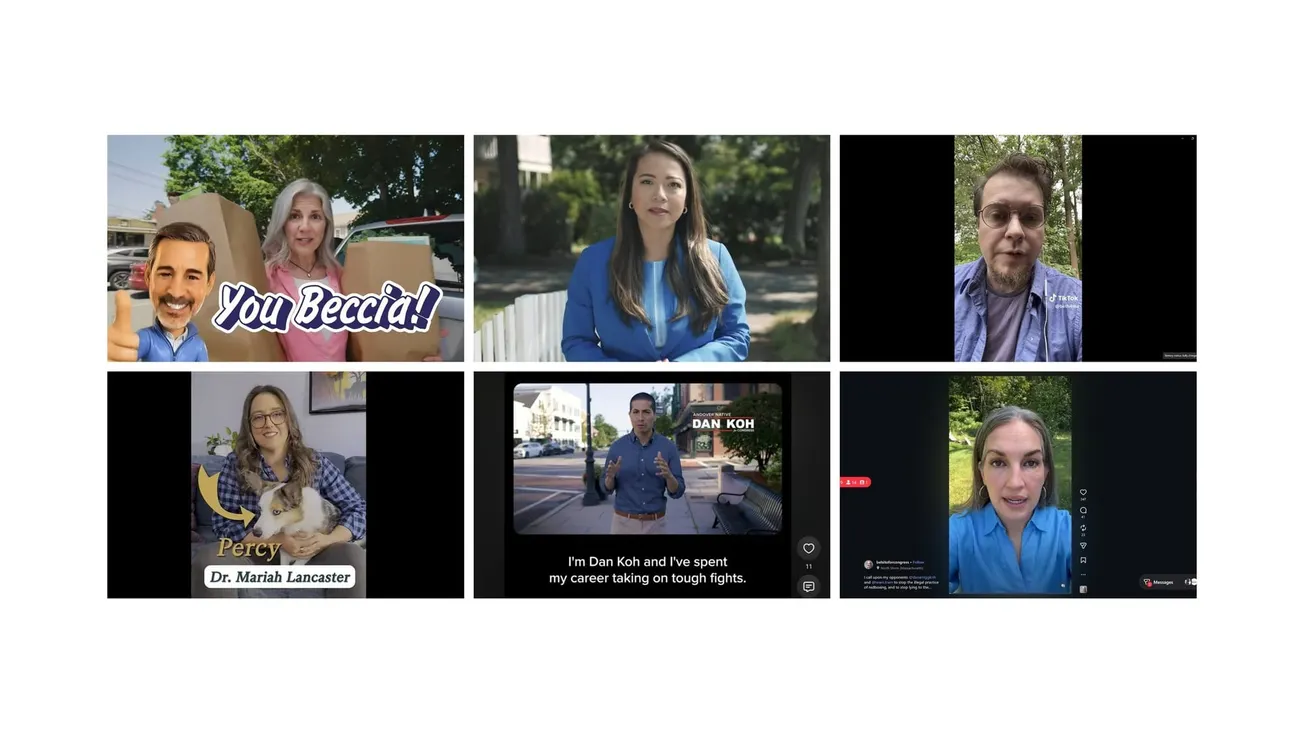
Watch the John Beccia ad closely and you can see it working. Thirty seconds, a bobblehead nodding on a desk, a man promising to be a self-made businessman who stands up for middle-class families — and, about nine times over, a small joke folded into his own name. Beccia, betcha. You Beccia. The spot is barely trying to win an argument. It is trying to make a hard-to-place surname easy to retrieve, and by the second week of August — arriving before the ballgame, inside the streaming show, again as a pre-roll on a phone charging in the kitchen — it has. In living rooms from Lynn to the New Hampshire border, people who could not name one thing John Beccia believes can finish the joke.
That was the point, and it was not free. The first installment of this series described a 6th Congressional District race in which two campaigns had stockpiled millions while their rivals fought for room. This is what those millions become once they leave the bank account and enter the voter's day: not votes, and not yet persuasion, but presence.
The seat is open because Rep. Seth Moulton is running for the U.S. Senate, and in a district this reliably Democratic the Sept. 1 primary is very likely the whole contest — the six Democrats on that ballot are competing for something close to the job itself.
Money buys repetition, and repetition buys familiarity. The useful way to read the summer's advertising is not as a stack of messages to be fact-checked one by one, but as a set of constructed messaging, each built to produce a feeling — this one is memorable, this one is already a national figure, this one is the tested public servant — before a voter has finished deciding whether any of it is true. The work worth doing is to separate the feeling from the fact: to ask who paid to create it, how often it was repeated, what image carried it and who could not afford the same atmosphere.
Ambient, or on-demand
For most of the race, no one could afford it. The campaign has been running since the summer of 2025, when Beth Andres-Beck became the first candidate in. State Rep. Tram Nguyen launched that October; Mariah Lancaster posted the first real candidate video in January, an economic-populist announcement about "billionaire oligarchs." None of it reached a voter who was not already looking. When the six Democrats met for a debate at Salem State University in mid-June, not one of them had yet run a television ad. The race existed, but as an on-demand event — something a voter had to seek out at a forum, in a local news story or in a social post no one had paid to place.
The three campaigns that could afford television held their fire until the sprint, roughly the final nine weeks, then went heavy, compressing the paid contest into about eight weeks before the primary. Timing is a luxury only cash affords: a candidate who must raise money before every buy cannot choose the moment, and a candidate sitting on a reserve can. On June 29, Beccia went on the air, and the atmosphere of the race changed for the voters who were not looking. That is the distinction worth holding onto. Some candidacies have become ambient — they find the voter through broadcast, cable, streaming and digital placement, repeated until they feel like part of the room. The rest stay on-demand. All six names sit on the ballot in the same typeface. They do not sit in the same number of living rooms.
Beccia went first, with a spot called "You Beccia" — what the Boston Globe reported as a seven-figure buy built to run continuously through primary day. Strip the spot down and there is little argument left in it — a line about a career spent bringing business, government and law enforcement together to prevent fraud, and no numbers to check. What there is instead is engineering. The bobblehead is a memory hook. The pun, repeated about nine times in 30 seconds, turns a name into a sound a voter can hum. An intro ad like this is not made to persuade; it is made to be remembered, and a name recalled without effort in the booth is the first thing money can buy.
The money was largely his own: Beccia, a first-time candidate and financial-technology executive, has loaned his campaign about $3 million, according to his filings. He spent the most disclosed dollars in the field to solve the smallest problem a familiar candidate never has — being known at all — and he bought the first-mover's advantage of defining himself before anyone else was on the screen to compete for the attention. One creative running for nine weeks risks wearing out its welcome, but even fatigue is a form of familiarity, and familiarity is the asset.
Manufactured, and earned
Dan Koh's ads solve a different problem, and his bank account lets him solve it more often, and for longer. Koh raised about $4.5 million and spent less than $1 million of it before July, ending June with roughly $3.6 million on hand — the largest reserve in the race and, by his campaign's own description, a way to decide when and how heavily to advertise without waiting on the next fundraising surge. The reserve is the weapon. By mid-July his first spot, "Bullies," was running across broadcast and cable, casting him as a battle-tested opponent of President Donald Trump and closing on the line "bullies only win when we don't fight back. Trump's not backing down, and neither am I."
The tell is in the arithmetic: the ad names Trump about twice as often as it names Koh. Its proof that Koh can stand up to Trump is not a record of fights won but proximity — Koh photographed in the same frame as Trump, and a résumé line about his time in Washington. Some of that stature is real; Koh did serve in a Democratic administration and has collected endorsements from Pete Buttigieg and former President Joe Biden.
What the money adds is not the credential but its omnipresence — the ability to place it in front of the same voter again and again until it reads as inevitability. A second wave on July 30, one cut of which Koh posted to his own channel, softens the combat into a father vowing to clean up corruption and accusing Trump and his allies of "lining their own pockets" instead of lowering costs.
Around all of it runs the only outside advertising anyone has found in the race — New Leadership PAC, a group spending on digital and streaming to support Koh, whose largest donor, the sports-betting company DraftKings, gave $250,000. It never touches broadcast, but it thickens the layer of Koh a voter passes through online, and the money itself has become a message, with Beccia charging that the company is spending "a quarter of a million dollars to return the favor" and Koh answering that he "has not taken a dime of corporate PAC money."
Nguyen reached television last, and with the least. A state representative from Andover and the only sitting officeholder in the field, she answers the money gap with biography. Her spot, "Little Girl," tells of a Vietnamese refugee who grew up in public housing on Medicaid and became an attorney and a legislator, closing on the line "I'm Tram Nguyen and I was that little girl," with a claim that she has already "defeated MAGA."
The feeling it reaches for is legitimacy — not a newcomer asking for a chance but an officeholder who has already earned one. Here the familiarity is not manufactured; it is real and partly unpurchased. Nguyen has run and won, and part of the district has already marked her name on an actual ballot. But earned familiarity and paid familiarity are different currencies, and in a district that runs well past her State House seat, only the paid kind scales. Her campaign says the buy reaches six figures across digital, streaming and cable — a narrower slice than the broadcast saturation Koh and Beccia can sustain. She ended June with about $330,000 on hand, a fraction of their accounts, and the Globe reported she is being outspent. The most authentic story in the field is also the one with the least money to repeat itself.
Nguyen is not the only candidate whose familiarity is partly earned rather than purchased. Former state rep. Jamie Belsito has also won voters in part of the district before. But she, too, is running in a congressional race where earned familiarity does not automatically scale. In July, Belsito put a digital ad, “Democrat Who Gets Stuff Done,” into voters’ feeds and built a coherent case against this very dynamic — challenging her better-funded rivals over “redboxing” and outside money in a video that tells followers, “We have enough liars in Congress.”
Waiting to be found
Lancaster, a veterinarian, opens her ad, "Think Bigger," on a couch with her corgi, Percy, before cutting to footage of her own surgeries and then to a split screen of Jeff Bezos, Elon Musk and Mark Zuckerberg under a shower of falling hundred-dollar bills — a populist case against "billionaire oligarchs" that would ban congressional stock trading and end Citizens United, and closes at a colonial Minuteman statue on the line, "We've overthrown a king once, and we can do it again." By the standard of this field it is an unusually sourced spot, flashing real news headlines on screen as it makes its claims about grocery bills and health costs. The irony is exact: the ad that works hardest to prove itself is among the least seen, running on organic video where reach depends on algorithms.
Beth Andres-Beck, who introduces herself as "a human science experiment" and argues in a TikTok that "America could have nice things, and the sixth district deserves better," has no paid placement at all; her widest audience arrived in June not from a buy but from right-wing accounts circulating her video in order to mock it — a reminder that unpaid reach, when it comes, often arrives on someone else's terms.
@beth4ma Watch this video on TikTok
Each of the three ended June with less cash on hand than a single week of Boston broadcast can cost, and the pattern is nearly a straight line: the ability to appear on television maps almost exactly onto cash on hand, and below roughly $130,000 a candidate is effectively off the air. The barrier is not theoretical. Rick Jakious, a former chief of staff to Moulton, withdrew April 15 and said running for Congress now requires access to significant wealth. Six Democrats stayed in after him.
None of this proves support. A voter who can finish "you Beccia" has promised Beccia nothing, and a spot that plays a hundred times moves no one's vote by itself. What the summer's money has done is earlier and narrower than persuasion. It has decided which candidates feel known, plausible, serious and already present when the choosing begins — and which ones a voter would have to go looking for. On Sept. 1, all six Democrats will appear on the ballot, equal in the booth, and in a safe Democratic seat the winner will most likely be the one who takes the district in November.
EDITOR'S NOTE: This story complements our new MA-06 campaign finance dashboard, a searchable breakdown of every dollar reported by all eight active candidate committees in the MA-06 race — the six Democrats competing in the Sept. 1 primary, one Democrat (Rick Jakious) who has since withdrawn, and Republican candidate Micah Q. Jones, who will face the Democratic nominee in November — who gave, how much, from where and what's left in the bank. You can sort candidates by any metric, trace itemized contributions down to individual donors and employers and see exactly how each campaign's money breaks down by category. Explore it yourself at marbleheadindependent.com/ma-06.