Table of Contents
Get our free local reporting delivered straight to your inbox. No noise, no spam — just clear, independent coverage of Marblehead. Sign up for our once-a-week newsletter.
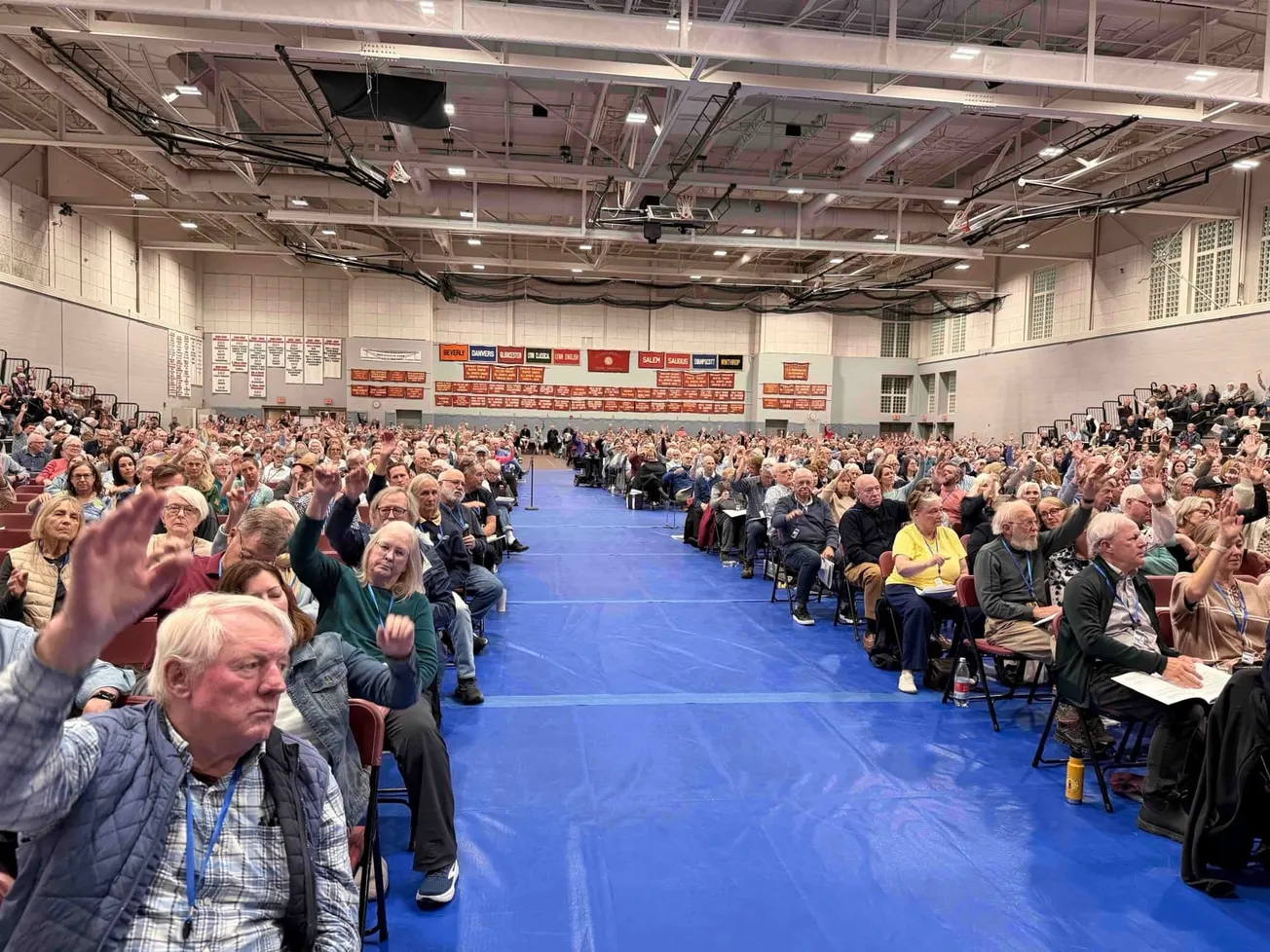
Marblehead's 2026 Annual Town Meeting cleared two of the most consequential questions on its warrant Monday night, voting overwhelmingly to send a three-tier Proposition 2½ override to the June 9 ballot and adopting a 3A multifamily overlay district on the town's fourth attempt in three years. Both votes came in a single session at the Marblehead High School Field House, the first one-night Annual Town Meeting in recent memory.
The override came first. Article 29, the legal vehicle the Select Board built to attach a contingent fiscal 2027 appropriation to the override, passed 1,227 to 159 on an electronic vote — about 89 percent in favor, with 1,386 ballots cast. Within minutes of the result, a noticeable share of voters stood up, gathered coats and headed for the doors, prompting Town Moderator Jack Attridge to remind the room that quorum is 300 and to ask anyone who could to stay through the rest of the warrant.
Monday's vote does not by itself raise taxes. It puts the override package in front of voters at the ballot box, where each of the three tiers will appear as a separate yes-or-no question. The highest tier to clear a majority is the one that takes effect; lower tiers are void if a higher tier prevails. If all three tiers fail at the ballot, Article 29 is void and the FY27 budget Town Meeting passed under Article 23 stands as is.
Select Board Chair Dan Fox, presenting the package on behalf of the board, told Town Meeting the FY27 budget cycle has produced a $7.7 million deficit, eliminating 43.5 full-time-equivalent positions across town departments and the schools and reducing services in nearly every silo. Article 29, Fox said, is how the town would restore positions, hold the line on services and reinvest in long-deferred capital. "This vote is what's deciding what Marblehead we want, for us, for our children and for the future," Fox said. "I ask you to vote yes on Article 29."
The three tiers phase in over three years and build on each other. Tier 1, "partial restore," totals $9 million and brings back a subset of the cuts: enough library funding to retain the state accreditation waiver, the Council on Aging nutritional coordinator, the only two custodians at the Mary Alley building and Abbot Hall, the Police Department's school resource officer, a heavy-equipment operator and laborer at DPW, and behind-the-scenes positions in finance and community development. Tier 2 fully restores library staffing, adds a Council on Aging social worker, brings back the GIS division at DPW, funds $450,000 in building maintenance, one police officer, two firefighters and several other positions, and on the school side underwrites a $150,000-a-year classroom technology refresh and full-day kindergarten for all families. Tier 3 reinvests in capital and personnel cut in earlier budgets, including a specialized heavy-equipment operator, an additional police officer, two more firefighters, a grant writer and $1.5 million in recurring capital expenses across the town and school budgets.
A separate ballot question on June 9 will ask voters whether to fund curbside trash collection through the tax levy or through the new $262-a-year household fee the Board of Health has imposed under Article 23. The Select Board is putting that question on the ballot regardless of how Article 29 landed Monday night.
The Select Board, the school committee and the Finance Committee have signed a memorandum of understanding capping the override at the published maximums and pledging not to return to voters for at least three years. Tax-impact figures presented Monday showed Tier 2 — the $12 million option — would raise the median Marblehead homeowner's bill by $280 in year one, $676 in year two and $274 in year three, a cumulative $1,230 by the third year on top of the standard 2.5 percent Proposition 2½ increase already built into the levy.
Town Meeting has authorized other operating overrides since 2005, but voters have rejected them at the ballot. The last permanent general operating increase Marblehead voters approved was on June 15, 2005. Since 1982, when Massachusetts adopted Proposition 2½, Marblehead voters have said yes to only three of 21 operating overrides — even as they have approved 68 of 84 debt exclusions for capital projects.
The second consequential vote came roughly 25 minutes later. Article 4, the 3A multifamily overlay, passed 881 to 82 on an electronic vote, with 963 ballots cast — about 91 percent of voters in the room in favor, and turnout down from the 1,386 ballots cast on Article 29. Required by a 2021 state statute that compels MBTA-served communities to zone for multifamily housing near transit, the proposal designates two overlay subdistricts in Marblehead — one along Broughton Road, the other on the grounds of Tedesco Country Club — where multifamily housing will be allowed by right. The Planning Board capped the affordability requirement at the 10 percent maximum permitted under the statute.
The vote ends a multi-year standoff with the attorney general's office. Earlier 3A proposals had failed at Town Meeting or were withdrawn after pushback over neighborhood impact, density and which sites should carry the burden. The Massachusetts Supreme Judicial Court settled the underlying legal question last year in Attorney General v. Town of Milton, ruling that 3A is enforceable and that Milton's noncompliance was unlawful. The attorney general sued Marblehead in January and the case had been held in abeyance pending Monday's vote. Noncompliance had also cost the town nearly $4 million in MassWorks, Housing Choice and other state grants over two funding cycles.
The floor debate ran along three threads. The first was Tedesco. A voter asked whether the country club had agreed to be inside the overlay; presenters said the club's leadership had been briefed and its questions answered, but stressed that 3A is a zoning overlay, not a mandate to build. "If Tedesco decides they never want to sell it, then nothing will ever change," one presenter said. The same point was made about Broughton Road.
Affordability drew the second round of questions. Under 3A, presenters said, towns may require up to 10 percent of new units in an overlay district to be affordable. That is the cap, not the floor — the statute leaves it to each community to decide how aggressively to pursue affordable housing within the overlay. Affordable-housing advocates from the floor pressed for more; presenters said anything beyond 10 percent would have to come through a separate process, not through Monday's article.
The third thread was money. A voter asked whether the Tedesco property would be reassessed at higher value under the new zoning. The answer, from the presenters: no, because the country club's land is classified as Chapter land — the state preferential-assessment program for open space and recreational use — and a zoning change does not by itself trigger a new assessment. The land would only be reassessed if it were sold and redeveloped. Another voter asked whether the town could recover the roughly $4 million in MassWorks, Housing Choice and other state grants Marblehead has been shut out of. Presenters said the closed application cycles cannot be recouped, but compliance makes the town eligible for the next rounds.
Nick Ward, speaking in support, framed the choice in plain terms. The 3A question lost on a town-wide ballot last year by five points, he said, "which tells me we need a five-point swing to get housing reform done in this town. Five points seems gettable to me." He said he did not want to be back at Town Meeting in three years choosing between library hours and another property-tax increase.
Another speaker put the cost of saying no in lawyer terms. "We adopt this now," he said, "or we go into debt paying lawyers so that the state can tell us how we're going to adopt it later, in a way that might be less beneficial." Presenters confirmed that if Town Meeting rejected Article 4, the attorney general would lift the stay on the January lawsuit and resume action.
The June 9 ballot will be the next test.
CORRECTION: May 5, 2026 — An earlier version of this article said Article 29 was the first general operating override Town Meeting had sent to the ballot since June 15, 2005. That is incorrect. Marblehead has put operating overrides before voters since 2005, but voters have rejected them; June 15, 2005, is the date of the last permanent general operating increase Marblehead voters approved. The article has been updated.