Table of Contents
Get our free local reporting delivered straight to your inbox. No noise, no spam — just clear, independent coverage of Marblehead. Sign up for our once-a-week newsletter.
Marblehead voters showed considerably more interest in this year's primary than they did two years ago, with turnout nearly doubling as two hometown candidates appeared on the Democratic ballot and a crowded race unfolded to replace one of them in Congress.
A total of 5,679 voters cast ballots in Tuesday's state primary, up from 3,005 in 2024. Turnout reached 36.7 percent of registered voters, according to unofficial town results. The source did not provide the registered-voter base used to calculate that rate.
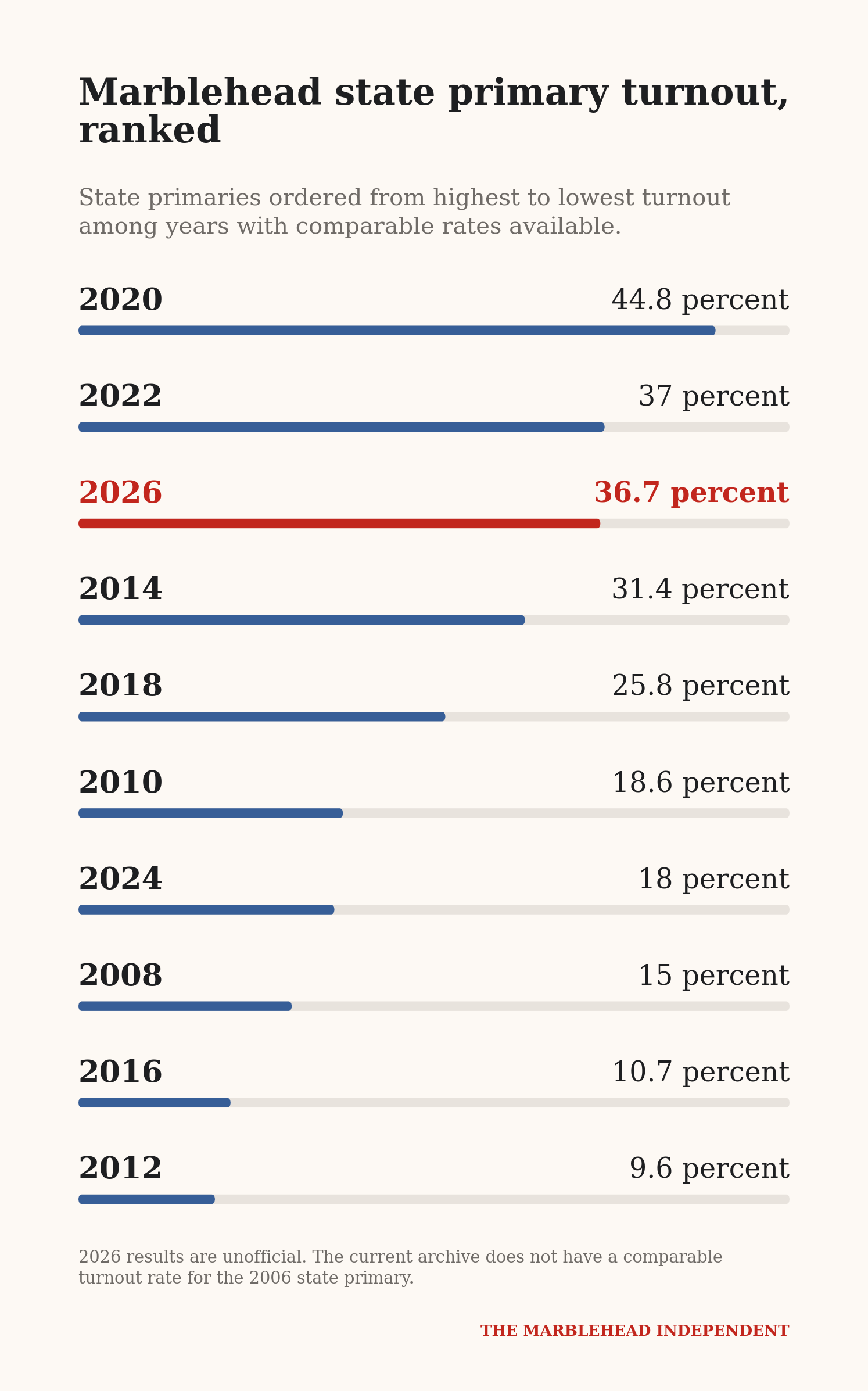
That made 2026 one of Marblehead's strongest state-primary showings in the modern record. Among years since 2008 for which comparable rates are available, only 2020, at 44.8 percent of registered voters, and 2022, at 37 percent, ranked higher.
The raw comparison to 2022 is striking: Marblehead cast 5,682 ballots that year and 5,679 this year. Three ballots separated them. The 2026 turnout rate was 18.7 percentage points above the 2024 rate and 10.9 percentage points above 2018.
Democrats drive the increase
The increase was overwhelmingly on the Democratic side.
Of the 5,679 ballots cast Tuesday, 4,822 were Democratic and 857 were Republican. Democratic ballots accounted for 84.9 percent of all primary ballots, or 4,822 of 5,679. Republican ballots made up 15.1 percent, or 857 of 5,679.
Those figures do not mean 84.9 percent of Marblehead voters are Democrats. Massachusetts allows unenrolled voters to choose either party's ballot in a primary. They show where the interest was Tuesday.
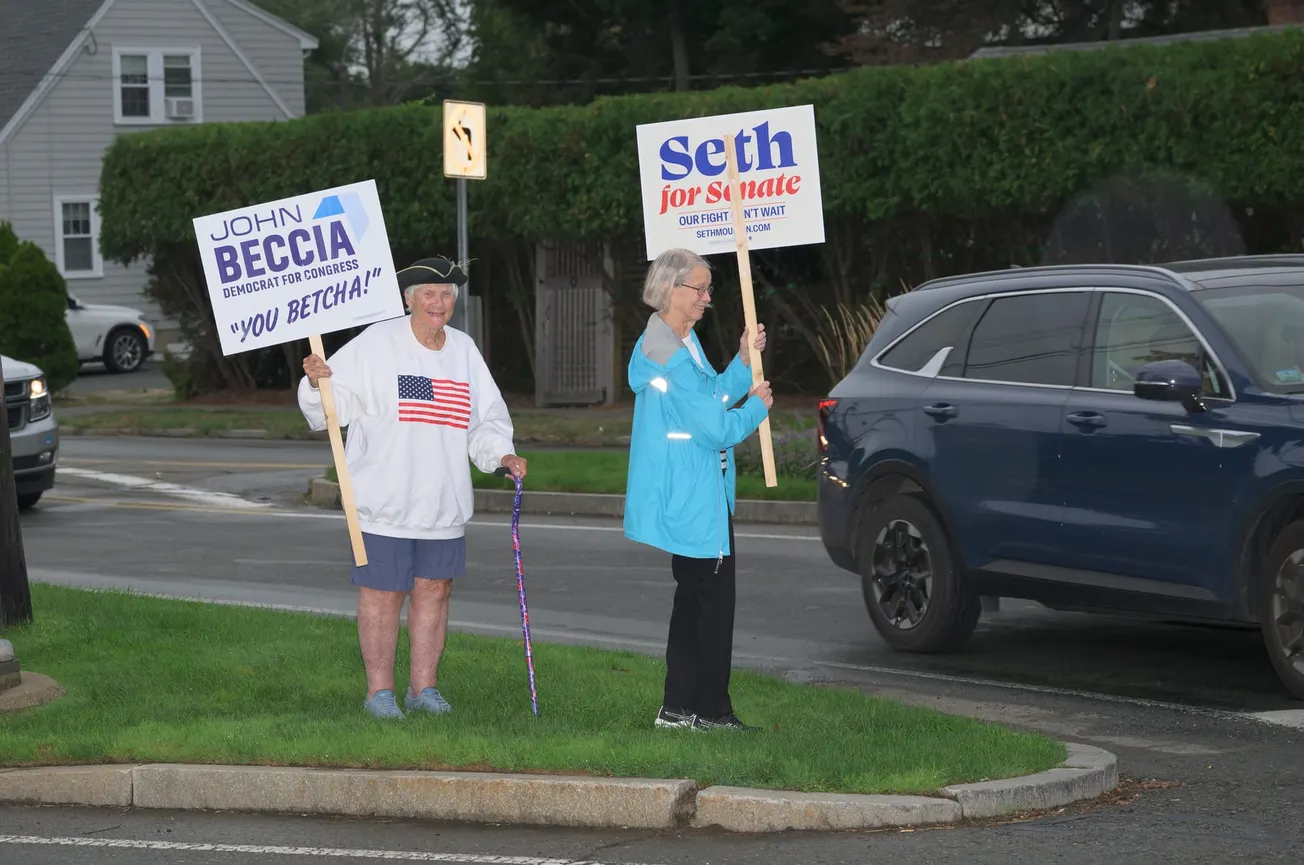
U.S. Rep. Seth Moulton, a Marblehead resident, challenged U.S. Sen. Edward J. Markey for the Democratic Senate nomination. Moulton's departure from the House also produced a six-way Democratic race to replace him in the 6th Congressional District. Marblehead resident Diann Baylis challenged Terrence W. Kennedy for the Democratic nomination for Governor's Council.
The returns cannot prove which race brought any particular voter to the polls. They do show that a primary with multiple local connections drew 2,674 more voters than the one two years earlier.
Home field, hard boundary
Once Marblehead voters arrived, they strongly favored their own.
Moulton defeated Markey in town, 2,894 to 1,876. Among the 4,770 voters who chose one of the two candidates, Moulton received 60.7 percent, or 2,894 votes, while Markey received 39.3 percent, or 1,876.
Baylis' hometown advantage was larger. She defeated Kennedy 3,049 to 1,108. Among the 4,157 voters who chose one of the two, Baylis received 73.3 percent, or 3,049 votes, while Kennedy received 26.7 percent, or 1,108.
Both carried all six Marblehead precincts.
Then the hometown strength evaporated beyond Marblehead. Markey won statewide, while Kennedy won across the Governor's Council district. The same town that gave Moulton and Baylis commanding margins was part of larger electorates that reached the opposite conclusion.
Turnout varied inside Marblehead, too. Precinct 1 led with 1,075 voters and a turnout rate of 40.8 percent of registered voters there. Precinct 3 was lowest, with 812 voters and 33.3 percent turnout, a 7.5-percentage-point gap. The unofficial results did not provide the precinct registered-voter bases needed to translate those rates into additional head counts.
A different kind of September
Marblehead's turnout history does not show a steady climb. It jumps around.
State-primary turnout, measured as ballots cast as a share of registered voters, was 15 percent in 2008, 18.6 percent in 2010, 9.6 percent in 2012, 31.4 percent in 2014, 10.7 percent in 2016 and 25.8 percent in 2018. It rose to 44.8 percent in 2020, held at 37 percent in 2022, fell to 18 percent in 2024 and returned to 36.7 percent this year. The current archive does not contain the registered-voter base for every one of those historical rates.
That pattern makes 2026 less a story of steadily rising participation than of a particular primary catching Marblehead's attention.
Moulton and Baylis lost beyond town, and Dan Koh won the Democratic contest to replace Moulton in Congress. But before those outcomes were known, Marblehead had already produced one clear result: 5,679 people showed up.
BEFORE YOU GO … Our reporting remains free and open to all. It is sustained by readers who choose to support it — by contributing so that routine, document-based local reporting continues without paywalls or promotional framing. Right now, 122 readers support The Marblehead Independent with monthly or annual contributions. Click here to become an Independent member.