Table of Contents
Get our free local reporting delivered straight to your inbox. No noise, no spam — just clear, independent coverage of Marblehead. Sign up for our once-a-week newsletter.
David Weber spent last spring in the audience — at Finance Committee warrant deliberations, at Select Board budget meetings, at a Dunkin' table where he and two others cornered a resident who had brought spreadsheets. Wednesday night he was called in last of five applicants, and 20 minutes later he had a three-year seat on the committee he had been watching.
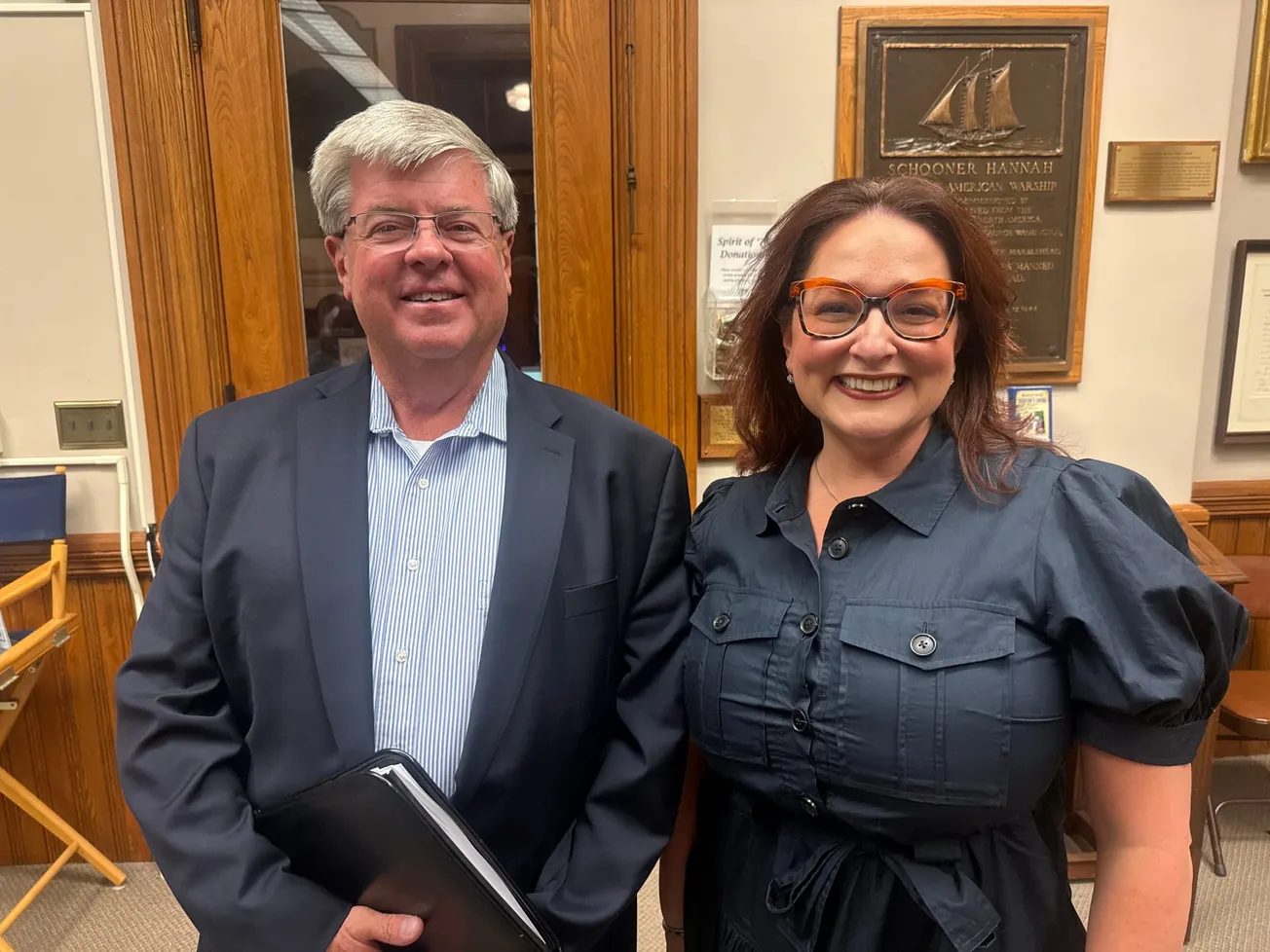
The Select Board appointed Weber and Renée Sidman to the two vacant Finance Committee seats at Abbot Hall, choosing from a field that also included Michael Klawitter, Dennis MacDonald and Mike Maniaci. Weber, appointed first, takes the term expiring in June 2029. Sidman takes the term expiring in June 2028.
The seats opened when Alec Goolsby, then the committee's chair, stepped down at the end of his term and Mike Janko resigned. The board interviewed the applicants one at a time, sending the others into a hallway where a meeting upstairs was loud enough to interrupt the proceedings. "Sounds more exciting than ours," one member said.
Every applicant got the same four questions, and one of them came back to the $15 million operating override voters approved June 9. Before that vote, the Select Board and School Committee signed a memorandum of understanding promising the money would carry the town three years. Former Chief Financial Officer Aleesha Nunley Benjamin put the figure closer to 10. The board asked all five how to stretch it.
Klawitter, a chartered financial analyst who retired in January after 25 years at Loomis, Sayles & Company, went first. He said he had read about the budget season in the paper, met with Town Administrator Thatcher W. Kezer III the day before and gone back two years in the town's budget documents. He was candid about the gap between his career and the job. "I'm sure I have a lot to learn as far as municipal accounting goes," he said, though he added that a municipal balance sheet is "still numbers."
MacDonald served 15 years on the Board of Finance in Bridgewater, Connecticut, elected three times and endorsed by both parties in two of those races, and was also elected town moderator there. He described a budget one-tenth the size of Marblehead's with the same structure: "all the same line items, just different zeros at the end of each one." He moved to town within the last year, after his daughter married into a local family.
Maniaci, who has run Piedmont Mortgage Corporation for about 30 years, said he prepared by watching the board's previous round of interviews on television. He argued the override buys no cushion. "There's no one big thing that's going to square up the budget," he said. "It's going to be a lot of little things. It's going to take a lot of work."
Sidman opened by introducing her sons, 17-year-old Caleb and 13-year-old Micah, and then herself. "I love data. I know that sounds super dorky," she said. She is director of enterprise analytics at Mass General Brigham, covering ambulatory operations across the system plus seven community hospitals and three specialty hospitals, after 14 years at Fidelity Investments supporting the high-yield and Strategic Advisors trading floors. Asked the committee's biggest challenge, she named trust. Hearing what would be cut at Town Meeting, she said, "was really impactful to me."
Watchdog, or partner
Weber pushed back on the word most often used to describe the committee. The Finance Committee's chair had sent him the state's 169-page handbook, and he had talked to members going back decades. "People talk about it being a watchdog sort of thing for the budget and for the different offices involved," he said. "I don't really like that connotation." He described instead the partnership he watched form in the spring among the board, the School Committee and the Finance Committee, and told the story of the Dunkin' information session where his phone rang with news that Gov. Maura Healey had signed the senior property tax relief package.
He was also blunt about the master plan survey data delivered a week earlier. "The town is absolutely divided on those things," he said. On municipal finance itself: "I'm still learning the language."
The vote
The board placed all five names in nomination and polled twice. Weber reached a majority with three votes on the first ballot, cast by members who cited his year of attendance. Rossana Ferrante was alone in backing Sidman on that ballot; Klawitter, she said afterward, would have been her second choice. On the second ballot, Sidman was unanimous. One member said he weighs volunteerism and leadership and pointed to her presidency of Congregation Shirat Hayam's board.
Another said the fit was narrower than that: the committee had just lost someone who was big into data crunching and analytics.


