Table of Contents
Get our free local reporting delivered straight to your inbox. No noise, no spam — just clear, independent coverage of Marblehead. Sign up for our once-a-week newsletter.
Fourth-grade students at Tower School are playing a hands-on role in a new oyster reef restoration effort set to begin this week.
Students, teachers, environmental groups and government agencies will gather June 5 at the Lead Mills Conservation Area for the installation of oyster reef structures as part of a pilot study aimed at improving water quality, restoring shellfish populations and reducing shoreline erosion.
The project brings together Salem Sound Coastwatch, Sustainable Marblehead, the U.S. Environmental Protection Agency, Coastal Technologies Corp., Massachusetts Oyster Project, the town of Marblehead and Tower School.
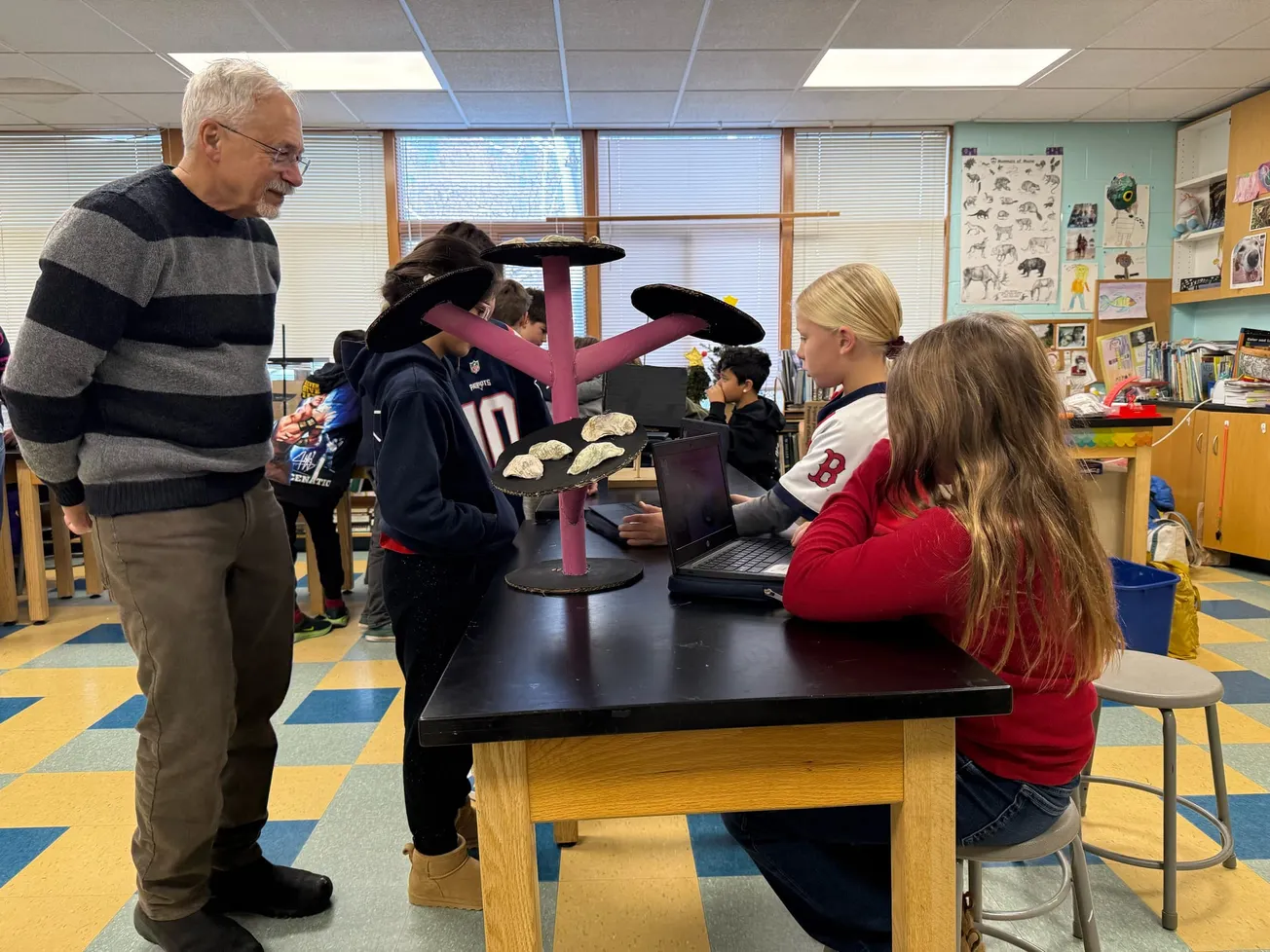
Tower science teacher Colleen Parenteau introduced fourth-grade students to the ecological importance of oysters, which filter water, provide habitat for marine life and help stabilize shorelines. Students also learned about oyster reef technology from George Thatos, head of design at Coastal Technologies Corp., before designing their own oyster stack concepts.
Students later presented their designs to Thatos and Steven Wolf, chair of Sustainable Marblehead’s Harbors and Waters Working Group and regional coordinator for the EPA’s marine protection program.
According to project organizers, the pilot study will evaluate whether oysters, mussels and other marine species can be successfully cultivated in Marblehead and Salem harbors to improve water quality and enhance coastal resilience.
Planned installations include oyster stack structures developed by Coastal Technologies Corp., shellfish cages designed to support oysters and mussels, and water-quality monitoring equipment that will provide real-time environmental data for students to study. Organizers are also considering transferring up to 60,000 oysters currently being raised in Marblehead’s oyster upweller at Tucker’s Wharf.
Parenteau said the project demonstrates how classroom learning can lead to real-world environmental action.
“To say that I am thrilled for this opportunity for our students is a massive understatement,” Parenteau said in a statement. “This work exemplifies how students’ creativity and self-efficacy can inspire agency, leading to the meaningful change we hope every student experiences through science.”
The installation is scheduled as part of Marblehead’s World Oceans Day celebrations, which run June 5-8. Organizers said students will continue monitoring environmental data and observing shellfish growth as the project develops.