Table of Contents
We covered this so readers could understand what is being proposed, what the state has — and has not — approved, and what the pilot would test in Marblehead harbors. The Marblehead Independent is now at 120 recurring monthly and annual contributions, with a goal of 175 by July; each one helps keep local reporting free to read and gives us time for context, follow-up calls and careful editing. While this story is still fresh, becoming a member today helps move that townwide support closer to the next mark. 🟦 Become a member here.
For more than a century, the answer to whether oysters belong in Marblehead Harbor has been a quiet no. The reefs early colonists wrote home about, the ones that had built up under indigenous shell heaps for generations before that, are gone from most of the coast north of Cape Cod. By the late 19th century, the federal census of the fisheries had already singled out the Salem area as a former oyster center, and naturalists were warning that the eastern oyster was “becoming rapidly extinct north of Cape Ann.” This summer, at Tucker’s Wharf, Steve Wolf and a handful of partners hope to put 60,000 of them back.
Wolf, a marine scientist and environmental engineer who lives in Marblehead, said in a May 19 email that the state had given a tentative go-ahead for a pilot shellfish project meant to test whether oysters and oyster-based structures could be planted, monitored and used to ease erosion and improve water quality in Salem Sound. The pilot, planned for the coming summer, would raise baby oysters in a starter tank at the wharf and move some to a handful of locations in the harbor. It is being organized through Sustainable Marblehead’s Harbor Working Group, with partners that include Salem Sound Coastwatch, the Massachusetts Oyster Project, Tower School and Coastal Technologies Corporation, a company that builds slate-panel structures called oyster stacks.
Wolf said he is doing the work as a resident, not in his role with the U.S. Environmental Protection Agency, though there is some overlap with his federal job. He described 22 years as an environmental consultant, then 10 years with the Army Corps of Engineers and five with the EPA, all focused on coastal New England. The idea came out of a talk he attended a few years ago about an oyster castle project in Nantucket.
“That’s where I saw that talk, and I was like, the light bulb went off,” he said.
Oysters that used to be here
Wolf is not, in his own framing, introducing oysters to Marblehead. He is asking them to come back.
“Historically, we had a lot of oysters here,” he said. “Oysters were sort of major along most of the New England coastline, and we lost a lot of them. I mean, there are very few of them anymore.”
The archaeological and historical record agrees with him. Shell heaps left by indigenous people along the Gulf of Maine, in some places several feet deep, document oyster harvests that long predate European arrival. Colonial writers found the bivalves in Massachusetts Bay early on — a 1621 letter from Plymouth described “many very good oysters here” — and 19th-century naturalists traced oyster beds in the Charles, Mystic and Weymouth rivers and across much of Cape Cod.
By 1880, when the federal government commissioned a national census of the American oyster industry, Salem warranted its own chapter as a regional oyster center. Oyster merchants there told the surveyor, Ernest Ingersoll, about earlier attempts to seed local waters. Some oysters brought up from Fire Island had been put down in the harbor channel and survived, growing large and good. A later attempt of 1,000 bushels planted in 5 feet of water in Bass River died over the winter.
“There is no very good ground for planting anywhere in that harbor,” the merchants told him.
By then, the Gulf of Maine native oyster was already in retreat; Ingersoll’s volume cited earlier naturalists describing the species as “becoming rapidly extinct north of Cape Ann.” It never came back at scale. The Marblehead pilot does not propose to put that whole world back. It is a small test of whether oysters can survive in modern Salem Sound at all.
Inside the pilot
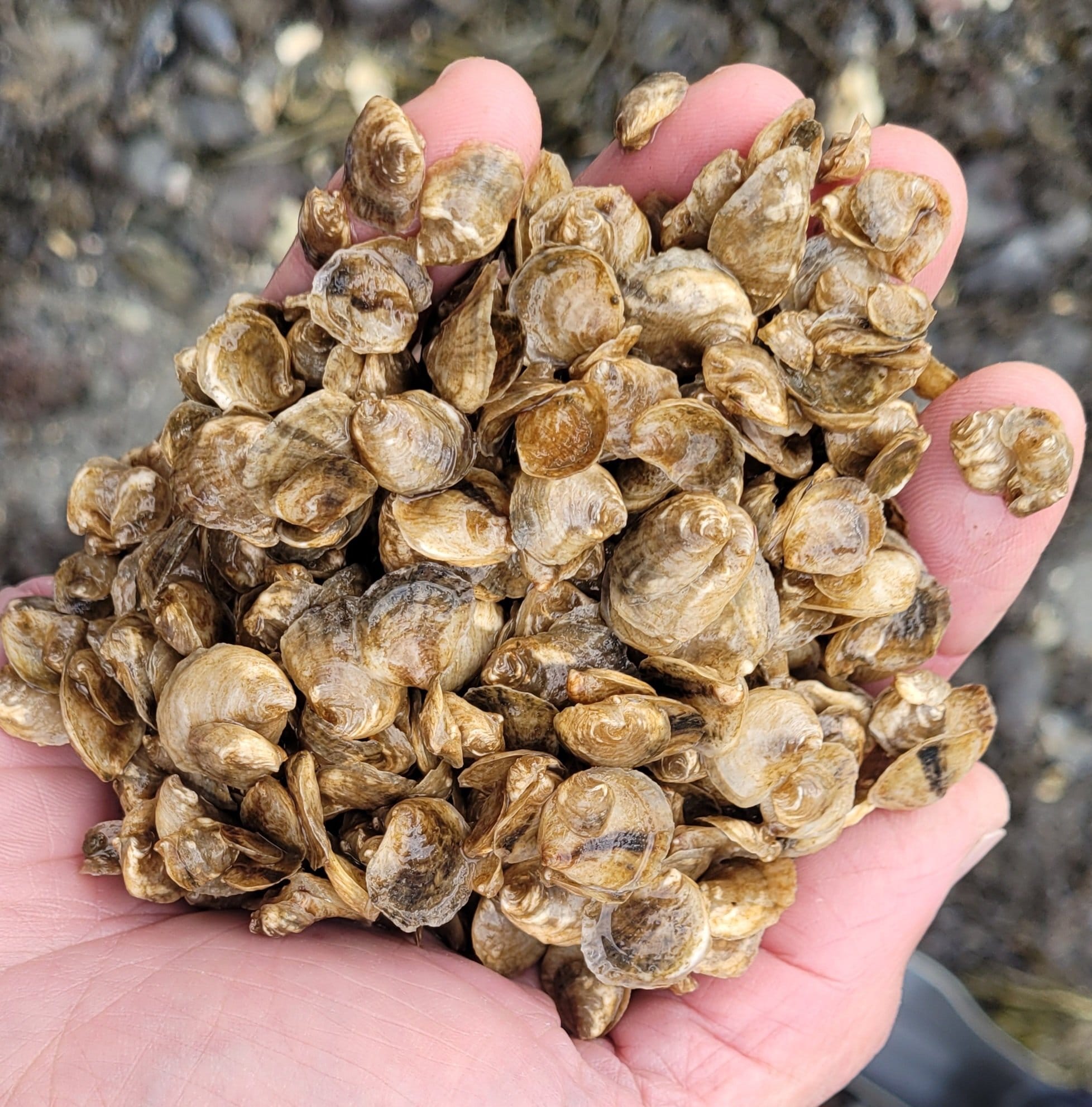
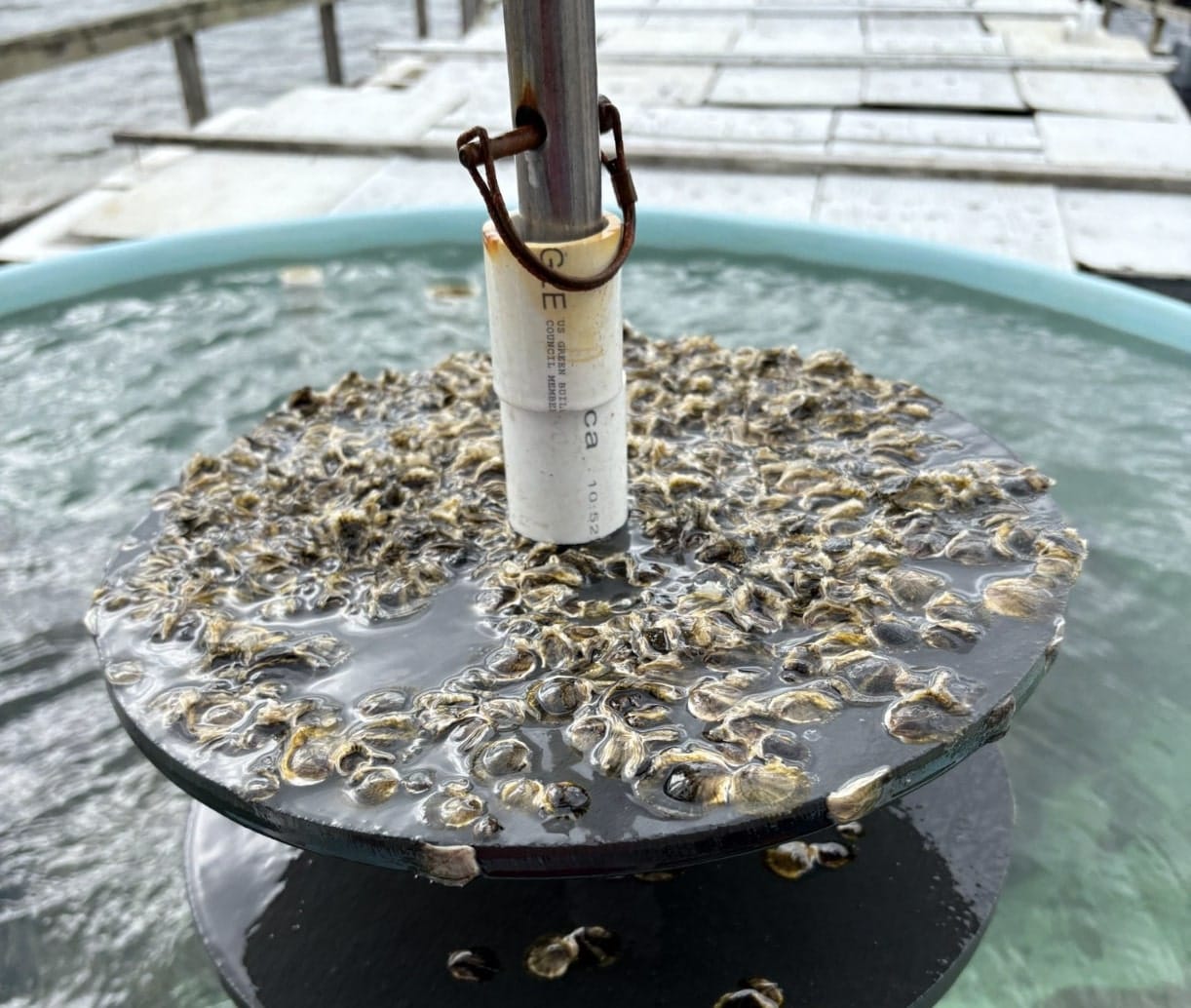
The first piece of equipment is an upweller, sometimes called an oyster up: a tank that pumps seawater through baby oysters and lets them grow to a size where they have a better chance of surviving in the open.
“You pump water through it, and you allow the baby oysters to grow till they get to a big enough size where they’re going to more likely survive in the environment,” Wolf said. “And then you release them.”
The Massachusetts Oyster Project is funding and providing the upweller, which will sit at Tucker’s Wharf, and Salem Sound Coastwatch is organizing volunteers to monitor it every day. About 60,000 baby oysters are expected to arrive a couple of weeks into June and to stay in the tank through the season, possibly into September. At the same time, the project hopes to place oysters, mussels and instruments at six locations around the harbor to measure conditions including temperature, salinity and light.
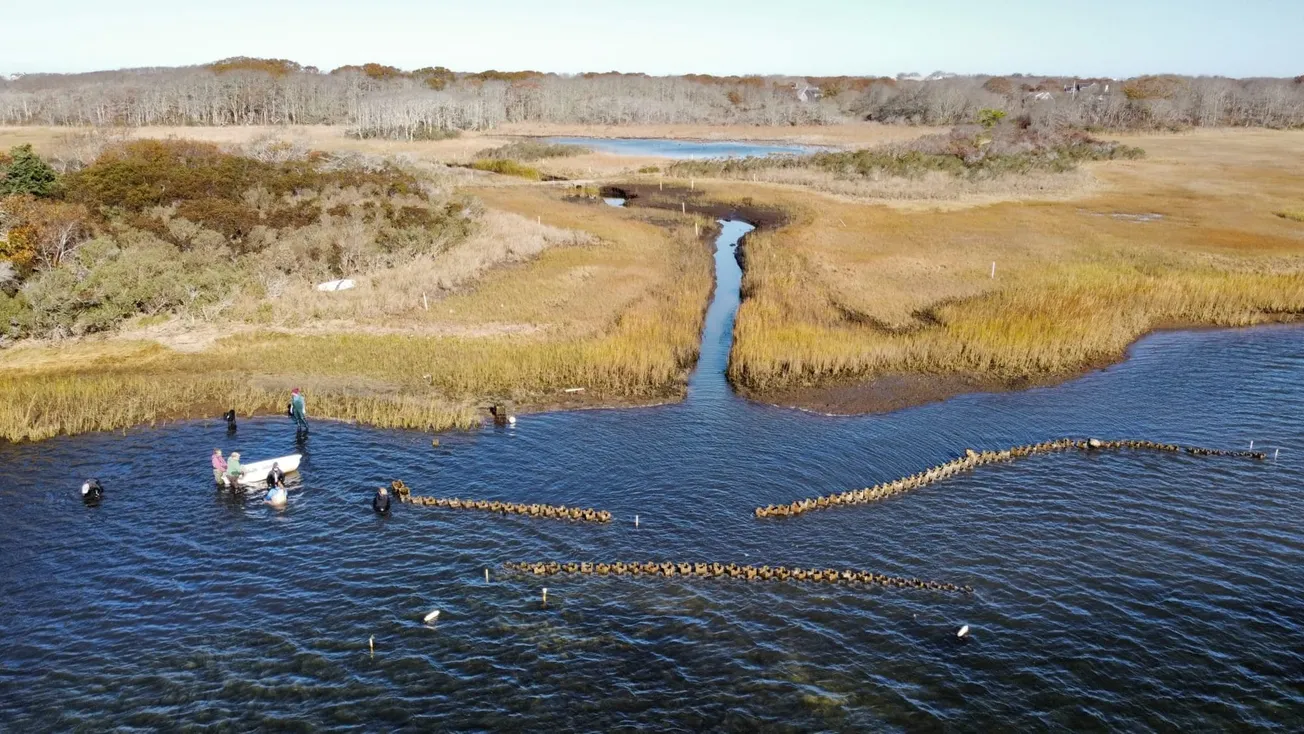
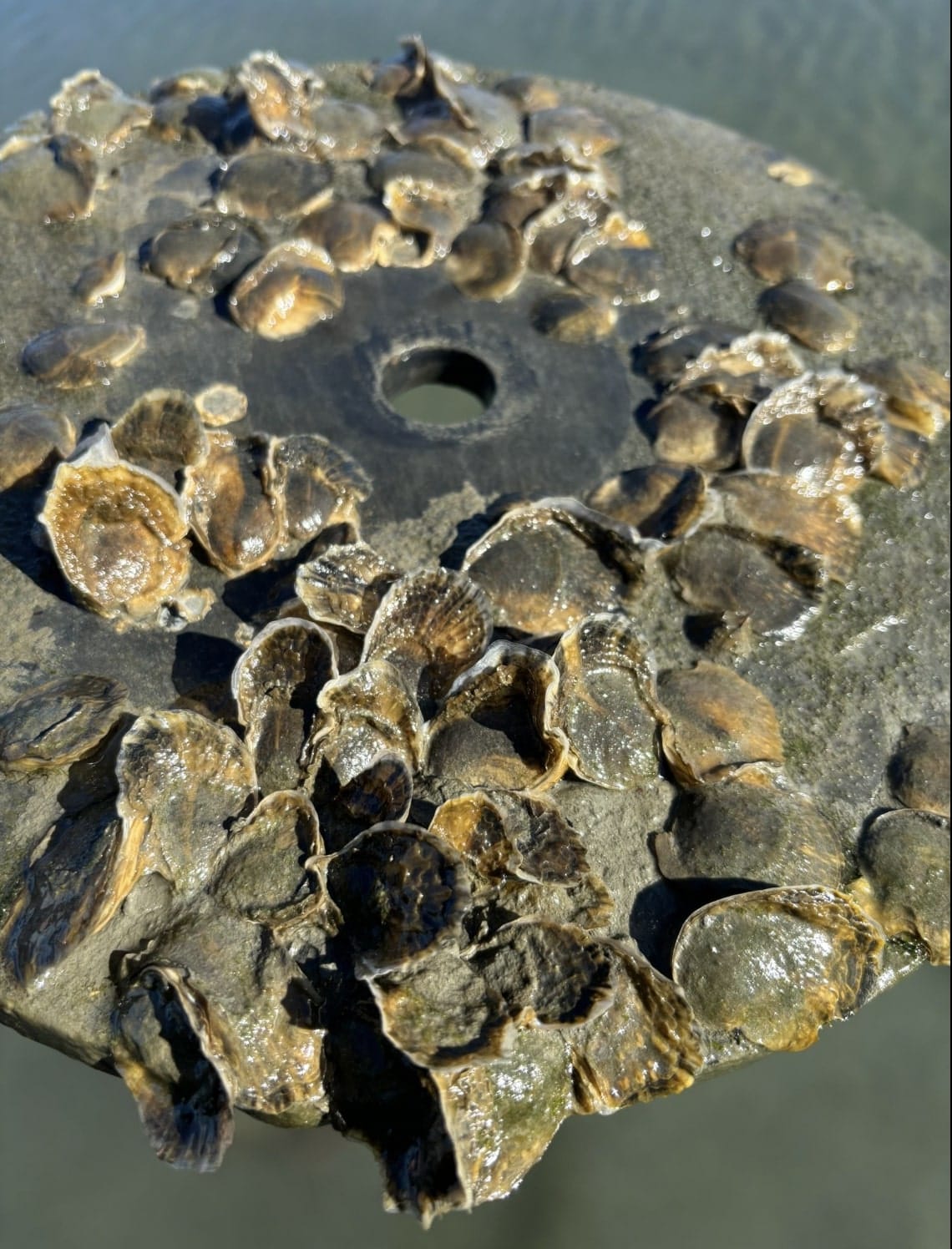
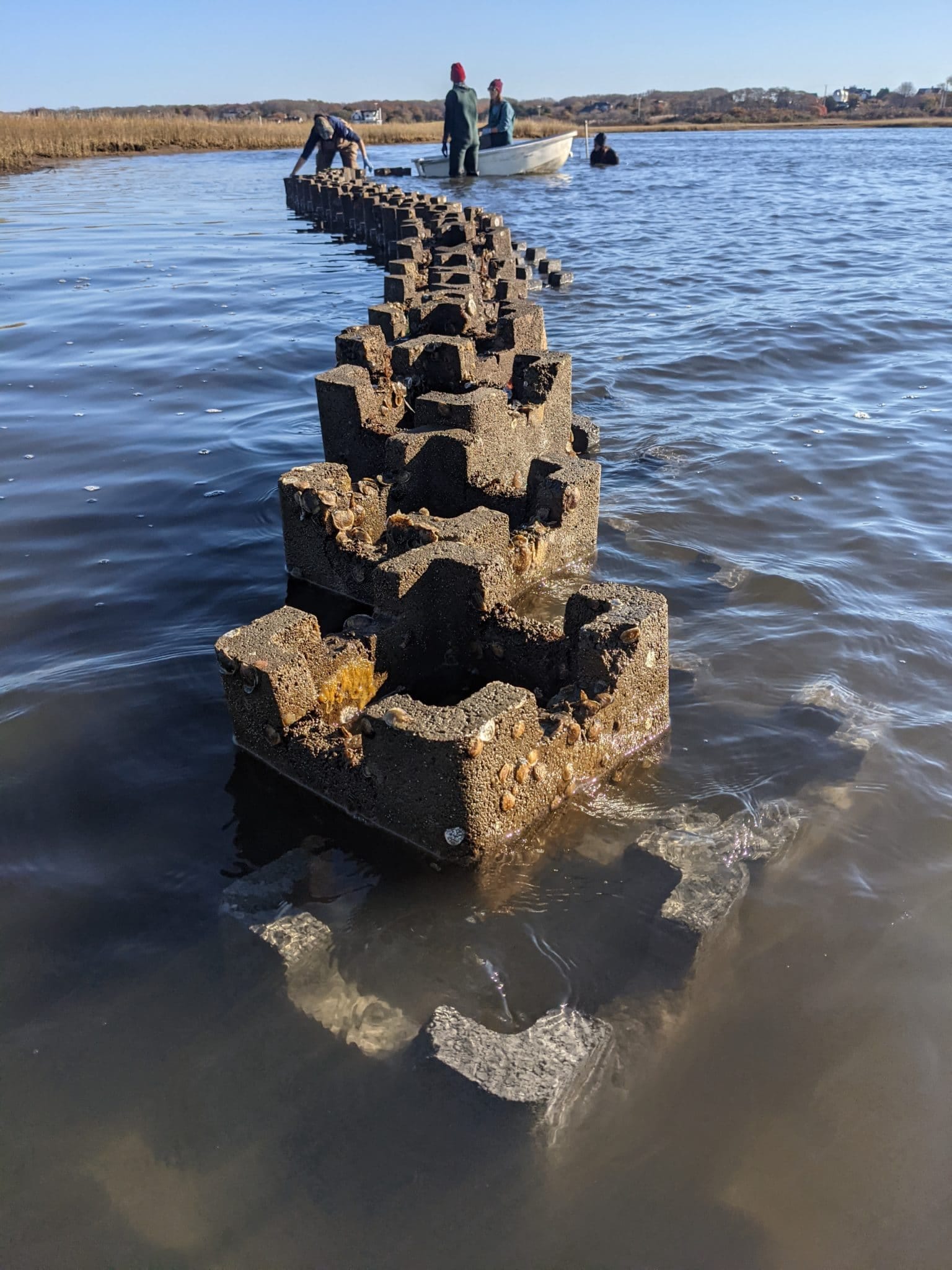
Some of those oysters would sit inside cages, and some on the slate panels of the oyster stacks. The stacks are the design Coastal Technologies Corporation has used at sites in parts of Long Island and on the New Jersey coast.
“It uses slate panels,” Wolf said. “And for some reason, oysters really like to attach to it. So it’s been a good sort of jump starter to get oysters back in.”
The Marblehead deployment is meant as a measurement, not a release. “It’s a pilot study,” he said. The stacks and cages can be lifted out if conditions go wrong.
The complicated part is that Marblehead waters and most of Salem Sound are closed to shellfishing, with a few exceptions, including Devereux Beach and a portion of the causeway when it opens for part of the year.
“The state says you can’t eat an oyster, a mussel, a clam out of it,” Wolf said.
The state’s concern is not the oysters themselves but anyone who might pick one up and eat it from waters closed for reasons of bacteria or sediment quality.
“Historically, the state has always been, if it’s closed to shellfishing because of bacteria or sediment quality, whatever, we don’t want anyone to plant oysters or restore them,” Wolf said. “Thirty, 40 years ago, that made a fair amount of sense. It’s interesting where we are now, in terms of trying to be able to manage that risk. It’s balancing risk.”
A 1997 ecological assessment of Salem Sound found high fecal coliform readings at river stations and noted that shellfish beds remained closed across the surveyed intertidal habitat. The pilot tries to manage that risk through education, signage, the shellfish constable program, the harbormaster’s office and structures that contain the oysters rather than scatter them.
One of the six pilot sites is the boundary water between Marblehead and Salem, near the Lead Mills Conservation Area, jointly owned by the two municipalities on the south shore of Salem Harbor. The 4.5-acre site sits on formerly industrial land where white-lead manufacturing began in 1831 and at one point produced 6,000 tons of white lead a year; after remediation more than a decade ago, the coastal bank was capped and planted with marsh grass. Marblehead’s 2018 Municipal Vulnerability Preparedness report identified coastal flooding, storm surge and erosion along the town’s 14.2 miles of coastline as hazards of concern; that year’s storms drove erosion close enough to a bike trail and a buried electric line at Lead Mills to worry the people watching it. Oysters off that bank, Wolf said, might filter water and slow incoming waves.
Living shoreline, not sea wall
That, he said, is the difference between a living shoreline and a hardened one. Sea walls and rock revetments stop a wave but reflect the energy.
“When you put up a sea wall, you stop the wave from hitting that area, but the energy is reflected, and it goes back somewhere else,” he said.
He pointed to wave energy bouncing back into the Neck near the Corinthian area, even on a shoreline that does not face the open ocean. Oyster reefs sit at the intertidal level — researchers studying restored reefs in shallow coastal bays have found that wave reduction tends to be strongest when water depth is near the height of the reef, and weaker when the water is much deeper.
“The thinking now is, can you build living shorelines?” Wolf said. “Oyster reefs, marsh, eelgrass — things that incorporate the living ecosystem.”
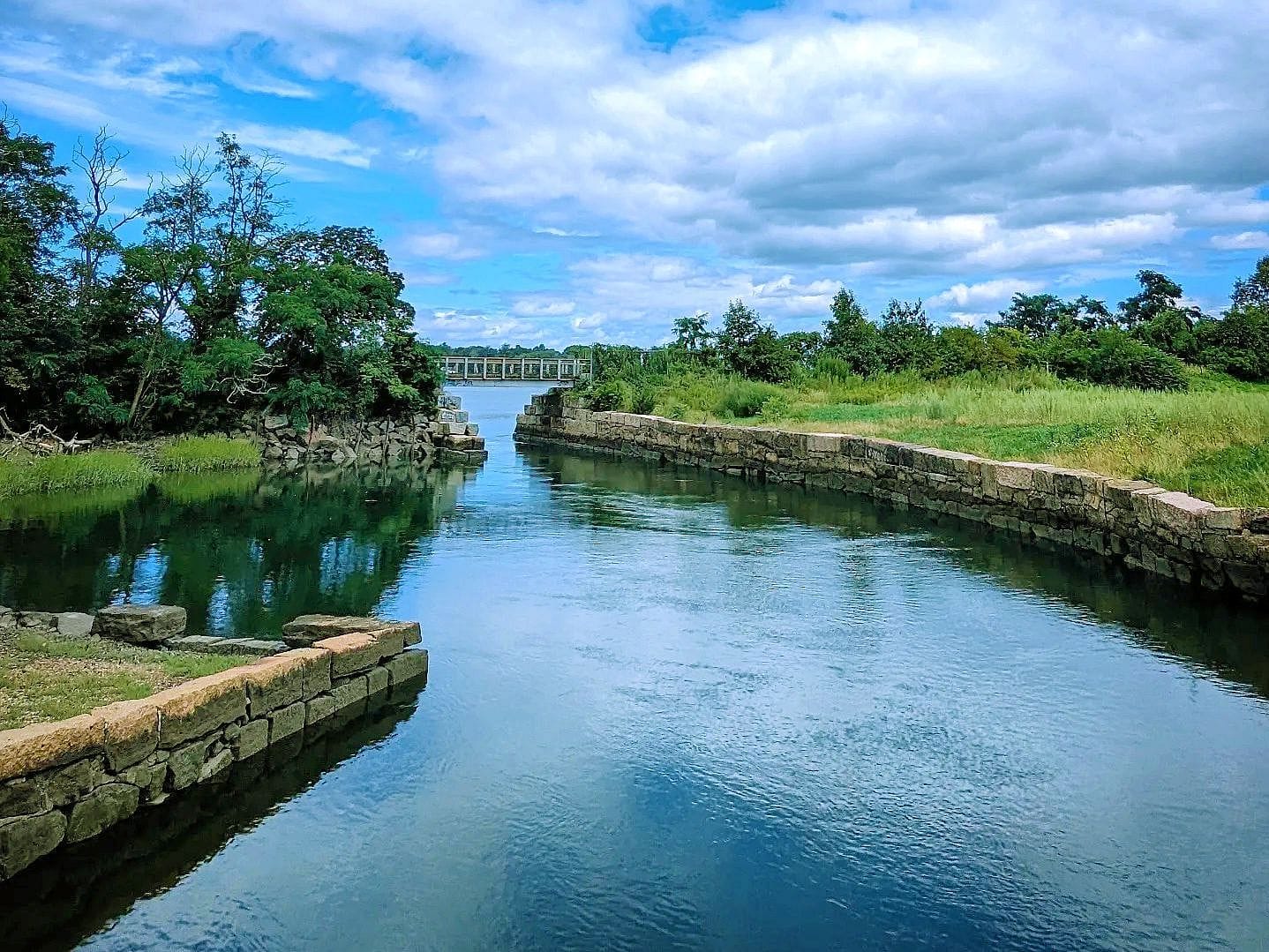
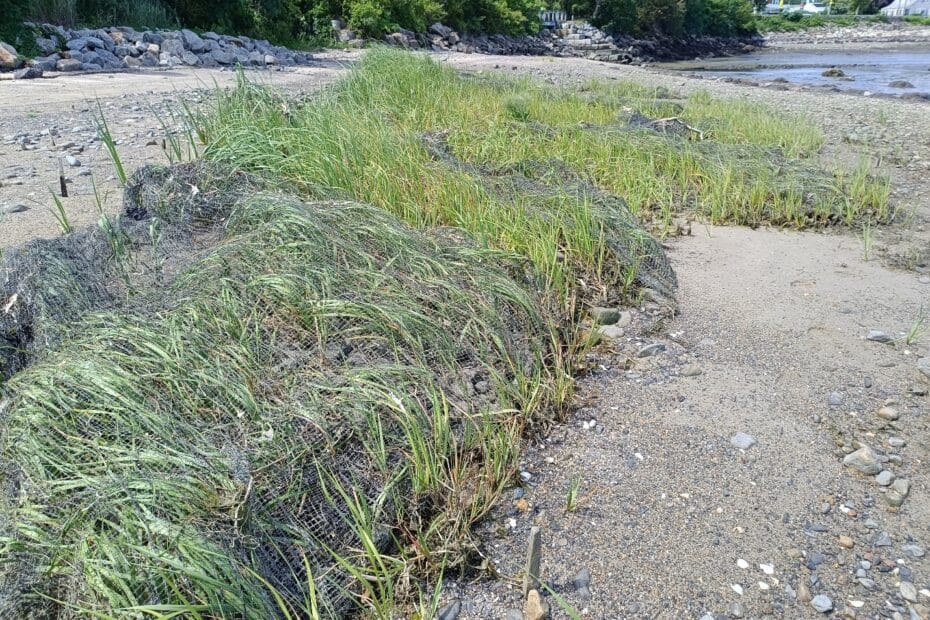
Fringing salt marsh grows along the Lead Mills Conservation Area near the Marblehead-Salem line. One of the Marblehead pilot sites is planned near the boundary waters by Lead Mills. COURTESY PHOTO /Salem Sound Coastwatch.
A single oyster, Wolf estimated, can filter about 50 gallons of seawater a day, feeding on plankton and pulling out the cloudiness that keeps light from reaching the harbor bottom. His wife, Lisa Wolf, used to run an education program that took kids out by boat to collect plankton and clams from a North Shore beach.
“We had clams with plankton in one container, like one liter, and no clams with the same conditions, and we let it sit overnight with the bubbler, and the one with the clams will be completely clear,” she said. “Just overnight.”
That clearer water, Wolf said, is part of why eelgrass has retreated in Marblehead Harbor — and part of what oysters might give back.
The pilot is small. The cost to the town is essentially nothing; the work is being done by volunteers and donations. Wolf said meaningful results would take roughly a decade — “we’re looking at a decade kind of thing,” he said — because oysters grow slowly and the biggest risks remain water quality, predators and a cold winter with too much ice. Reaction so far has been positive. “We haven’t met anyone who isn’t excited about [it],” he said.
Sustainable Marblehead will debut its new upweller during a four-day World Ocean Day celebration from June 5–8. The weekend kicks off Friday at 6 p.m. with a free talk by Shelley Brown at the Corinthian Yacht Club. On Saturday at 10 a.m., the organization will unveil a public water-refilling station at State Street Landing and officially introduce the upweller at Tucker’s Wharf. Festivities conclude Monday from 5:30 to 7:30 p.m. at the Warwick Place Theatre with a benefit reception and a One Ocean Film Tour screening to support local shellfish restoration.
“We can’t wait for the 60,000 baby oysters to arrive in the new upweller,” Elaine Leahy, executive director of Sustainable Marblehead, said in announcing the events. “This is a project that Steve Wolf and our Harbor Working Group have envisioned for years, so seeing this important restoration effort finally come to fruition is incredibly rewarding.”
The state’s approval remains tentative. The oysters have not arrived. The instruments have not been set.
“Anything that we can do to improve the long term outlook of [the harbor] is beneficial to the town,” Wolf said.
In waters that have not held a working oyster population in living memory, a small group of residents and scientists is preparing to ask them back.
Get our free local reporting delivered straight to your inbox. No noise, no spam — just clear, independent coverage of Marblehead. Sign up for our once-a-week newsletter.