Table of Contents
This took time inside Abbot Hall: interviews, close looking and careful reporting on a student-run exhibition with more than 300 works by Marblehead students in grades 7-12. Because you read stories that help the town see its young artists clearly, consider joining the 120 readers who already give monthly or annually as we work toward 175 by July. Support today, and help keep this kind of local arts coverage free for every neighbor. 🟦 Become a member here.
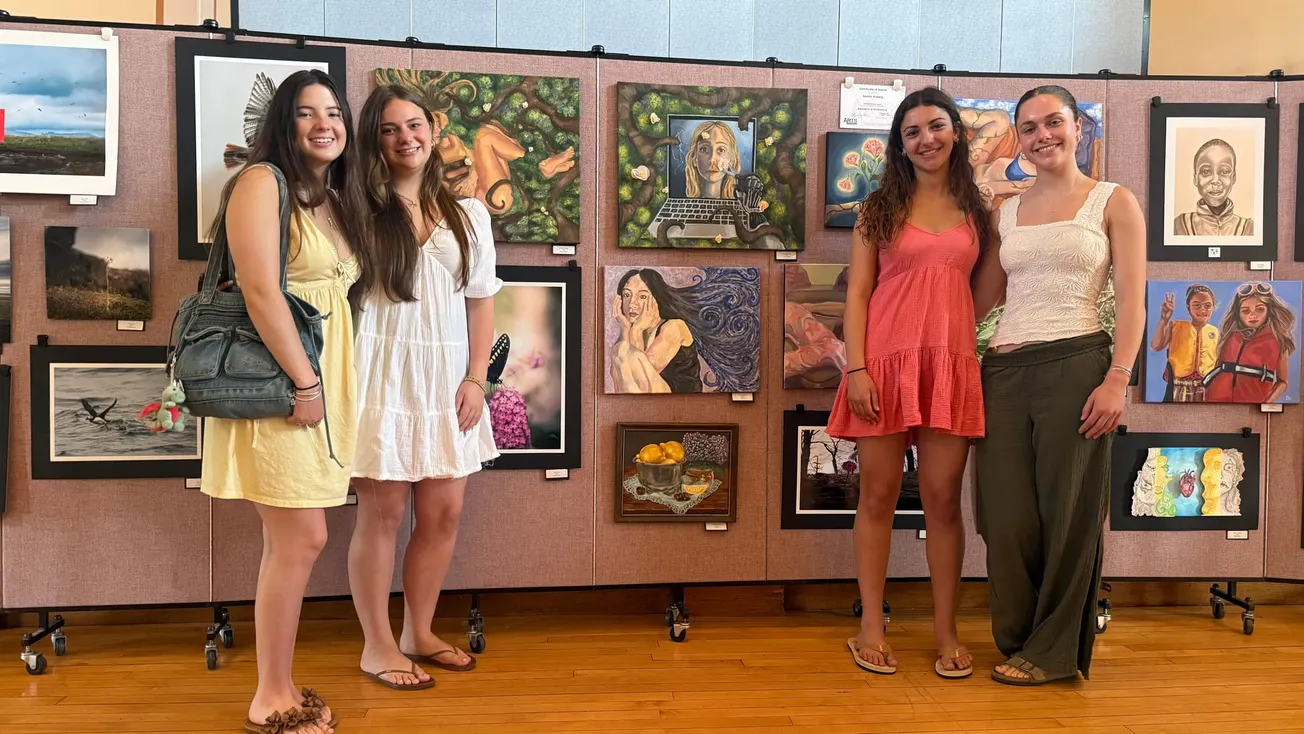
On opening night, Marblehead High School senior Birdie Cohen watched the middle schoolers do exactly what she had hoped they would. They moved through Abbot Hall Auditorium in clusters, pausing at the boards where their own assigned projects hung a few feet from the strongest work in the building. Some stayed a while.
“It’s really interesting to see them see what they could become as an artist — if they stick with it,” Cohen said.
She was standing in the cavernous auditorium on a Tuesday morning, alongside three of the four other seniors who curated the 2026 Marblehead Veterans Middle School-Marblehead High School Annual Spring Art Exhibition as their senior project: Lilah Greten, Noa Brochstein and Maeve MacCallum. The fifth, Serena Nyberg, could not make it.
That question — what could they become? — runs through the exhibition, which opened May 14 with a public reception from 4:30 to 7 p.m. and runs through May 27 at Abbot Hall, 188 Washington St. Admission is free, and the show can be viewed during the building’s regular weekday hours.
Organized by the schools’ Visual & Applied Art Department, the show features more than 300 works by students in grades 7-12.
Finding their niches
The curating took weeks. Before the doors opened, the group spent days inside Abbot Hall building the infrastructure the show required — cutting mat boards, mounting work, trimming photographs, tracking every piece through a shared spreadsheet. They divided the labor by aptitude as much as plan: Brochstein cut the boards, Greten handled the mounting, Cohen trimmed the photography and MacCallum managed the spreadsheet, assigning a number to each piece and following it through every stage. "We all found our niches in like a way," Cohen said.
It was not always smooth. "There was definitely moments where like tensions were high, and we kind of just stepped back," Cohen said. "You have to remind yourself ... it's not that serious. It's ... you know it's the art show, it'll all come together."
It did. The curators put deliberate thought into how the boards are organized. Near the entrance, work in different mediums hangs together — painting beside photography beside charcoal — and a 7th grader's assigned project sits close to senior-level pieces. "We try to display a lot of different mediums on the front boards, just to give people like a taste of what they're expecting," MacCallum said.
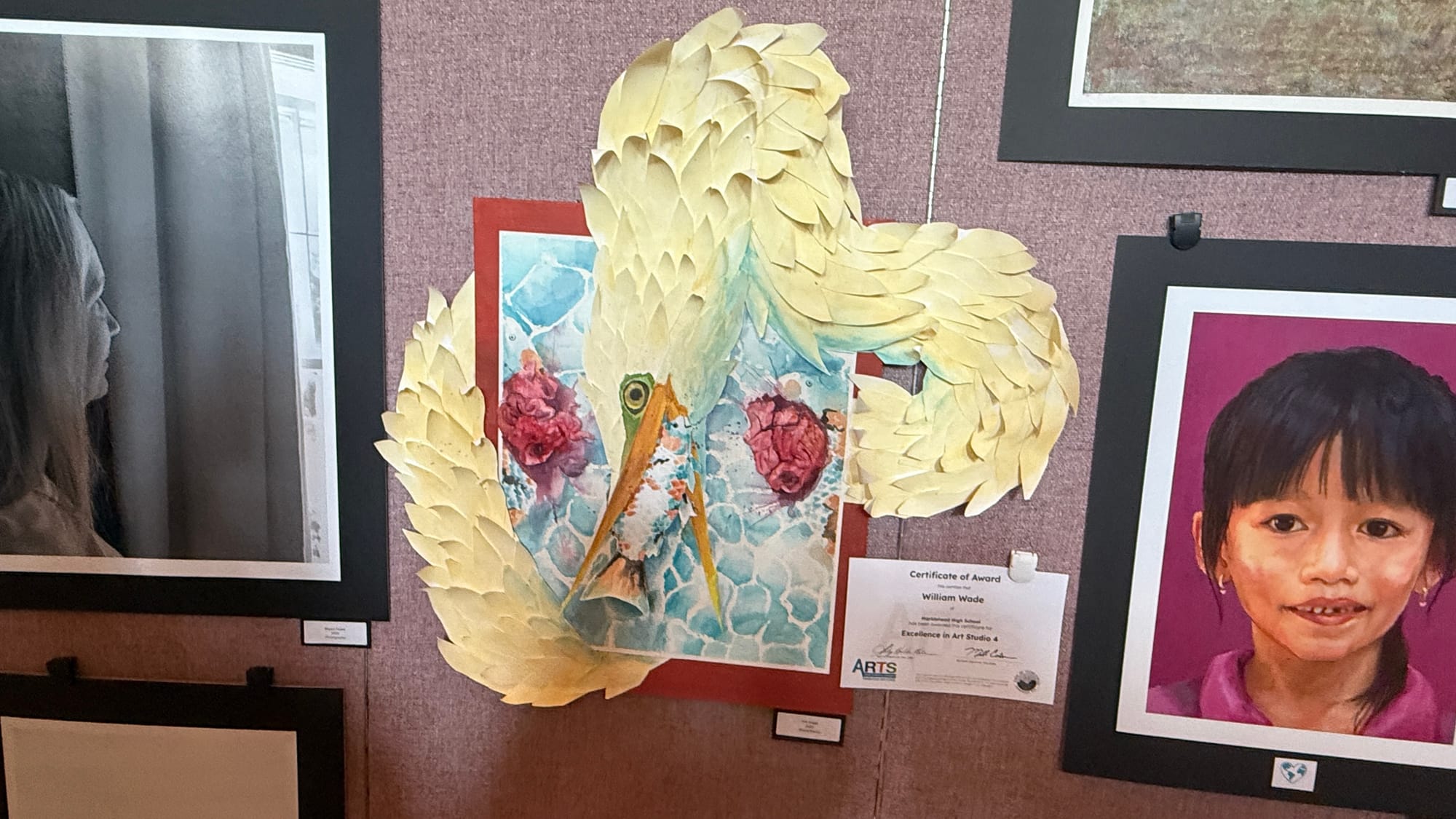
Not every choice on those boards was an easy one. Asked to name the riskiest piece in the show, the curators landed fast on a mixed-media work by William Wade. A long-beaked bird, built up from pale layered paper feathers that lift off the surface and curl into the air, bends its head low over a watercolor of a fish set among two deep-red blooms. "It's just like a little bit of a bloody scene, but it's a really cool art," MacCallum said.
Past the front boards, the seniors get a section of their own. "All of our senior work is posted on the backboards," Greten said. "The seniors get their own little exhibit." It is where the curators' own range comes into view, none of it wider than the work of Nyberg, the fifth curator, who couldn't be present when the Independent interviewed the students for this story.
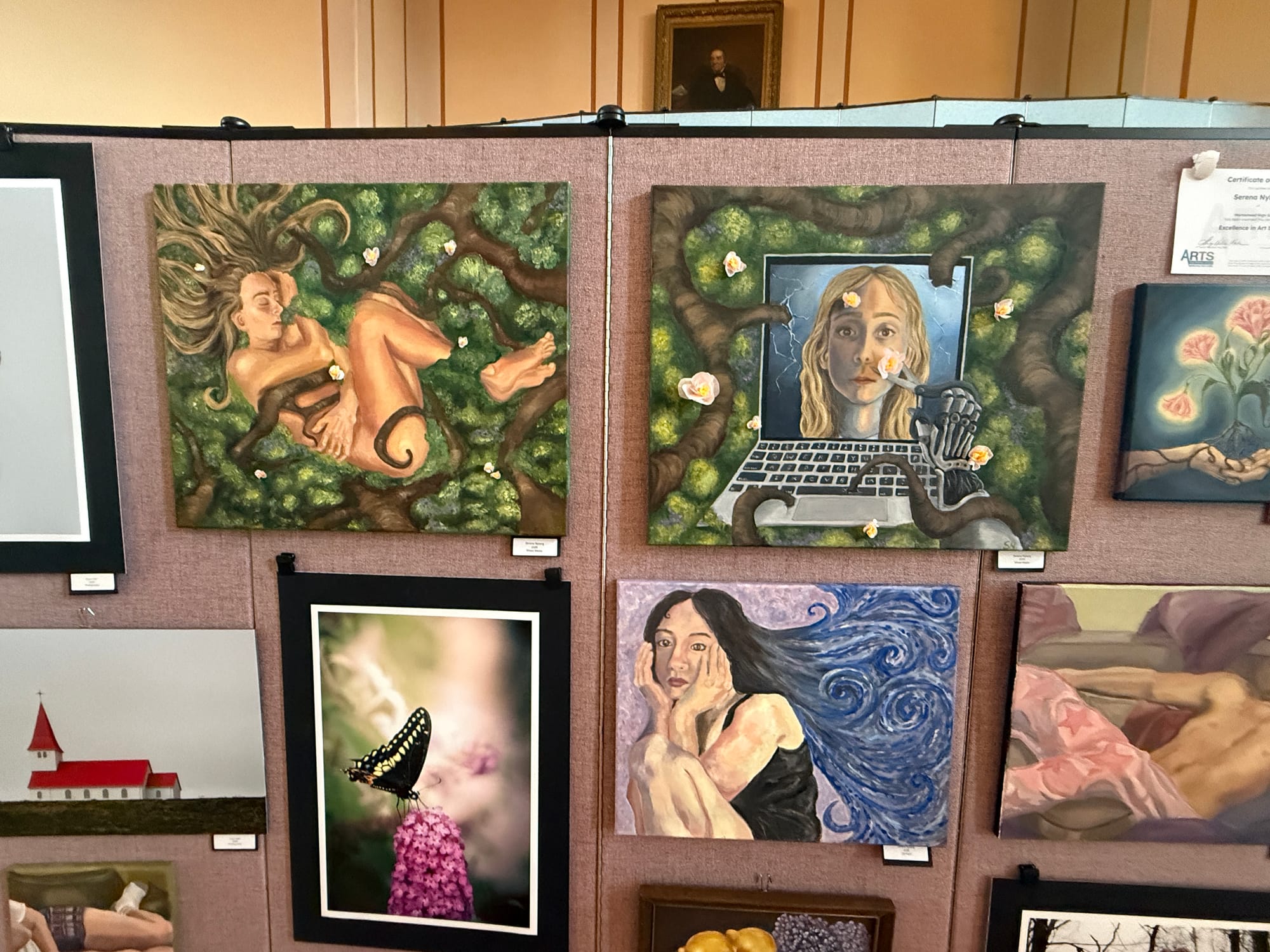
Cohen described Nyberg's diptych as an exploration of technology's interference with humans in nature. In one canvas, two figures sleep curled together, half-held by a tangle of branches and green; in its twin, a girl's face surfaces from the cracked screen of a laptop as a skeletal metal hand reaches toward it, branches threading through the keyboard. Pale orchids drift across both.
A separate Nyberg piece may be the strongest work in the entire show. A young woman sits cross-legged on a black field, painted with patient realism down to the creases in her jeans and the strain in her face as she hauls a green garment over her head. Real clothing crowds in from all four edges — socks, denim, a gingham shirt, a sweep of yellow — three-dimensional and close to suffocating, until the figure seems boxed in by the very thing she fights.
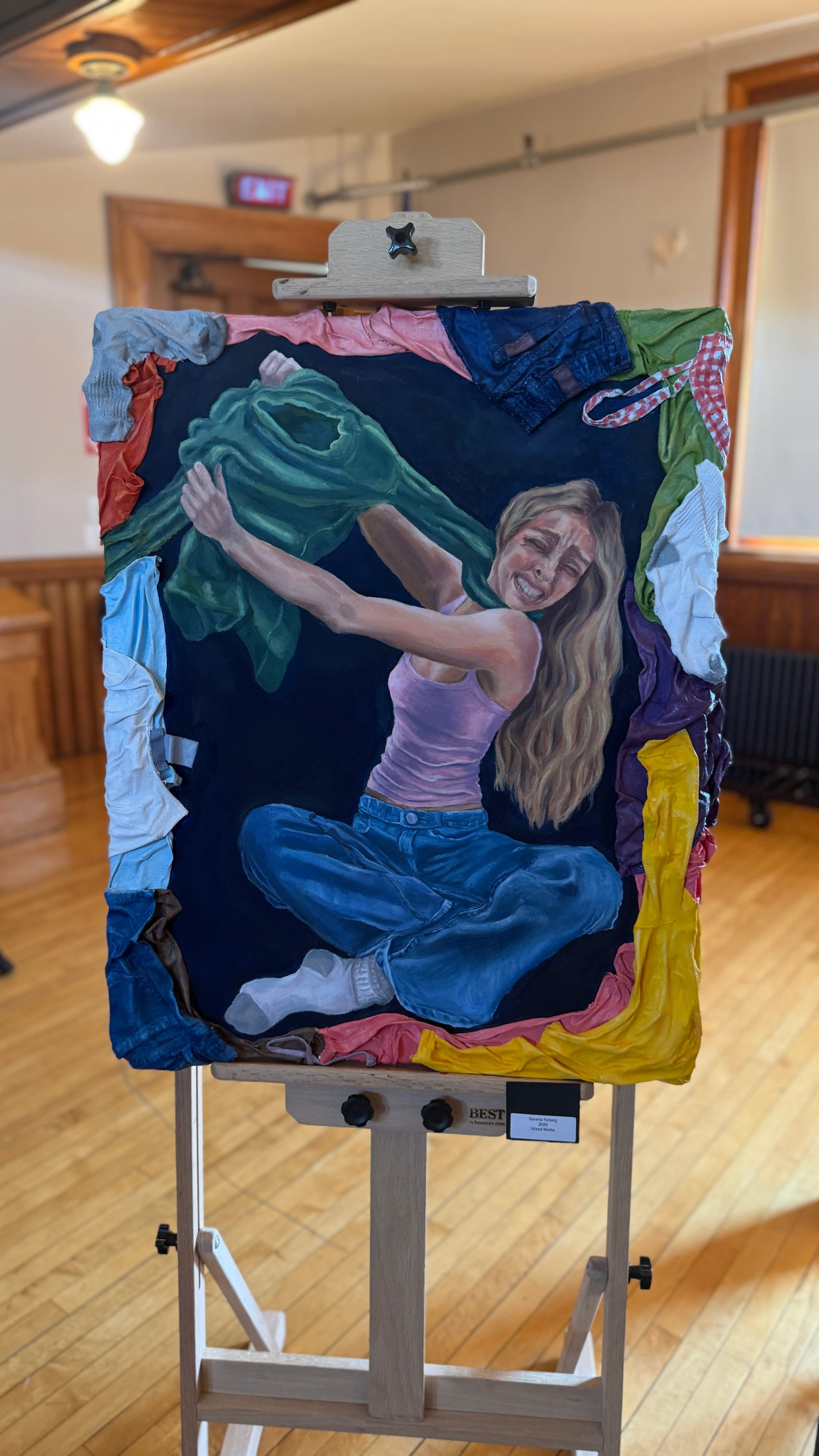
The curators said the work grapples with overconsumption, in which materialistic things can strangle us — and with the way a cluttered room can press on a person. Nyberg is headed to Tufts University for psychology, where she plans to double major in fine arts.
The whole show, in one sentence
If you asked Cohen to describe the whole show in one sentence she nailed it out of the park: "Progression and maturity shown through different mediums of art over the years." That logic shaped the selection: virtually every student who submitted was included, the tentative beside the assured. Cohen said she is proud of how the boards came together.
“I think we did a really good job mixing the mediums and mixing, the variating strength in the artwork," Greten added. "I think that's really important, because it does show the progression."
It also left room for work that asks to be read slowly. A few panels deep hangs the piece the seniors returned to most: a graphite diptych by Lucia Gaunt, a fellow senior, built around a thread of illness and care. In one sheet, a figure lies beneath a wide burst of light, a patterned blanket pulled close, the words "you are loved" worked into its fabric.
Not all the strongest work is on the walls. At a table in the center of the room, small ceramic pieces by Marblehead Veterans Middle School students surround a standout work by Sydney Ferris. "Imagine just creating that and then like go in a math class or something," Cohen said. Photography alone, Brochstein noted, makes up more than 150 of the show's 300-plus pieces. "I think there's over 150 pieces of photography," she said.
For MacCallum, walking through the finished show carries its own weight. "It's just time to reflect," she said, "and like, ‘Oh, this was me just a few years ago, and look how far I've come, like the difference.’"
A picture worth the front wall
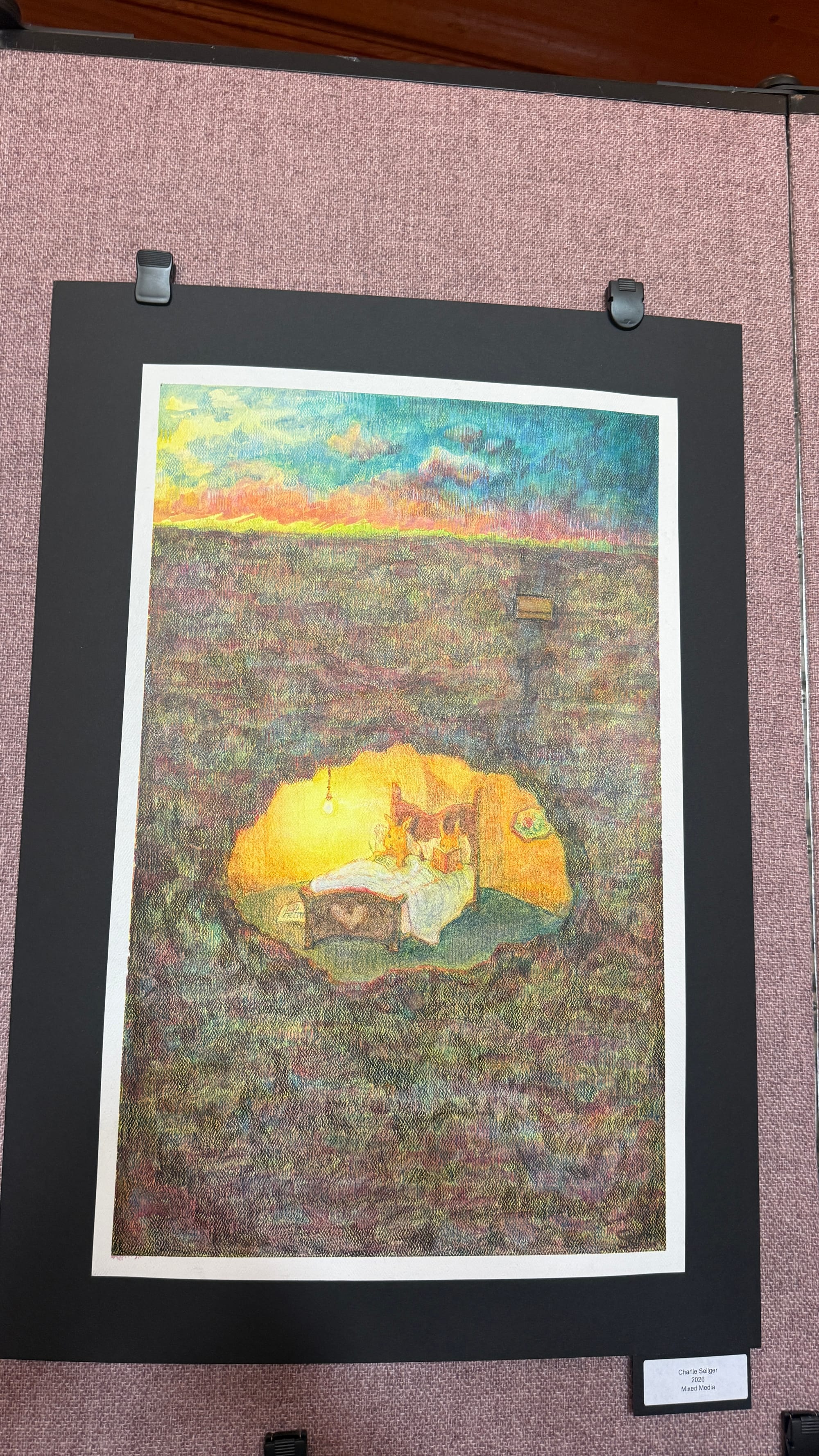
The piece the curators gushed over was Charlie Seliger's mixed-media work — drawn first in pencil, then washed in watercolor over what they called a "wicked long time" — shows a clutch of rabbits tucked into a small lit bed inside an earthen burrow, a warm pocket of gold beneath a wide, darkening field and sky. It is the kind of picture that stops someone without quite saying why.
"Quite frankly,” Greten said. “It looks like it belongs like a storybook.”
Get our free local reporting delivered straight to your inbox. No noise, no spam — just clear, independent coverage of Marblehead. Sign up for our once-a-week newsletter.