Table of Contents
Get our free local reporting delivered straight to your inbox. No noise, no spam — just clear, independent coverage of Marblehead. Sign up for our once-a-week newsletter.
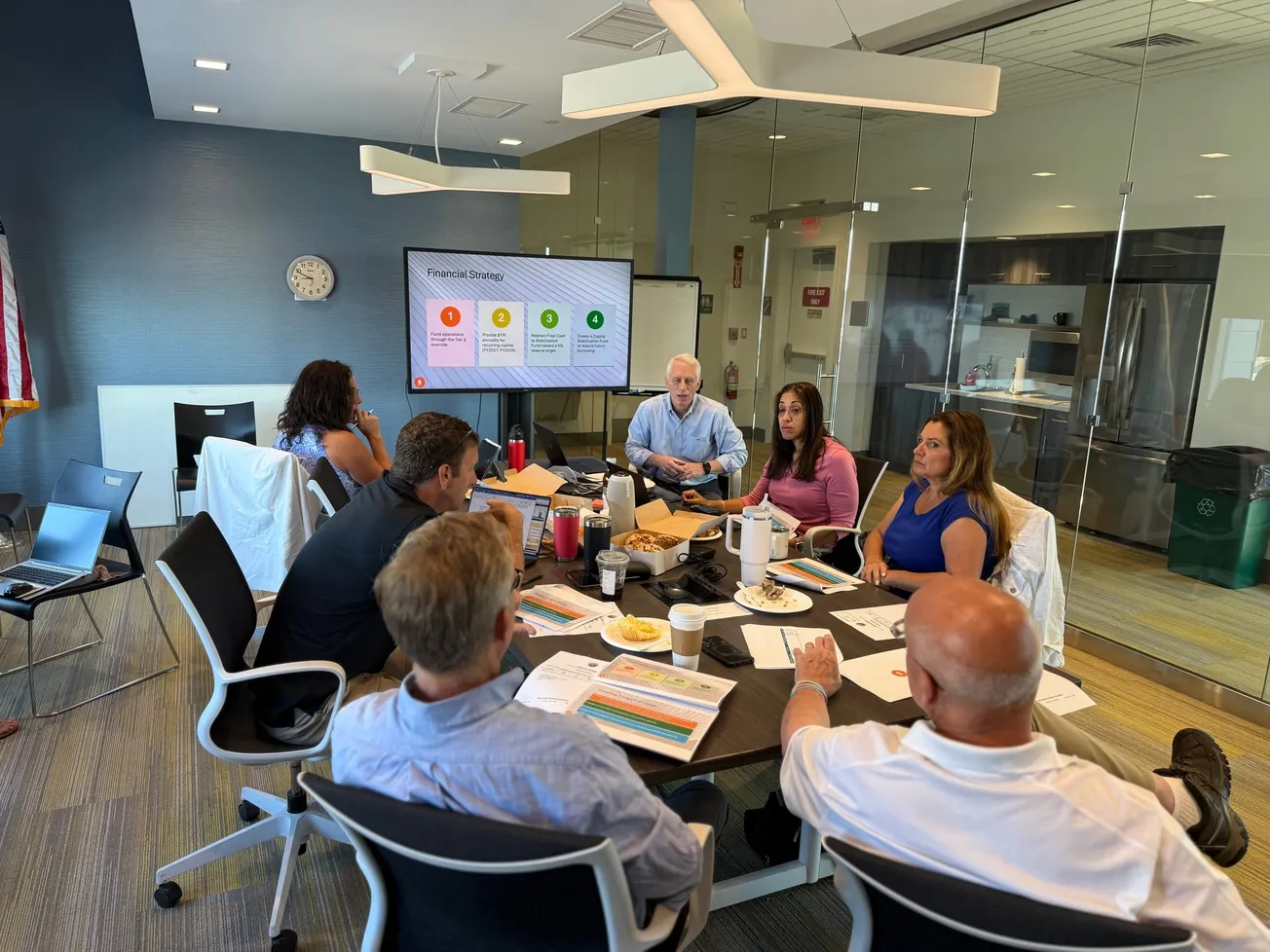
There were muffins the size of softballs on the table and boats on their moorings outside the windows. Select Board member Jim Zisson wanted a number.
Partway through the board's goal-setting retreat Friday morning, held in the second-floor conference room at the Marblehead Municipal Light Department overlooking the harbor, he asked Chief Financial Officer Aleesha Benjamin what she was seeing in health insurance.
"I'm predicting 10 percent," she said.
Marblehead budgeted $16.75 million for group insurance this year, up $1.65 million and the second-largest appropriation in the budget behind the school department. Another 10 percent would add roughly $1.7 million. That is the number the town's new 10-year plan is built around, and the one that could unbuild it.
"If it's 10 percent or below, we can probably absorb it," Benjamin said. "If anything higher than that, then we'll have to look."
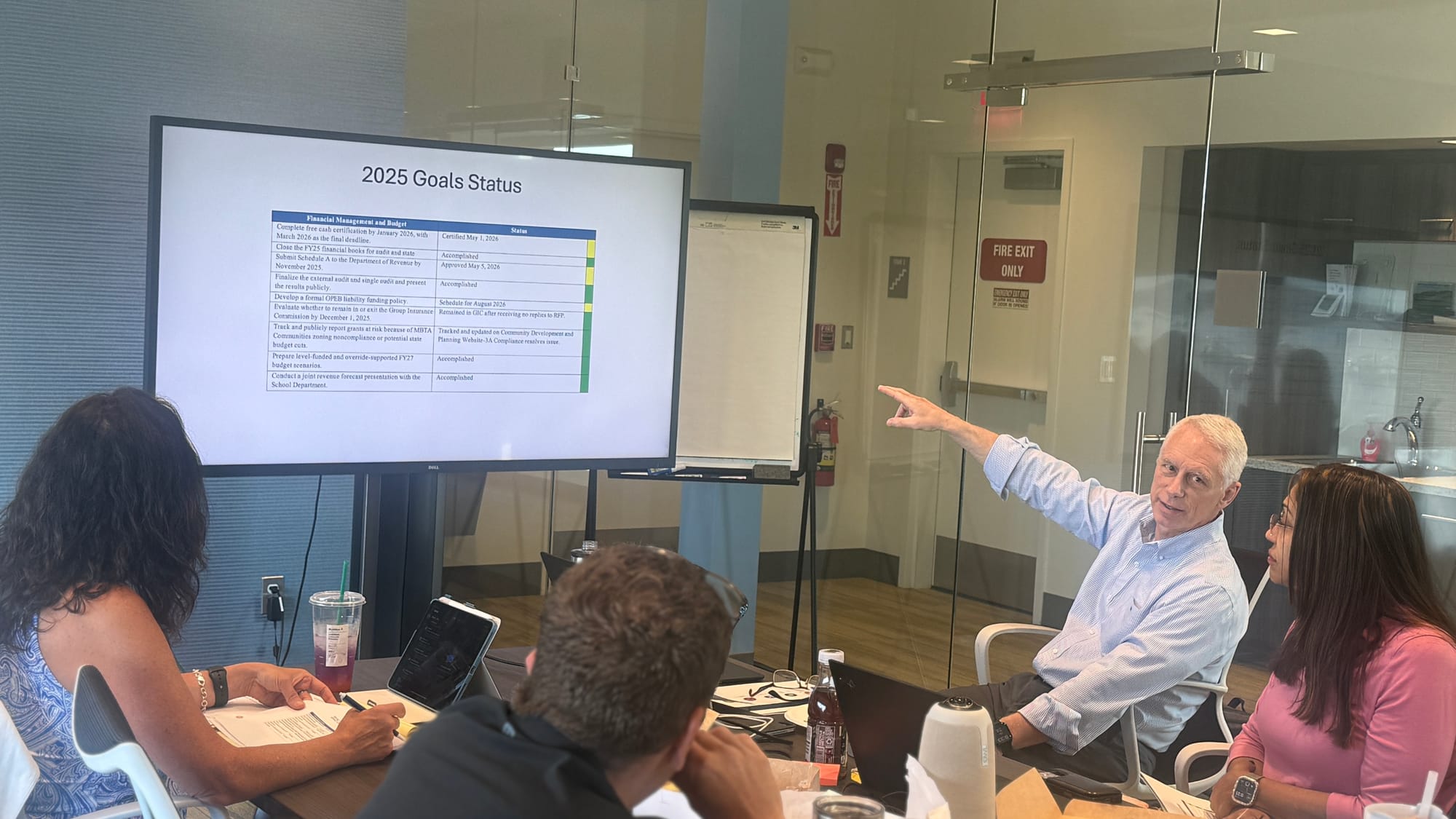
The retreat was the board's first extended look at the money voters approved June 9, when Marblehead passed a $15 million operating override, 4,278 to 3,594, its first since 2005. Turnout hit a record 8,092 ballots. Voters also approved a separate $2.3 million trash override.
Fiscal 2027 began July 1, so Town Administrator Thatcher Kezer, at Benjamin's left with a laptop and a coffee, spent the morning mapping with her what happens to that money through 2036. Nothing required a vote, and the talk moved accordingly: half presentation, half spitballing, ideas floated across the pastry boxes and left there. The slide on the screen reduced the plan to four boxes: fund operations through the Tier 3 override, $1 million a year for recurring capital, free cash into the Stabilization Fund toward a 5 percent reserve and a new fund to hold down borrowing.
The budget it lands on is austere. Town Meeting appropriated $123.5 million on May 4 — $110.2 million in the general fund, $13.3 million from enterprise funds — after closing a $7.7 million deficit. The town cut 22 positions, 12 percent of its general-fund workforce; the schools cut 18.25, or 4 percent. It also zeroed out $250,000 a year for retiree health care and $250,000 for the Stabilization Fund. The override restores in stages, starting with $4,296,718 this year.
Health costs set the ceiling
Health insurance drove $1.7 million of that $7.7 million gap. Group Insurance Commission rates have risen 6 percent, 7 percent, 9 percent, 13 percent and 10 percent over the last five budget years, an average of 9 percent.
Shopping the private market did not work. Marblehead's claims experience is too high, Benjamin said, and no carrier bid. Zisson said a Finance Committee consultant found the town roughly $3 million "upside down" on premiums, paying more in claims than it collects. The state absorbs those losses inside the Group Insurance Commission in a way private funds do not. A Public Employee Committee settlement adds an opt-out in fiscal 2028 and buys about two years to shop again.
In fiscal 2028, the town intends to move school employees' health-insurance and pension costs onto the school side of the budget while still administering the benefits. Zisson raised one caution.
"The downside I have is they have the authority to move the money elsewhere," he said, pointing to declining enrollment as an example.
Kezer said the change also fixes an old distortion. When the school side weighed the cost of adding employees, he said, "they only calculated the salary, and we took a hit for the health."
That reallocation is already visible. Recalculating shared benefits moved the town-school split from 49-51 to 38-62, dividing this year's $96.5 million in available revenue into $36.4 million for the town and $60.1 million for schools. The April 7 memorandum of understanding holds that formula through fiscal 2029 and bars another general override until at least fiscal 2030.
Free cash heads back to reserves
Because the override builds recurring capital into the levy, free cash no longer has to cover it. The town certified $6.1 million and spent $5 million balancing the operating budget, leaving nothing for reserves. The Stabilization Fund sits at $1.5 million, or 1.4 percent of the general-fund budget, the fourth-lowest ratio in Massachusetts. The target is 5 percent, roughly $5.5 million.
The override carried something else the town had never funded: a $450,000 building-maintenance budget.
"Many, many municipalities, and I'll say every single one I work for, defers their maintenance because they never have a dedicated maintenance budget," Benjamin said.
The trash override replaces the $2.2 million annual fee residents would otherwise be paying now and covers five years of contracts, pushing the next decision on curbside collection to about 2031. The local rooms-and-meals excise cleared $1 million for the first time, in what Benjamin called "an astronomical year."
Debt service runs $11.5 million this year; Benjamin said she has held it at or below roughly $11 million since arriving around fiscal 2024. About $1 million in debt exclusions falls off in 2032 and $2.4 million more in 2035, dropping the annual bill toward $8.5 million.
The pension line, $5.84 million this year, climbs to nearly $14 million by 2036, when the pension is expected to be fully funded, four years ahead of the state's deadline. Benjamin will ask the board in August to redirect about 65 percent of that freed money, roughly $9 million, to Other Post-Employment Benefits (OPEB), the retiree health care liability the town stopped funding this year, leaving about $5 million for the budget.
Select Board member Moses Grader asked why that share. "Why not 50 percent? Why not 40 percent?" The liability is too large and growing too fast for a smaller share to dent it, Benjamin said. Kezer expects the state will eventually impose an OPEB schedule the way it did for pensions.
"We want to stay ahead of that," he said.

Capital list dwarfs what got funded
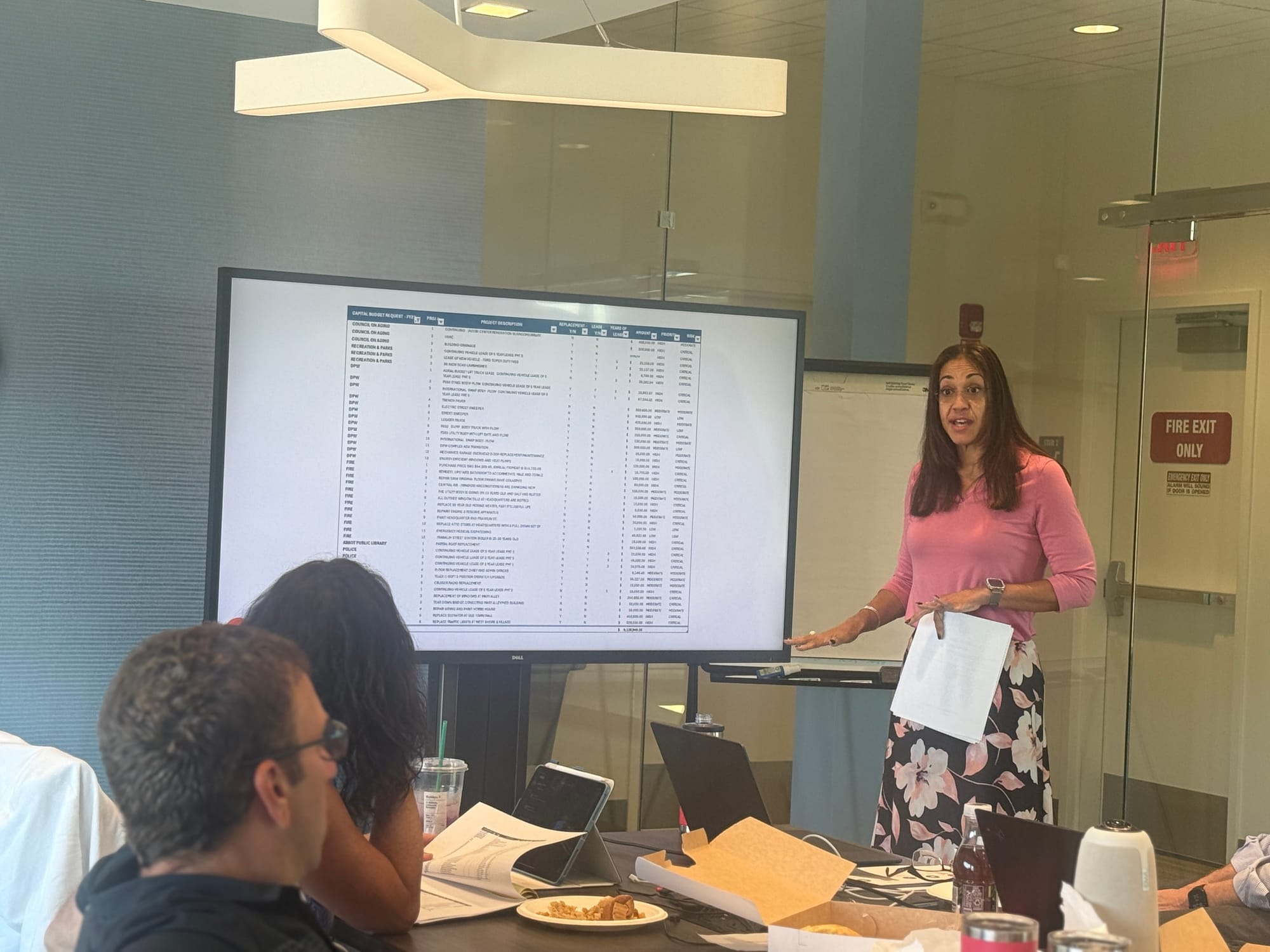
Then Benjamin stood at the screen with the capital request list: a Council on Aging elevator, a trench paver, traffic lights at West Shore and Village. Each row carried a priority and a risk rating, critical to low, and the column at the right ran to about $6.1 million on the town side, with $1.6 million more from the schools. Behind it sits roughly $80 million in identified need.
What Town Meeting could fund was $510,682, all of it existing leases: trash carts, a plow truck, three police vehicles, a school bus. The override's $1 million in recurring capital begins closing the gap, with $500,000 for the schools in its final year.
How to choose among the rest drew the longest exchange of the morning. Town Moderator Jack Attridge said the Capital Planning Committee once built a prioritized list for every capital asset in town, rather than judging projects one at a time at Town Meeting. Grader said the planning never stopped, but the town does a poor job showing it.
Some planning is already physical. The Department of Public Works building is moving out of what Kezer called crisis status as staff repair its floor and electrical systems, and the salt shed is being designed for conversion if the town switches to liquid brine de-icing.
By late morning the conversation had loosened further. Kezer floated a building nobody has started planning. The Broughton Road senior-housing redevelopment will crowd youth services out of the community center, he said, and one facility could hold youth services, full-day preschool and the historic archives, phased into debt service as the old debt falls away.
Select Board Chair Dan Fox suggested a first step.
"I think we need to get a year or two here of showing that we can maintain our current facilities before we start talking about building and acquiring," he said.
The last slide put a condition on everything before it: no further operating override through 2036, provided inflation runs near 3 percent and health insurance stays at or below 10 percent. Kezer said the town had spent the year moving from the edge of a cliff, looking into the valley, to a place where it could see out.
"We actually look forward now," Fox said.