Table of Contents
The Bay State sets record-tying nine-question ballot for Nov. 3
Get our free local reporting delivered straight to your inbox. No noise, no spam — just clear, independent coverage of Marblehead. Sign up for our once-a-week newsletter.
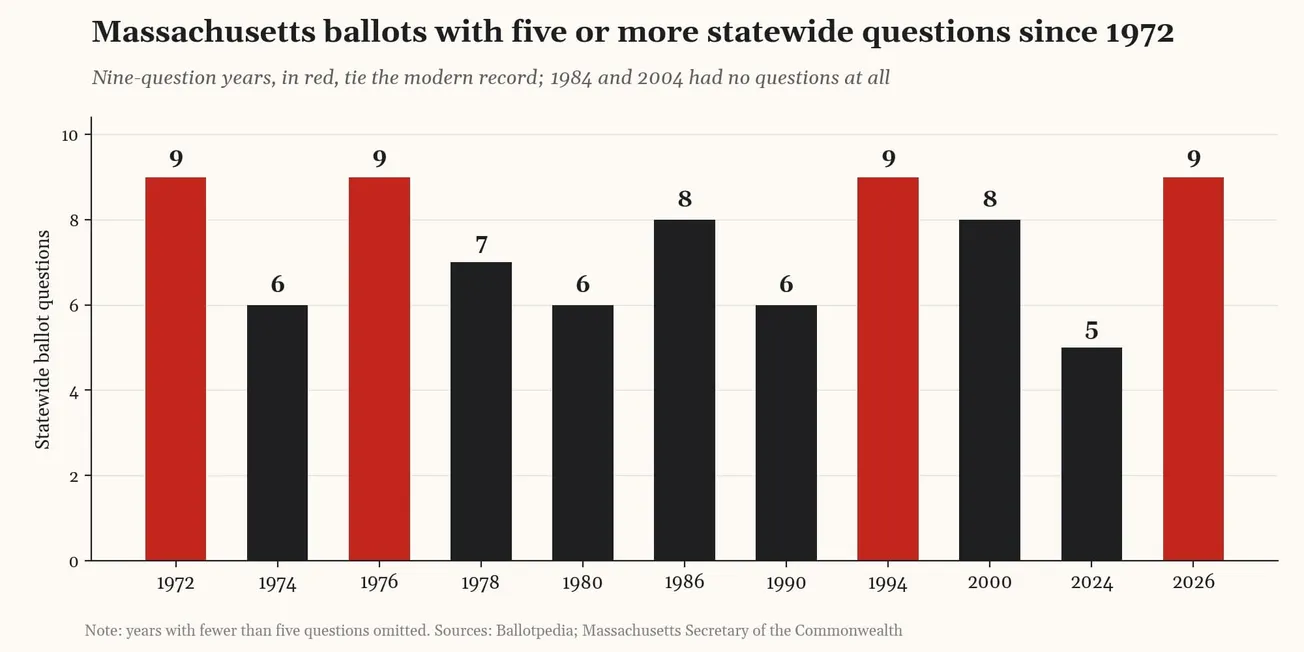
Massachusetts voters will need to keep turning the page Nov. 3. Nine statewide questions — enough that most communities expect ballots running two to three pages — ask them to rewrite the rules on government transparency, elections, taxes, conservation, housing, marijuana and guns, tying a modern record set in 1972, 1976 and 1994.
The field locked July 21, when Secretary of the Commonwealth William Francis Galvin's Elections Division assigned final numbers and, the same day, the State Ballot Law Commission rejected the last pending challenge — a fraud objection to the marijuana repeal's signatures — finding objectors had not proved enough names invalid.
The nine are what survived a boom. Attorney General Andrea Campbell said residents filed "a record-breaking 47 ballot initiative petitions this year," and the Legislature enacted none of the certified measures by its May 5 deadline. The Supreme Judicial Court (SJC) then thinned a potential field of as many as 12 in June: it struck a rent-control petition whose exemption for religious institutions' housing made it an "excluded matter" the state constitution keeps off the ballot; blocked an income tax cut after finding Campbell's official summary of it "significantly misleading" and helped sink a legislative-stipend overhaul with an advisory opinion.
Eight of the survivors are initiative petitions — citizen-drafted laws that reached the ballot after backers gathered 74,574 signatures, 3% of the last vote for governor, lawmakers declined to act and backers collected 12,429 more. The ninth is a veto referendum, an up-or-down verdict on a law already in force. Each is decided statewide, yes or no.
Question 1 would make most records held by the Legislature and the governor's office public records, with carve-outs for policy drafts and constituent communications. Both branches are now exempt — a status the Coalition for Healthy Democracy and its proponent of record, Jesse Littlewood, call a national outlier. The House answered in June with a bill covering the governor's office but writing separate rules for lawmakers. A yes vote opens both branches' records; a no vote keeps the exemptions.
Question 2 would give employees of the Committee for Public Counsel Services (CPCS), the state's public defender agency, an explicit right to unionize and bargain collectively. Tom McKeever of Service Employees International Union Local 888 filed it after the 2025 right-to-counsel collapse, when bar advocates — paid $65 an hour in district court, the lowest rate in New England — stopped taking cases, and courts under an SJC protocol freed unrepresented defendants and dismissed more than 120 cases in Boston Municipal Court in a single day. But bar advocates are contractors, not CPCS employees, so the question would not by itself settle their pay fight. A yes vote creates the bargaining right; a no vote leaves current law in place.
Question 3 would end party primaries for state and congressional offices — presidential contests aside — replacing them with one primary listing every candidate; the top two advance to November regardless of party, and candidates for governor and lieutenant governor run as a ticket. The same coalition, whose convening chair is Harvard's Danielle Allen, points to arithmetic: State House News Service, using data from Galvin's office, found voters will have a choice between listed candidates in just 82 of 200 legislative seats this year, with 25 incumbent senators and 91 representatives unopposed. Two veteran Democrats sued to block the question; the SJC let it proceed. A yes vote creates the top-two system; a no vote keeps party primaries.
Question 4 would let eligible residents register, or update an address, at the polls on Election Day by showing proof of residency and signing an oath; suspect attempts would be referred for criminal investigation. The proponent of record is Galvin himself — the chief elections officer went to the ballot after the House repeatedly killed same-day registration bills. Registration now closes before Election Day, and the National Conference of State Legislatures counts 25 states and Washington, D.C., that already allow same-day sign-ups. A yes vote permits Election Day registration; a no vote keeps the current deadline.
Question 5 would rewrite Chapter 62F, the 1986 cap on state tax collections, resetting the limit each year to the prior year's actual collections grown with wages — and counting the Fair Share surtax money lawmakers walled off in 2023. The cap has hit twice: 1987, then fiscal 2022, when collections of about $41.8 billion topped an allowable $38.9 billion and the state returned $2.94 billion to roughly 3 million taxpayers as credits equal to 14.0312% of each filer's 2021 income tax liability, per the Department of Revenue. Christopher Anderson of the Massachusetts High Technology Council filed the rewrite. The Tufts Center for State Policy Analysis projects the new formula would make refunds "routine" — arriving three to five times as often and returning five to 15 times as much money — and the business-backed Massachusetts Taxpayers Foundation calculates it would have paid out $3.9 billion in fiscal 2024. The Massachusetts Budget and Policy Center counters that folding in the surtax "erodes the intent" of the 2022 Fair Share vote. A yes vote installs the new formula; a no vote keeps the current law.
Question 6 would steer the state sales tax collected on sporting goods, recreational vehicles and golf into a new Nature for All Fund — half of it at first, all of it after July 1, 2028 — with spending still subject to legislative appropriation. Mass Audubon's Sam Anderson filed it; campaign spokesperson Andrew Farnitano pegs the yield near $100 million a year, based on $2.49 billion in reported 2022 sporting-goods sales. Those receipts now flow into the general fund alongside the rest of the more than $9.6 billion the state collected in sales and use taxes in fiscal 2025. Because lawmakers keep the final say, Anderson has conceded, "The goal is to set up this fund, and to send a message." A yes vote creates the fund; a no vote keeps the receipts in the general budget.
Question 7 would bar cities and towns from requiring lots larger than 5,000 square feet, or more than 50 feet of frontage, for a single-family home on residential land already served by public water and sewer. Zoning codes set those minimums town by town now, and Boston, governed by its own statute, is exempt. Andrew Mikula, a senior housing fellow at the free-market Pioneer Institute, filed it, citing academic evidence that minimum lot sizes raise home prices and slow construction. A yes vote caps lot-size mandates statewide; a no vote leaves zoning local.
Question 8 would end legal recreational marijuana sales a decade after voters approved them, closing licensed shops, growers and testing labs and banning home cultivation, now capped at six plants for adults 21 and older. Medical marijuana and decriminalized possession of up to an ounce would survive — there would simply be no legal place to buy. No state has reversed adult-use legalization, and the market at stake logged $1.65 billion in 2025 sales, per the Cannabis Control Commission. The Coalition for a Healthy Massachusetts qualified the question with out-of-state money: its entire $1.55 million came from SAM Action Inc. of Alexandria, Virginia — the Smart Approaches to Marijuana network — and more than $1.4 million of that paid a Missouri firm to gather signatures, per state campaign finance filings. A University of New Hampshire poll of 620 likely voters released Feb. 24 found 20% supported repeal and 63% opposed it. A yes vote ends retail sales and home growing; a no vote keeps the current market.
Question 9 is a veto referendum on Chapter 135 of the Acts of 2024, the firearms law Gov. Maura Healey signed July 25, 2024 — and it reads in reverse: a yes vote keeps the law, a no vote repeals it, and the gun-rights groups that forced the vote are campaigning for no. The law broadened the state's assault-style weapons definition, regulated ghost guns, banned bump stocks, expanded extreme risk protection orders and required live-fire training; it passed the House 124-33 and the Senate 35-5. The Civil Rights Coalition, chaired by Toby Leary of Cape Gun Works — "Gun rights are civil rights," he says — had 78,707 signatures certified, more than double the 37,287 needed for the ballot but short of the roughly 49,700 that would also have suspended the law, so Chapter 135 has been in force throughout. Yes for a Safe Massachusetts, led by Ruth Zakarin of the Massachusetts Coalition to Prevent Gun Violence and backed by Healey, defends it in a state that posted the nation's second-lowest gun-death rate in 2024 — 3.8 deaths per 100,000 people, per a Violence Policy Center analysis of federal data. A yes vote keeps Chapter 135; a no vote repeals it.
The money behind the questions is concentrated and, in the marquee fights, national. Filings with the state Office of Campaign and Political Finance through Jan. 20 — the last before a blackout that runs to September, so most 2026 money is not yet public — show the Coalition for Healthy Democracy committee behind Questions 1 and 3 spent nearly $2.1 million in 2025, the most of any ballot committee, led by about $550,000 from David Randolph Peeler. Taxpayers for an Affordable Massachusetts, the Question 5 committee, drew $1.6 million from the Massachusetts Opportunity Alliance. For Question 9, Smith & Wesson's $50,000 contribution in 2024 remains the repeal side's largest reported gift, per The Boston Globe, while Everytown for Gun Safety gave $39,900 to the other side.
For Marblehead and Essex County, Question 7 cuts closest to home. Ali DiMatteo, counsel to the Massachusetts Municipal Association, warned that "many, many municipalities with water and sewer are at or near capacity," pointing to North Shore communities already turning to the Massachusetts Water Resources Authority, and said the measure "makes no mention of capacity issues." Chris Kluchman of the Executive Office of Housing and Livable Communities countered that towns "would not be forced to amend their zoning," though they would have to allow lot divisions down to 5,000 square feet. Question 8 touches town budgets too: host communities may levy up to a 3% local tax on marijuana sales, revenue that ends if the sales end.
The official rundown reaches voters in September, when Galvin's office publishes its red "Information for Voters" booklet: each question's summary, the plain yes-and-no statements and 150-word arguments from each side. Then comes a ballot two to three pages long, ending on the one question where voting yes changes nothing.