Table of Contents
Get our free local reporting delivered straight to your inbox. No noise, no spam — just clear, independent coverage of Marblehead. Sign up for our once-a-week newsletter.
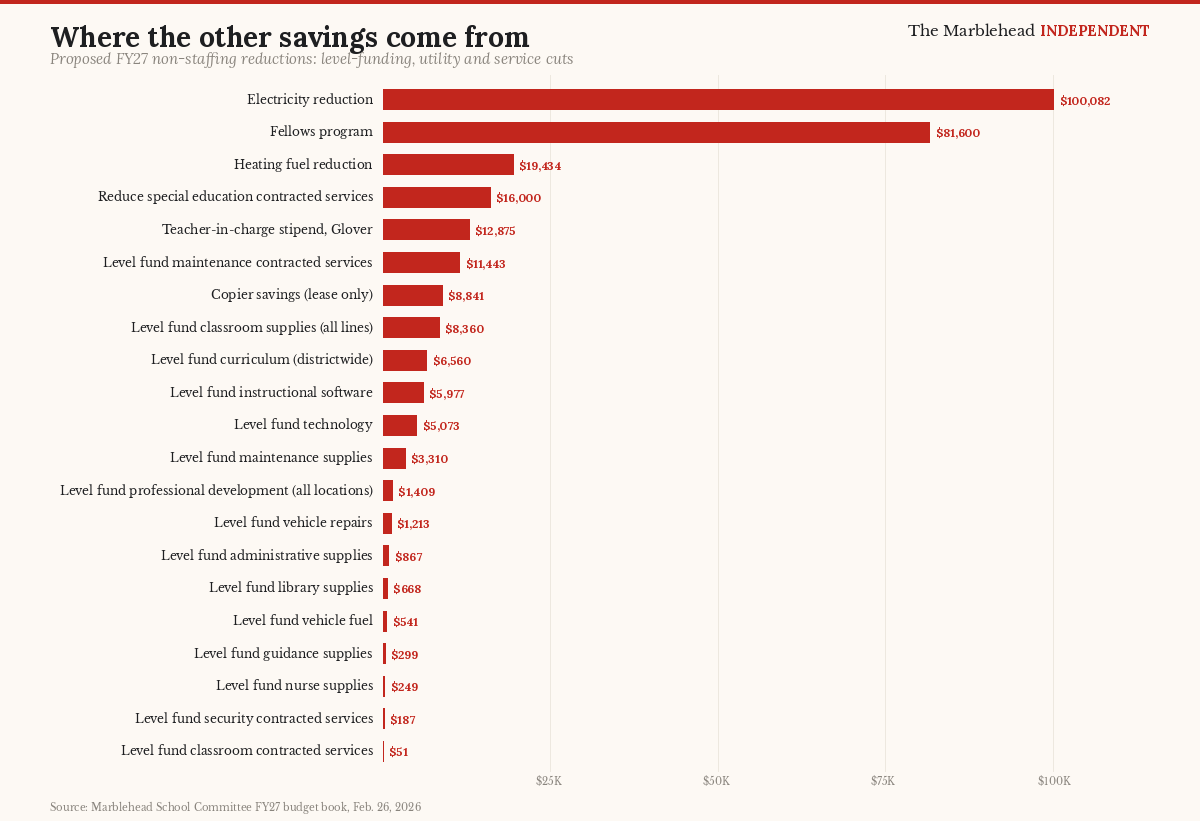
With a $49.1 million level-funded budget that trims staffing, the Marblehead School Committee faced sharp questions Thursday about whether the town should pursue a Proposition 2½ override.
The proposed fiscal 2027 spending plan totals $49,120,285 — identical to the current approved budget. District officials estimate it would cost about $55.1 million to maintain current programs and staffing next year under a level-service budget — roughly $6 million more than the proposed plan.
Superintendent John Robidoux said holding spending flat comes with tradeoffs.
“The district is being asked to operate with the same funding as the current year,” he told the committee, adding that the budget “places constraints on our ability to provide high-quality, rigorous education to our students.”
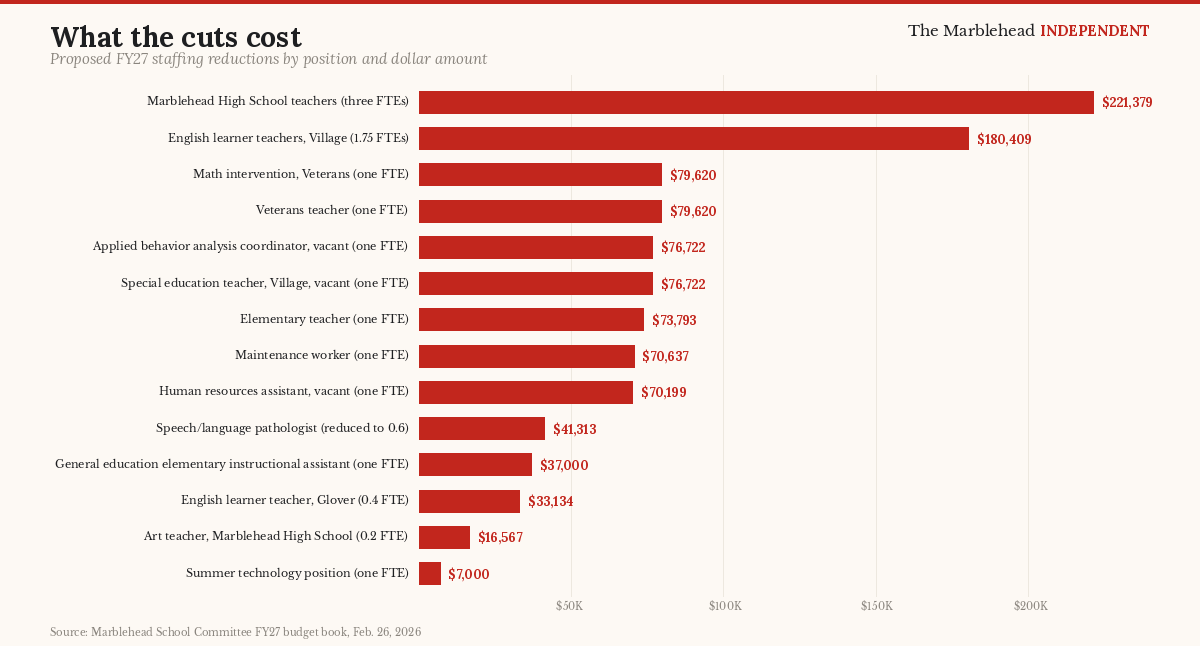
The proposal eliminates 14.75 full-time equivalent positions and one stipend across two rounds of cuts.
Enrollment has declined 23% over the past decade, from 3,144 students in 2016 to 2,435 this year — a loss of 709 students. Licensed teaching positions have fallen 19% during that period, from 263.9 full-time equivalents in 2016-17 to a proposed 215.4 next year — a reduction of 48.5 positions. Robidoux said the district projects about 2,349 students next fall, roughly 86 fewer than the current enrollment, describing the forecast as “a moving target.”
Committee member Melissa Clucas cautioned against equating declining enrollment with proportional cost reductions.
“The system, while smaller, is much more complex, much more highly regulated,” she said.
She noted that while overall enrollment has declined, the share of high-needs students has grown from 27% in 2016 to 32% this year. That represents roughly 849 high-needs students out of 3,144 a decade ago compared with about 779 of 2,435 today — fewer students overall, but a larger proportion requiring services, increasing demands on staffing and programming.
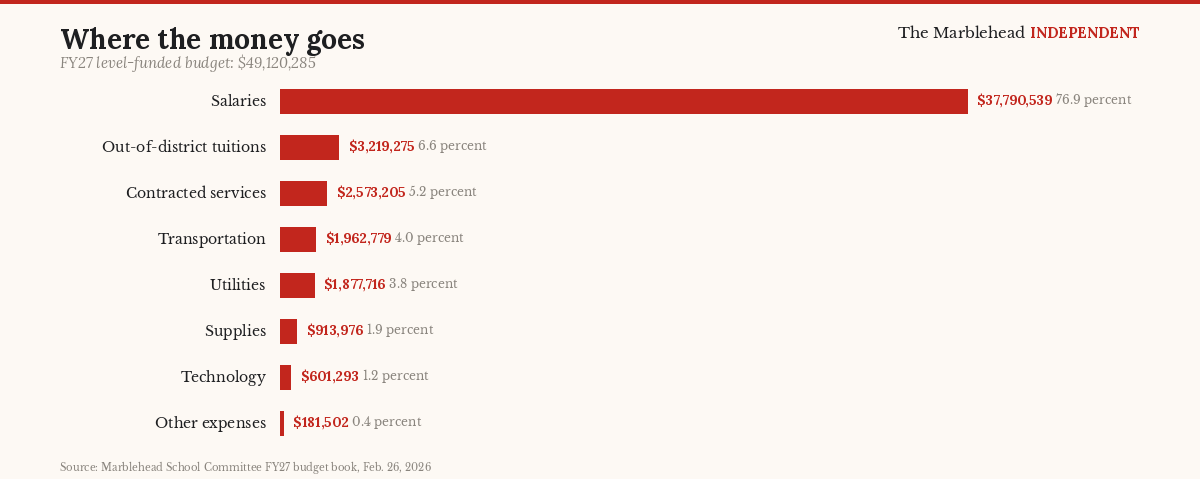
Assistant Superintendent of Finance and Operations Michael Pfifferling said roughly 80% of the $49.1 million level-funded budget — about $39.3 million — goes to salaries. The district has relied more heavily on revolving accounts, including prekindergarten and kindergarten tuition, to reach level funding — a strategy he said could last only a few years.
“We could probably do that for three years before we need to tamp it back down,” he said.
Special education out-of-district tuition and transportation costs are projected to rise from $6,122,273 this year to about $6,627,273 next year — an increase of roughly $505,000. Contractual salary increases of 3% will add approximately $1.18 million in fiscal 2027 alone.
Residents warn of impact as staffing cuts take shape
Public comment reflected frustration. A teacher with nearly 20 years in the district warned that cutting intervention positions would leave struggling students behind.
“My concern is that with fewer bodies in the building, we won’t have the opportunity to provide those services,” she said, pointing to students on the cusp of needing support. “I really just worry about those few kids on the cusp who might slip through the cracks.”
Samantha Rosato, a parent and former school employee, urged the committee to pursue a Proposition 2½ override.
“Buildings don’t educate the children,” she said. “People do.”
She noted that Marblehead has not approved a general override since 2005 and argued that the standard 2.5% annual increase rarely keeps pace with rising costs.
“When Marblehead Public Schools receives a two and a half percent annual increase, it rarely keeps up with actual costs,” she said. “This year, a zero percent increase.”
She also questioned recurring year-end surpluses and whether the proposed budget reflects what students need.
Robidoux responded cautiously.
“We drafted a budget that met the expectations of the town at this point,” he said. “That’s the best way I can answer that question.”
Questions about surplus and transparency
David Patton, who said he does not have children in the schools but follows the budget closely, questioned enrollment forecasting and whether staffing reductions should go further given declining student numbers.
“If you lost eight and a half percent of your student body this year, and you’re going to lose some more next year, then all of these cuts seem perfectly reasonable to me, and maybe should be greater,” he said.
Robidoux and Clucas emphasized that the districtwide 11-to-1 staff-to-student ratio reflects all licensed staff relative to 2,435 students, not class size. Average kindergarten through sixth-grade classes currently sit at 19.7 students.
Former School Committee member Sarah Fox pressed for greater transparency in how surplus funds and out-of-district special education prepayments are presented.
“It’s about transparency,” she said.
Pfifferling said year-end balances largely result from unfilled positions and the district’s practice of prepaying about $1 million annually in special education tuition. He said a vacant math interventionist position budgeted at about $75,000 and an unfilled human resources assistant position budgeted between $65,000 and $70,000 together accounted for more than $140,000 in savings in one recent year.
“The crumbs start adding up,” he said, noting that the district might end a year with roughly a $600,000 surplus after prepayments are applied.
Shelly Curran Bedrossian asked about rising enrollment at Essex Technical High School. Robidoux said roughly 27 Marblehead students are believed to be attending this year, more than double the prior year, though the final count is not confirmed. Pfifferling said vocational school costs are carried in the town’s budget rather than the school department’s.
Override discussion emerges as vote approaches
Retired educator Anne Marie Jordan urged residents to organize early if an override is pursued, recalling the broad community effort behind the town’s last successful campaign.
Finance Committee member Molly Teets called the current budget season the most difficult she has seen in four years.
“The best run towns have a collaborative relationship between the schools and the town,” she said.
All five School Committee members expressed support for increased school funding. Jennifer Schaeffner said this is the first time in her experience the committee has been asked to bring forward a fully level-funded budget. A placeholder for a general override remains on the town meeting warrant, though no decision has been announced.
“I don’t think people get themselves onto a School Committee because they don’t want to fund the schools appropriately,” member Kate Schmeckpeper said.
School Committee member Henry Gwazda said that if the committee determines an override is necessary, he would support it.
Robidoux closed by pointing to student performance despite financial constraints.
“We are doing a lot with realistically a little,” he said. “That speaks volumes to the staffing that’s in the classrooms.”
BEFORE YOU GO … Our reporting remains free and open to all. It is sustained by readers who choose to support it — by contributing so that routine, document-based local reporting continues without paywalls or promotional framing. Right now, 101 readers support The Marblehead Independent with monthly or annual contributions. Click here to become an Independent member.