Table of Contents
Robert Booth propped one loafer against a microphone stand, notes fanned across his lap, and told a crowd spread across the lawn at Goldthwait Beach Reservation that a Marblehead shoemaker who never held elected office had twice kept George Washington's campaign from collapsing.
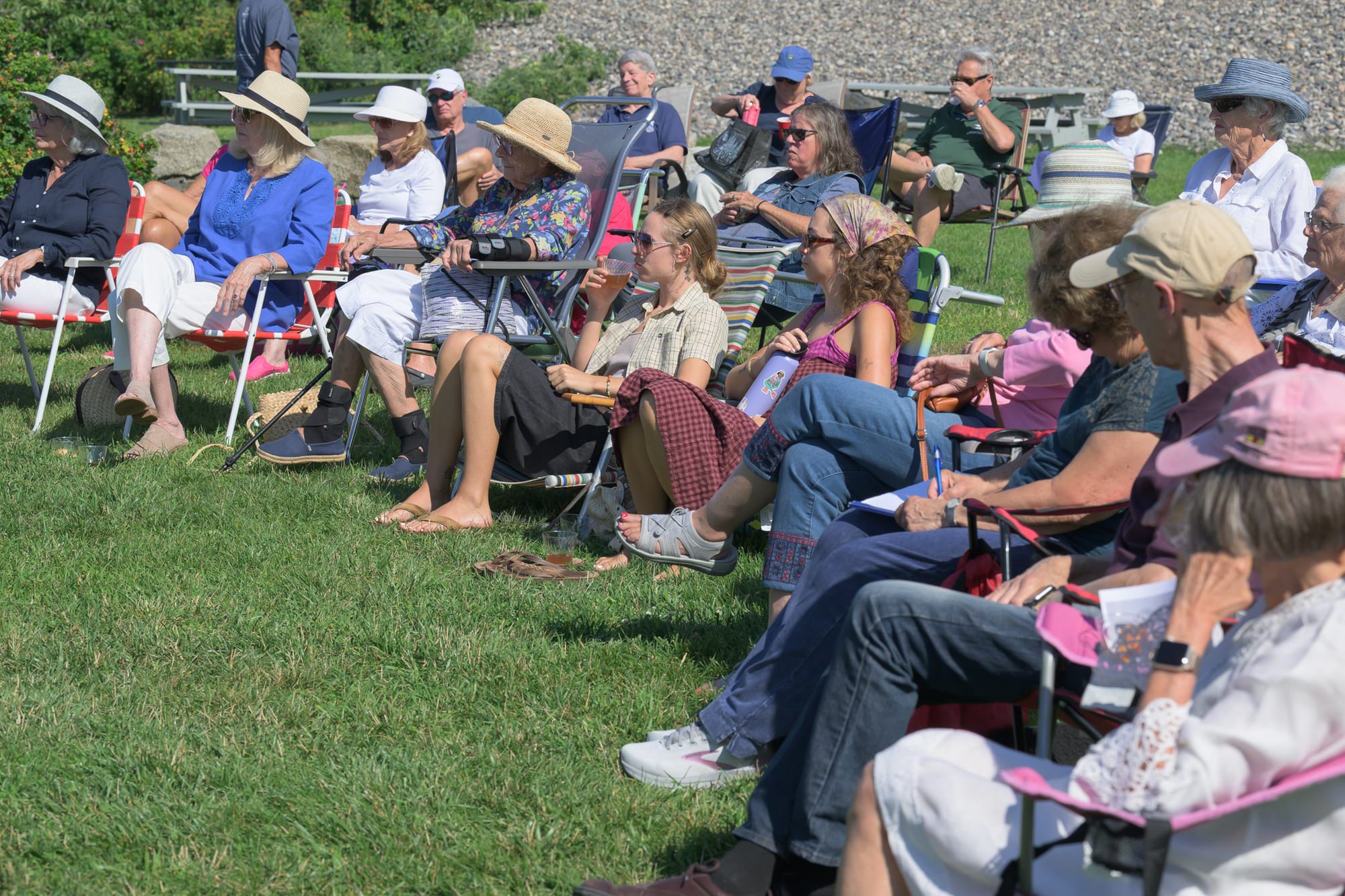
The July 25 talk, held under a blue event tent with camp chairs and sun hats scattered across the grass and rosa rugosa hedges screening the parking area, opened "Glovers at Goldthwait," a three-part series tied to Marblehead 250, the town's recognition of America's 250th anniversary. The series is funded in tribute to Daniel W. Shea, a longtime Goldthwait Reservation trustee who died before seeing it staged; organizer Fiona Lubbock also asked the crowd to remember Bob Healy, another Goldthwait trustee who died recently.

"I think many of us feel very strongly, as we get older, how blessed we've been to live here," Lubbock told the crowd, "in this beautiful, quiet space next to the ocean."
Booth, a Gloucester resident and Marblehead native, has written "Death of an Empire" and "Mad for Glory," along with "The Women of Marblehead," and serves as historian to the Save the Glover Farmhouse campaign. He needed a moment to adjust to the setting before he started.
"I'm used to speaking indoors, and I figured beach weather, there'll only be 12 people," he said, "but we're at the beach, so come on."
Then he turned to John Glover, the Marblehead man who spent the first 42 years of his life doing nothing to suggest what came next. Glover was born in Salem and orphaned young when his father died in 1737, leaving his mother, Tabitha, with four little boys and no property. The family moved in with Tabitha's brother-in-law, Benjamin Stacy, a Marblehead hat maker and tavern keeper who raised the boys as his own and paid to apprentice each of them rather than send them to sea at age 12 — the fate of most Marblehead boys in a fishery Booth said carried a 10% death rate, a figure he did not tie to any specific number of boats or crews lost.
Three of the four brothers used that head start to grow rich at sea. Jonathan Glover became a shipmaster and, by 1761, built the largest house in Marblehead, still standing off Front Street with what was then a 100-foot lawn running to the water. Samuel Glover fought the French and their Native allies before taking over the Three Cods Tavern. Daniel Glover became a ship's captain.
John Glover did neither. He made shoes until he was 29, then became what the era called a "gentleman" — an investor, not a merchant — putting borrowed money into the fishing trade. He never rose past ensign in the town militia and never held office. "Nothing about his life will predict that he is going to become a military leader," Booth said, "but I think that is what we like about him — that he was an ordinary person, and given the opportunity, he rose to the challenge and did something extraordinary."
By the early 1770s, Booth said, Marblehead had turned almost entirely against the crown, with only eight of the town's 6,000 residents remaining loyalists. Jonathan Glover joined the Non-Importation Committee and was elected selectman. Jeremiah Lee, one of the richest men in Massachusetts and colonel of the town regiment, was secretly importing Spanish munitions and had picked John Glover as one of his officers. When Lee died in May 1775 after fleeing British troops near Lexington, the officers above Glover stepped back, and the regiment elected him colonel instead.
Washington noticed. Booth said the Marblehead Regiment's discipline during the Siege of Boston led Washington to send its mariners out as the war's first American naval raiders, capturing 35 British merchant vessels within months.
Then, Booth said, came Pell's Point. In October 1776, Glover's 750 men were all that stood between roughly 3,000 landing British troops and the rest of Washington's retreating army. Glover sent a company of 40 men down the road to trade volleys with the oncoming British column; after five exchanges, all 40 walked away unhurt, having lured the British into a crossfire from two regiments hidden behind stone walls. Booth said 220 British soldiers were killed, stalling the entire advance for the rest of the day and letting Washington's army escape being cut off on Manhattan.
By Christmas, Booth said, Glover's own regiment had shrunk to 147 men and 30 officers as enlistments expired in the cold. That night, they ferried roughly 3,000 of Washington's soldiers across the ice-choked Delaware River for the march on Trenton — the first American victory of the war.
Glover asked to go home the moment it was over. Washington obliged, then wrote in February to say Glover had been made a brigadier general. Booth said Glover's reply came that April Fools' Day and began, "Surely you jest."