Table of Contents
Get our free local reporting delivered straight to your inbox. No noise, no spam — just clear, independent coverage of Marblehead. Sign up for our once-a-week newsletter.
Results of the Marblehead Independent’s first pulse of community sentiment suggest that several of the most consequential articles on the 2026 Town Meeting warrant — including a fiscal 2027 operating overrides and a Massachusetts Bay Transportation Authority Communities housing article — would have majority support from the residents who responded.
The findings arrive at a moment when the override itself is still taking shape, and town officials prepare to attach a dollar figure to the tiered override any day now.
The survey, open to town residents 18 and older who self-identified as living in Marblehead, drew 259 qualifying responses between March 23 and April 2. It is a snapshot of sentiment, not a scientific poll, but it offers the clearest public read to date of where engaged residents stand as Town Meeting approaches.
The Select Board on March 25 voted to pursue a three-tier service override and a separate trash-funding ballot question to close a $7.7 million budget gap, but dollar figures for each tier had not been released when the survey closed. Town Administrator Thatcher Kezer is expected to bring the tier amounts and restoration details back to the Select Board at its next meeting. Survey respondents were therefore reacting to the concept of an override, not to a specific dollar amount or ballot structure. A separate Marblehead Independent news analysis examines how that structure interacts with the town’s voting history.
Override: clear support, with a vocal minority opposed
Six in 10 respondents said they would support a fiscal 2027 operating override. That is the headline number, and it is the one that will get repeated. But the shape of the support matters as much as the size of it.
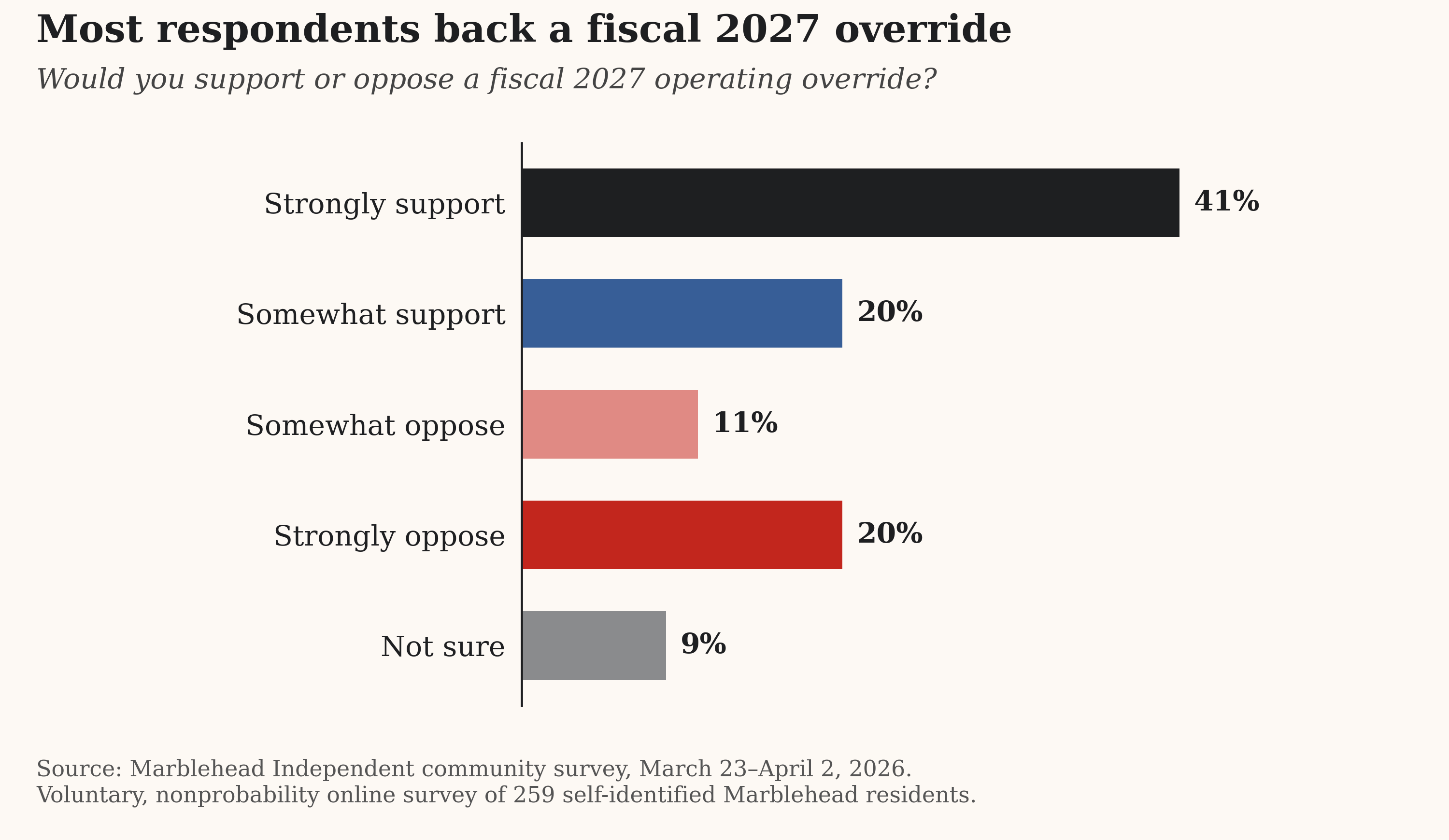
Two patterns inside the chart are worth pulling out. First, the strongly-support bloc is twice the size of the somewhat-support bloc — meaning the yes side is not soft. The people who say yes mostly say yes with conviction. Second, the strongly-oppose bloc is just as large as the somewhat-support bloc. There is a hard no vote in the room, and it is the same size as the soft yes vote. If a debate or a piece of new information moves the soft middle, the floor of the no side does not move with it.
The picture gets more complicated when respondents are asked not whether they support an override but how they want the gap closed.
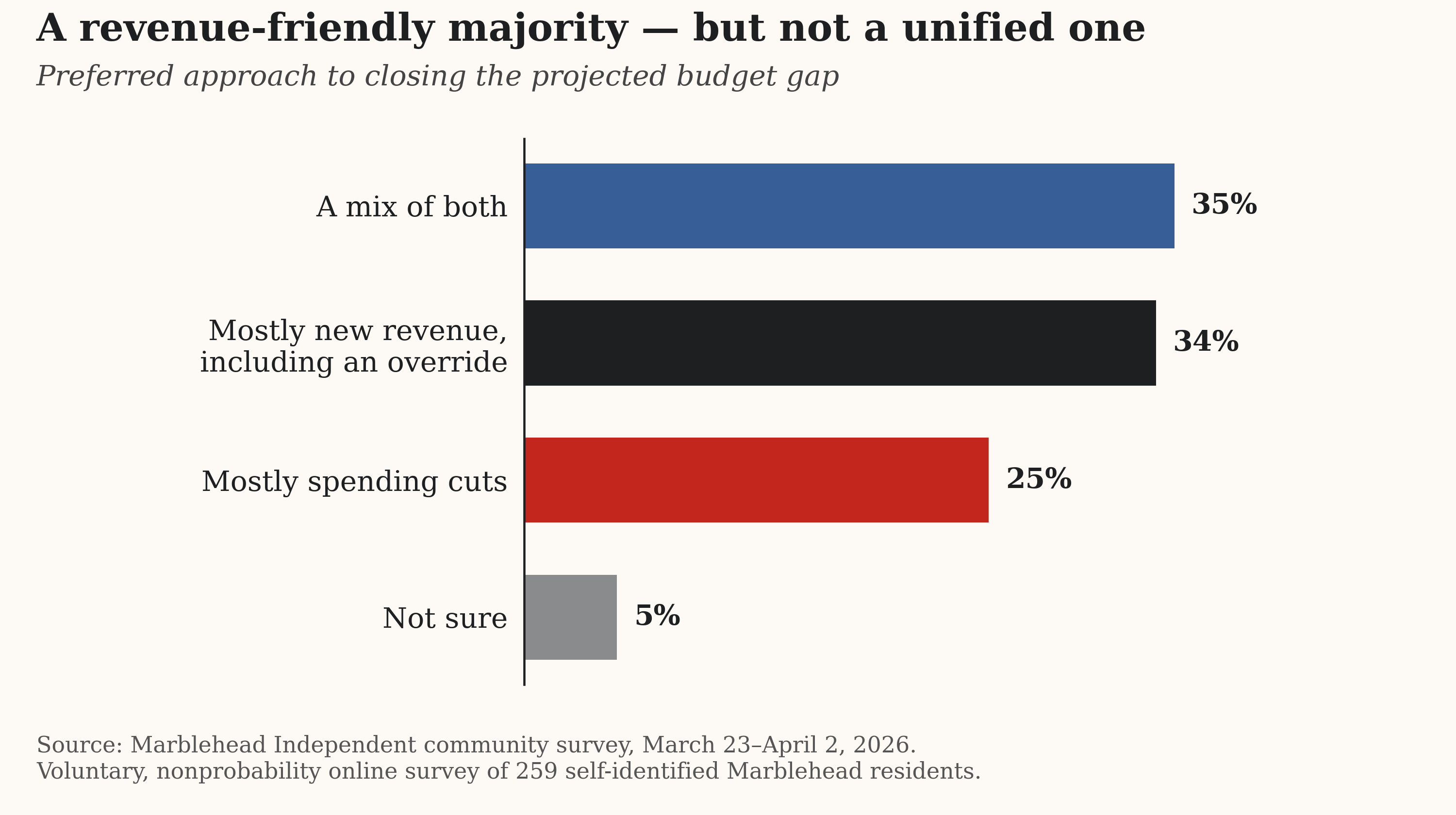
Only about a third of respondents picked “mostly new revenue” as the right approach. The largest single group picked “a mix of both” — wanting some combination of cuts and new money. And one in four picked “mostly spending cuts.” Add the cuts-first group to the mix-of-both group and you get a clear majority of respondents who want spending discipline to be part of any solution, even though most of those same people will also vote for an override. The override question and the approach question are not contradictions. They are two halves of the same answer: yes, raise the money, and also show me the cuts. The age breakdown adds a third layer.
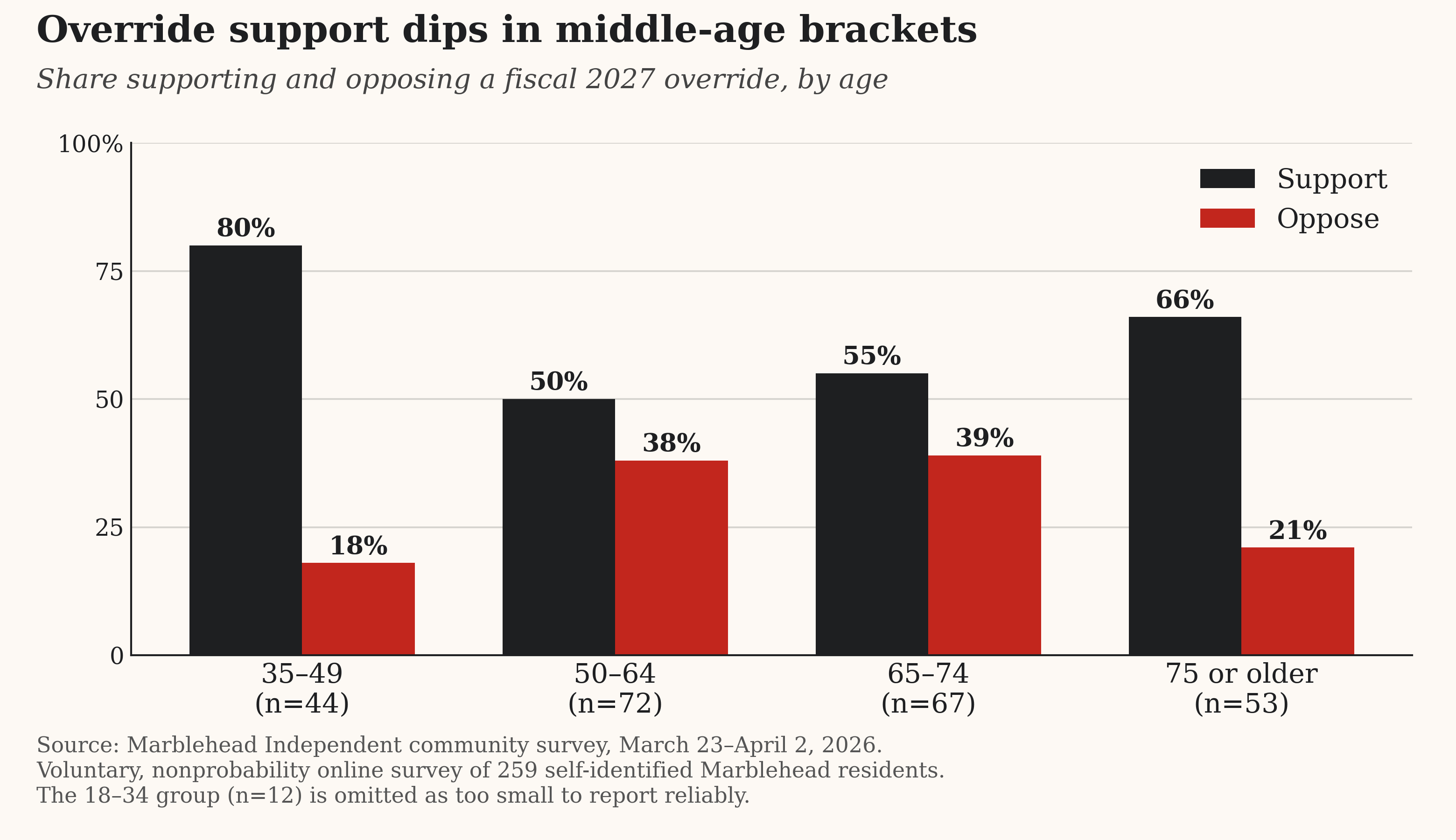
The strongest support comes from the 35-to-49 group, where four in five respondents back an override. Support also runs high among respondents 75 and older. The softest support — and the largest opposition — sits in the 50-to-74 brackets, the age range that includes most of the town’s empty nesters and recent retirees. That is the part of the electorate most likely to be on a fixed income but no longer have children in the schools. It is also, historically, the part of the electorate most likely to actually vote.
Support this work. One hundred eight members of this community are already supporting the Marblehead Independent through recurring monthly and annual contributions. This survey took roughly 12 hours to analyze, chart and report. All of it exists because of them. If this reporting mattered to you heading into Town Meeting, join them. A recurring membership contribution keeps the next one possible. Click here to become an Independent member.
Schools, roads and public safety top the protect list
Asked to choose up to three town services that should be the highest priority for protection if leaders have to make difficult budget decisions, respondents pointed to a familiar trio: roads, schools and public safety.
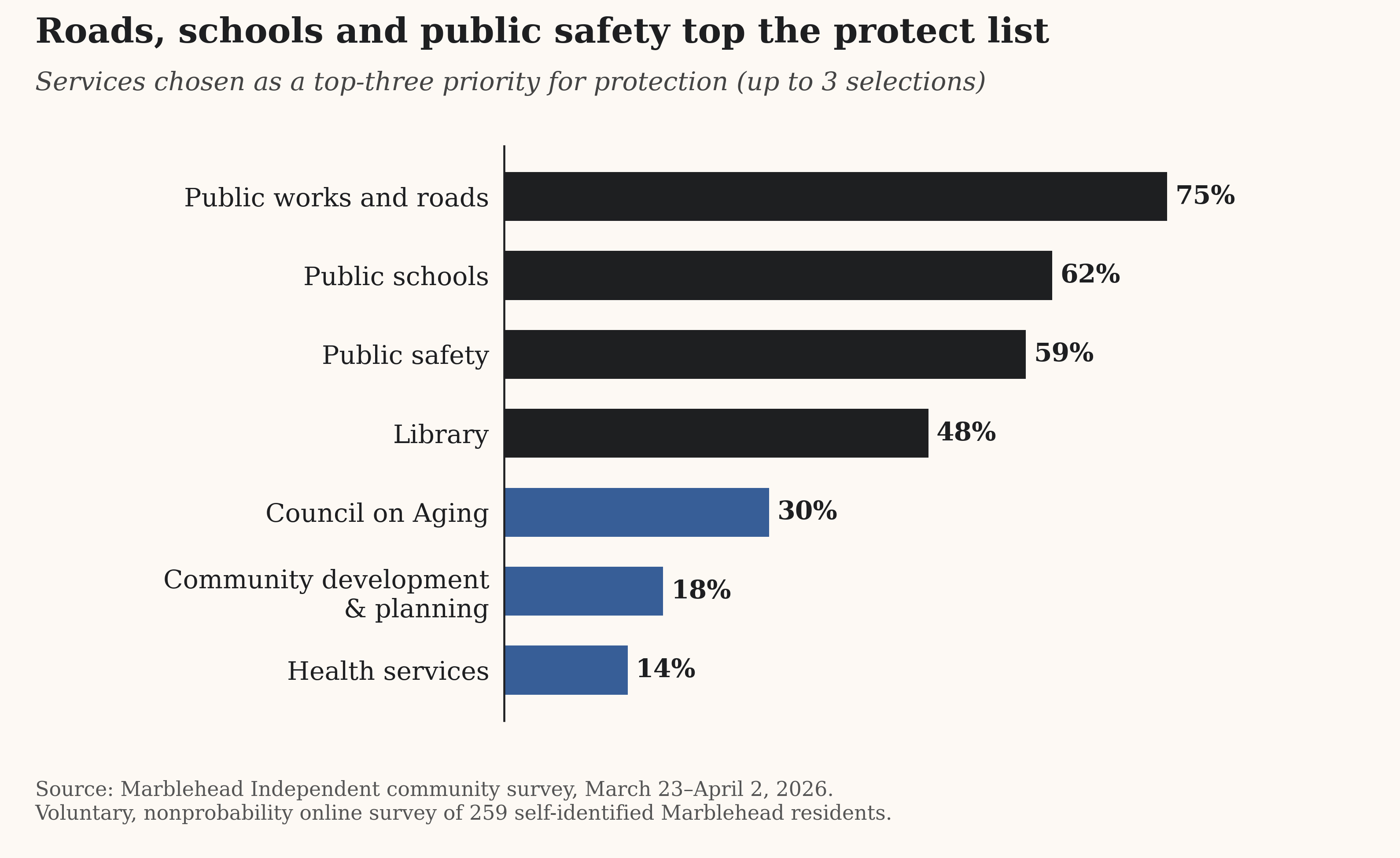
Three things stand out. The top three services were each named by more than half of all respondents — meaning there is real consensus, not just a plurality, on what people want protected. The library, named by nearly half, sits just below that top tier and well above everything else. And the bottom of the list is just as telling as the top: community development and planning and health services were named by fewer than one in five respondents, putting them in a different conversation about cuts than the protected core.
The pattern holds even among respondents who said the town should close the gap mostly through spending cuts. In other words, the cuts-first voters are not arguing for cutting roads, schools, the library or public safety. They are arguing for cutting somewhere else, and the open-ended comments offer some clues, with multiple respondents pointing to administrative salaries, consultant fees and what one called “non-essential items.”
Several write-in comments singled out schools as essential to property values and community identity. “Prestigious towns that people want to move to have strong school systems,” one respondent wrote. “Schools, schools, schools.“
Voters cool on shorter Select Board terms
Respondents were considerably less enthusiastic about a citizen petition that would return Select Board members to one-year terms instead of the current three-year staggered terms. It was the only item the survey tested where a majority of respondents lined up against the proposal.
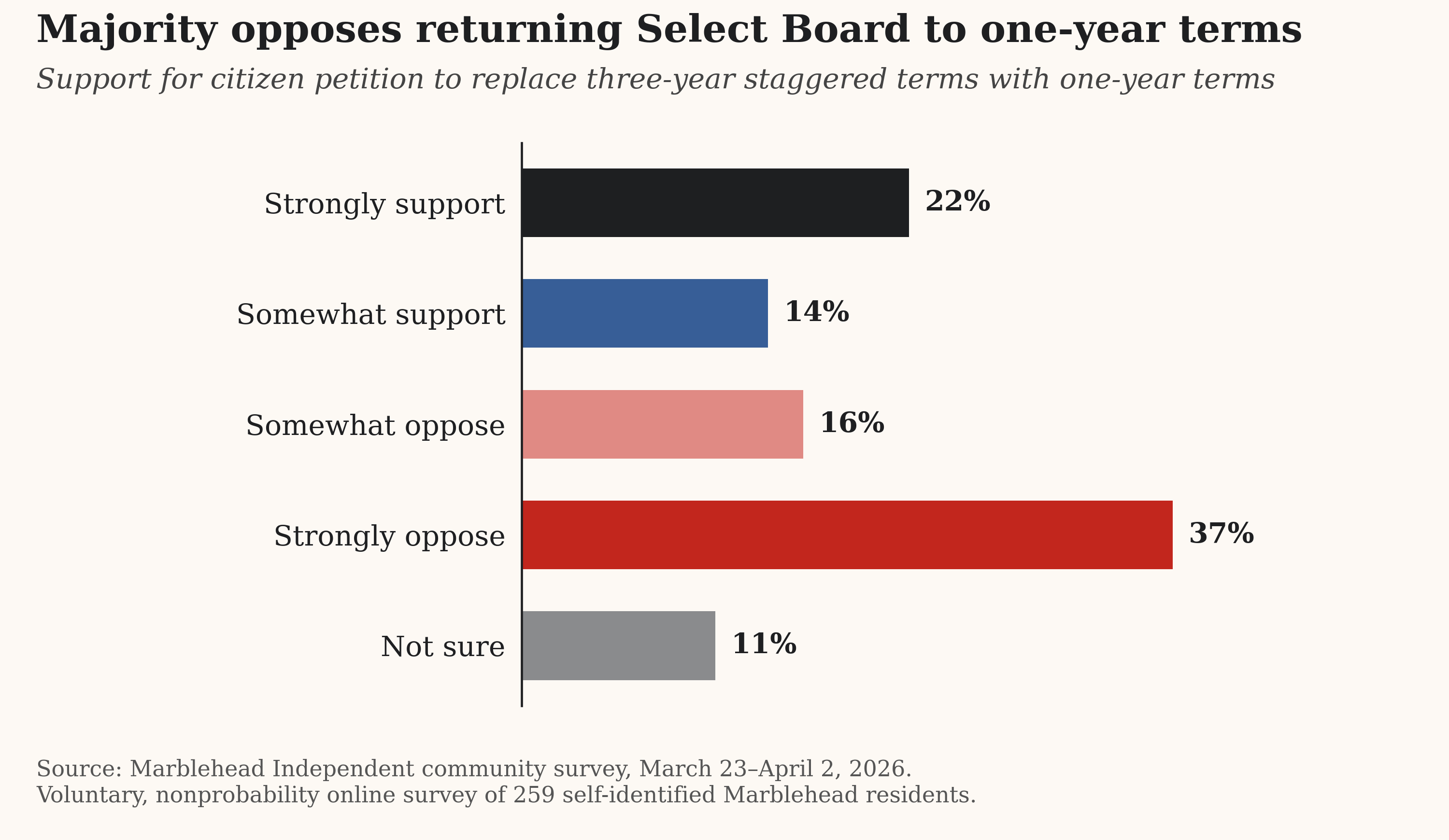
The result is worth sitting with for a moment. The open-ended comments are full of criticism of town leadership — references to lost trust, calls for an independent audit, complaints about specific officials by name. And yet a majority of those same respondents do not want to make the Select Board easier to turn over. The 36% who do support shorter terms is not nothing, but it is short of a majority and well short of the level of support the override and the housing article drew.
One reading is that respondents distinguish between accountability and instability. Another is that the people most frustrated with the board’s decisions are not the same people who complete community surveys. A third is that voters see structural change as a separate question from any individual grievance. The survey cannot tell you which reading is right, but the gap between the volume of complaints and the level of support for the structural fix is one of the more interesting tensions in the data.
Want your voice in our next local poll? Join The Marblehead Independent’s poll panel and get occasional quick surveys on the issues shaping Marblehead. It only takes a few minutes, and your responses stay anonymous. Click here.
A communication gap — but voters say they’re ready anyway
Perhaps the most pointed finding involves how town officials have explained the fiscal 2027 budget situation. Respondents split almost evenly, with a sharp tilt toward the negative end of the scale: the harshest rating outpaced the most positive one by nearly 2-1.
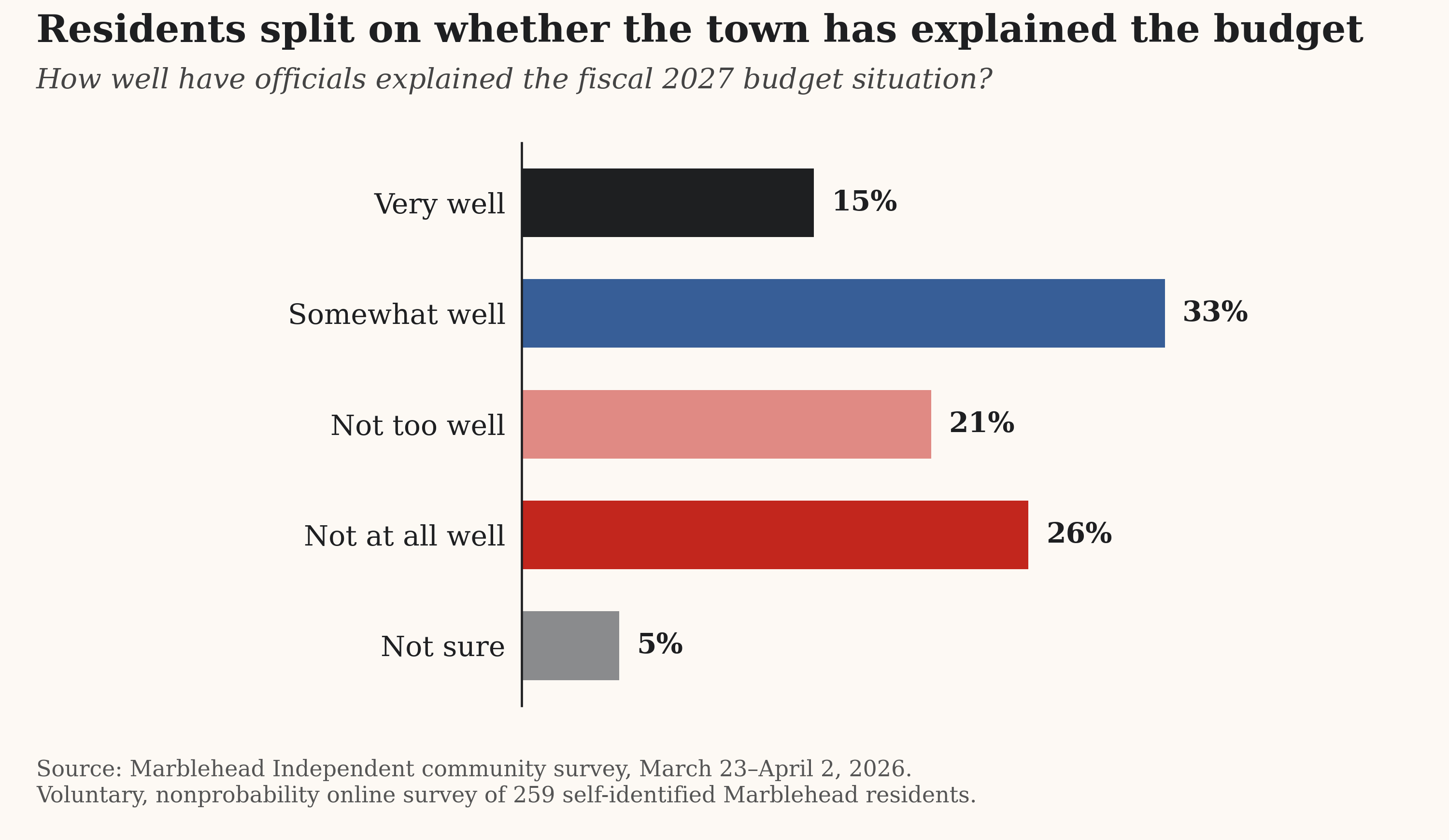
Yet the discontent did not translate into respondents feeling lost. Most said they feel prepared to make decisions at Town Meeting and in any election that follows.
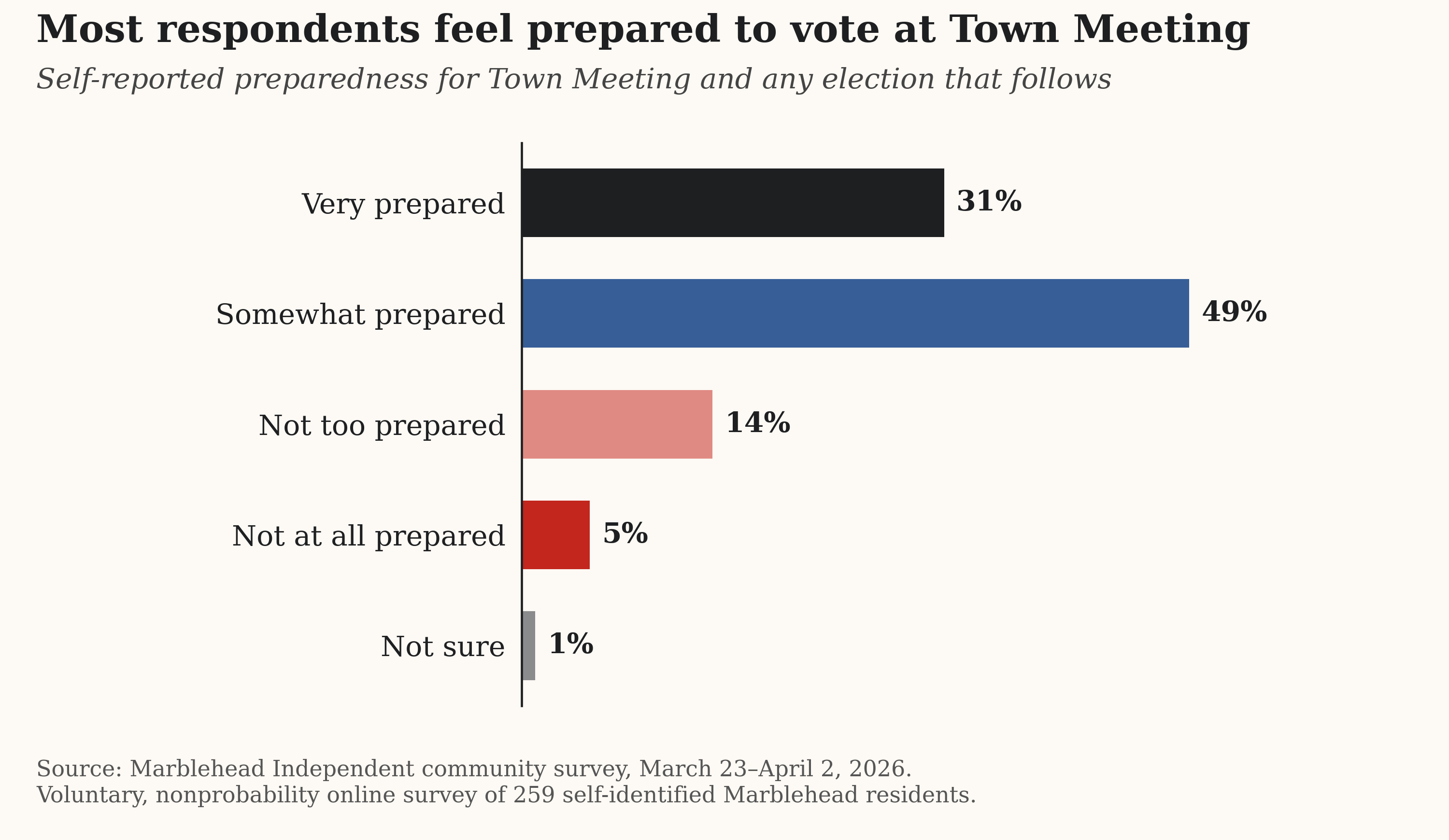
Set the two charts side by side and a real puzzle emerges. About half of respondents say the town has done a poor job explaining the budget. Four in five say they are ready to vote anyway. Those two things can both be true only if a sizable group of respondents feels prepared to vote despite — not because of — what they have heard from town hall. They are getting their information somewhere else, or they are bringing it with them. Either way, the gap suggests that for a meaningful share of the electorate, the case for or against the override may already be made before any new information lands.
That has practical implications for the next four weeks. If voters who feel underinformed are still planning to vote, the question is not whether they will participate but what they will be working from when they do. Whether town officials offer additional information sessions, public forums or written explainers between now and May 4 will shape whether late-deciding voters get a fresh case to weigh — or whether they walk into Town Meeting carrying whatever impressions they already have.
Several open-ended responses captured the frustration. “I would like town officials to clearly explain how we got to such a large deficit,” one respondent wrote. Another called for “communication to town residents what caused the budget morass and what we lose without an override.” A third went further: “First they need to vote and support an audit by the state auditor’s office to identify inefficiencies, evaluate resource allocation and opportunities. This will also build trust between leaders and voters.”
MBTA Communities article draws strongest support
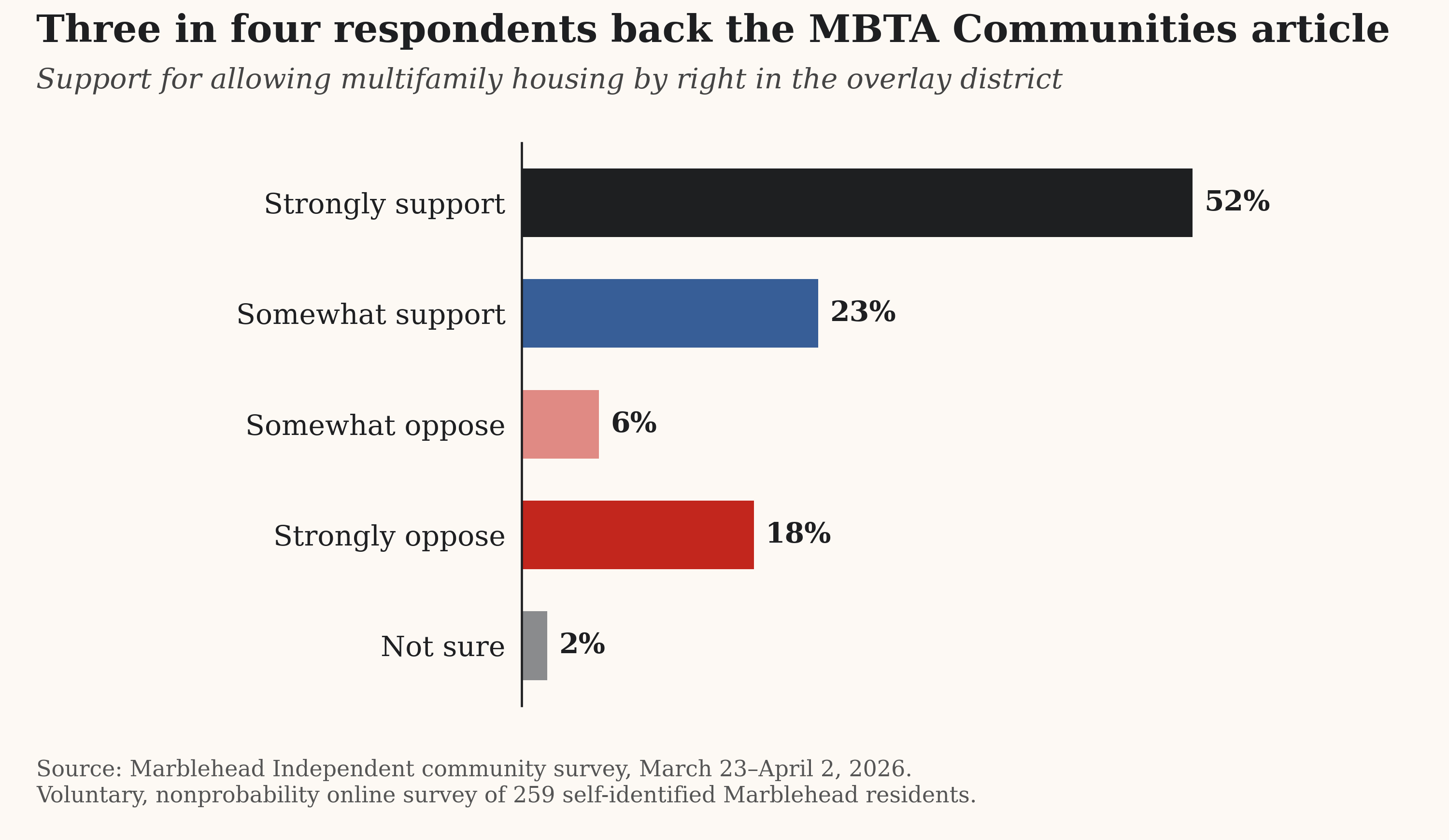
A Town Meeting article that would allow multifamily housing by right in an overlay district covering the Broughton Road and Tedesco areas, as required under the MBTA Communities law, drew the strongest support of any item the survey tested. About three in four respondents said they would back it, and more than half supported it strongly. The Planning Board has been finalizing district rules to meet a required capacity of 897 units, with the state attorney general pursuing legal action against noncompliant communities. Several respondents tied the article directly to the budget, noting that out-of-compliance towns risk losing access to certain state grants
Town Meeting attendance: most respondents say they will be there
The strongest signal in the survey may be about Town Meeting itself. More than 83% of respondents said they are very likely or somewhat likely to attend the May 4 session.
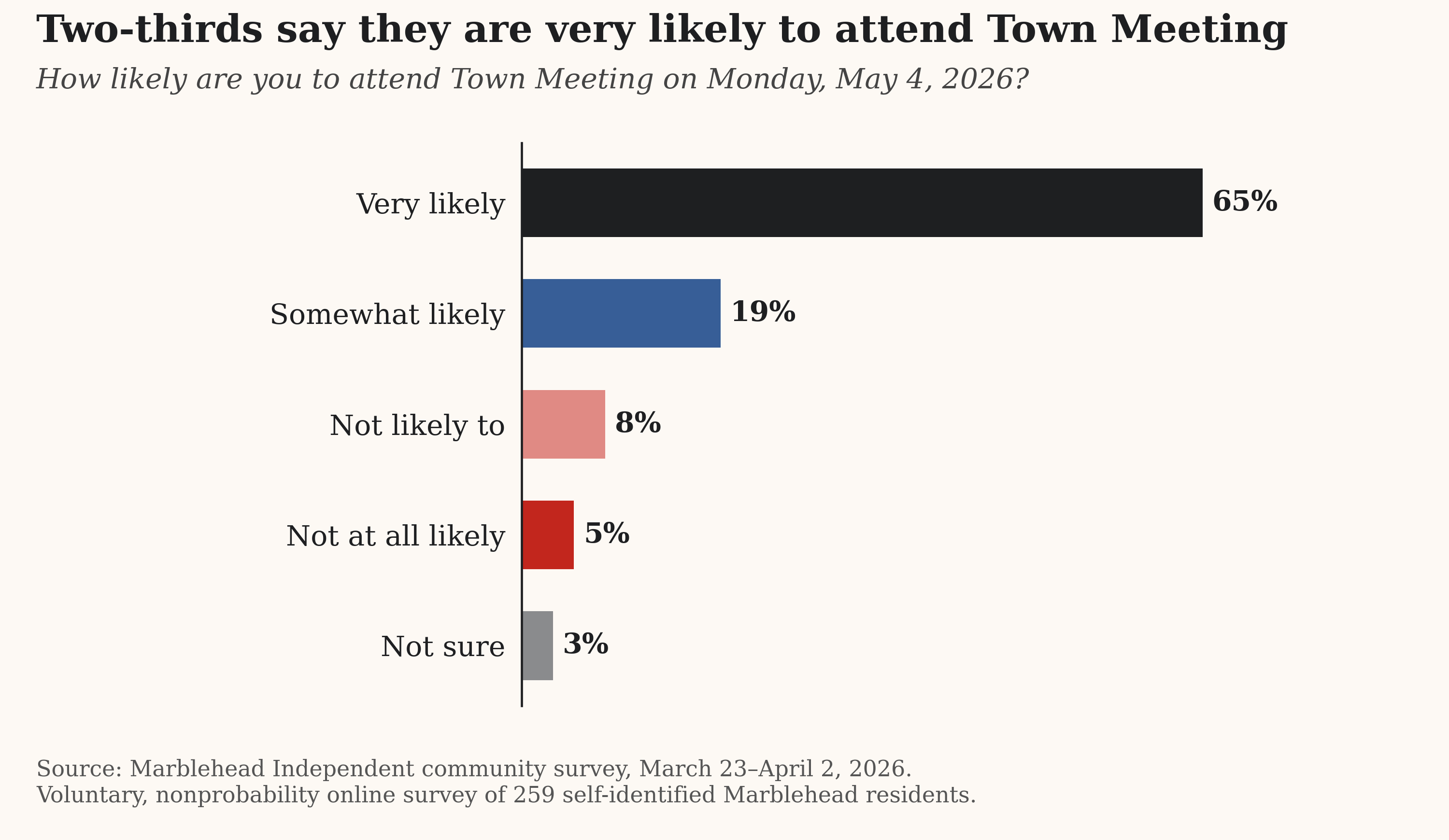
That number deserves to be read carefully. People who fill out community surveys about Town Meeting are not a random sample of the town — they are by definition the engaged residents, the kind of people who already plan to be there. So the 83% figure is not a forecast of overall turnout. What it is, instead, is a signal about commitment among the people most likely to drive the room. If the residents who took this survey actually do show up, the room on May 4 will reflect a population that backs the override 61% to 31%, backs the MBTA article 75% to 24%, and considers schools, roads and public safety the three things to protect first.
That is the answer the survey can give. The answer it cannot give is whether the broader electorate looks the same — or whether the residents who skipped the survey, including the smaller group who told us they are not likely to attend, hold views that would change the picture in the room. Town Meeting is decided by who shows up. The people who took this survey say they plan to.
Of the 220 respondents who wrote in the single most important issue facing town government in the next year, more than 100 mentioned the budget, fiscal management or town finances in some form, making it by far the dominant theme. The comments captured the full range of the override debate. “Pass the override — we knew drawing on free cash would have to end — we waited too long,” one respondent wrote. “Hiring freeze, show me the town is fiscally responsible before asking me to cut,” another wrote. As a third put it, the most important issue facing Marblehead in the next year is straightforward: “Transparency and trust.”
Who responded
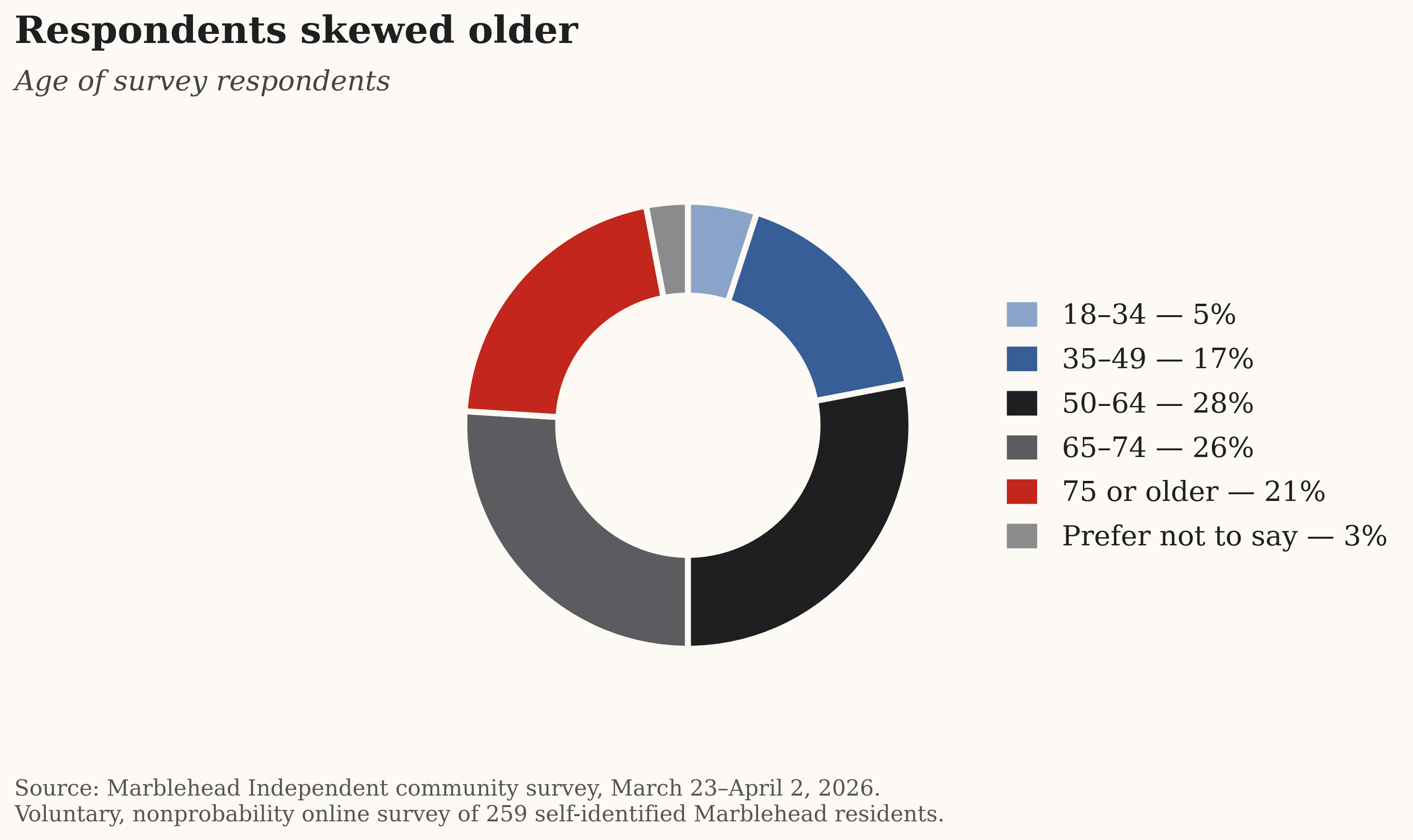
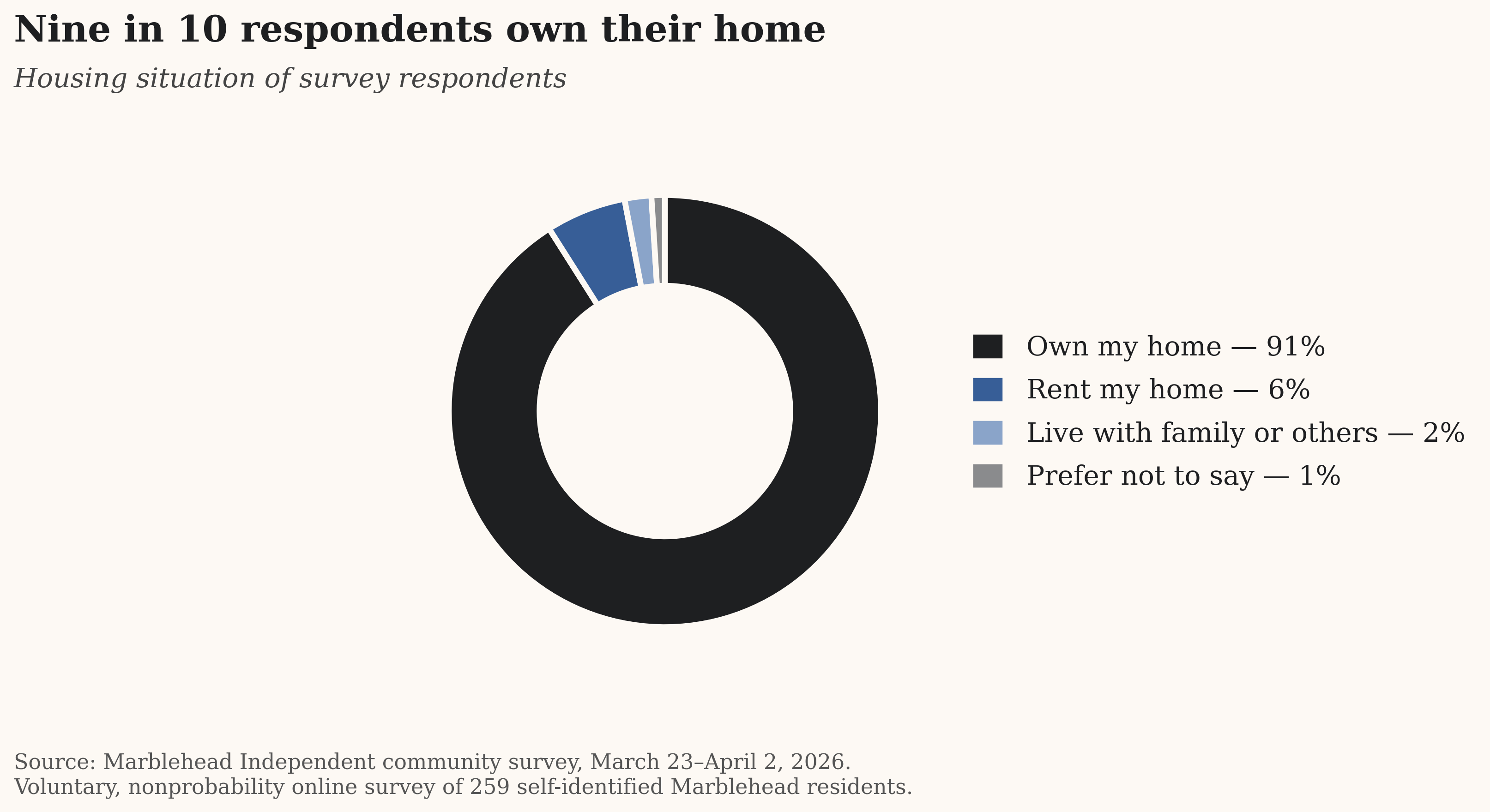
Survey respondents skewed older and toward homeowners.
Methodology note: The Marblehead Independent community survey was an open, voluntary, nonprobability online survey conducted from March 23 through April 2, 2026, drawing 259 qualifying responses from town residents 18 and older. It is a snapshot of community sentiment, not a scientific poll, and results reflect the views of respondents only. A companion Marblehead Independent news analysis examines how the override and trash-funding questions interact with the town’s 44-year history of Proposition 2½ votes.