Table of Contents
Get our free local reporting delivered straight to your inbox. No noise, no spam — just clear, independent coverage of Marblehead. Sign up for our once-a-week newsletter.
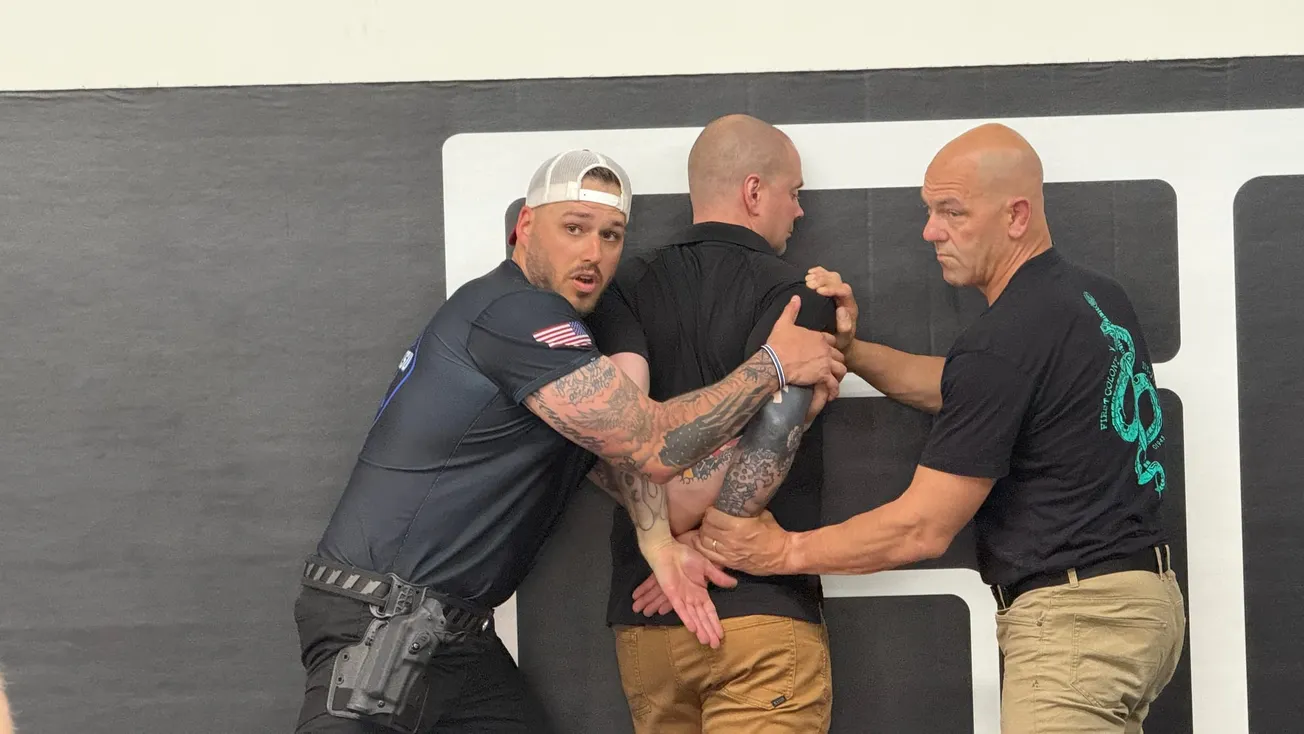
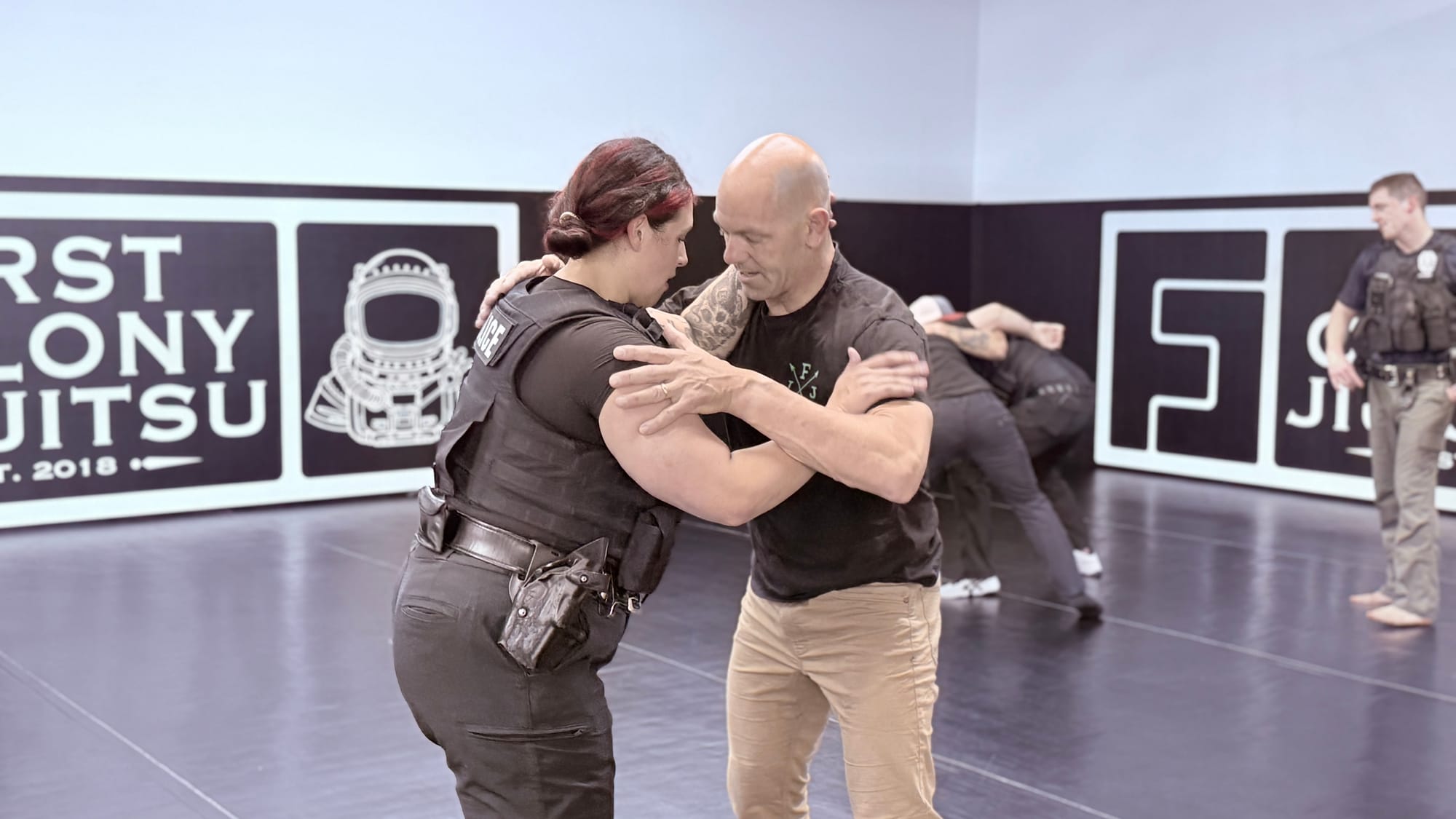
Two officers stood near a padded column with their hands on a third person’s arms, slowly walking him toward the wall. Their duty vests were on. Their boots were not. The black mats absorbed the sound of socks shuffling, of breath catching, of one quiet correction after another from an instructor pointing at a wrist, then a shoulder, then a hip.
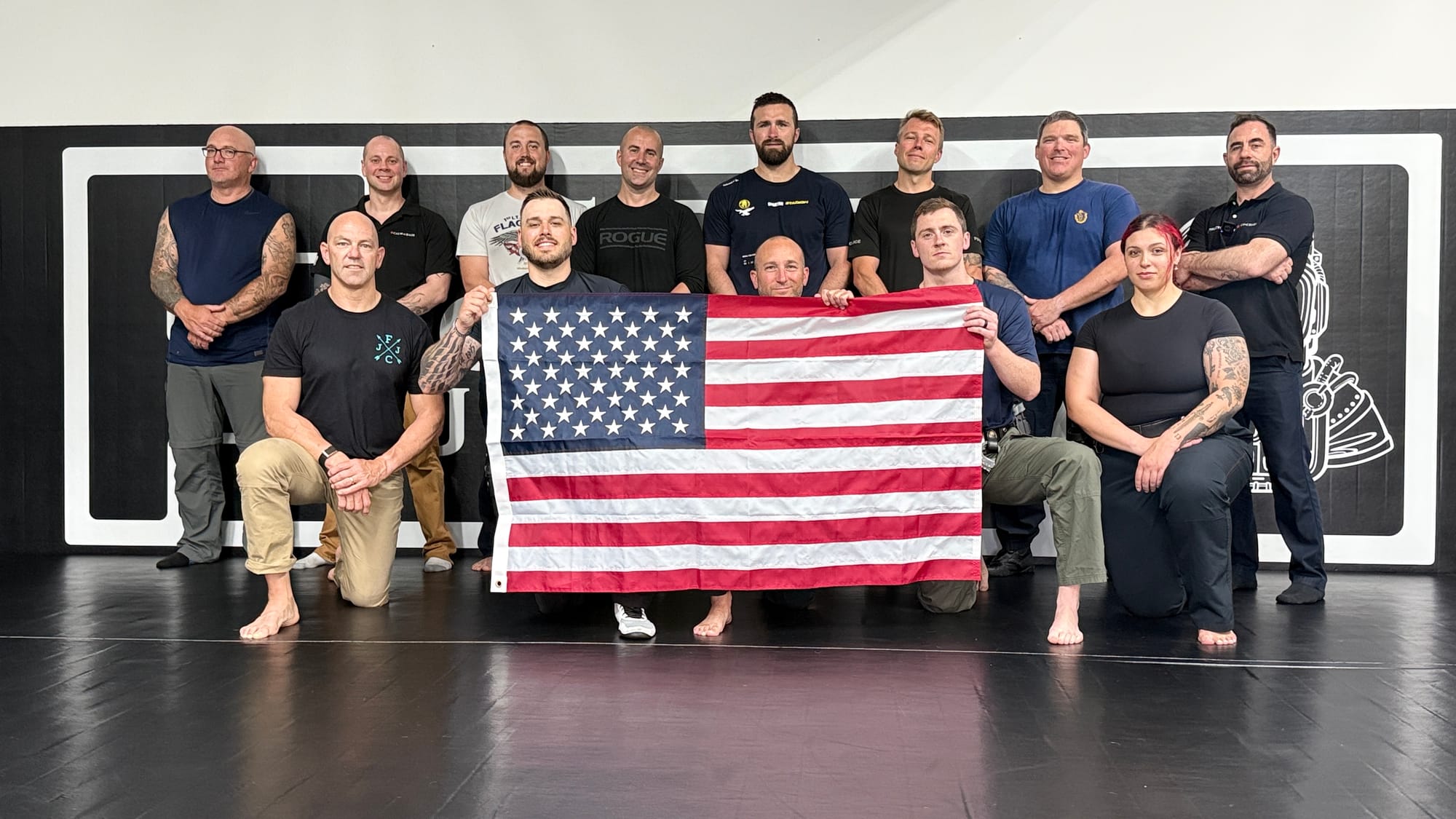
The session was “Jiu Jitsu for Law Enforcement,” held May 20 at at First Colony Jiu-Jitsu, 100 Hoods Lane. Calm in Chaos (CiC) Defense Solutions instructors ran the morning: Liam McGeown, a black belt and the gym’s owner; Matthew Christensen, a purple belt and Army veteran; Kevin Reen, a purple belt and police officer; and Jared Lopez, a blue belt and Gloucester police officer. The session helped officer future enhance their safety, reduce injury risk, de-escalation skills and resilience among the benefits.
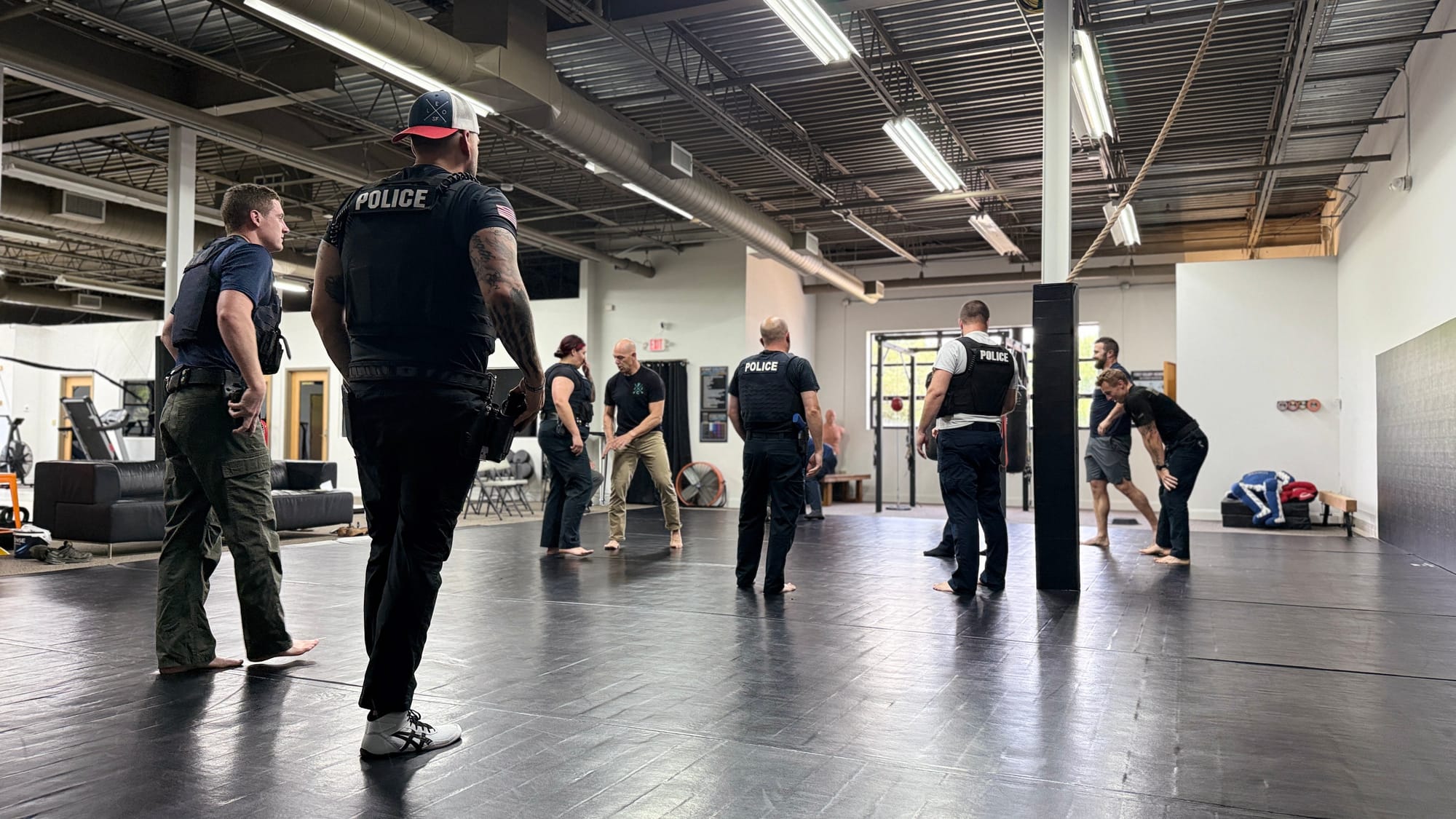
Officers from Gloucester, Swampscott, Essex, Wenham and Barre showed up in training pants, uniform shirts and vests. They drilled takedowns, then how to hold a person face down without crushing the chest, then how to disengage. A handwritten lesson plan taped to a column laid out the morning in shorthand — control, drunk-escort, hands, sit awareness, standing to takedown, head misalignment, kimura, two-person wall technique. The instructors repeated one phrase nearly every round: slow down.
“Our mission statement is compliance through control,” said Lopez, a patrolman who has been an officer for seven years. He framed the morning as a layer on top of what officers already learn. “They go to academy for 26 weeks, and they’re expected to handle people day one,” he said. “We’re taking that a step further and giving officers the confidence and the ability to do certain things subconsciously — second nature.”
McGeown described the work as problem-solving, not striking. He framed each encounter as a set of possibilities the officer must shrink — push, pull, snap a posture down, take the back, get the hands on the mat — until the choices narrow. “What you’re trying to do is create a system, not something that you remember,” he said.
That framing matters because most of what officers practice in an academy is faster, louder and shorter. Recruits across the country average 806 hours of basic training, according to a 2022 census by the U.S. Department of Justice’s Bureau of Justice Statistics. The session at First Colony is not a substitute for academy training. Christensen described the gap plainly. “People get the job, go through the academy, and that’s it,” he said. “They never do any other training.”
Reen, a Swampscott patrolman in his third year of jiu-jitsu, has been a fitness instructor at a police academy since 2007 and came to the mat after 25 years as an endurance athlete. “It has had a significant positive impact on how I work and my ability for de-escalation,” he said. He described the practice as a language.
“When you learn the vocabulary, you build from speaking one to two words to speaking a sentence to speaking a paragraph to holding a conversation,” Reen said. “The only way to get better at your language is through practice.” His wish list for the morning was modest. “A mindset of open thought process. Communication with my partners, de-escalation tactics, and the ability to use their training when things become physical.”
The limits are not subtle. A jiu-jitsu mat is flat, padded and predictable. A real encounter is none of those things. Officers arrive into someone else’s worst moment — a mental health crisis, a fight in a parking lot, a domestic call at 2 a.m. — carrying a gun, a radio, a body camera and whatever fatigue the shift has produced. The person in front of them may be drunk, in pain, in psychosis, armed, fleeing or all of those at once. Bystanders matter. Policy matters. So does the moment a decision must be made in less time than it takes to read this sentence.
Lopez was direct about why he keeps coming back. “You’re a grown man, and you’re going up with another grown man,” he said. “You enter a weapon into that altered dynamic. You lose that weapon. What’s stopping them from using that against you?” He was also honest about the morning’s limits. “The weakness is getting a taste, not coming back,” he said. “You think you’re Superman to do this, and then you only do it once, and you go on the street, and you subconsciously tell yourself you can do this. And you end up not being able to do it.”
Briana Reder, a Swampscott patrolwoman in her fourth year, came at the invitation of Reen, who brought the seminar to her department. The academy taught hand-to-hand techniques, she said, but not at this level. Asked whether learning to control someone without hurting them made her feel more compassionate, she did not hesitate.
“My goal is to never injure or harm anyone, but to get them safely, either with us, with EMS, or anything like that,” she said, adding the philosophy underneath. “Just because you graduate school doesn’t mean you should stop learning.”
Jiu-jitsu extends into areas beyond self-_defense, Christensen said.
“It’s a lifestyle,” he said. “That’s what we promote, more than the jiu-jitsu. It’s a whole lifestyle of getting yourself right, getting yourself prepared.”
Lopez offered the most personal version of why it mattered.
“What I’m wearing right now is a clown suit. That’s not who I am,” he said, looking down at his rash guard. “I usually introduce myself as Jared. I don’t introduce myself as Officer Lopez. I go, ‘Hey, my name is Jared.’” The people he meets on patrol — including the ones he arrests — are people he might see again. “We’re all human beings, we’re all God’s children. We all deserve the same order of respect.”
Research on jiu-jitsu for police is thin but growing. A 2024 study in Martial Arts Studies surveyed more than 300 officers who train recreationally and found that more time on the mat correlated with higher confidence in defensive tactics.
BEFORE YOU GO … Our reporting remains free and open to all. It is sustained by readers who choose to support it — by contributing so that routine, document-based local reporting continues without paywalls or promotional framing. Right now, 101 readers support The Marblehead Independent with monthly or annual contributions. Click here to become an Independent member.