Table of Contents
Get our free local reporting delivered straight to your inbox. No noise, no spam — just clear, independent coverage of Marblehead. Sign up for our once-a-week newsletter.
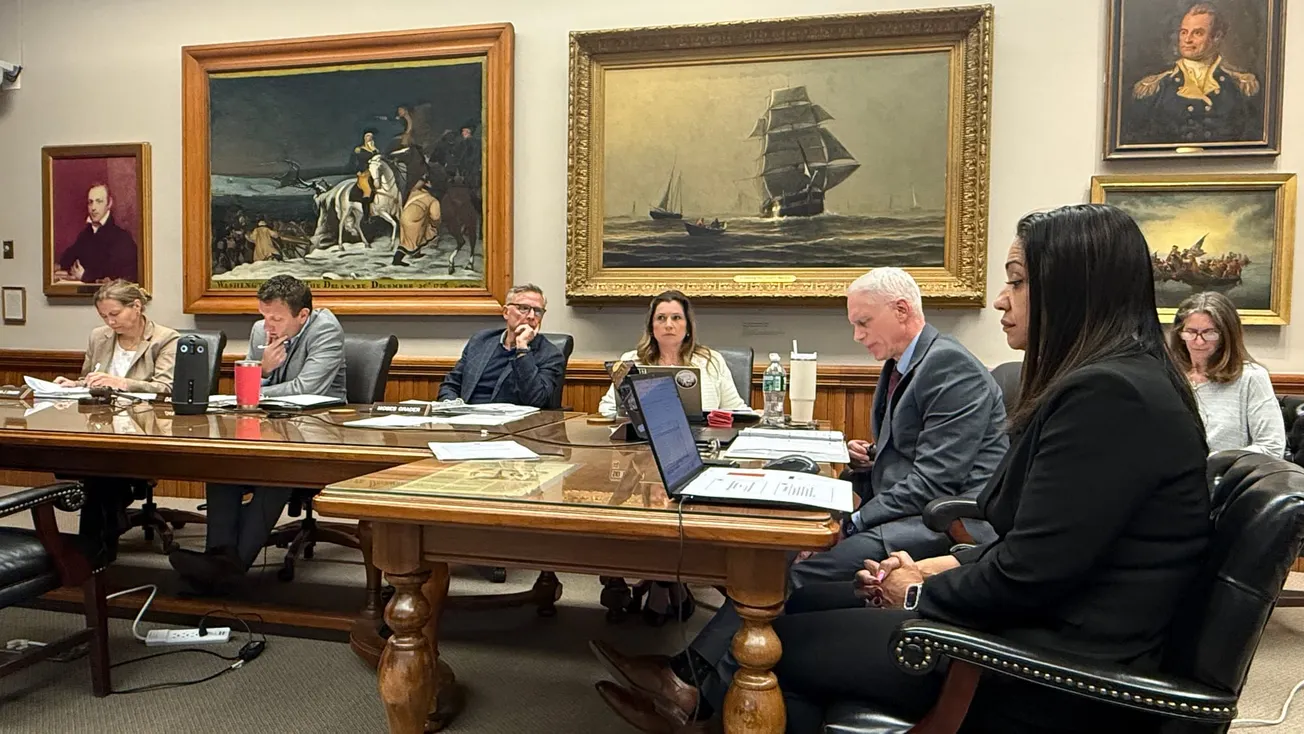
Town Administrator Thatcher Kezer and Finance Director Aleesha Benjamin on Wednesday presented the Select Board with a three-tier, multiyear Proposition 2½ override plan totaling $9 million to $15 million over three years, along with a separate $2.3 million override option to fund curbside trash and recycling through the tax levy instead of a household fee.
The dollar amounts put numbers behind a framework the board locked in March 25, when members voted 4-1 to pursue a three-tier override and a separate trash funding question. The board did not vote Wednesday. A vote on whether to place the questions on the June ballot is expected April 22, after the School Committee takes its own vote Thursday.
Under the proposal, Tier 1, “Partial Restore,” would authorize $9 million, with an estimated tax impact on a $1 million home of $127 in fiscal 2027, $503 in fiscal 2028 and $270 in fiscal 2029, for a three-year total of about $900. Tier 2, “Stabilize & Build,” would authorize $12 million, with estimated impacts of $281, $590 and $329, totaling about $1,200. Tier 3, “Invest & Improve,” would authorize $15 million, with estimated impacts of $430, $624 and $446, totaling about $1,500.
Each tier builds on the one below it. Voters would be asked to approve or reject each level independently, with the highest tier to win majority support determining the permanent increase to the town’s tax levy.
“Whatever the number is that gets voted, it’s not that that should be raised and spent year one,” Kezer said. “They’ll be allocated over a number of years.”
Tier 1: Partial Restore
Benjamin described Tier 1 as the town’s effort to bring back the most critical positions cut from the balanced fiscal 2027 budget. It would restore the school resource officer, Police Department small equipment, $52,500 in inspections and technical subscriptions, and DPW staffing including one special laborer, one temporary general clerk and one heavy equipment operator, plus hot top funding for roads.
At Abbot Public Library, Tier 1 would restore $311,183 — an amount Benjamin said was calibrated to the library’s accreditation threshold. Tier 1 would also restore the director of community development and planning, a groundskeeper, a cemetery laborer, Council on Aging staff, two custodians, the town’s $96,771 OPEB stabilization transfer, $97,662 in workers’ compensation and the full $26,000 Finance Committee reserve fund.
Several positions would remain cut under Tier 1, including the assistant planner, a grant coordinator being converted to a conservation agent and a town clerk’s office position. Also left out are a handful of library jobs that the board’s March 25 presentation had slotted into Tier 1 as part of a full library restoration.
Tier 1 contributes nothing to the schools in fiscal 2027 but would fund cost-of-living increases and $1.5 million in special education out-of-district tuition in later years.
Tier 2: Stabilize and Build
Tier 2 adds another $3 million on top of Tier 1. Benjamin said it adds a second police officer and two firefighters aimed at reducing the overtime that has driven the Fire Department onto 96-hour shifts, along with a GIS position in DPW, an IT director and budget analyst in finance, and the remainder of library staffing, materials, a part-time custodian and a part-time library assistant.
Tier 2 also restores the assistant planner and conservation agent in community development, adds a part-time senior clerk and $15,000 in maintenance for recreation and parks, a part-time social worker and $15,000 for the Council on Aging, a new $450,000 maintenance division for public buildings and the special clerk in the town clerk’s office. On the school side, it would add technology lease funding and eliminate the full-day kindergarten fee in fiscal 2028 and 2029.
Tier 3: Invest and Improve
Tier 3, at $15 million, layers capital and longer-term investments on top of Tiers 1 and 2. Benjamin said it adds two more police officers and four additional firefighters, bringing the total firefighter restoration to six.
It would also fund a grant writer, $1 million annually in recurring capital and $60,000 for psychological counseling in the Health Department. On the school side, Tier 3 would reestablish curriculum and professional development funding, create a special education program for students ages 18 to 22 and add roughly $500,000 in school capital.
The trash question
Kezer said the separate trash override would replace the Board of Health’s planned curbside fee with a permanent tax-levy increase of $2,298,575. That covers the first year of the new collection contract at roughly $2.1 million, plus an additional 2.5 percent to absorb the 5 percent annual contract growth Proposition 2½ would not otherwise cover.
If voters reject the trash override, the Board of Health will implement a curbside fee of about $262 per household, with discounts for residents who qualify for tax abatements. Residents could also opt out and use the transfer station sticker program.
Board pushes for clearer presentation
Select Board member Moses Grader, who cast the lone dissenting vote on the framework in March, urged Kezer and Benjamin to rebuild the presentation around a more traditional profit-and-loss format that walks forward from the fiscal 2026 base budget.
“There’s a real story around how the balanced budget was achieved,” Grader said.
Select Board member Erin Noonan said the materials need to show residents the thinking behind which positions landed in which tier.
“It’s a strategic decision, frankly, because there’s so much at stake if all three failed,” Noonan said.
Fox defended the choices behind Tier 1, saying the board could have loaded more positions into the lowest tier but had to weigh what voters would accept.
“This is not a true restore. It’s pretty far from it,” Fox said. “I’ve almost called it ‘Survive.’
Residents press for clarity
Resident Ginny O’Brien told the board the ballot mechanics confused her and her friends. Her instinct, reading three tiers on a sample ballot, was to add the numbers together.
“If you vote for each choice, then you’re voting for $36 million,” O’Brien said.
Fox explained that only the highest tier to win a majority would take effect, meaning a resident who wants the fullest restoration should vote yes on all three. O’Brien said the town needs to do a better job telling residents what services they stand to lose at each level, not just what would be restored.
Abbot Public Library Director Kim Grad asked for a meeting with Benjamin to get clarity on which library positions had been selected for Tier 1, saying the restorations did not match what she had been expecting.
Resident Albert Jordan pressed the board on why the override could not be written as three standalone questions rather than a cumulative tier structure, saying he worried it would feel like ranked-choice voting to older residents.
Kezer said Proposition 2½ allows the pyramid structure specifically to let voters signal how much they are willing to commit without the numbers adding together.
Jordan also asked what would happen if voters approved the trash override but rejected one of the service tiers. Fox said the money could not be redirected — a commitment the Select Board plans to formalize in a memorandum of understanding with the School Committee and Finance Committee.
How the town got here
The override traces back to a $7.7 million budget gap driven largely by fixed costs. The Group Insurance Commission approved an 11.17 percent premium increase for active employees, pushing projected health insurance costs to nearly $15.8 million for fiscal 2027. Under Proposition 2½, Marblehead can raise only about $2.2 million in new tax revenue each year.
The Select Board approved a $56.6 million balanced budget that eliminated about 18 positions. The School Committee followed with roughly $1.5 million in reductions before voting 5-0 to join the town’s override effort.
Town Meeting, where any override must first be authorized before it can go to the June ballot, is less than four weeks away