Table of Contents
Get our free local reporting delivered straight to your inbox. No noise, no spam — just clear, independent coverage of Marblehead. Sign up for our once-a-week newsletter.
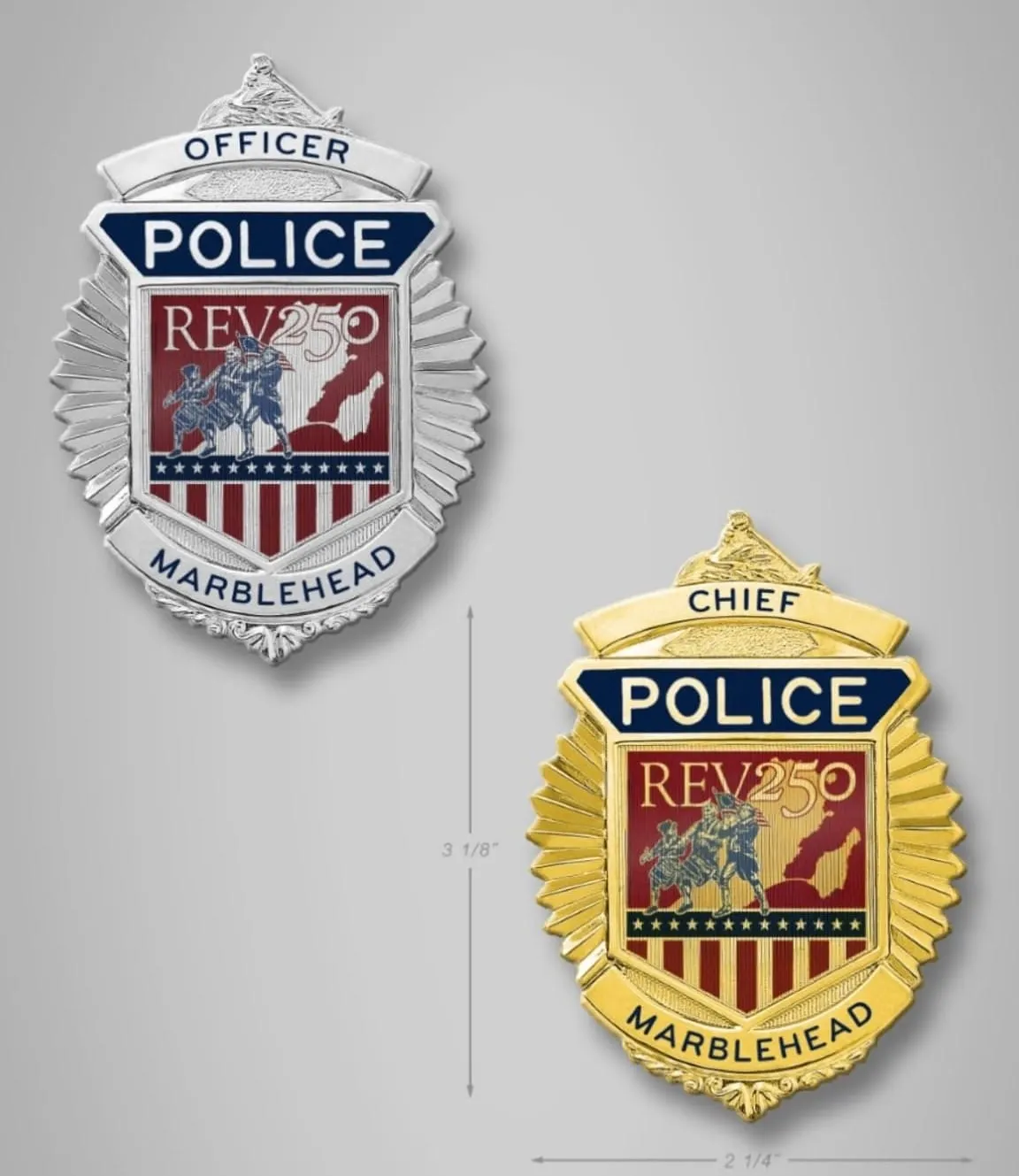
As Marblehead marks the nation’s 250th anniversary, the Marblehead Police Department has adopted a special Revolution 250th badge that links present-day service to the town’s Revolutionary record. The badge was developed with the approval of police leadership and purchased by officers themselves.
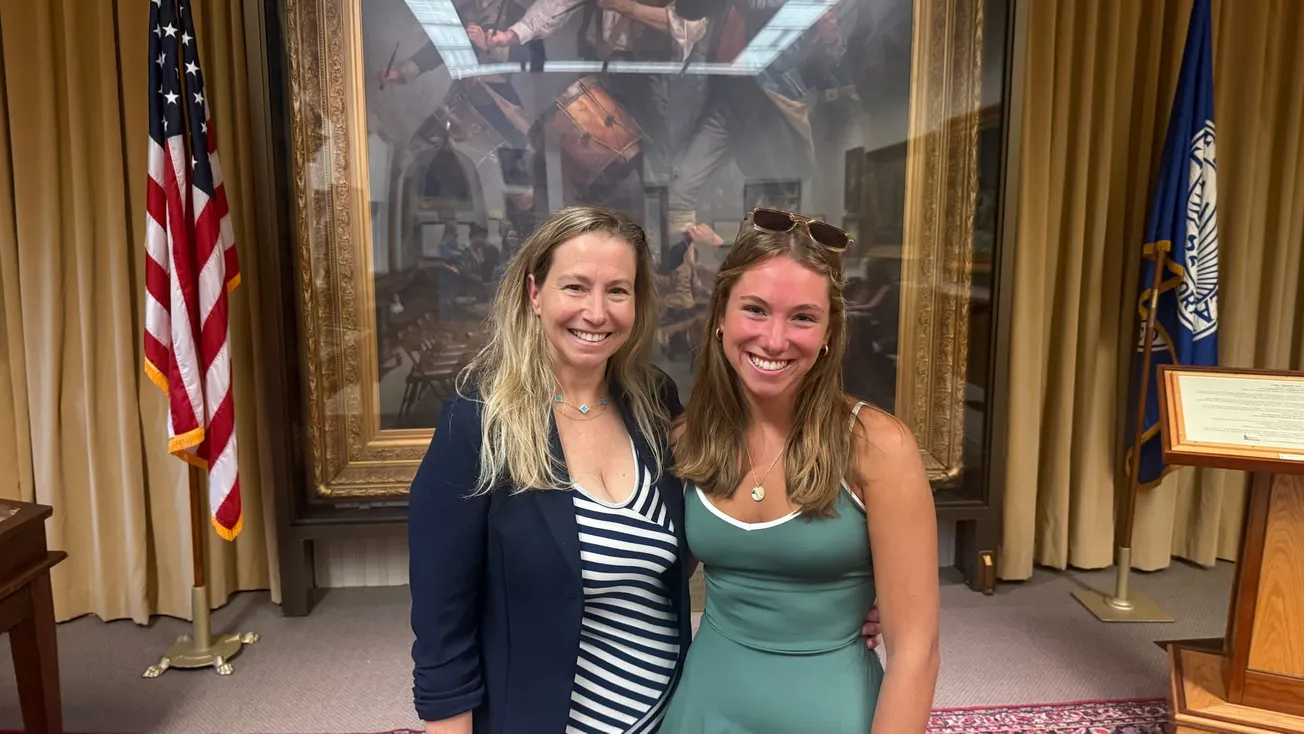
Police Sgt. Timothy Morley said the idea began with a straightforward goal: to mark the anniversary in a way that fit Marblehead’s history and the department’s role in the community. Morley said dispatcher Theresa Collins was closely involved in the project and helped shape the design from its early stages
“She is, like, the design guru,” Morley said.
The shield-shaped badge features the iconic silhouette from ’The Spirit of ‘76’ painting — the fife and drum trio — set beside the outline of Marblehead, with ‘REV 250’ above and 13 red and white stripes below a row of stars.
Morley said the objective was to create something official and lasting, not something overly decorative.
“I didn’t want something gaudy,” he said.
That approach reflects the history the badge is meant to acknowledge.
Marblehead’s ties to the Revolution run deep and predate the war itself. By the early 1770s, the town was one of the largest and wealthiest ports in the Massachusetts colony, its economy built on the cod fishery and a fleet of skippers, mates and sailors whose livelihoods depended on the sea. That maritime workforce would become one of the most valuable assets the Continental Army possessed.
Marblehead men were among the earliest to organize in response to British military pressure. The town’s militia, raised largely from the fishing fleet, became the 14th Continental Regiment under Col. John Glover. Known as the Marblehead Regiment, the unit was unusual in the Continental Army for its discipline, its seafaring expertise and, notably, its integrated ranks, which included Black, Indigenous and white soldiers serving side by side at a time when such composition was rare.
In August 1776, after Gen. George Washington’s army suffered a catastrophic defeat at the Battle of Long Island, the Marblehead mariners carried out what many historians regard as one of the most consequential military operations of the war. Over the course of a single night and into a dense morning fog, Glover’s men silently ferried roughly 9,000 troops, along with horses, cannon and supplies, across the East River to Manhattan. The evacuation saved the Continental Army from almost certain destruction.
Weeks later, the regiment helped cover the American retreat at Kips Bay and fought at the Battle of Pell’s Point, where a small force under Glover delayed a far larger British advance and bought Washington time to reposition his army.
Then came the crossing that would become the most famous image of the Revolution. On the night of Dec. 25, 1776, it was the Marblehead men who manned the oars as Washington’s troops crossed the ice-choked Delaware River to launch the surprise attack on Hessian forces at Trenton. The victory revived a collapsing cause and is widely credited with keeping the Revolution alive through its darkest winter.
Those actions were not symbolic. Marblehead sailors brought maritime skill and discipline that proved critical at several moments when the army’s survival depended on moving troops, horses and artillery under extreme pressure. The town also paid a steep price for its service, losing a significant share of its men to combat, disease and captivity, and seeing its fishing economy devastated by the war.
Morley, an Army veteran who served in Afghanistan, said that history made the anniversary an occasion worth marking with care. He brought the idea to the chief of police, who has final authority over uniform policy. Morley said the chief supported the project and approved the badge for wear during the anniversary period.
“It’s a great morale thing for the guys,” Morley said.
The department worked with V.H. Blackinton & Co., the Massachusetts manufacturer that produces Marblehead’s regular badges. Morley said the company refined the department’s initial ideas into a finished design that was clean, balanced and suitable for duty wear. He said the company told him Marblehead was the first department to approach it about a special Revolution 250 badge.
“He said, ‘I really want to get this right,’” Morley recalled.
The badges were not funded with public money. Morley said each officer bought his or her own badge. He said broad participation across the department helped make the order feasible.
The badge will be worn throughout the anniversary period and later will continue as a July badge, giving it a place in department tradition beyond the commemoration itself.
Morley said residents have already noticed the badges and offered compliments. In a town with a long memory and a well-established place in Revolutionary history, the design appears to have struck the tone its creators intended.
“I never expected to get a compliment,” Morley said.
BEFORE YOU GO … Our reporting remains free and open to all. It is sustained by readers who choose to support it — by contributing so that routine, document-based local reporting continues without paywalls or promotional framing. Right now, 101 readers support The Marblehead Independent with monthly or annual contributions. Click here to become an Independent member.