Table of Contents
Get our free local reporting delivered straight to your inbox. No noise, no spam — just clear, independent coverage of Marblehead. Sign up for our once-a-week newsletter.
A series of winter storms has pushed Marblehead past its snow and ice budget and tested the limits of an aging municipal fleet, with the town’s Department of Public Works crews working shifts of up to 40 hours straight to keep roads passable through what has become the first major test of the community’s revamped parking ban system.
Marblehead has received more than 30 inches of snow this season, based on National Weather Service spotter reports and data from surrounding communities. The largest confirmed total was 16.6 inches recorded at “2 NNE Marblehead” during the Feb. 22-24 blizzard. A late January storm delivered 14.7 to 22 inches to nearby Essex County towns. Marblehead does not host a National Weather Service observing station, so local totals rely on neighboring communities and spotter reports.
“We have about over 35 people on the road for plowing operations,” she said.
Overtime and salt use climb
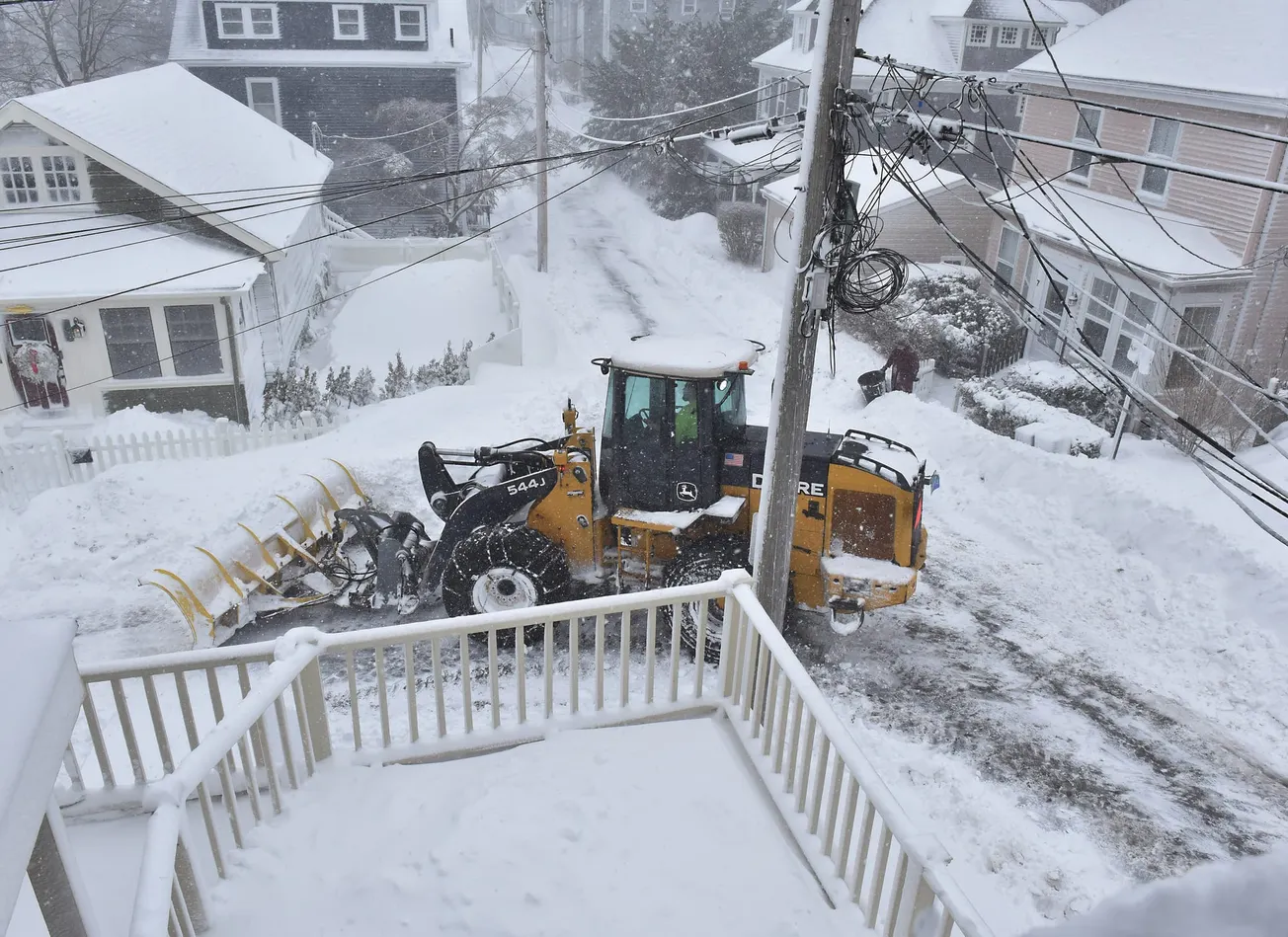
In total, the town deploys 70 pieces of snow equipment, including loaders, large and small dump trucks, pickup-style trucks and two trackless sidewalk machines.
The strain on workers has been significant.
“So we’ve had two storms that these people have been on the road for over 36 to 40 hours straight,” McHugh said. “So no admit, you know, there’s no long breaks,” she added.
She said crews move directly from plowing into snow removal and cleanup, while other departments return to their regular duties, including maintaining sewer pump stations, water systems and the transfer station.
Financially, the season has already exceeded expectations. The town budgets $105,000 annually for snow and ice.
“So I’m allowed to legally overrun my snow budget,” McHugh said, explaining that the account can run a deficit under state rules.
This year, she said, total spending is projected to be well over $300,000, driven largely by overtime and salt use.
The department has used 1,200 tons of road salt so far this season. McHugh said the current per-ton cost is $73. Salt expenditures alone total $87,600 based on that rate.
Capital pressures continue to loom. McHugh said the average age of DPW equipment is around 15 years.
“Every piece of equipment off the DPW? I think the average age of equipment is around 15 years,” she said.
The department operates loaders from 2005 and 2008 and a large snow blower dating to 1978. Replacing a loader would cost an estimated $200,000 to $300,000, she said.
Although the town has invested in some newer multipurpose equipment in recent years,
McHugh acknowledged the overall fleet still falls short of what the department needs.
This season has also served as the first real test of Marblehead’s restructured parking ban.
Aging fleet and harbor-dumping underscore long-term pressures
The town previously maintained a seasonal ban that kept cars off streets for three to four months each winter, McHugh said. Residents voted to end that system. The town formerly enforced a midnight-to-7 a.m. overnight restriction from Nov. 15 through March, with full parking bans declared on an emergency basis storm by storm.
McHugh said the shift has made snow operations harder to manage. Under the old seasonal ban, streets were reliably clear at night, allowing crews to return after storms and plow back snowbanks on their own schedule. Now she must request an emergency declaration for each event and coordinate with police before imposing a townwide ban — and she cannot target individual neighborhoods.
The four-day snow emergency declared Wednesday repeated overnight enforcement and removal cycles, compressing the department’s timeline for widening streets and clearing snowbanks.
“I have always said what you voted for, not having a winter parking ban is not going to work on a year you have a lot of snow,” McHugh said.
The compressed timeline has forced crews to squeeze plowing, removal and street widening into tighter windows dictated by each declared ban rather than spreading the work over days. McHugh said the old system gave her flexibility to stage operations; the new one adds logistical steps at the worst possible time.
McHugh said residents still do not understand that they must be off the street during snow operations.
As snowbanks narrowed roadways and storage space disappeared, Marblehead turned to harbor dumping. After a vote and proclamation following the February storm, the town began another round of snow removal. McHugh said this marked the third round of harbor dumping this season.
“Marblehead is at capacity with snow, right? I got to keep snow in the public way,” she said.
She said snow removal priorities are driven by public safety.
“In snow removal, the critical piece right is to get public safety down,” she said, noting the need to maintain access for ambulances, fire trucks, police vehicles and water and sewer response.
Forecasting remains an inexact science.
“We spend days watching forecast. We watch five or six different sources,” McHugh said. “They all change.”
Correction: An earlier version of this story misstated the months covered by the town’s overnight winter parking restriction.
BEFORE YOU GO … Our reporting remains free and open to all. It is sustained by readers who choose to support it — by contributing so that routine, document-based local reporting continues without paywalls or promotional framing. Right now, 102 readers support The Marblehead Independent with monthly or annual contributions. Click here to become an Independent member.