Table of Contents
Get our free local reporting delivered straight to your inbox. No noise, no spam — just clear, independent coverage of Marblehead. Sign up for our once-a-week newsletter.
Joy Meshulam had the whole field’s attention, and she used it to talk about getting rejected.
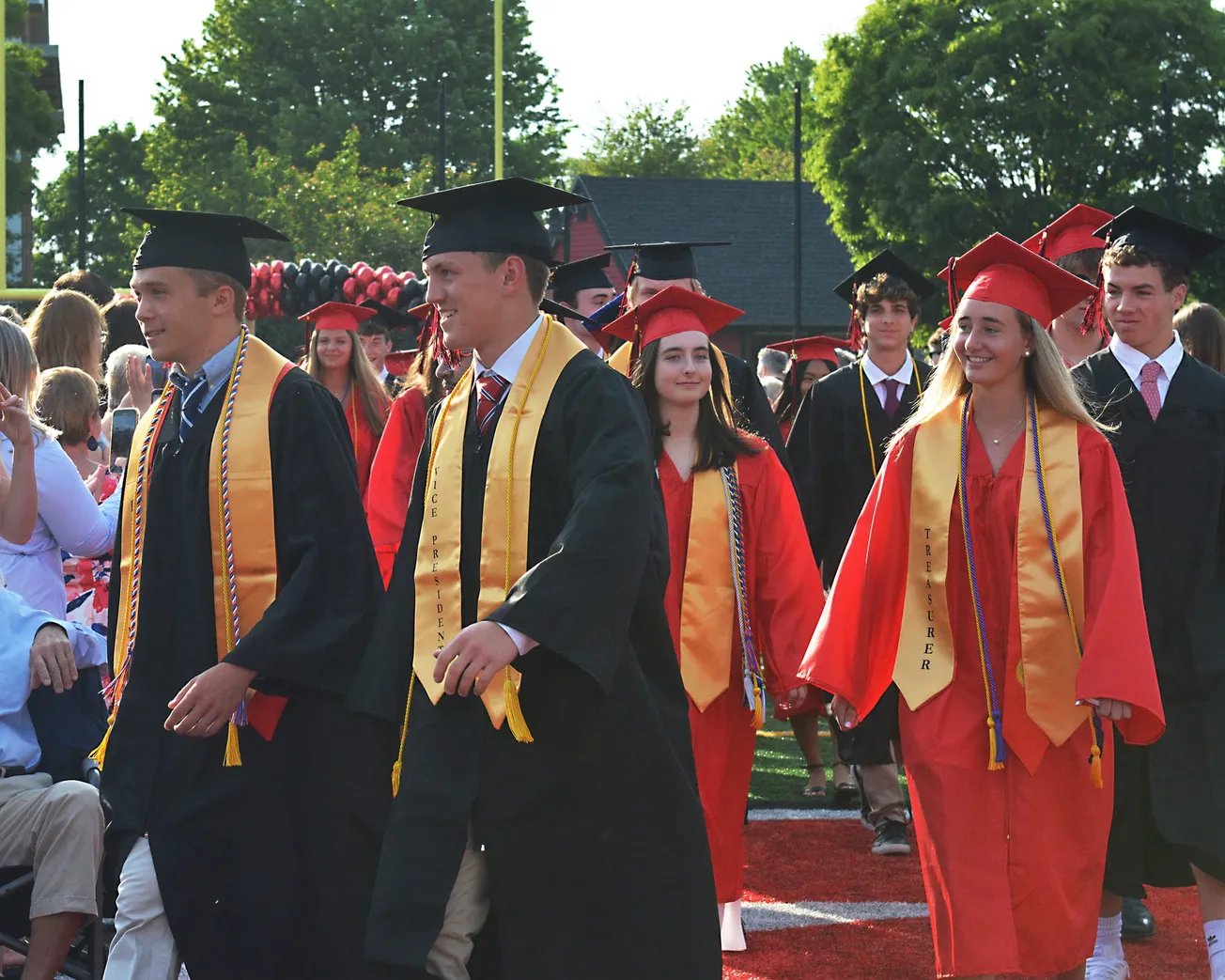
The valedictorian stood before 183 classmates on the Piper Field turf at 6 p.m. Friday, with families in bleachers on either side of the stage, others spread across the grass in folding chairs, phones raised and the early-June light still hanging over the water beyond the school. Then she confessed that she once asked five people to junior prom and struck out with every one.
One of them, she said, promised in the middle of biology class to email his answer, then bolted from the room. She could have opened with a grade-point average or a list of acceptances. She opened with rejection, because rejection was the point.
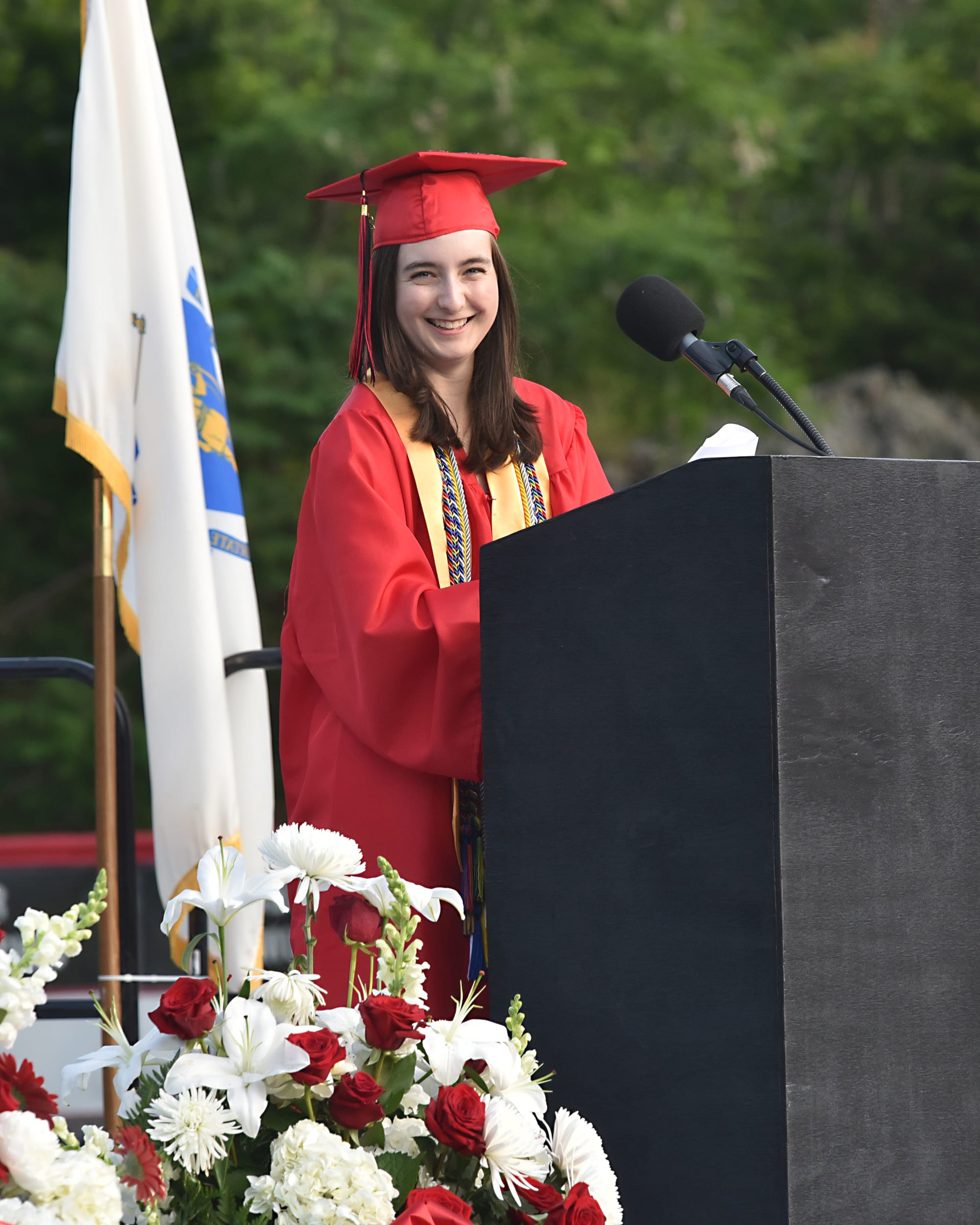
“I rather regret the things I do than the things I never did,” Meshulam said. It was as close as the evening came to a single thesis. One speaker after another kept circling the same unglamorous idea — that the hardest and bravest thing this class ever learned was how to make itself vulnerable, both to reach toward other people and to step past the edge of whatever felt safe.
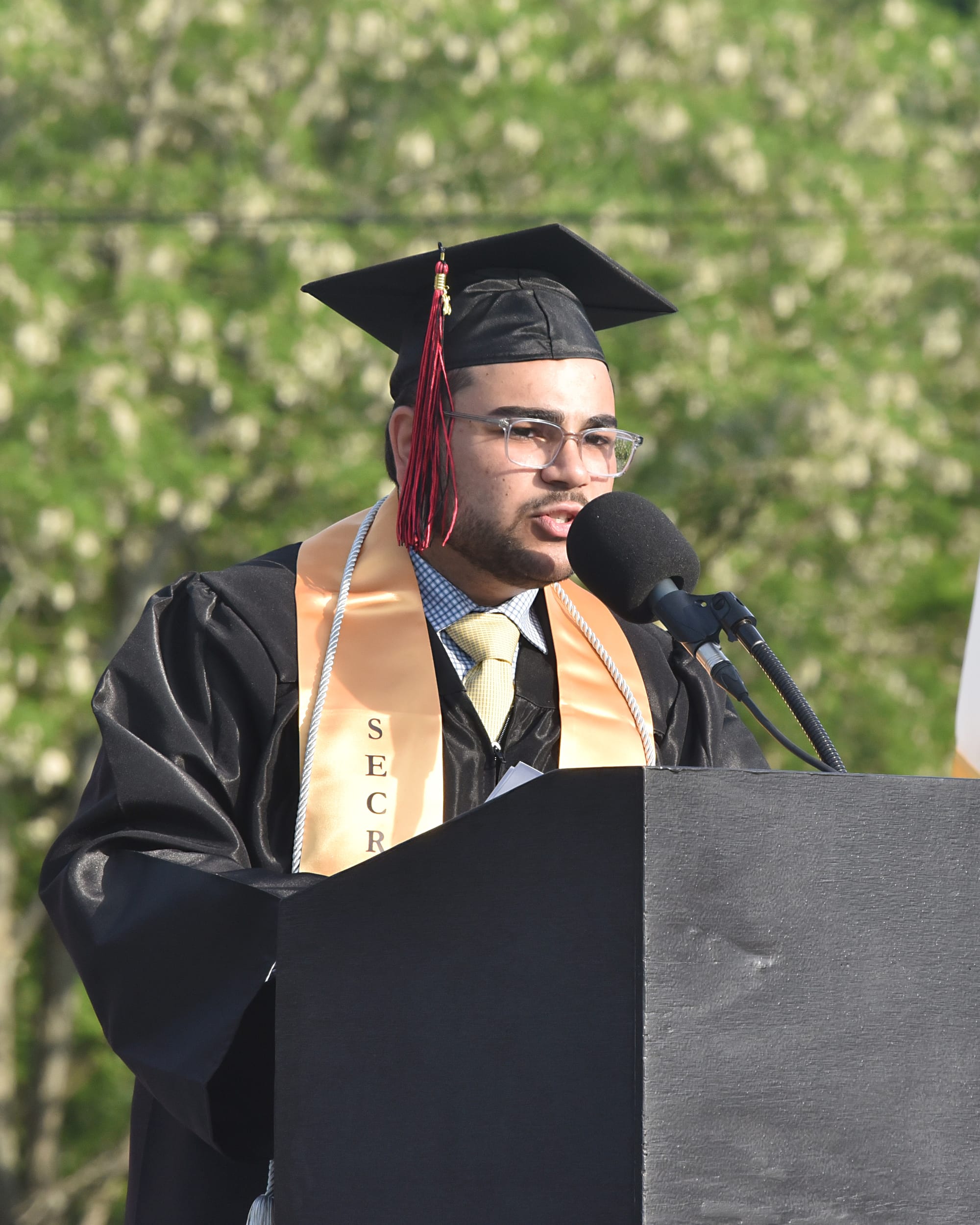
The argument started with the night’s first words. Class secretary Abdullah Al Janabi, who opened the ceremony with the welcome, admitted he had asked Principal Michele Carlson why she picked him — a student with a 3.3 grade-point average, as he put it — to speak for the class. The answer was how much he had changed since freshman year, and what changed him, he said, was simply talking to people: hedge fund managers and trash collectors, lawyers and grocery cashiers, anyone who would trade 30 seconds with him.
“It was always the human being behind the fancy suit or the orange safety vest that I wanted to know,” Al Janabi said. His advice to his classmates came down to one word, talking, and a small revision to an old line. “It’s not who you know,” he said. “It’s who knows you.”
That kind of connection did not come easily to a class that spent its early adolescence apart. Much of their middle school, Carlson reminded the crowd, unfolded at a distance — in front of screens, behind masks, separated from one another at exactly the age when children are supposed to be learning, clumsily, how to be together. The class then came of age as schools confronted a student mental-health crisis, lost two full weeks when their teachers walked out on strike and now graduates into a world where artificial intelligence is rewriting what a classroom is even for.
“You experienced disrupted learning, missed milestones, and uncertainty,” Carlson said. “Yet your class is defined not only by what you endured, but how you responded.”
Showing up
Meshulam made the cost of that response concrete. She told the field about being the only girl on the boys’ golf team, and about the afternoon she ended up consoling an opponent she had just beaten — a teenager undone, she said, by her eight iron. She described a lonely stretch when she decided that if friendship would not come to her, she would go after it, a campaign that once included telling an older student she wanted to hang out and getting a reply that began, “Sorry, I have a girlfriend.” She kept putting herself out there anyway, and eventually found the friends she had been looking for. “Everything meaningful starts with the willingness to be vulnerable,” she said, “because failures fade, but never trying lasts a lifetime.”
If Meshulam’s courage pointed outward into risk, Owen Dulac’s pointed at the small, unshowy bonds that hold a town together. The vice president skipped past the big memories and talked instead about the front-door security guard he greeted every single morning — the one who liked to take his time with the lock whenever students came sprinting up late. Theirs was a friendship measured in seconds and built one ordinary morning at a time.
“A short two-minute conversation that has been consistent,” Dulac said. “I hear a bit about his day, and he hears about mine.” The guard could not be there on Friday. Dulac told the story anyway.
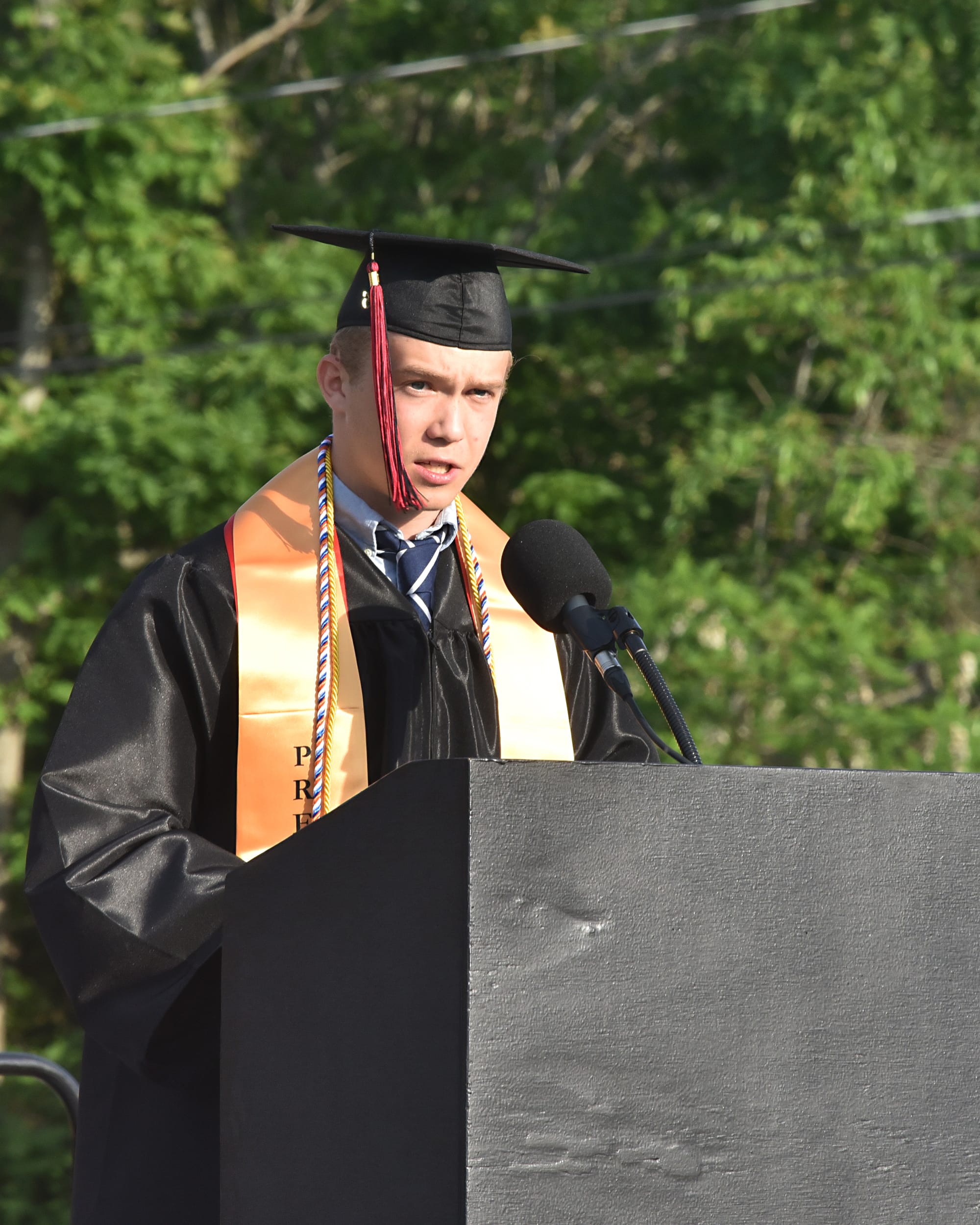
Class president William Cruikshank found that same hidden web out on the roads. A distance runner, he said the miles around Marblehead taught him to notice the people who keep the town moving when no one is watching: the fishermen heading out before dawn, the crossing guards, the shop owners, the police officers and firefighters who once dropped everything to escort his team home after a championship race.
“The more miles I ran, the more I began to notice connections that had always been there,” he said. Then he turned the observation into an assignment for the graduates seated in front of him. “Community is not something we simply inherit,” Cruikshank said. “It is something each generation has the responsibility to sustain.”
What it was all for
Salutatorian Ian Chemel argued that the real worth of their diplomas was never the grades behind them. The point of all those years, he said, was to become someone at ease in the wider world — able to hold a hard conversation, to make something with their hands, to form an opinion that is genuinely their own.
“Intelligence is not just classes and tests, it is also a maturity, an experience with the world,” Chemel said, “to see the world not as a foreign place, but as a home somewhere, if you have a place in it.”
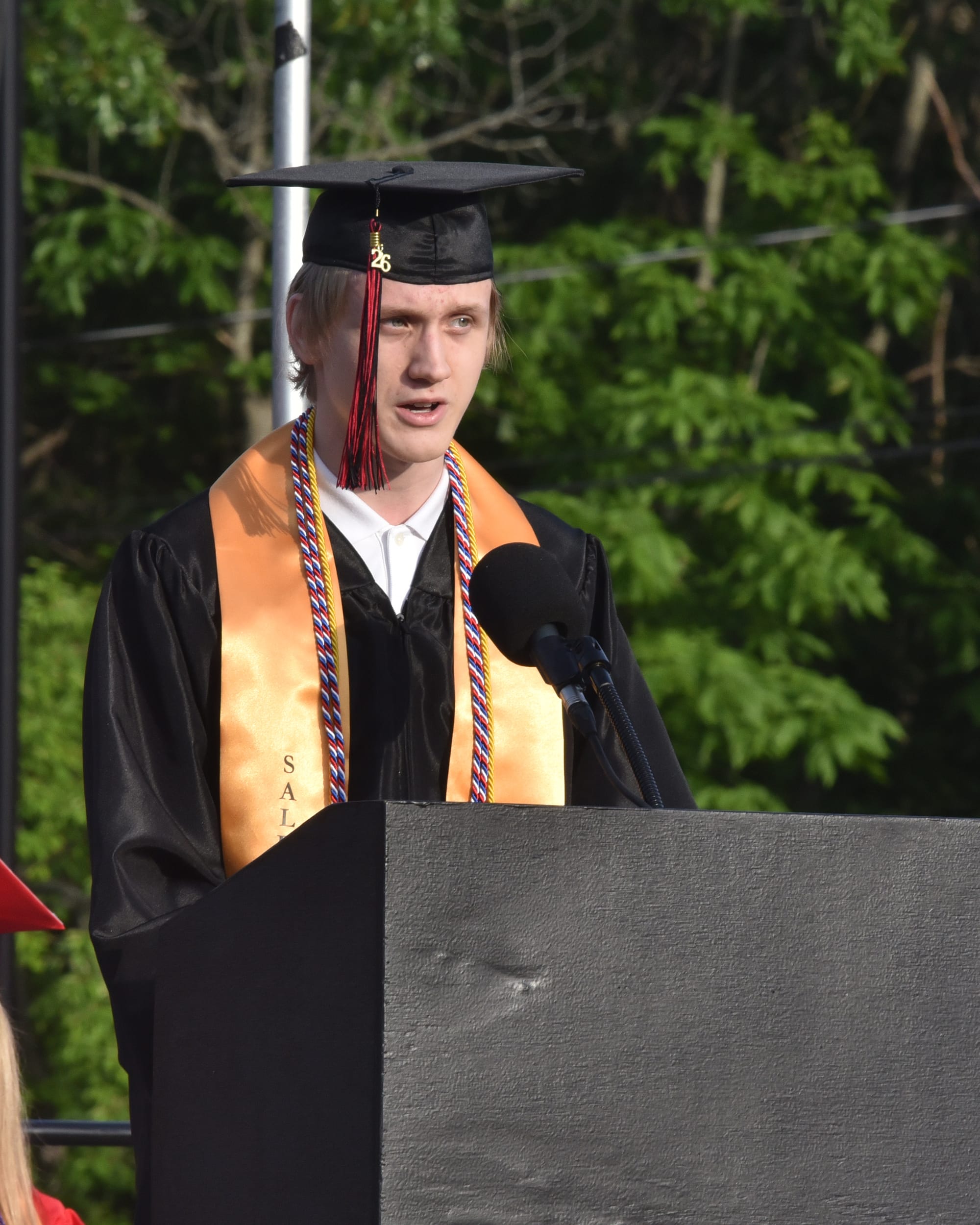
If the students made the case for connection, Superintendent John Robidoux made it hard to take too seriously – at least at first. A father of five who married young, he framed his remarks as advice for the parents he figures most of the graduates will become someday, “way, way in the future.” His first rule was to collect every bad dad joke possible and use it as often as humanly possible. “What did the triangle say to the circle?” he asked the field. “You’re pointless.” His second was that parents are bound by some unwritten law to embarrass their children at every opportunity, a duty he said begins around sixth grade and never really ends.
But the jokes were a setup. The advice Robidoux actually wanted to leave them with was earnest, and, like nearly everyone else’s that night, it was about other people — marry for the right reasons, put family first, stay a lifelong learner, treat others the way you would want to be treated, be humble and kind and empathetic, remember who you are.
“Marry for love, not for money, power, or status,” he told them. “Being a father and being a dad are two very different things.”
Then he sent them off with one more groaner and a steadier line, telling the seniors to stay safe, be well and make the town proud.
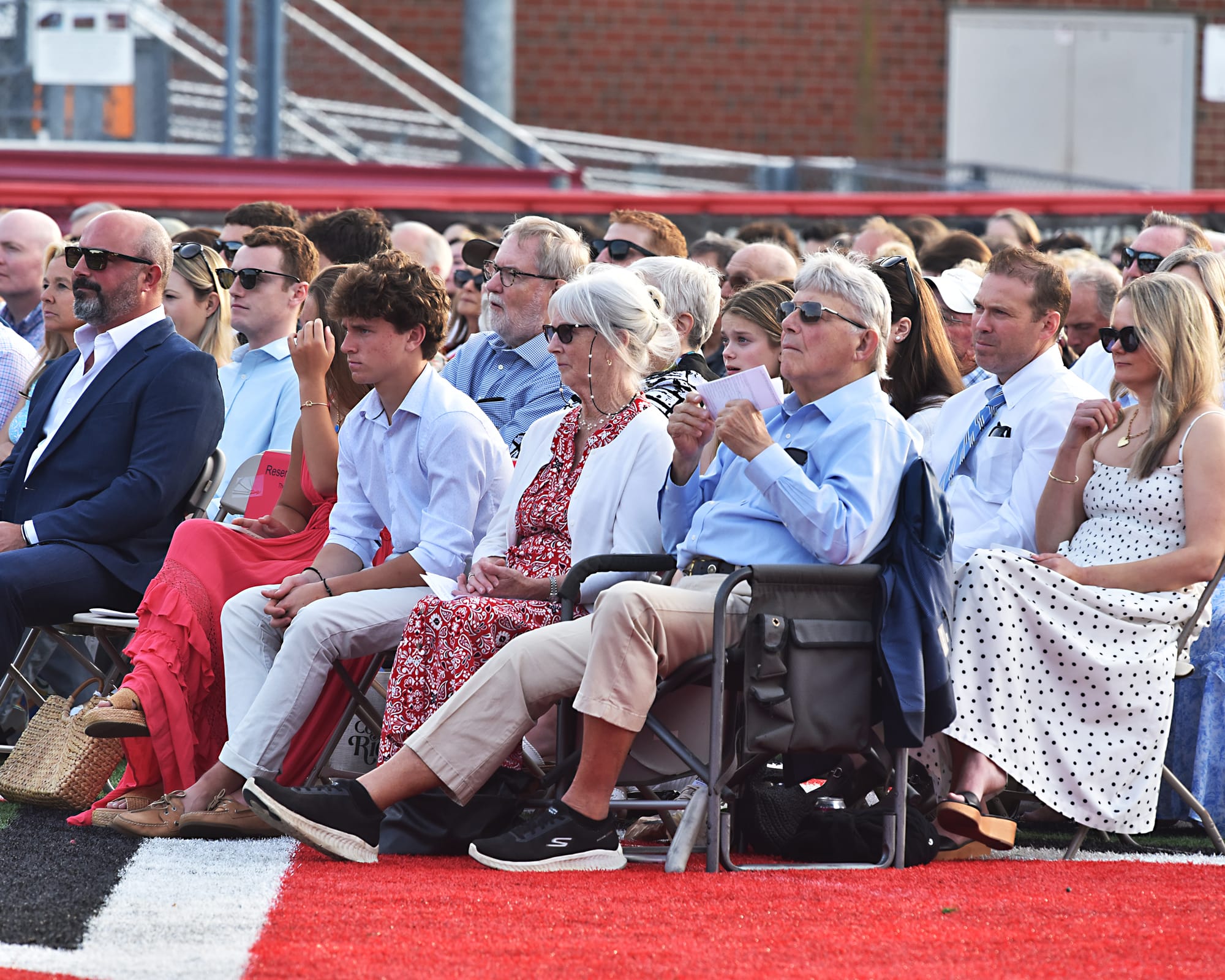
Ninety-two destinations
For all the talk of staying close, Friday was also a goodbye, and the numbers make that plain. Nationally, the typical undergraduate stays close to home: a recent analysis of federal data found a median college distance of just 17 miles, and about 69% of undergraduates enroll within 50 miles of home. Marblehead’s class, by contrast, is spreading itself across a much wider map.
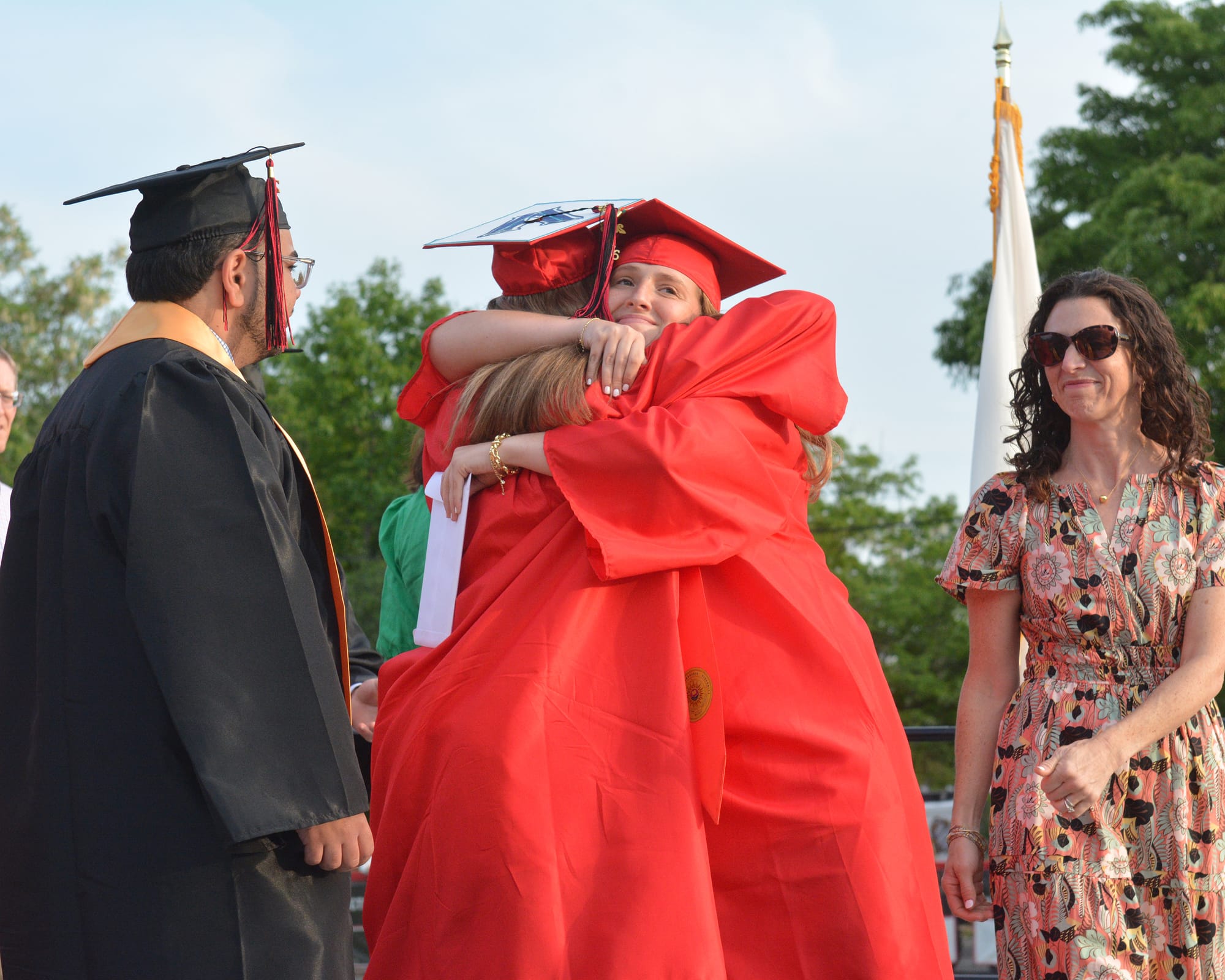
The 183 graduates reported 92 different post-graduation destinations — nearly one for every two students — scattered across 28 states, plus Washington, D.C., and, in one case, another country, at the University of Toronto. The closest is about 2 miles from Piper Field, at Salem State University. The farthest sits roughly 2,684 miles away on the California coast, at California Polytechnic State University — more than 150 times the national median distance from home.
The paths are as varied as the map. Of the 92 destinations, 78 are four-year colleges, ranging from Dartmouth, Johns Hopkins and Notre Dame to the University of Michigan and New York University. Five are dedicated art, design and music schools, including Berklee College of Music and the Massachusetts College of Art and Design. Three are community colleges and three lead into the military and maritime service, among them the United States Naval Academy. The last three skip the dorm altogether, for a job, a gap year or a postgraduate year — the only destinations on the list with no campus to pin on a map.
The class leaves decorated, too: 145 of the 183 graduates, or 79%, finished with honors, and 104 of them, more than half the class, reached High Honors with a grade-point average of 3.8 or better. The town sent them off with help as well, in the form of dozens of local scholarships, many named for Marblehead residents the community has lost.
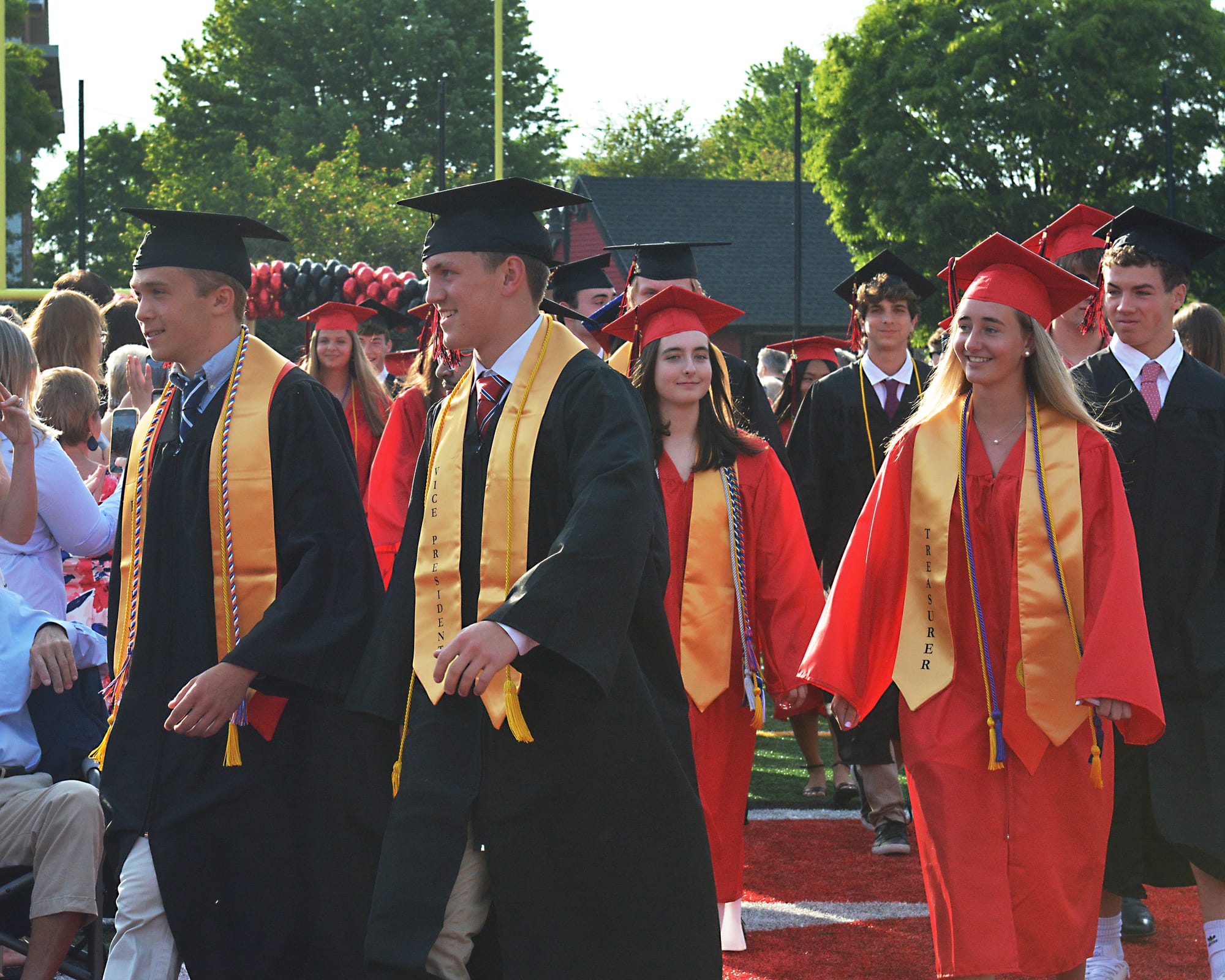
The ceremony kept folding back into the theme of going and staying at once. The choir sang “Rivers and Roads,” a song about people pulled apart by distance and finding their way back to one another, arranged by Griffin Collins, a Marblehead graduate from the Class of 2023. Then, one by one, all 183 names were read, the diplomas crossed the stage, and the thing this class had spent four disrupted years building began, formally, to come apart.
What they carry off Piper Field is a class that learned early what isolation costs, and decided the answer was simply to keep showing up — to ask the question, to sit with the stranger, to talk to the guard, to take the long way home. They are walking into a world that often feels pulled apart, already practiced in the one thing that many at the podium Friday night argued it most requires: The nerve – the vulnerability – to need one another.