Table of Contents
Get our free local reporting delivered straight to your inbox. No noise, no spam — just clear, independent coverage of Marblehead. Sign up for our once-a-week newsletter.
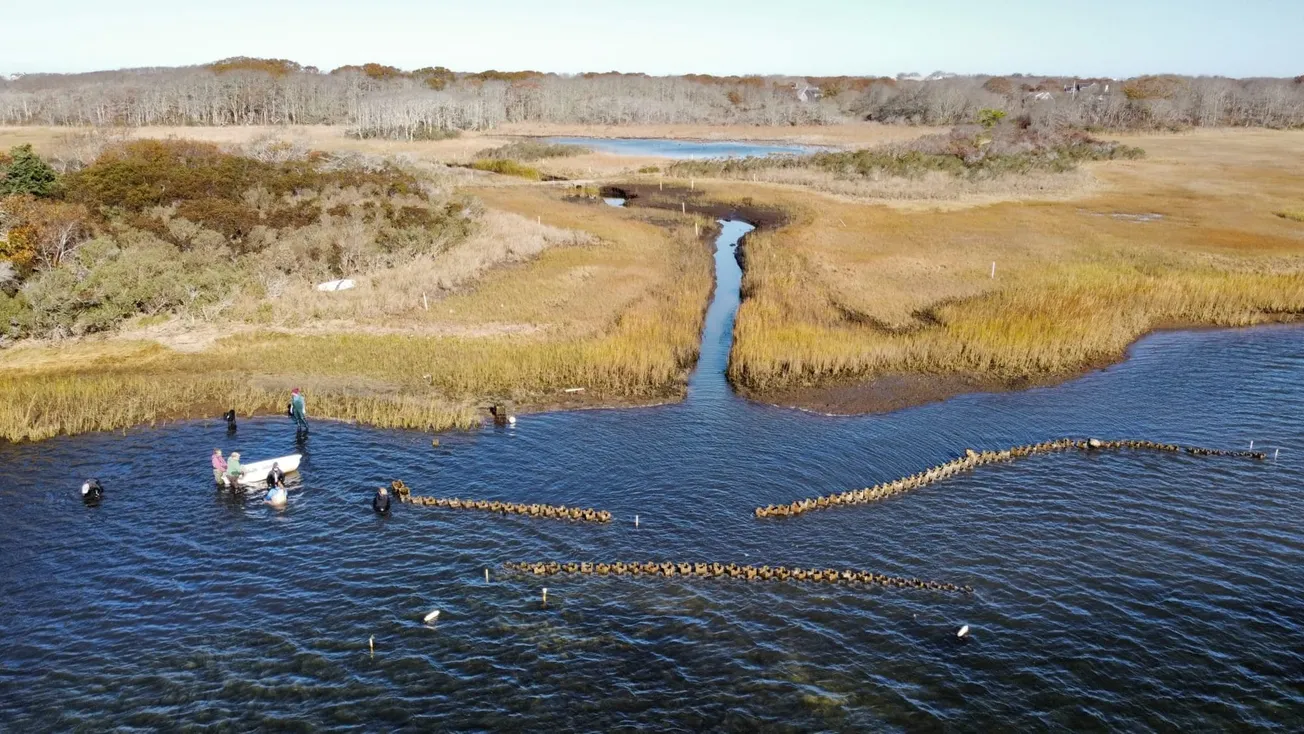
On a low-tide Friday morning, a class of Tower School 4th-graders left their desks behind and picked across the rocky flats below the Lead Mills Conservation Area, where oyster-reef structures — part of a project their own classroom work had helped inspire — were about to go into the mud. The June 5 installation, on the boundary water between Marblehead and Salem, opened the town’s four-day World Ocean Day celebration.
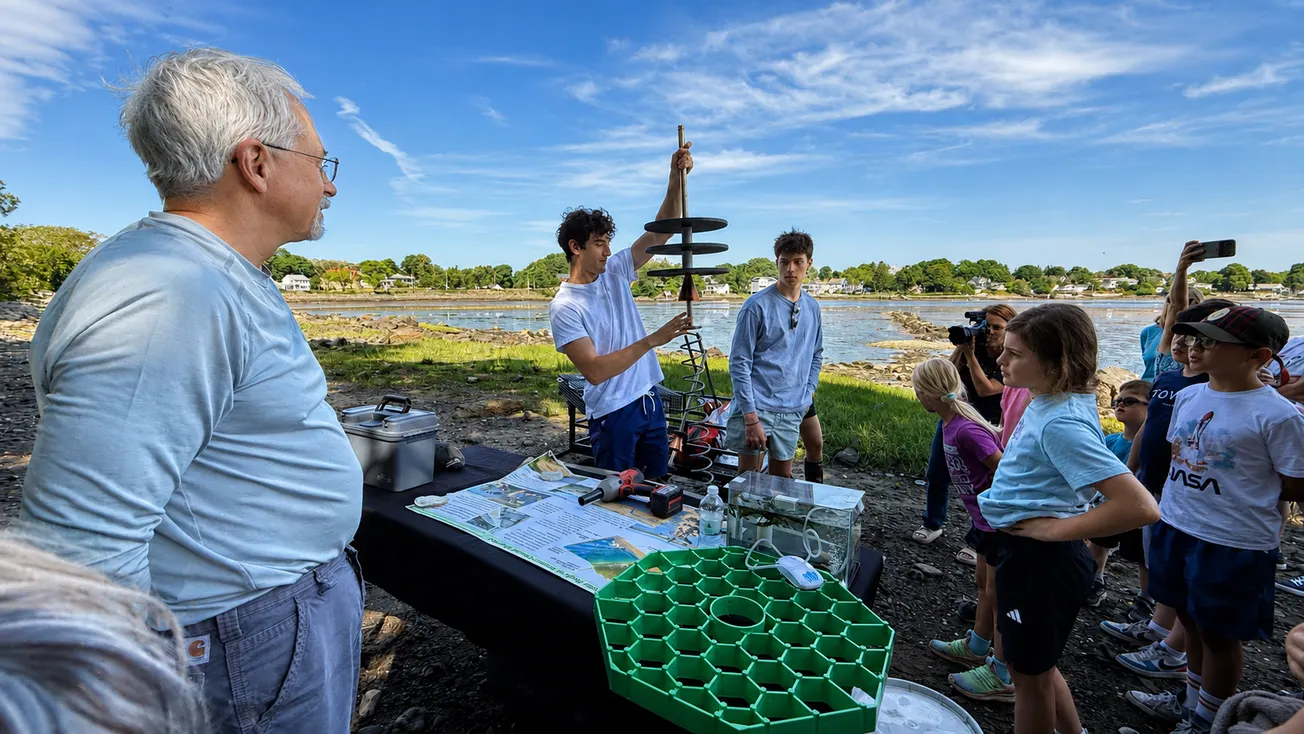
The morning began on the cobble shore, around a black folding table crowded with gear: a clear water tote, a power drill, a folded diagram and a bright kelly-green honeycomb tray for growing young oysters. George Thatos, head of design at Coastal Technologies Corporation, held up a slender model — a pole stacked with round slate plates, like a spindly artificial tree — and told the children where the day was headed. “We’re gonna get very muddy,” he said, then laid out the experiment: stacks of different shapes, materials and heights, set at different levels above the sea floor, so the students could later see which oysters fared best.
He crouched over a stack already planted in the sediment to show how it worked — a stainless steel coil that a drill drives into the mud like an anchor, and slate plates that slide on and off so the reef can be studied, measured or moved. A copper-and-brass baffle near the base, he explained, turns away the oyster drill snails that crowd these flats, because the metal does not agree with their soft flesh. This year he was adding a bar to lock several stacks together, “since the triangle is the strongest shape,” he said, and the kids were about to watch it tested on the flats for the first time.
Connecting the classroom to the coast
The students were not spectators. In Colleen Parenteau’s science class they had studied how oysters filter water and steady shorelines, learned the reef technology from Thatos and then designed their own stacks, presenting the concepts to him and to Steve Wolf, who leads the pilot. Organizers have said the students’ design work helped inspire the broader effort. Lucy Wedel, a 4th-grader, described what her group had made. “We made a marsh guard and an oyster stack,” she said. “It stops erosion and helps with food because it makes the water clean.” With her friend Alder she had built a classroom prototype — an algae-inspired take on Thatos’s design, branching outward like seaweed.
She had the science down, too. Oysters, she said, “clean 50 gallons of water a day,” and were once everywhere along the coast — “back in the days, there was a lot of them, but then people over fished them, and now they’re not very many.” She could explain how reefs rebuild themselves on old shells, and how “the spat drops from the top of the ocean down onto George’s oyster stacks.”
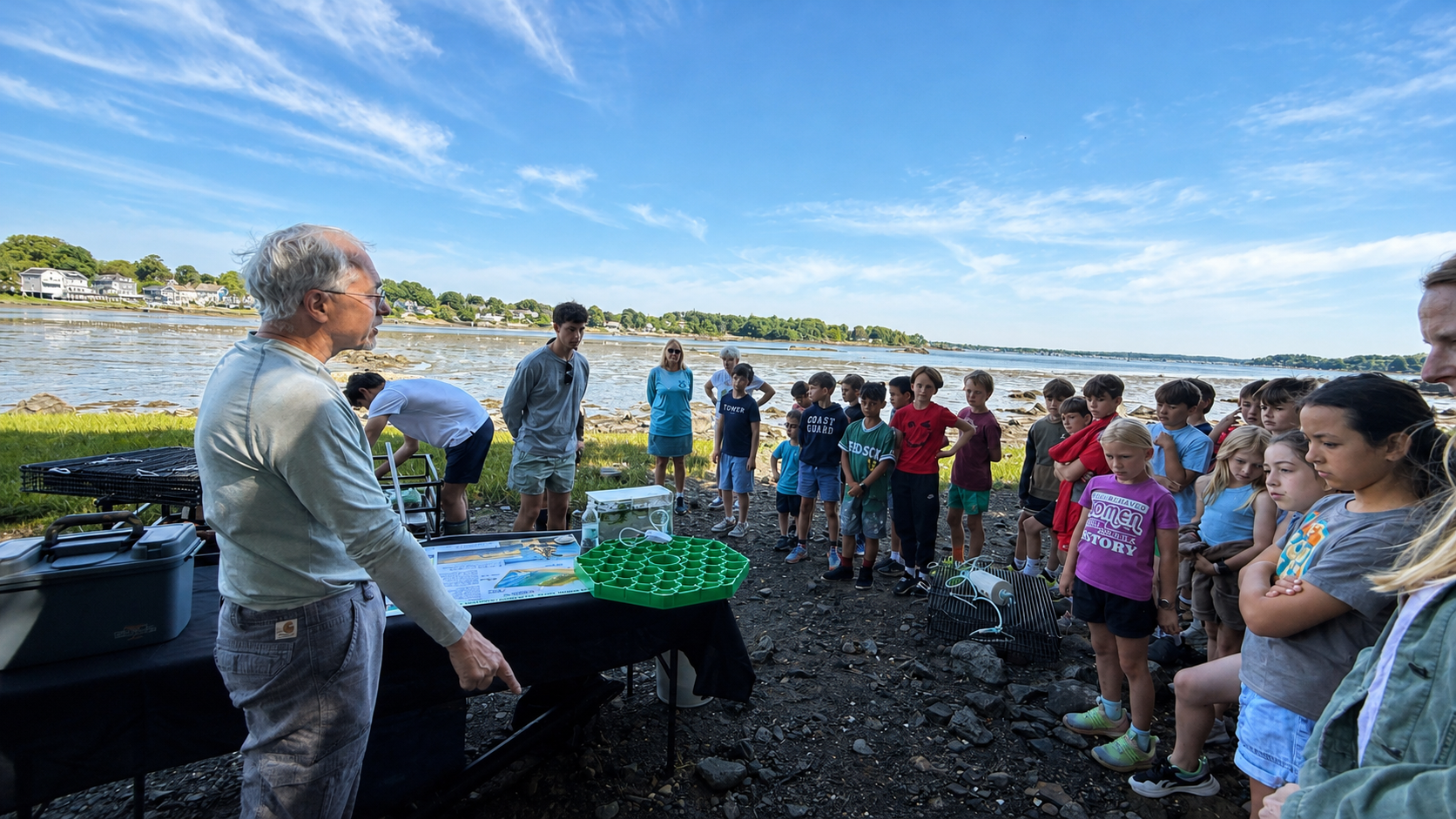
Wolf, a marine scientist who chairs Sustainable Marblehead’s Harbors and Waters Working Group and is taking part as a resident rather than through his job at the U.S. Environmental Protection Agency, gathered the children and pointed up the beach to a low cliff a nor’easter had cut into the bank a few years back — the kind of erosion oysters might one day slow. Oysters had thrived here before people harvested them out, he said, and the pilot would set oysters, cages and instruments at six spots around the harbor and track them for a year or two. A sensor on one cage would log water temperature and light and “send some data to your class, and you’ll get to look at that,” he said.
The reef structures are one part of a larger pilot. At Tucker’s Wharf, an upweller — a tank that pumps seawater past baby oysters until they are big enough to survive — is to raise about 60,000 of them this season, tended daily by Salem Sound Coastwatch volunteers, with some bound for the harbor sites later. The target is the Eastern oyster, prized because it builds reefs on the shells of other oysters. The state has given the project only a tentative go-ahead; Marblehead’s waters are largely closed to shellfishing, so the work is a monitored study, not a release.
Good neighbors on the flats
Lead Mills is a pointed place to try it. The 4.5-acre site on the Marblehead-Salem line once manufactured white lead, and after remediation more than a decade ago the bank was capped and planted with marsh grass. The 2018 storms that tore at the shore drove erosion close to a bike trail and a buried electric line. Oysters off that bank, Wolf has said, could filter the water and pull energy out of incoming waves — a living shoreline, rather than a sea wall that only reflects the surf somewhere else, like the Neck.
Todd Eveleth, the head of Tower School, watched from the rocks and said the value lay in letting students own something real. “Projects like this build engagement,” he said. “These students will be part, or have been part, of the engineering design and research process in this. They built their own prototypes of towers like this.” For years, he added, they would pass the harbor and wonder how their work was doing. The school uses the shoreline often: 1st graders were counting crabs in a tide pool that same morning, and in the fall 8th graders study Lead Mills with a Harvard research program. With graduation set for Tuesday, he wanted the children to see that “just because they’re in an independent school doesn’t mean that they’re isolated from real-world problems.”
The classroom unit that led them here grew out of the Williamson Innovative Science Education Fund, which the family of Frances Williamson, a beloved Tower science teacher, established in 2013 for hands-on programs; Parenteau won one of its grants. The school’s director of development, Jessie Achterhof, traced the fund’s history for those who turned out, among them state Sen. Brendan Crighton. “To say that I am thrilled for this opportunity for our students is a massive understatement,” Parenteau said in a statement.
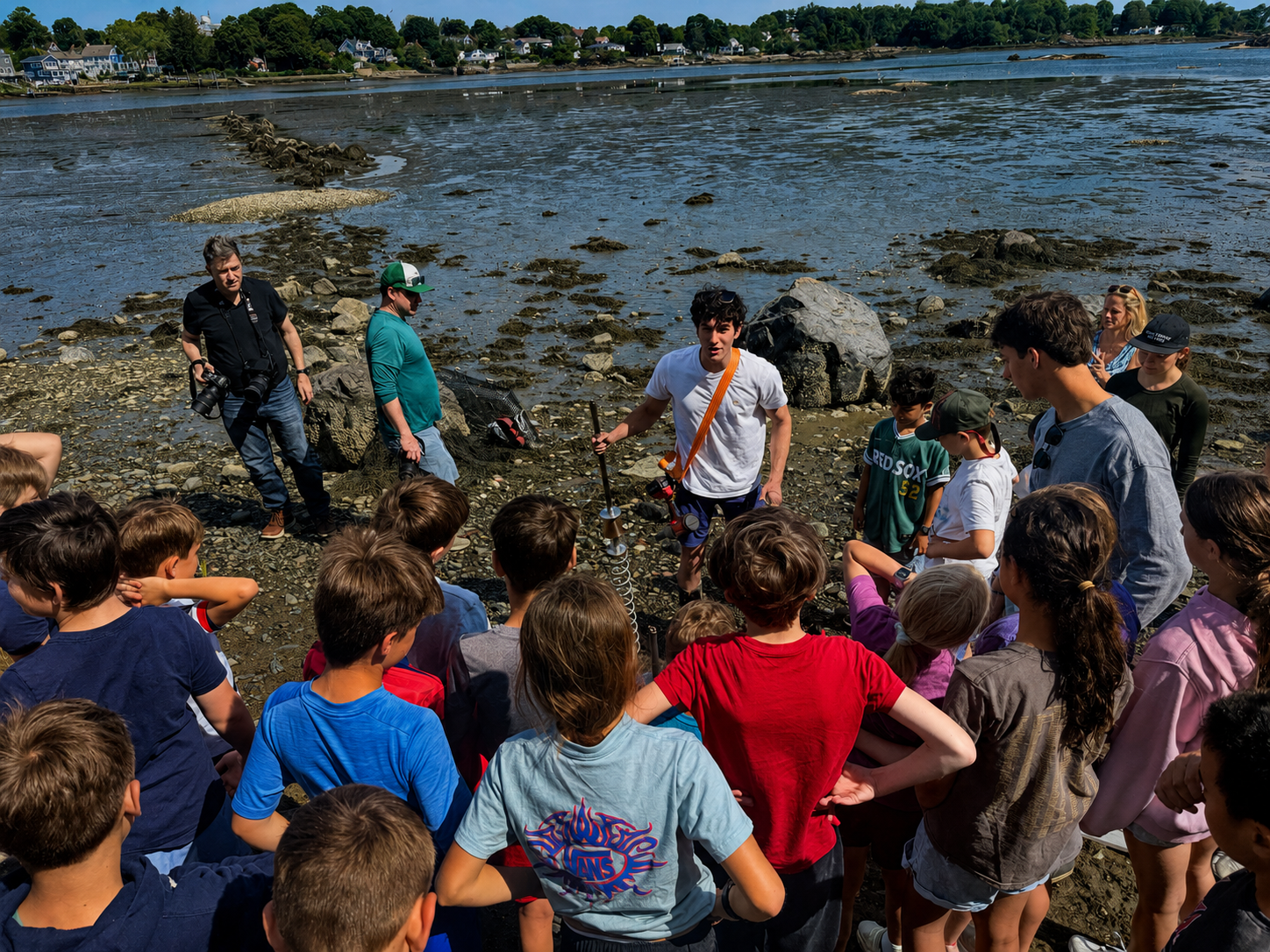
By midmorning the talk broke up and the children waded out across the flats toward the rocks to be part of the installation, where the first stacks already stood anchored in the sediment. The oysters have not arrived, and the instruments will keep logging numbers for the class to study as the reef takes hold. The structures are in the mud now — the kind of work the children’s own designs helped set in motion — in water that has not held a working oyster bed in living memory, no longer a lesson on paper but something real they can come back to watch.
Contributions help keep The Marblehead Independent free to read while supporting the reporting time, editing and follow-up work local coverage requires. We’re at 121 contributors toward a goal of 175 by July, which means 54 more neighbors can help close the gap. If you’ve been meaning to support independent Marblehead journalism, this is a good moment to do it. 🟦 Become a contributor here.