Table of Contents
Get our free local reporting delivered straight to your inbox. No noise, no spam — just clear, independent coverage of Marblehead. Sign up for our once-a-week newsletter.
When the Select Board voted 4-1 on March 25 to pursue a three-tier operating override, and then voted unanimously to place a separate trash-funding question alongside it, the board built a June ballot — assuming Town Meeting authorizes the questions first — that will field-test two different theories of how Marblehead voters decide whether to raise their own taxes.
One theory says voters want a bundled, labeled choice with layers of ambition. The other says they want a single, specific, standalone question tied to a single, specific expense. If Town Meeting approves them, both will appear on the same ballot. Both will be decided by the same electorate on the same night. And together, they will determine whether the town closes a $7.7 million budget gap.
The 44-year history of Proposition 2½ votes in Marblehead gives one of those theories a substantial head start.
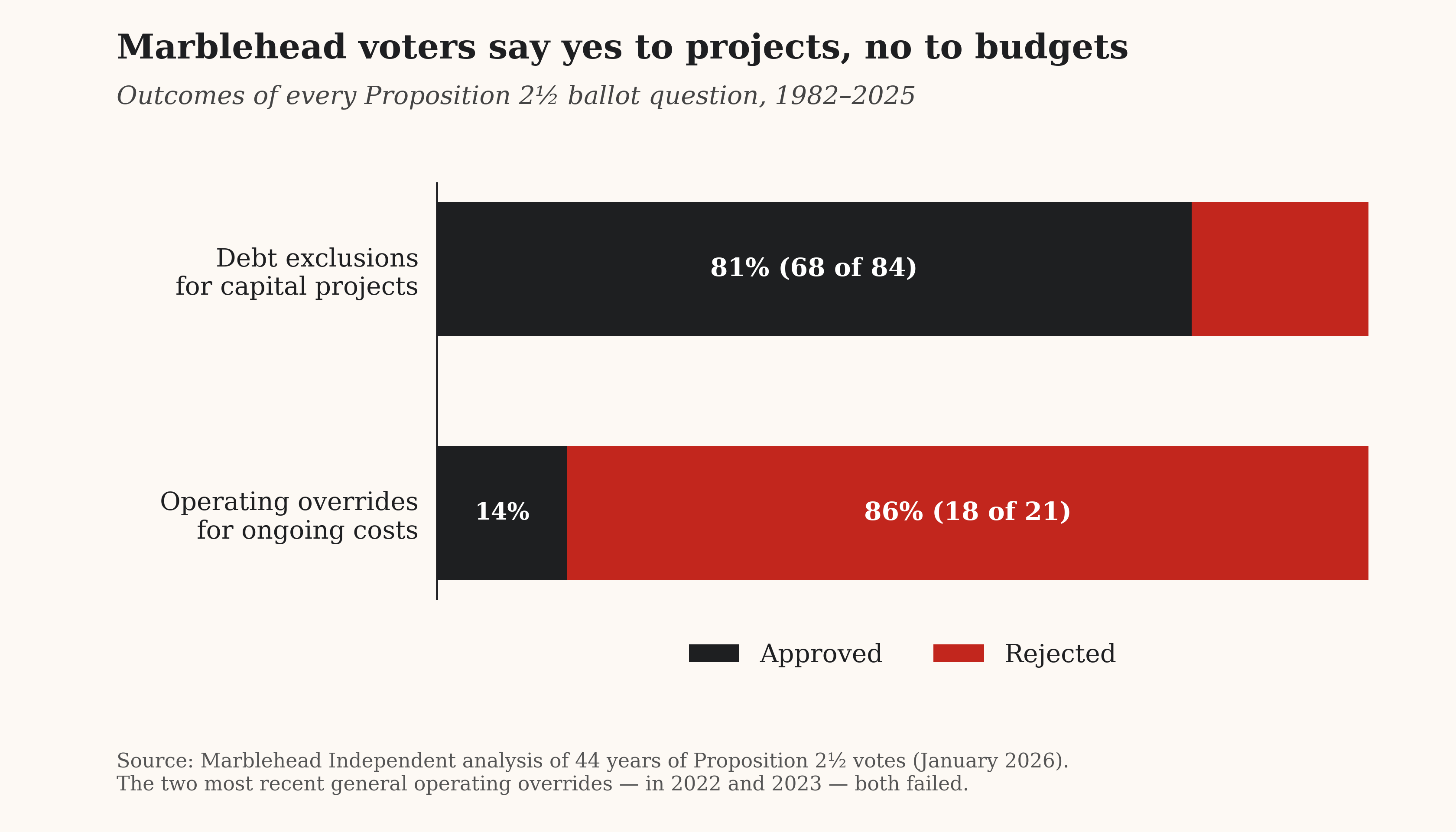
A Marblehead Independent analysis published in January found that since 1982, voters have approved 68 of 84 debt exclusions for capital projects, an 81 percent success rate, while approving just three of 21 operating overrides, an 86 percent failure rate. The town has not approved a permanent general operating budget increase since June 15, 2005. Select Board member Moses Grader, the former Finance Committee chair, described the reason for the split in a January interview: “Debt overrides are transparent, specific and directly accountable. Operating budgets are generally not as clear. Too many discretionary components. Less accountability around why increases are happening.”
A debt exclusion has historically won in Marblehead because voters are approving a defined object — a seawall, a fire truck, a school roof — with a fixed cost, a fixed repayment schedule and a fixed endpoint. When the bond is paid off, the tax increase expires. Specificity, visibility and reversibility.
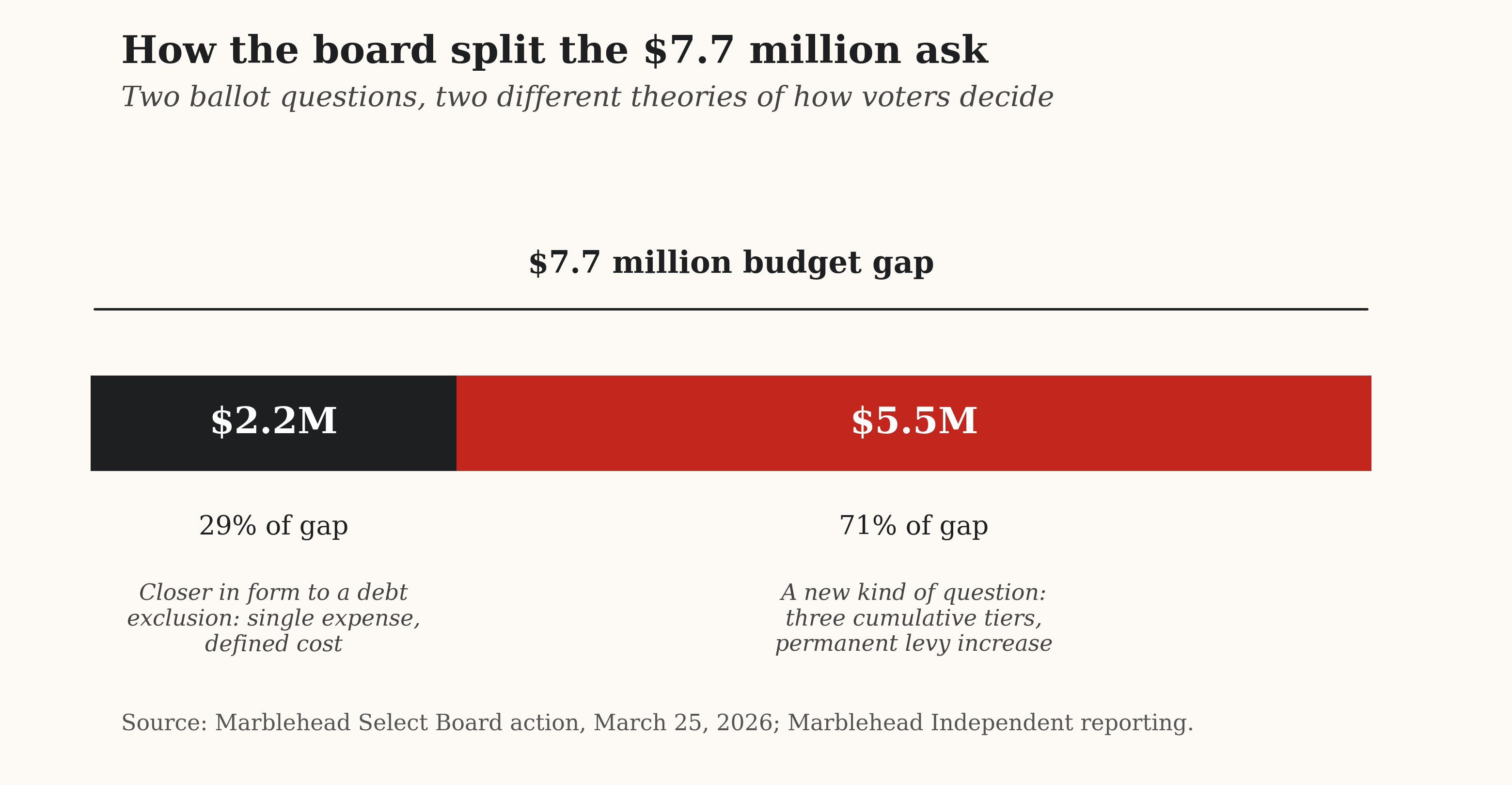
The trash question the board advanced on March 25 carries most of those features, and a substantial share of the math. The Board of Health is moving to implement a curbside trash fee of about $262 per household to cover new collection contracts, shifting roughly $2.2 million off the general fund. The override question would give voters the option of funding those services through the property tax levy instead, effectively replacing the fee.
At $2.2 million out of $7.7 million, it accounts for roughly 29 percent of the total shortfall — leaving the remaining $5.5 million to the three-tier service override. It is tied to a single, nameable expense at a defined cost. A voter considering it will be asked a yes-or-no question about a specific service at a specific price — closer in form to the debt-exclusion questions voters have approved 81 percent of the time than to the operating overrides they have rejected 86 percent of the time.
The three-tier service override is a different kind of question — and a larger one. Town Administrator Thatcher Kezer said the structure divides the remaining $5.5 million into cumulative layers. Tier 1, “restore,” would bring back services cut from the balanced budget, including a firefighter position, the school resource officer, full library staffing, custodians and positions across several departments. Tier 2, “stabilize and build,” would add building maintenance, additional public safety and public works staffing and implementation of a consultant’s salary study recommendations. Tier 3, “invest and improve,” would add capital investments. Voters would mark each tier yes or no, and the highest-value tier clearing a majority would set the permanent levy increase.
How much of the debt-exclusion logic that structure captures is a question the tiers themselves answer only partially. Each tier bundles multiple items together. The tiers are cumulative rather than independent: a voter cannot approve Tier 1 and Tier 3 while rejecting Tier 2. And none are reversible without an underride ballot question. Each represents a permanent addition to the tax base. The structure carries the first of the three historical features — specificity about what each dollar buys — but not the second or the third.
The board’s vote was not unanimous. Select Board member Moses Grader cast the lone no vote, arguing that tier one should be structured as a one-year choice rather than a permanent levy increase, and that the restoration tier should be broken out into a more itemized format in which individual department heads would defend specific line items before town meeting. Both Grader and fellow Select Board member Jim Zisson advocated for menu-style approaches during the discussion too. Zisson presented a four-slide framework grouping departments into independent functional clusters — public safety, public infrastructure and maintenance, culture and recreation — that voters could approve or reject on their own. That structure more closely mirrored the debt-exclusion pattern. Zisson argued the menu and tiered approaches were not mutually exclusive, and when the motion came to a vote, he sided with the majority.
The menu structure more closely mirrors the debt-exclusion pattern. The board rejected it. Select Board member Dan Fox said it would dilute the board’s unified message: “I think that we swim as a town, or we sink as a town.” Select Board member Erin Noonan called the menu approach “operationally dysfunctional,” arguing that the real cost drivers — health insurance and pensions — cut across the entire budget. Select Board member Alexa Singer cited the 2005 override, in which a department-by-department approach produced an imbalanced budget that required a second override 12 months later.
But in approving the trash question as a standalone ballot item in the same meeting, the board effectively adopted a miniature version of the menu approach it had just rejected for the rest of the override. What it did, in effect, was carve out the single biggest nameable expense in the budget gap — nearly 30 percent of the total — and give it the ballot treatment the historical record says works, while leaving the remaining $5.5 million in the tiered structure the historical record has not yet tested.
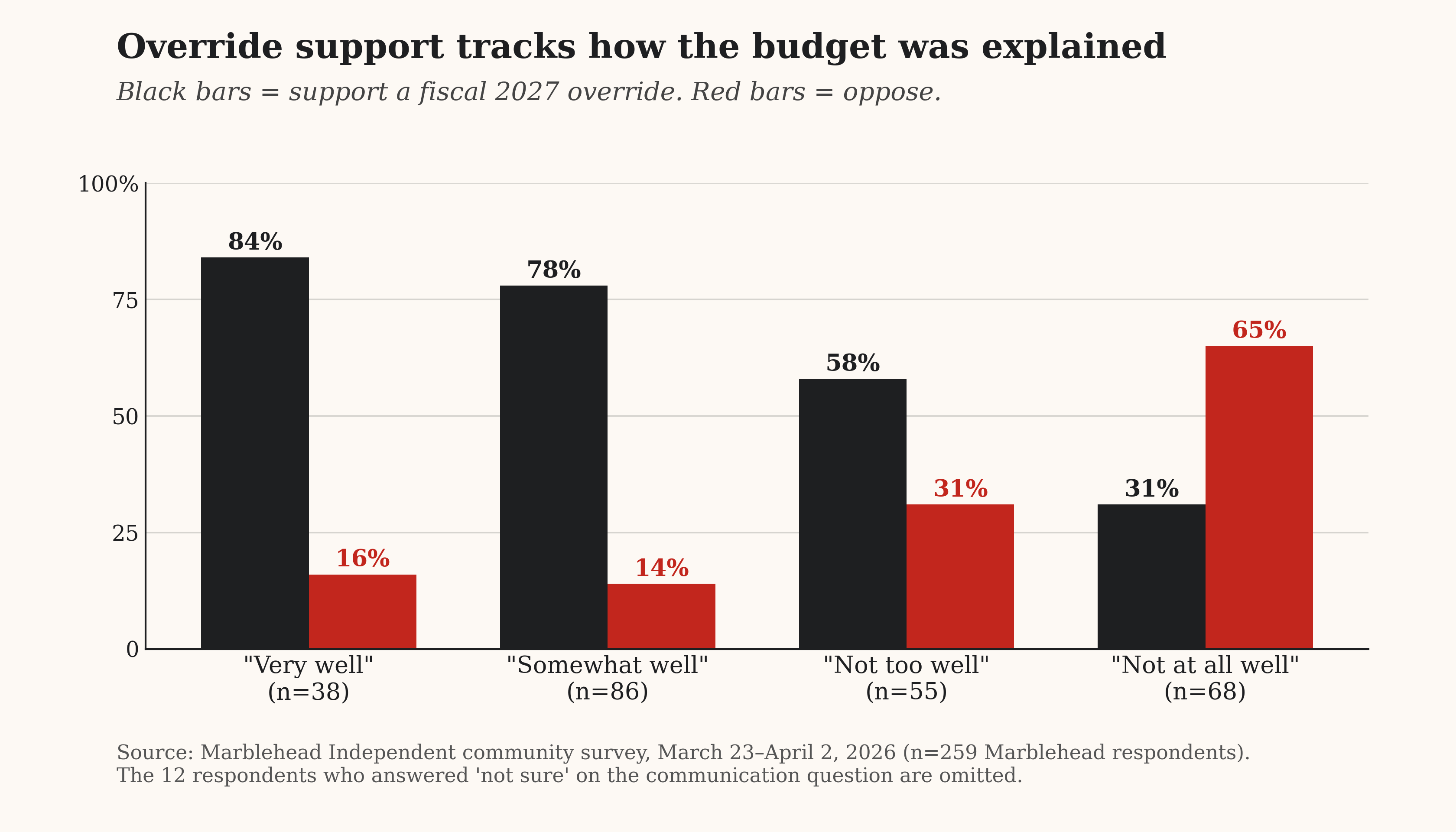
The Marblehead Independent’s community-sentiment survey, conducted between March 23 and April 2, suggests the distinction will matter. Sixty-one percent of the 259 respondents say they support an override. But only 34 percent picked “mostly new revenue” as their preferred approach. Thirty-five percent picked “a mix of both.” Twenty-five percent picked “mostly spending cuts.” The 91 hybrid-approach respondents — the largest bloc — lean yes by nearly four to one, but their preferred solution includes spending discipline.
The decision to pair the tiered override with a unified town-and-school working group is the part of the March 25 vote that runs most directly into the recent ballot history. The last two general overrides Marblehead voters considered both involved school funding — a school-only request in 2022 and a combined town-and-school request in 2023 — and both failed. The board’s working group will produce a third version that has not been tested locally at all.
The numbers attached to each tier, which Kezer said would be developed in the weeks following the March 25 vote, will determine whether the service override reads as three reasonable increments or as one large ask divided into three labels. Until those figures land, the tiered structure exists as a framework rather than a question. The trash question already has a shape voters can recognize from 44 years of ballot history — and a dollar value that accounts for nearly a third of what the town needs to raise. Whether that resemblance translates into a different outcome in June, and whether the remaining two-thirds can follow, is the test the board has, perhaps inadvertently, set up for itself — if Town Meeting lets the questions get there at all.
CLARIFICATION: An earlier version of this article attributed the menu-style ballot proposal to Select Board member Moses Grader alone. Both Grader and Select Board member Jim Zisson advocated for menu-style approaches during the discussion. Zisson presented a four-slide framework grouping departments into independent functional clusters.
Our reporting is free and open to all — and it stays that way because 108 readers choose to support it through recurring monthly or annual contributions. Their support is what keeps independent, document-based local reporting in Marblehead going, with no paywalls and no promotional framing. Click here to become an Independent member.