
Table of Contents
Get our free local reporting delivered straight to your inbox. No noise, no spam — just clear, independent coverage of Marblehead. Sign up for our once-a-week newsletter.
SALEM — Dan Koh kept his family close all night — his 5- and 3-year-old children, his immigrant father, named again and again as the reason he was in the race. Then Jamie Belsito decided his money was fair game too, and a debate that had run on near-total agreement finally cracked open.
For most of the 90 minutes Wednesday at Salem State University, the six Democrats competing to succeed U.S. Rep. Seth Moulton had echoed one another on nearly everything. The break came over campaign cash.
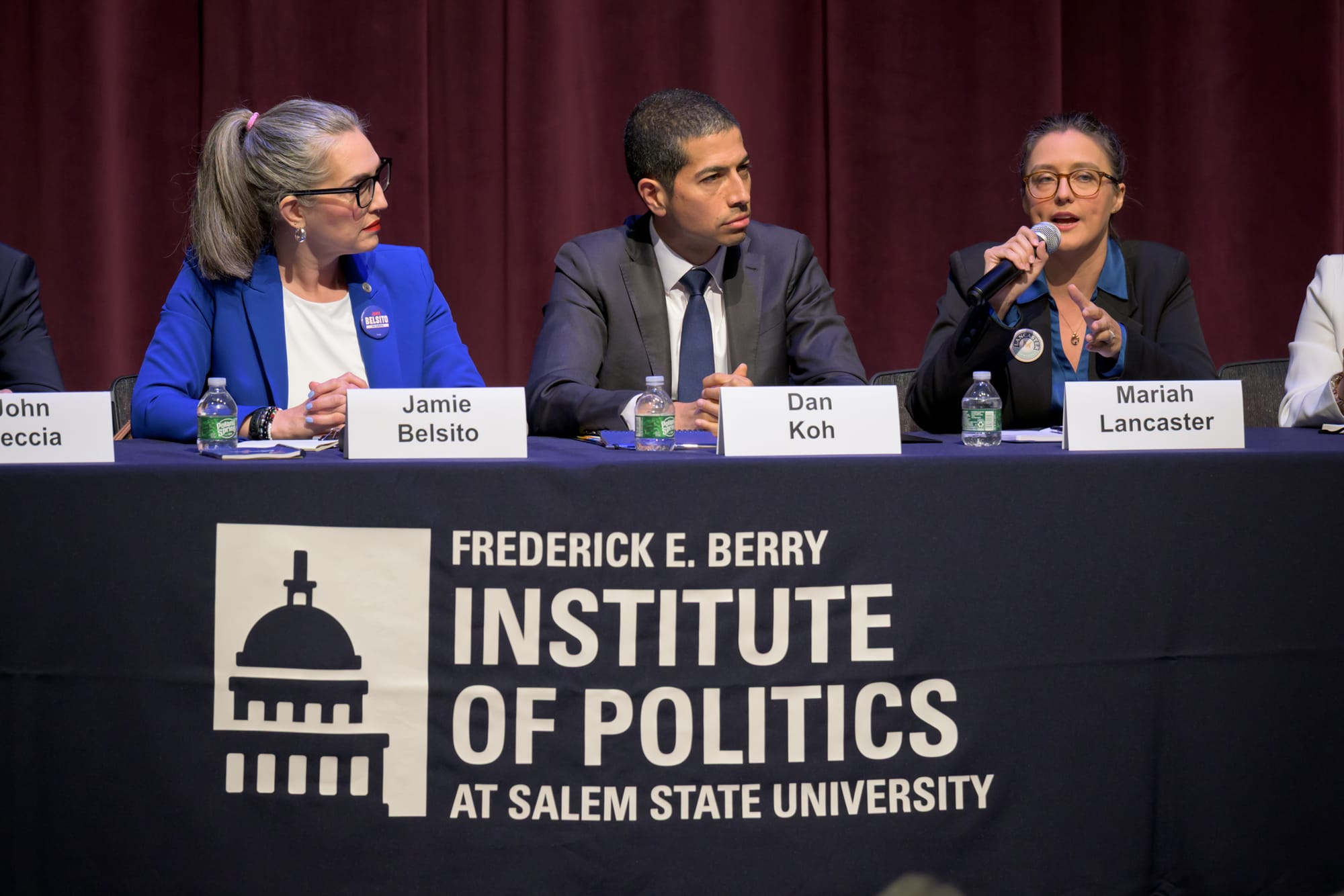
Most people, Belsito said, do not have “access to the wealth that you do” — and the room turned with her.
“For you to call out my family in this debate is something that is way past the line,” Koh said.
Belsito did not retreat. “Your father’s got a phenomenal job,” she told him.
Mariah Lancaster cut in. “Why do you talk about your kids on this stage?” she asked.
Koh, who had invoked his children all evening, said only that he was “proud to be a father.”

The event was hosted by the Frederick E. Berry Institute of Politics and drew the full Democratic field to one stage for the second debate since Moulton announced he would give up the North Shore seat to challenge Sen. Edward Markey in the Sept. 1 primary. In a district the Cook Political Report rates as 11 points more Democratic than the national average, that primary will almost certainly decide who goes to Congress; the winner meets Republican Micah Jones on Nov. 3. Former U.S. Rep. John Tierney, who has endorsed Koh, watched from the audience.
The argument over money sat atop a lopsided ledger. Federal filings through March 31 show Koh, an Andover native and former aide in President Joe Biden’s White House, raised about $3.5 million, more than anyone in the race, with roughly $3 million still in the bank and a list of endorsements he recited onstage — Biden, former Vice President Kamala Harris and, he said, “over 70 unions and local elected officials.” John Beccia, a fintech executive from Lynnfield, has loaned his own campaign nearly $2 million. The rest are running on far less: state Rep. Tram Nguyen reported about $431,000; Lancaster about $207,000; Belsito $134,000 and a $25,000 personal loan; and Bethany Andres-Beck, a Middleton software engineer who entered the race first and has spent most aggressively, just $9,535 on hand.
Beccia, who said he was “betting on myself,” brushed off the attack on self-funding. “You can’t buy an election,” he said, leaning on his banking background and his “People Over Politics” pitch.
Belsito, the daughter of a union floor layer, was unmoved. She called the contest, at bottom, “class warfare,” and told the audience to look at “what’s going into people’s campaign accounts.”
Candidates split over governing with a slim majority
The candidates drew real blood over a quieter question: how to govern if Democrats retake Congress. Koh argued for ambition without apology. “You don’t need a single Republican vote to pass,” he said.
Nguyen, the only state legislator on the stage, disagreed from experience. Even a slim majority, she said, would force Democrats to “work with people across the aisle,” noting she had passed “13 bills in a bipartisan way” across eight years in the Massachusetts House.

Lancaster, who worked at the State Department and as a congressional aide, went further. “I disagree fundamentally,” she said. Passing anything on climate or coastal resilience would take Republican votes in the Senate, and pretending otherwise was “ignorant, and I’m sorry, but it’s true.”
Andres-Beck turned the same doubt on Beccia, who in one breath had called for reform and cross-party cooperation. “I don’t understand how you can call for revolution on the one hand and then say you expect to do bipartisan cooperation with people currently in power on the other,” they said.
For all the friction, the policy daylight was thin. Asked in a lightning round whether Immigration and Customs Enforcement, or ICE, should be abolished, all six said yes. All backed universal health care, though Beccia and Nguyen paired it with a public option. All supported student-loan forgiveness — Lancaster noting her own debt had grown by $70,000 over nine years. Only Belsito declined to support expanding the Supreme Court.
None would raise the Social Security retirement age. Andres-Beck’s answer was “absolutely not. AI should pay for it.”
Affordability runs under it all
Affordability ran under everything. Nguyen described her mother, retired on about $1,000 a month, watching her health-insurance premium climb to $235 — close to a quarter of her income.
Koh conceded his own party had no clear answer. “What is our affordability agenda? I wish I knew,” he said. He pitched what he called a “no more agenda”: $10-a-day child care, $25,000 in down-payment help, and caps on what families pay for rent and utilities, a package he said would save a typical district resident $23,000 a year, paid for by reversing tax cuts he attributed to Elon Musk. He said the administration had cut 40% of the federal affordable-housing budget, though he did not give the dollar total the figure came from.

Beccia put the cost of the president’s tariffs at $1,700 a year for the average family.
Housing exposed a sharper split in approach. Belsito called for rent control and pointed to new apartments near the Salem State campus renting at about $3,500, with little built for anyone priced out; her own teenagers, 13 and 16, were already eyeing cheaper homes in North Carolina.
Andres-Beck was blunt about her rivals’ fixes. “I’m struck by how many of the proposed solutions would make the problem worse,” they said. “People are saying that capitalism is the problem, and then telling you they’re going to do more capitalism, and it’s magically going to fix it.”
Rivals vie to claim the working class
Underneath the policy was a contest over who could claim the working class.
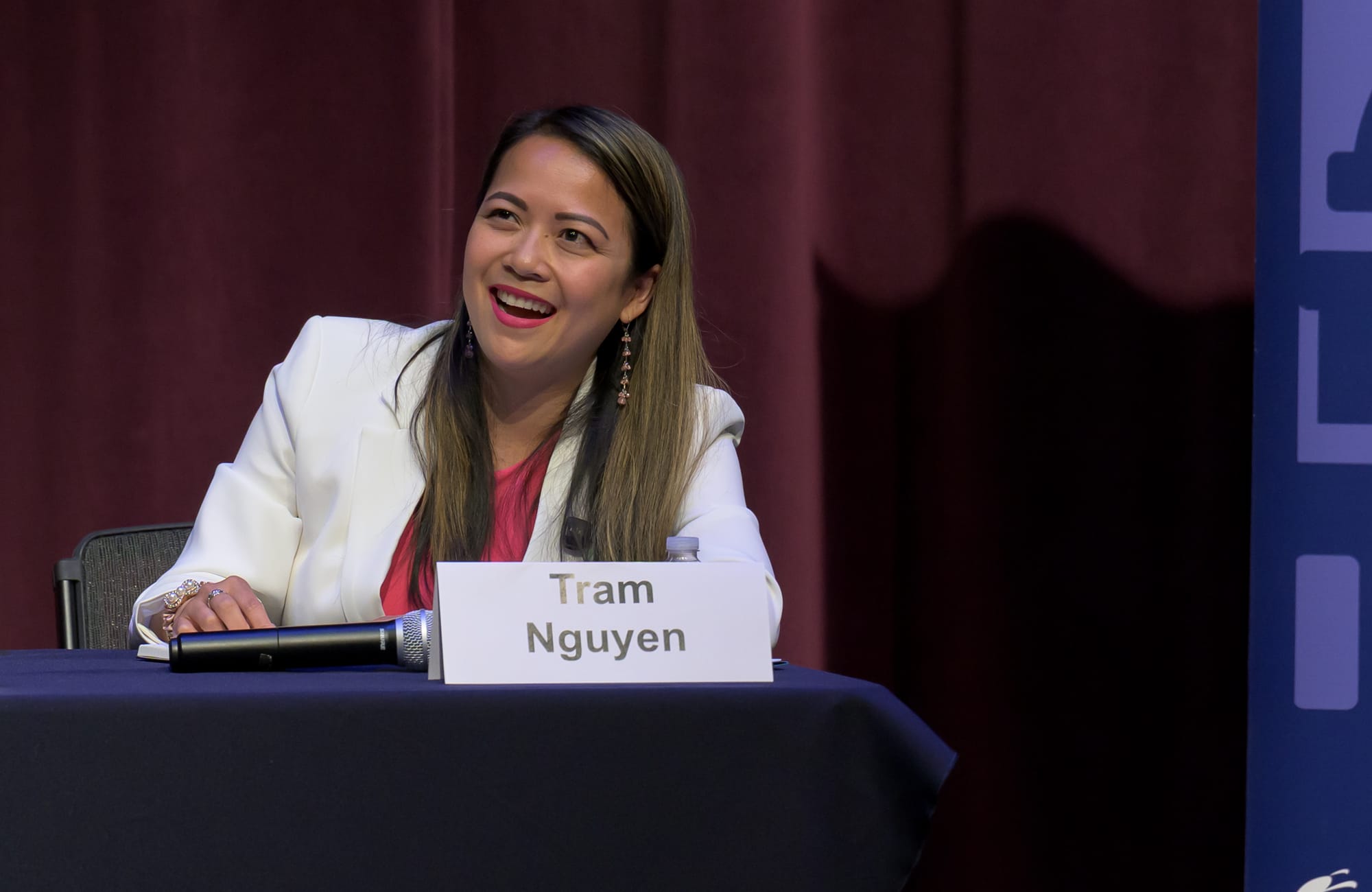
Nguyen, who came to the United States as a refugee from Vietnam with $100 to the family’s name and grew up in public housing, her father a political prisoner for eight years, called herself “the only legislator in this race.”
Beccia ran on a working-class childhood and the company he built; Belsito on a maternal-health nonprofit she said pushed $25 million through Congress and into a Republican president’s budget; Andres-Beck on years writing software, including for Hillary Clinton’s 2016 campaign.
Even artificial intelligence, which all six said Congress should regulate harder, split along the same biographical line. Beccia, who helped build the cryptocurrency firm Circle, said AI would make crypto look like child’s play; Lancaster pressed him on money laundering. Andres-Beck, the software engineer, warned that badly written regulation only opens a door for corruption. Koh steered the question back to children — one in three young people, he said, were turning to chatbots in place of a person, and the apps had, by repeated reporting, handed children dangerous advice.

The last question asked each candidate for a role model. Beccia named his father, once a selectman. Belsito named state Sen. Joan Lovely, who was sitting in the room. Koh named Marty Walsh, the former Boston mayor he had served as chief of staff. His rivals had spent the night making his money the line between him and the families everyone wanted to claim; given the last word, he reached for the patron who had built his career.
They agreed on the policy and on the enemy. One question the night kept circling and never closed: in a field this aligned, who gets to claim the working families all of them want to represent. Lancaster, the Salem veterinarian, had put it most plainly hours earlier. Democrats, she said, should be “sending working people to Washington.” The candidates could not settle it in 90 minutes. The voters will on Sept. 1.
CORRECTION: An earlier version of this story said Wednesday’s debate was the first since Seth Moulton announced he would give up the seat. The six candidates had appeared together earlier, at a May 7 debate in Swampscott hosted by the Marblehead, Swampscott and Nahant Democratic town committees.
The Marblehead Independent is 52 members away from reaching our summertime drive goal of 175 recurring contributors. This reporting takes time: following the race, checking the filings, listening through the full debate and keeping it free for every reader. Join the neighbors who make independent local journalism possible while this story is still fresh. 🟦 Become a member here.