Table of Contents
Get our free local reporting delivered straight to your inbox. No noise, no spam — just clear, independent coverage of Marblehead. Sign up for our once-a-week newsletter.
A bicycle crash in the Pyrenees, and the nuns who appeared afterward. A stolen dinghy, rowed out into a dark harbor to reach a boat. A cross-country flight in a small plane that turned out to be a last flight. These were true stories, told without notes, on Thursday afternoon in the sanctuary of the Unitarian Universalist Church of Marblehead on Mugford Street.
About 50 people came for the second year of the Moth-inspired storytelling hour at the Marblehead Festival of Arts Literary Festival. Organizers had laid down the rules: the story had to be true, it had to have happened to the teller, and no notes, phones or index cards were allowed. Five minutes was the goal, six the limit. A bell would ring at five minutes. What the organizers would do with the promised hook at six, no one seemed quite sure.
The format borrows from "The Moth Radio Hour," the wildly popular public radio program produced in Woods Hole, Massachusetts, by Jay Allison. The program ran about 45 minutes of the hour set aside for it.That turned out to be the right length, for enough people were willing to stand, and the stories were good enough, that nobody was counting.
A warning about a trip
Debra Duxbury went early, and she went far.
She described a young woman's plan to see Europe by train, plane and youth hostel — until an astrology teacher looked at her chart and warned her not to drive anything. She drove something anyway: a bicycle down the Pyrenees, a backpack strapped behind her, one curve taken too fast.
"Fortunately did not go off the cliff, but went in to the cliff," she said.
Then came the part that made the room lean in. Nuns, out walking from a nearby nunnery, found her at the roadside and took her in for the night. A more serious crash followed in France, then a hospital stay in Avignon, a blood clot that sent her home and, not long after, Woodstock. Her friend Barbara hauled the bicycle back across the ocean and met the man she would marry.
The sequence was almost too much to believe, which was the point, and the audience followed every turn of it.
Great wrists
Brian Hancock grew up inland in South Africa, dreaming of sailing around the world, reading every book by every big sailor he could find. In the summer of 1980, at 22, he spent all his money on a one-way ticket and landed at Logan Airport with about $5 in his pocket and no one there to meet him.
He had never been to America. He did not know it was Halloween.
He made his way to Marblehead by subway and bus, past houses with little skeletons on the porches that he took, at first, for some kind of Disney World. He found the Boston Yacht Club, where a night watchman had never heard of him, his friends or their boat. He was cold, down to $3, and half convinced he would freeze to death on the sidewalk his first night in the country.
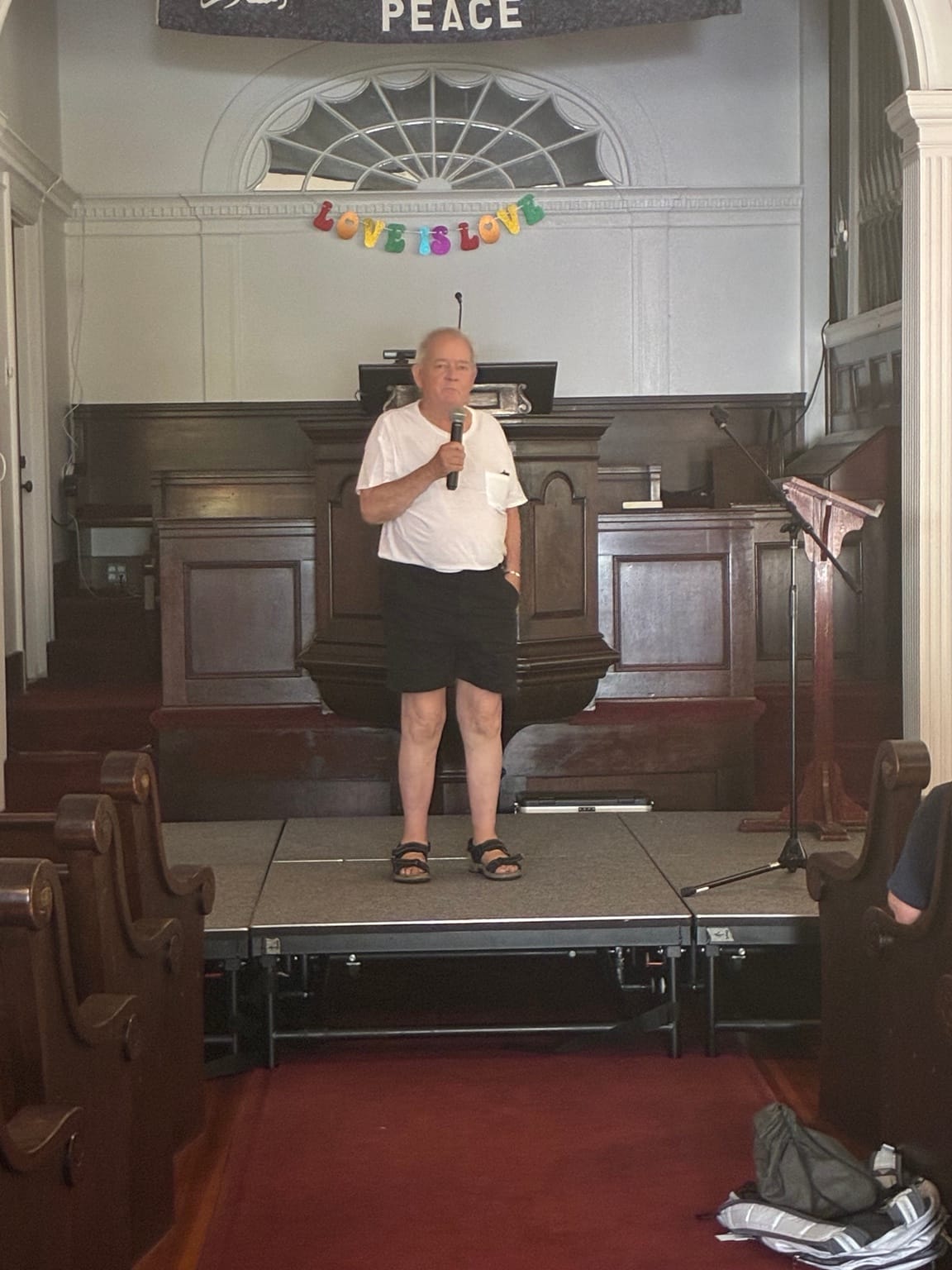
His friends were coming, delayed by engine trouble in Maine. When their boat slipped into the harbor and took a mooring out by Fort Sewall, they cut the radio, opened the beers and never heard him yelling from shore. So he found a dinghy leaning against somebody's house.
"I stole it," Hancock said. "He never knew."
He rowed out, found the boat and returned the dinghy the next day. To make it up to him, his friends took him the following night to Maddie's Sail Loft, where the first bartender he saw was a pretty Irish woman. He was 22 and, by his own account, a little emboldened.
"You've got great wrists," he told her.
She said she knew, because she was on the dance team. Her name was Erin, and she became his first wife. They had a daughter and, later, two grandsons. Hancock has since sailed around the world four times. The line about the wrists drew the biggest laugh of the afternoon, and he let it sit there without explaining it.
A trip that became a last flight
Aviv Hod began with airplanes, and for a while the audience thought that was the story.
Hod has flown most of his adult life, mostly out of Beverly Airport. He described the chance to ferry a plane from Beverly to California for Richard Davis, an 86-year-old Navy veteran who had flown off aircraft carriers across more than 60 years in the air. They could have made the trip in two days. They took a week instead, flying about four hours a day, stopping at aviation museums, letting Davis point out the planes he had once soloed and landed on carriers.

"What are we in a hurry for?" Hod recalled. "Let's enjoy this. Let's take the whole week."
Then the turn. About six weeks later, Hod called Davis. His son answered. Davis had died of heart failure a couple of hours earlier.
The room went quiet. Hod did not reach for tragedy. He said only that he felt fortunate — that a trip that had seemed like a convenient errand became, in hindsight, a last flight. He is now weeks from owning a plane of his own.
The stories kept coming, each one loosening the room a little more. People were volunteering without being asked twice.
Trish had not planned to speak. She said the room itself pulled the story out of her. Years ago, working a government job in Boston and wanting to use her creativity, she had enrolled in a part-time film program and set out to interview homeless people who were at peace with their lives.
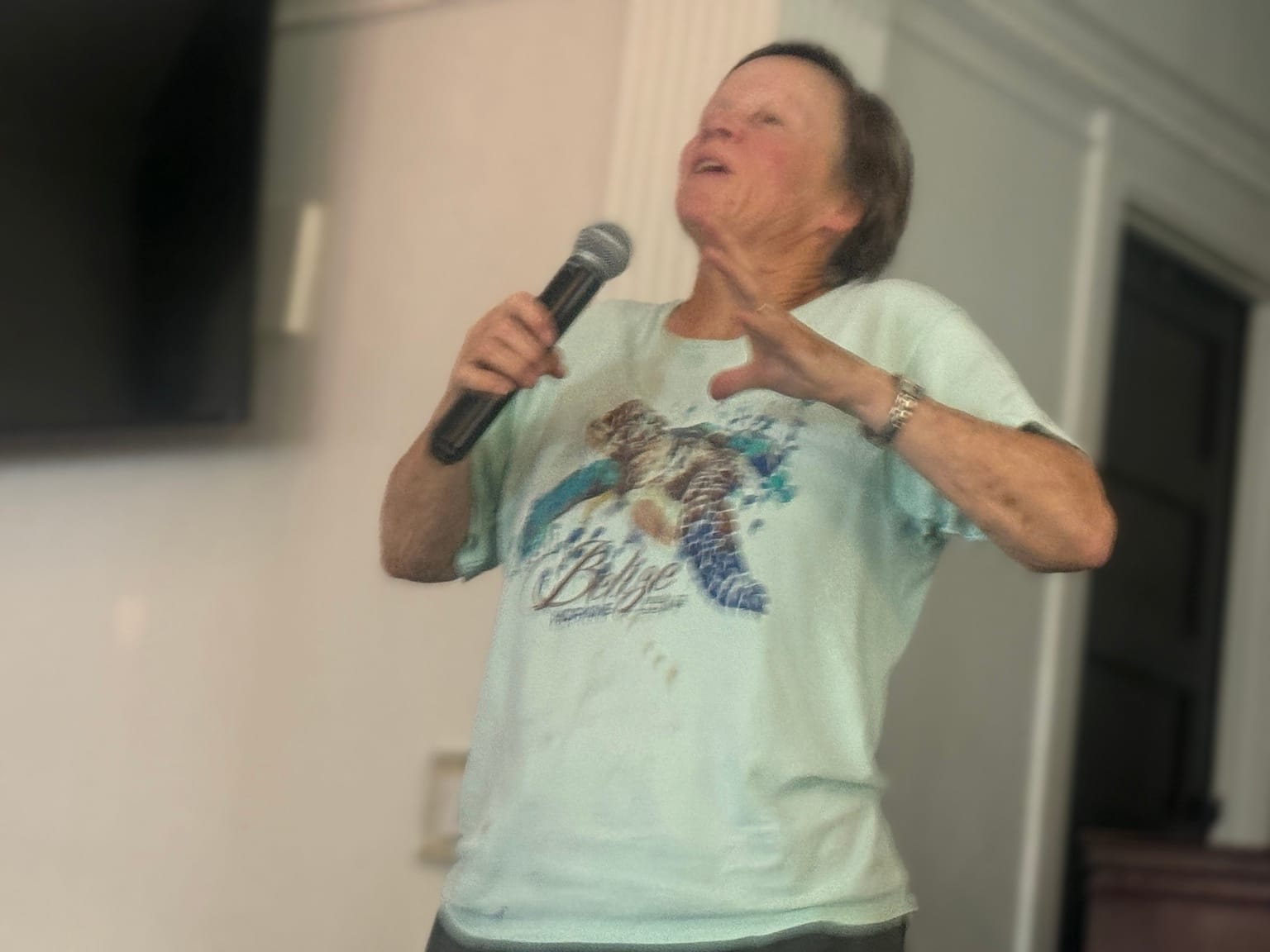
The first attempt failed when the camera did not record. So she and her partner ended up at a Starbucks with a young man named David, who talked for 45 minutes about his illness, his gratitude for his parents, his love of soap operas and his ties to Marblehead.
Later she saw a notice that David had died. He was the son of Sue, someone connected to the church. Trish offered her the tape. Sue asked whether she could cut a five-minute version for the memorial service at Marblehead High School. Trish, brand new to editing, made it.
"You never know when something bad happens, something good could happen," she said.
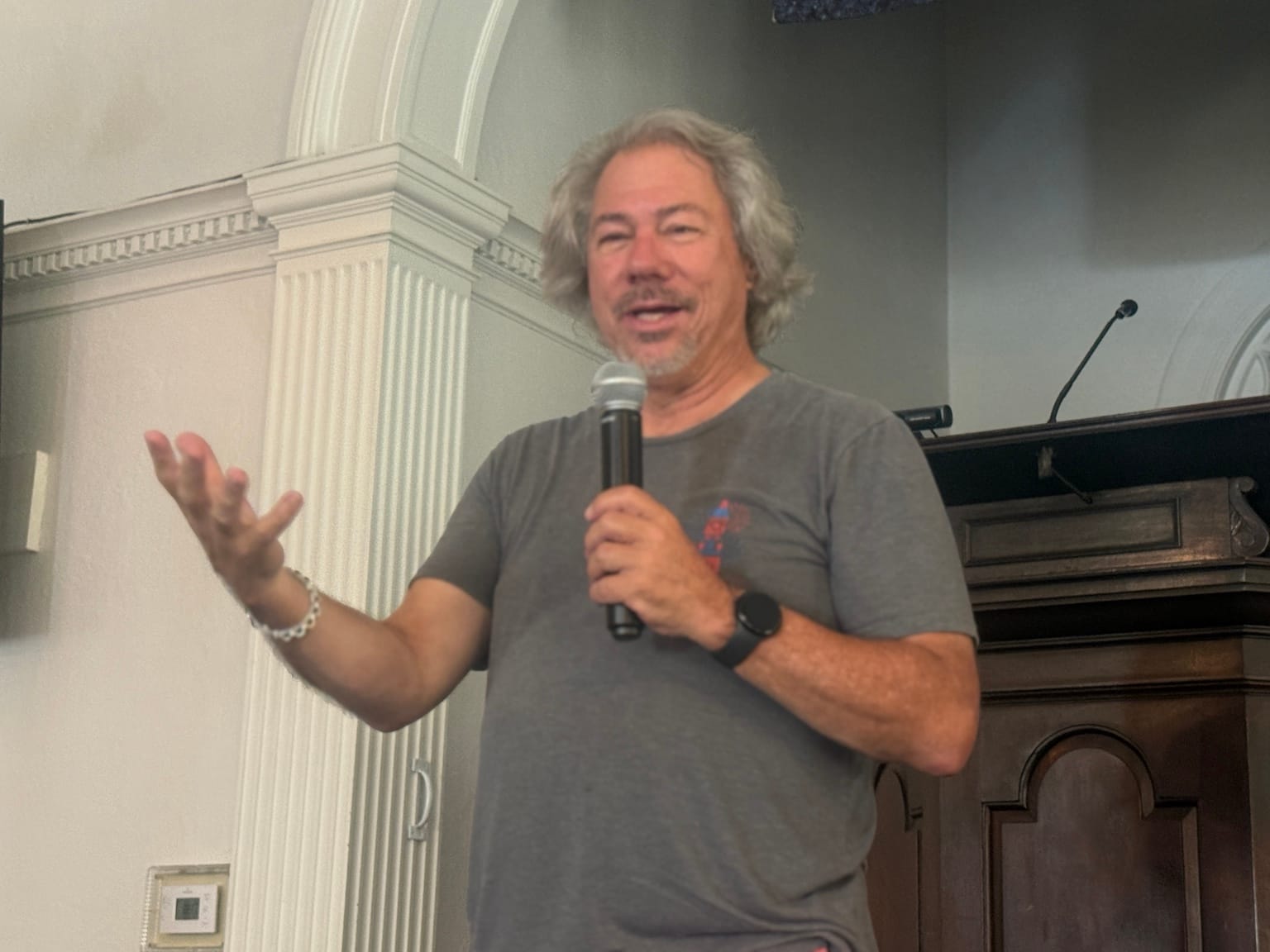
Scott Solberg could barely start. He had laughed so hard he could not hear, and it took him a moment to steady himself. His youngest son, Ian, then 2 1/2, had looked at a book of space photos and announced he wanted to go on a space shuttle. Solberg explained he could show the boy the Apollo exhibits but not a launch. That night he opened his email and found an invitation to the next shuttle launch.
He asked if he could bring the family. He could. In the scramble to pack everyone else, he forgot his own luggage — a problem solved by a Walmart on the way to Cape Canaveral. On the tour bus, the boy named the hardware as it rolled past, one spacecraft after another, and the room laughed at the idea of a 2-year-old who already knew everything he was looking at. The family watched the shuttle go up. Years later they brought his wife back so she could stand under the Saturn V rocket too. By the time he reached that part, Solberg was no longer laughing; his voice caught, and he let it.
When the last story ended, the applause came, and people did not rush for the doors. They lingered in the pews, and among them was chatter of holding more Moth-inspired gatherings.
While this story is still fresh, reader support helps keep local coverage like this free for the whole town — from public meetings to arts events, from follow-up calls to the small scenes that show how Marblehead gathers. Neighbors make this work possible, and membership is a direct way to keep it available to everyone. 🟦 Become a member here.