Table of Contents
Get our free local reporting delivered straight to your inbox. No noise, no spam — just clear, independent coverage of Marblehead. Sign up for our once-a-week newsletter.
Historian Robert Booth opened the evening with the obituary, not the battles. The Salem Gazette in 1797 called Gen. John Glover "the affectionate husband, the kind brother and the best of fathers." That, Booth told a packed audience Wednesday night in the Salem Armory's screening room, was the man most people miss — the one who turns up as a bronze statue but almost never on a Marblehead wharf, at a shoemaker's bench or in a meetinghouse pew.
The wharf came first. The family came first. The town came first. The war, Booth said, was the loudest part of his life — but not the biggest.
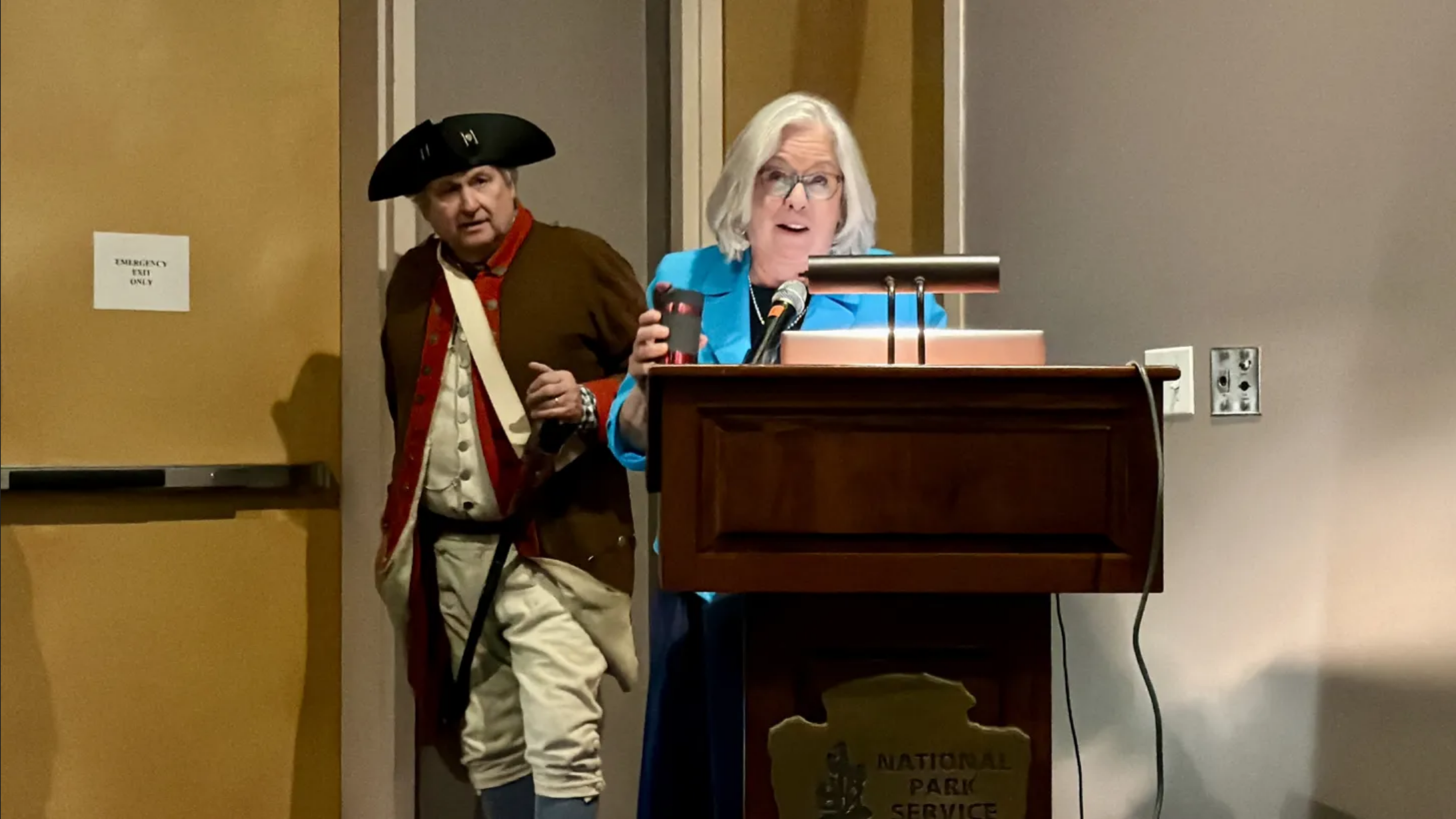
The talk, hosted by the Essex National Heritage Area and the National Park Service, gathered Booth, Larry Sands of Glover's Marblehead Regiment and Nancy Lusignan Schultz of the Swampscott Historical Commission for an evening on the Marblehead fisherman-merchant-general whose men rowed George Washington across the Delaware River on Christmas night 1776.
The timing carries weight beyond a calendar. Much of the Essex National Heritage Area and National Park Service's 250th programming has gathered around Revolutionary figures who lived and worked in this corner of Massachusetts, and Glover is the one whose final home is on a clock. The demolition delay on his Swampscott farmhouse expires July 20, 2026 — the month of the 250th.
Glover was born in Salem, on Nov. 5, 1732, and moved with his family across the bay to Marblehead, while still a boy. He started at a shoemaker's bench, found it not to his taste, and walked instead to the fish-flakes and the wharf. He married Hannah Gale, a Marblehead girl, in 1754. They had 11 children. Two died in infancy. By the time the Massachusetts Provincial Congress made him a colonel in April 1775, he was 42, a wealthy merchant trading cod to France, Spain and the West Indies.
A community before a war
Booth spent most of his time inside Glover’s house and on its block. The smallpox crisis of 1773, when Glover and his brother Jonathan helped raise the Essex Hospital on Cat Island only to watch Marblehead fishermen burn it down a few months later, was the test of what kind of citizen Glover was. The hospital divided the town along class lines. Glover stayed.
Asked during audience questions how he chose his sources, Booth gave the line that became the spine of the evening.
"You cannot pull John Glover out of Marblehead and get him right," Booth said. "He only makes sense as a citizen embedded in a community — at the wharf, at town meeting, in the pew. The minute you take him out of that room, you have already lost him."
The committees of correspondence, the militia ensign's commission of 1759, six terms as selectman after the war, two terms in the Massachusetts House and a seat at the 1788 convention that ratified the U.S. Constitution were, Booth argued, the same civic life. The war years were just louder.
Sands, who captains Glover's Marblehead Regiment, the reenactment company that bears the general's name, took up the battlefield only to make Booth's point louder. The men in the boats at Brooklyn, at Pell's Point and at Trenton were Marblehead men, he said, including Spanish, Native American, Jewish and African American sailors. They were neighbors and kin.

"These were not strangers in uniform. They were the boy from the next wharf, the cousin up the lane, the man you sat next to in church the Sunday before," Sands said. "When Glover ordered them into a longboat in a snowstorm, he was ordering his neighbors. That is why he was so careful with them, and so heartbroken when one did not come back."
The heartbreak was not abstract. Sands read from a letter Glover wrote from West Point on Jan. 28, 1781, asking to be relieved of duty and calling his five remaining young children "helpless orphan children." Their mother, Hannah, had died in 1778 while his brigade was in Rhode Island after the battle of Newport. His eldest son John, a captain under his own command, also did not survive the war.
"He is calling his own children orphans, and their mother had been gone three years," Sands said. "He had not been home in 20 months. That is not a general writing. That is a Marblehead father whose 18-year-old daughter was at home raising eight younger siblings on her own."
The farmhouse and the long quiet after
Schultz, who is also president of Save the Glover! Inc., closed the evening with the years almost no one tells. In May 1781 Glover paid 1,369 pounds for the confiscated estate of the Loyalist William Browne — a farmhouse and 180 acres straddling Salem, Marblehead and Swampscott. He moved there in 1782 with his second wife, Frances, retired from the Continental Army, ill and broke. He partitioned off a corner of his sitting room and cobbled shoes again, the trade he had walked away from at 17, to feed the children still at home.
The Salem diarist the Rev. William Bentley wrote that Glover used to say he was not sure which town he lived in, the boundaries being so loose he could step out his front door into another. Schultz used the line to land her own.
"He stepped out his front door and didn't know which town he was standing in, and frankly that was Glover — at home in three of them at once," Schultz said. "That farmhouse is still standing on the same ground he walked, and right now it is one demolition order away from being gone."
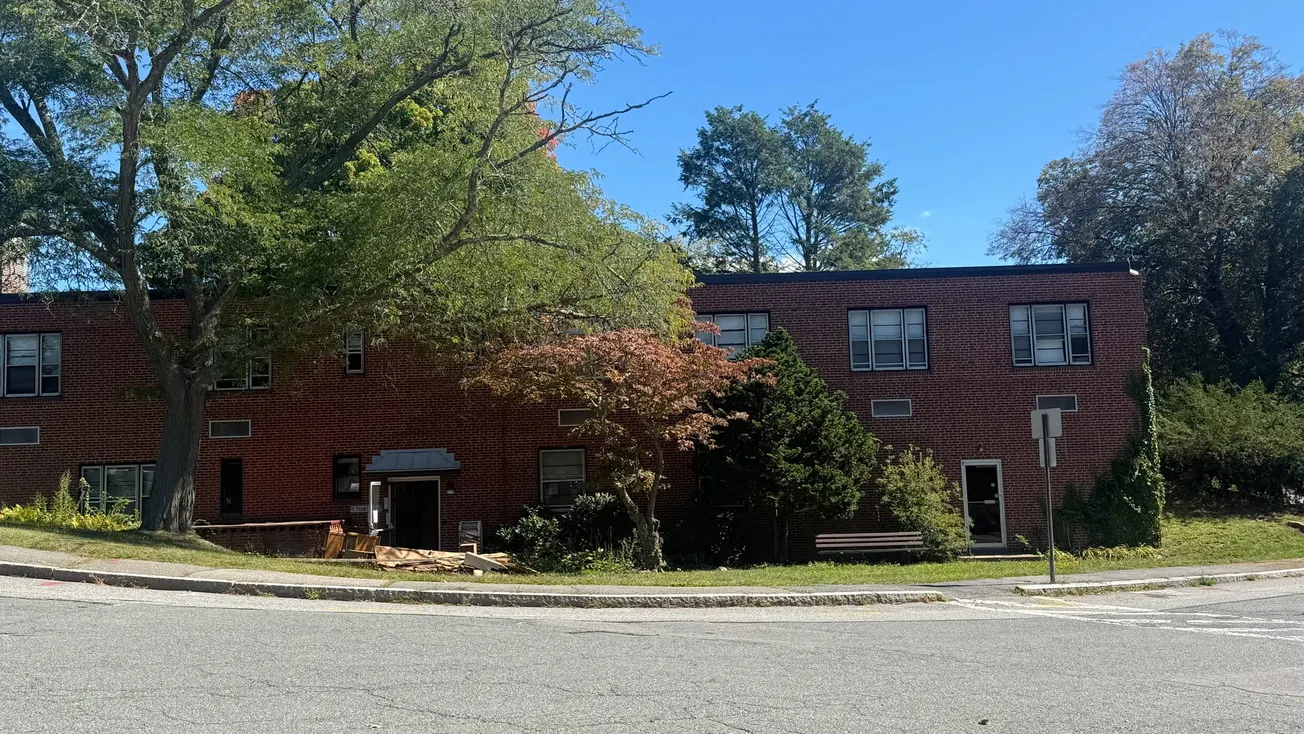
The house, last operated as the General Glover restaurant before closing in the mid-1990s, has stood vacant for nearly 30 years. Engineers have found 70% to 75% of the original 18th-century framing intact. The first developer to propose a 140-unit complex on the site, Leggatt McCall Properties, walked away after community opposition. The new owner, National Development, presented a plan in March that keeps the Glover farmhouse on its original footprint, with the Historical Commission hoping it can be operated as a museum under a long-term ground lease. Schultz's nonprofit, Save the Glover! Inc., has raised roughly $600,000 of a $1 million goal it hopes to hit by year's end.
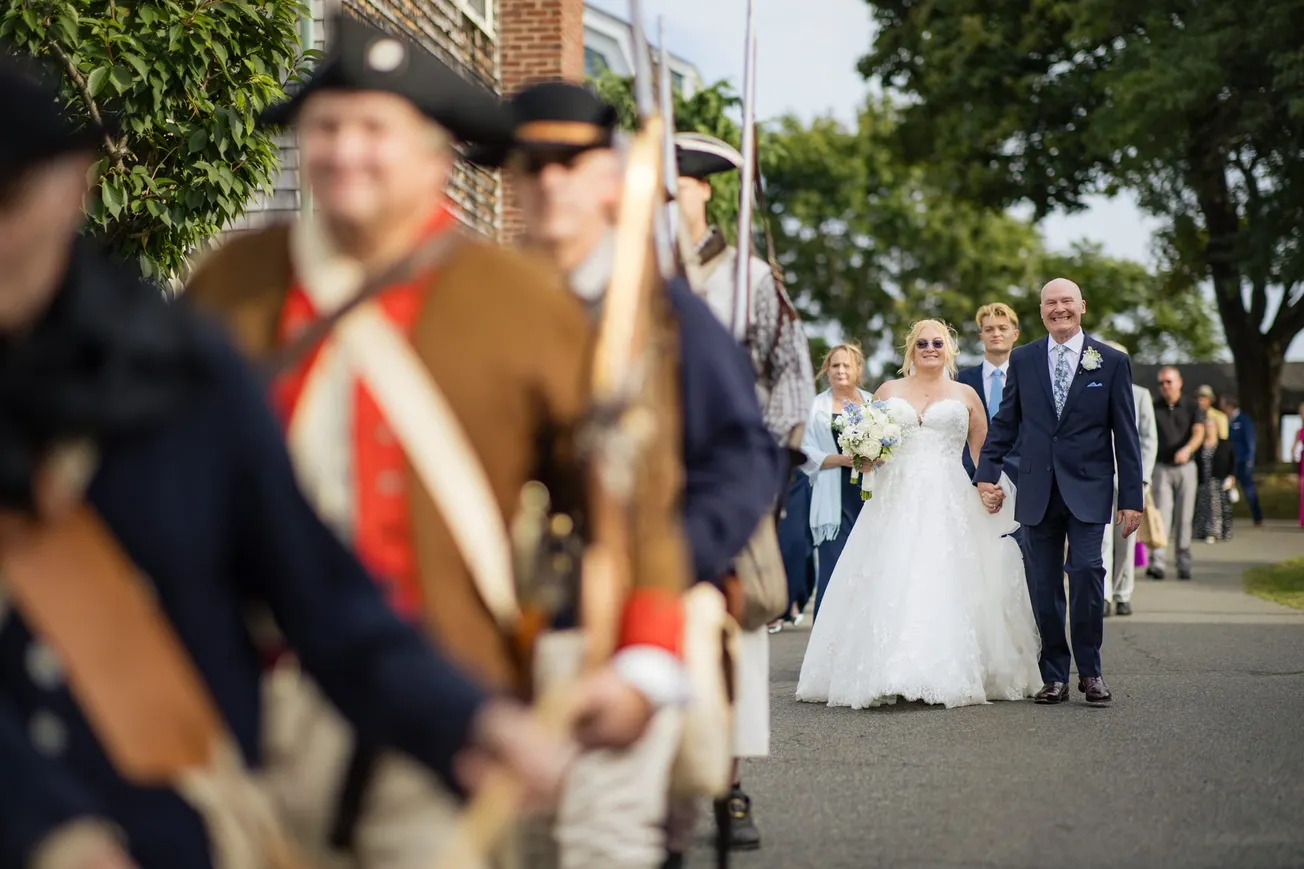
Glover died at the farmhouse Jan. 30, 1797, at 64, and was buried at Old Burial Hill, in the same ground as many of the men who had rowed his boats. Glover's Marblehead Regiment, alongside a legion of 'Headers, walks up the hill every year on the anniversary of his death.
"We do that walk in whatever weather Marblehead gives us," Sands said. "Half the guys in our company can name the stones around his without looking down. That is the point. He is still up there with his neighbors."
That, more than anything else from the night, was the picture the room left with: Not the bronze statue, but a small town walking up its own hill to one of its own.
This took a packed Salem room, three speakers and one endangered farmhouse to connect Gen. John Glover’s public life back to Marblehead’s wharves, pews and meetinghouse. Because you read stories like this — local history with dates, documents and stakes attached — we’re asking readers to help keep this work free for neighbors. Every membership helps pay for reporting time, editing and follow-up coverage on the places that shape town memory. 🟦 Become a member here.