Table of Contents
By Melissa Clucas
Many Marblehead residents care deeply about our public schools — whether they have children currently in the system, grown children who once attended or simply value the strength of our town.
We are living through a period of significant financial pressure across the town, and those pressures are real for families and taxpayers alike. School budgets are complicated, and they affect everyone. It is reasonable — and healthy — for residents to ask hard questions. One of the most pressing questions of late has been: Enrollment is down, why haven’t staffing and costs fallen in the same proportion?
As a member of the School Committee, I believe our community deserves a clear understanding of where we have come from — and what is shaping the decisions in front of us. The analysis below is based on data Marblehead Public Schools reports annually to the Massachusetts Department of Elementary and Secondary Education. That information is publicly available through the department’s district profile for Marblehead.
The demographic reality: Since the 2016-17 school year, enrollment in Marblehead Public Schools has declined from 3,144 students to a projected 2,389 students this year — a 24% decrease. This shift reflects long-term demographic changes in our town and is not indicative of a decline in school quality. Communities across Massachusetts and the nation are experiencing similar enrollment declines, driven by lower birth rates and aging populations. Public school participation in Marblehead has remained steady at 76% to 79% of school-aged residents for nearly a decade; the reality is simply that many households whose children once filled our classrooms have aged out. Since 2016, the share of residents age 65 and older has risen from 17.9% to 22.6% — meaning roughly 1,100 more Marblehead residents are now over age 65 than in 2016.
Proactive rightsizing: The district has not been idle in the face of these shifts. The consolidation of Bell, Coffin and Gerry into the Brown School was a significant, multiyear structural change driven by projected declines in enrollment. By reducing our building footprint, we eliminated the overhead of maintaining aging facilities and redundant programs. This was a proactive rightsizing of our infrastructure designed specifically to address the demographic shifts we are seeing today.
The staffing “delta”: While enrollment has declined 24% since 2016, staffing has declined 14.7%. That 9% gap understandably raises questions. Two factors explain most of it:
—Enrollment has declined gradually across 13 grades and five schools. Because the district cannot eliminate a fraction of a teacher, staffing reductions occur only when enrollment drops enough to consolidate an entire classroom. As a result, staffing adjustments naturally lag enrollment declines.
—While we have fewer general education classrooms today, overall staffing has not declined at the same rate as enrollment because the needs of our students have changed. We have seen a fundamental shift in the complexity of student needs. Since 2016 — and especially since the pandemic — the percentage of students identified as “high needs” has increased from 27% to 32%. Students identified with autism have increased approximately 34%, and those with neurological or health-related disabilities approximately 48%. These students often require specialized, federally mandated support ratios that do not fluctuate with general enrollment. As a result, much of the 9% staffing “delta” reflects the personnel required to serve our highest-need students.
Benchmarking the “Marblehead standard”: Despite significant demographic shifts, Marblehead continues to operate as a lean and efficient district. Our student-teacher ratio of 11.4-to-1 matches the statewide average, and our per-pupil expenditure of $21,972 is approximately 4% below the state average.
Importantly, this efficiency has not come at the expense of academic outcomes. Marblehead High School ranks in the top 20% of Massachusetts public high schools, according to U.S. News & World Report, and boasts a 99% graduation rate. In spring 2025, 58% of Marblehead students met or exceeded expectations on the Massachusetts Comprehensive Assessment System in both English language arts and math — 15 percentage points above the state average of 43%. The district also offers more than 20 Advanced Placement courses with strong student participation, reflecting a broad and rigorous academic program.
Marblehead is delivering a high-performing school system at a below-average cost — and strong public schools contribute meaningfully to the long-term stability and property values of our community.
The choices ahead: A 24% enrollment decline does not translate into a 24% reduction in costs because the system, while smaller, is more complex and more regulated. We have reached an “operational floor” where every building requires baseline services — nurses, custodians and principals, among others — regardless of whether a class has 18 students or 27.
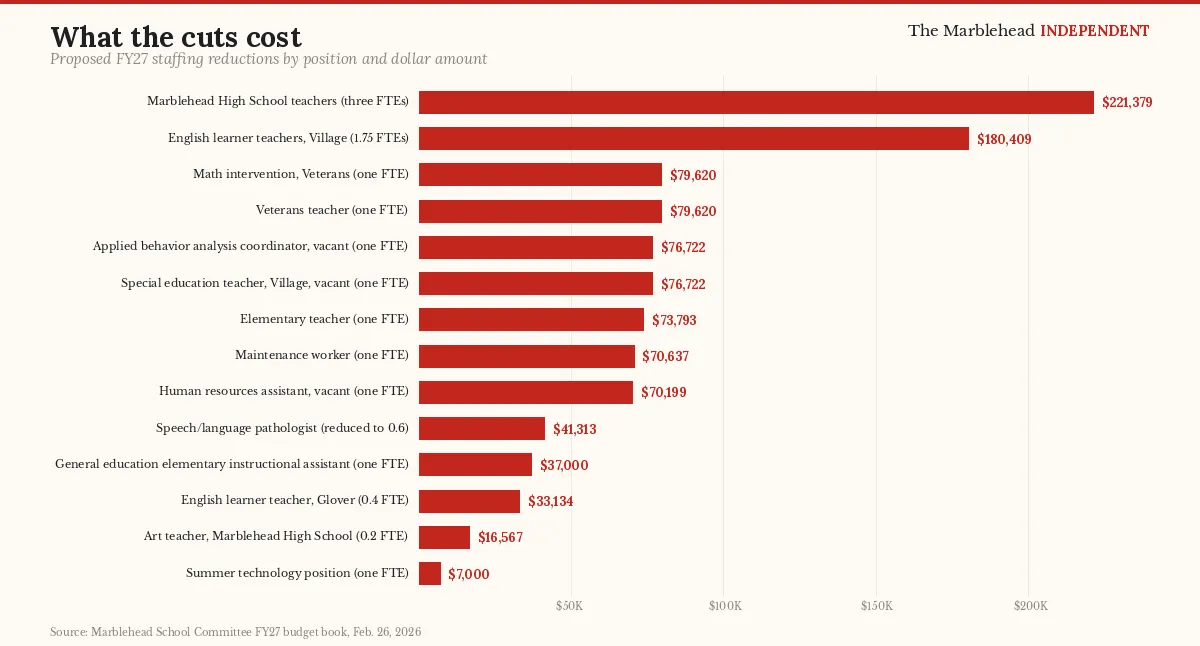
At this point, further reductions would require changes that directly affect programming and students. Any additional cuts would move beyond efficiency adjustments and into structural decisions that shape the classroom experience. In practical terms, that could mean larger class sizes, reductions in elective offerings at the middle and high school levels, fewer intervention or support staff for students who are struggling or the elimination of certain extracurricular or enrichment programs. These are not abstract trade-offs; they directly shape students’ daily experience and the quality of a Marblehead education.
The path forward is not simple. It requires balancing fiscal responsibility with preserving the strength of a school system that anchors our town and contributes to the long-term stability and property values of our community.
My commitment is to transparency, fiscal discipline and responsible stewardship of taxpayer dollars. I believe the School Committee and district leadership are approaching this work thoughtfully and with clear eyes about the trade-offs involved. Marblehead is at a consequential financial moment — shaped by demographic realities, structural cost pressures and years of deferred financial strain. The decisions we make now will influence not only next year’s budget but the long-term strength of our schools. We may not all agree on the solution, but we owe one another an honest, fact-based conversation as we determine what kind of school system — and community — we want to sustain.
Melissa Clucas is a member of the Marblehead School Committee.