Table of Contents
Get our free local reporting delivered straight to your inbox. No noise, no spam — just clear, independent coverage of Marblehead. Sign up for our once-a-week newsletter.
National Development appeared before the Swampscott Planning Board on March 9 for a pre-application review of a significantly revised concept for the long-debated Glover property, unveiling plans that would keep the Gen. John Glover farmhouse in place while building a 140-unit multifamily development around it.
The presentation covered a parcel spanning three communities — 299 Salem St. in Swampscott, 202-204 Tedesco St. in Marblehead and 20 Vinnin Sq. in Salem — and marked the first time the developer publicly placed preservation of the Revolutionary War-era structure at the center of its concept.
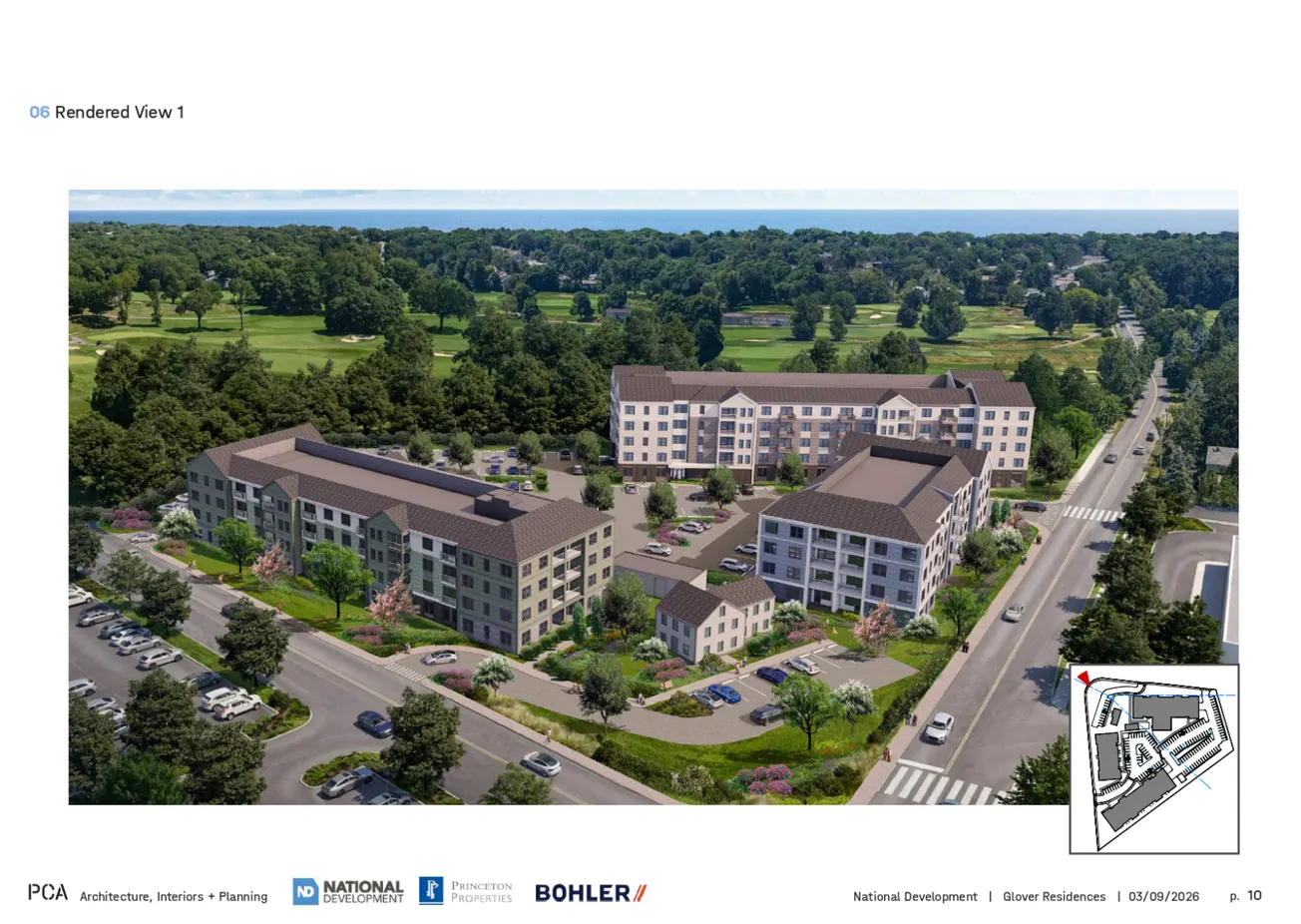
National Development, working with Princeton Properties, architect PCA and engineering firm Bohler, is proposing three residential buildings with a combined 140 apartments and 220 parking spaces. The unit mix consists of 45 one-bedrooms, 24 one-bedroom-plus-dens and 71 two-bedrooms, with an average unit size of 1,058 sq ft. Building 1 would contain 36 units, Building 2 would contain 60 and Building 3 would contain 44. The overall gross floor area shown in the presentation is 206,376 sq ft, encompassing residential space, common areas, amenity space, mechanical areas and parking.
The concept plan shows the Glover House highlighted and explicitly labeled as "to remain," while surrounding existing structures are marked for demolition. Ryan Murphy, National Development's vice president of development, said the decision came out of conversations with the town and the Historical Commission and represented a departure from earlier plans that would not have preserved the house. He described the concept as a placeholder that will continue to evolve.
"The proposal would use a lot of vertical and horizontal variation so the development reads more like a series of buildings accumulated over time, not one giant slab," Murphy said, according to reporting from the meeting. He also said the design would frame the Glover House while keeping the facades facing it "a little quieter" — language that suggests the historic structure is being treated as the visual and symbolic anchor of the site.
The presentation also showed parking near the farmhouse to allow public access, a detail that preservation advocates have sought as they push for some civic or museum-style future for the site.
Planning Board chair Ted Dooley said there had already been preliminary conversations involving National Development and the town about a possible 99-year ground lease that could place control and maintenance of the Glover property in the hands of the town, the Historical Commission or another mutually approved entity. He praised the decision to preserve the site and provide parking near the house, calling those features "very helpful and appreciated."
The proposal raises unresolved dimensional and parking questions under Swampscott zoning. Of the 220 total spaces, 112 would be on the Marblehead side of the project and 108 on the Swampscott side, with 141 exterior spaces and 79 in garages across the full site. The 96 units proposed in Swampscott fall under the Glover Multifamily Overlay District, which requires 1.5 parking spaces per dwelling unit — a standard that translates to 144 required spaces for those 96 units. The plan currently shows 108 spaces on the Swampscott side, leaving a gap of 36 spaces relative to that requirement. The overlay district also sets a maximum building height of 50 ft, while the proposed height of 60.4 ft exceeds that threshold by 10.4 ft. The presentation noted that waiver, special permit or variance relief may be required.
Dooley flagged the height question at the March 9 session, noting that one proposed structure would become the second-tallest building in Swampscott, standing about 2 ft shorter than the former Hadley School building currently being converted into a hotel.
Architecturally, the team said it is pursuing a New England design vocabulary. Design standards shown in the presentation called for varied architectural styles, changes in rooflines and materials, facades broken into smaller bays, balconies and porches, roofs with at least an 8:12 pitch and vertically proportioned windows. A material board showed fiber-cement shingles, fiber-cement lap siding, fiber-cement vertical siding, brick, stone veneer and architectural asphalt shingles.
The 44 units in Marblehead are all contained in Building 3, which also includes 33 parking spaces and an amenity space. Amenity spaces on the Swampscott side could include community kitchens, offices and outdoor grilling areas, according to meeting reporting.
Because March 9 was a pre-application session rather than a public hearing on a filed special permit, the board did not vote. Dooley noted that the developer may continue to request pre-application sessions, but once a formal application is submitted the project would move into a public hearing process.
The Swampscott Historical Commission has imposed a demolition delay on the property running to July 20. The Save the Glover campaign has been raising money toward a restoration target, with preservation advocates arguing the farmhouse is among the town's oldest surviving homes and possibly its only still-intact, originally sited direct connection to the American Revolution.
The revised concept does not resolve the question of the Glover House's long-term future, but it reframes it: where earlier plans treated the structure as an obstacle to development, the current version incorporates it as a central feature of the site.
BEFORE YOU GO … Our reporting remains free and open to all. It is sustained by readers who choose to support it — by contributing so that routine, document-based local reporting continues without paywalls or promotional framing. Right now, 101 readers support The Marblehead Independent with monthly or annual contributions. Click here to become an Independent member.