Table of Contents
Get our free local reporting delivered straight to your inbox. No noise, no spam — just clear, independent coverage of Marblehead. Sign up for our once-a-week newsletter.
The hardest thing the Finance Committee tried to do Monday night was not arithmetic. It was telling residents what they would actually be voting on.
A vote next week at Town Meeting will not raise anyone’s taxes. It will only decide whether two Proposition 2½ override questions reach a ballot. One is a three-tier operating override that asks voters to choose, in dollars, how much of the town they want to put back together. The other is a separate trash override that would move $2.2 million in curbside collection costs off a new user fee and back onto property tax bills. The committee voted to recommend both — but not without disagreement on the second one.
The choices have a price tag the committee can name with unsettling precision. The fiscal 2027 budget Marblehead is about to bring to the floor closes a $7.7 million gap by cutting 22 town-side positions, 18 of them held by people who will be laid off, and slicing 18.25 full-time equivalents from the schools. To make the school side balance at all, administrators prepaid $1.5 million in out-of-district special education tuition — a sleight of hand Finance Committee Chair Alec Goolsby said the schools cannot repeat in fiscal 2028.
The harder choice
That balanced budget was the optimistic version. Available revenue is projected at $96.5 million, about $600,000 less than last year. Wages, pensions, health insurance, the new trash contract and out-of-district tuition each pulled hard in the wrong direction; together they pushed the level-service gap to $7.7 million, with about $4 million falling on the town side and $3.7 million on the schools. It is also why the trash question matters. To balance without an override, the town created a curbside collection fee that lands outside the tax levy. The override would undo that, folding the cost back into property taxes the way Marblehead has historically paid for it.
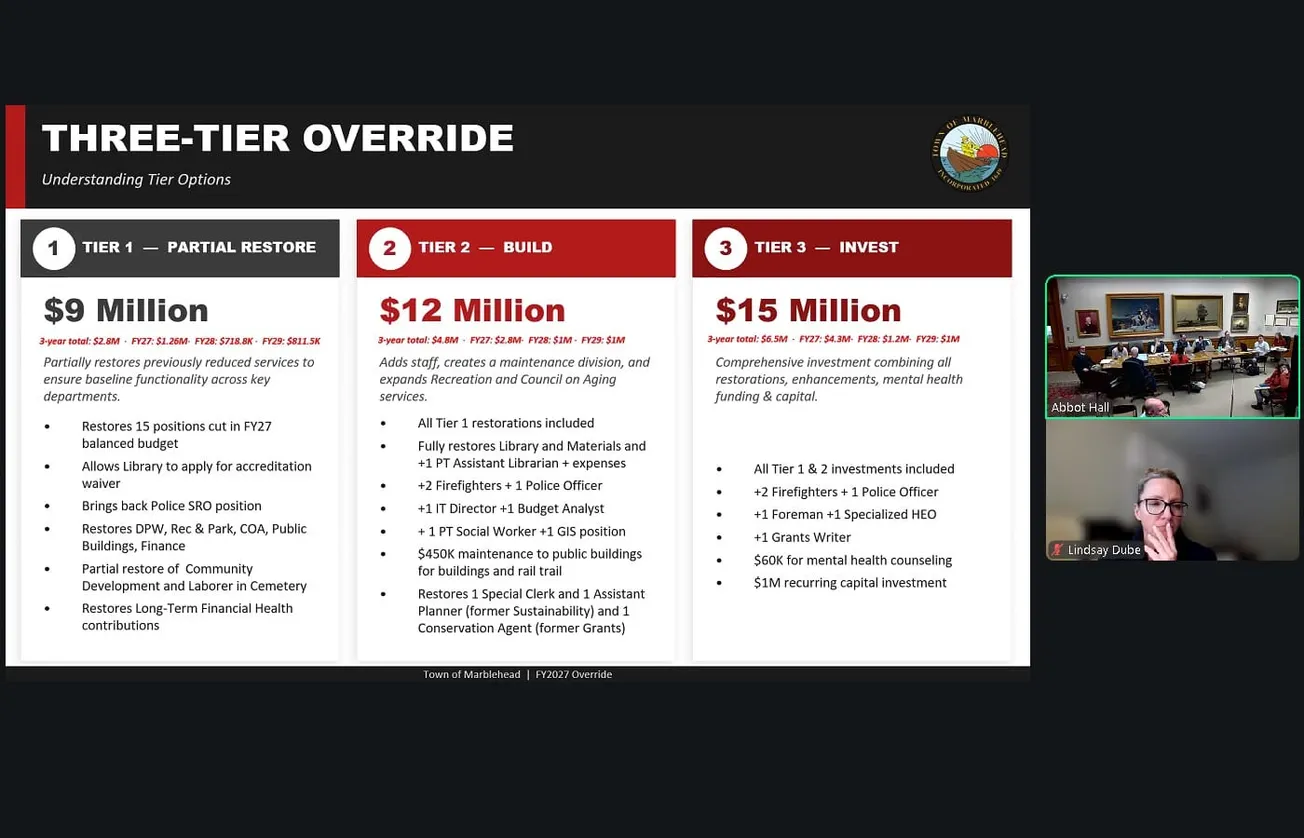
The operating override the committee endorsed gives voters three answers to the broader problem. Tier 1, $9 million over three years, is labeled “partial restore.” It would bring back 15 of the 22 town positions, save library accreditation, return the school resource officer and resume contributions to the Stabilization Fund and post-employment benefits that the balanced budget zeroed out. Tier 2, $12 million, adds full library restoration, two firefighters, a police officer, an IT director, a budget analyst, a social worker, planning and conservation capacity and a $450,000 buildings maintenance line. Tier 3, $15 million, layers on more public safety, a grant writer, $60,000 for mental health counseling and $1 million in recurring capital. On the school side, Tier 1 covers contractual raises and restores the prepayment trick; Tier 2 funds technology and free full-day kindergarten; Tier 3 builds out curriculum, a post-graduate special education program for students ages 18-22 and a $500,000 school building capital fund.
The ballot mechanism took longer to explain than the dollars. Voters will see all three tiers separately and can vote yes or no on each. The highest tier with a majority is the one that takes effect — and only the first year is appropriated up front. Every later draw still has to clear Town Meeting.
“Taxpayers deserve the right to choose,” Goolsby said. He plans to recommend the article without endorsing any particular tier.
The trash override drew the night’s only split vote, 7-2. Vice Chair Molly Teets cast one of the two against and explained why: only about 20% of Massachusetts towns fully fund trash services through property taxes, and Marblehead is one of a small share of communities where residents can choose between curbside pickup and hauling their own. The fee preserves that choice, she said, because residents can opt out. An override does not. The contract is also growing about 5% a year, faster than Proposition 2½ allows the levy to grow, meaning the override would close the gap for three years at most before the math caught up again. Goolsby disagreed but with less conviction; he said he was “not passionate” about which mechanism funded trash and would let voters decide.
The risk beyond overrides
The room turned briefly toward something neither override can fix. Essex North Shore Agricultural and Technical School District officials walked the committee through a state-mandated lottery that drew 1,715 applications for 427 seats and gave Marblehead a target of 39. Twenty-eight residents applied; 21 remained after seven declined. Teets did the longer math out loud.
“This injects a significant amount of risk to our budgeting process,” she said, noting that future-year exposure could climb by millions if applications surge. Goolsby steered against the worst-case number, warning it assumes a wave of interest the town has not seen.
Article 19, the fire union contract, came back from April 7 settled. Town Administrator Thatcher Kezer described a three-year deal with 3%, 3% and 3.5% cost-of-living increases — the pattern other unions have already set — and said the budget already absorbed the bulk of it. About $171,000 in additional costs will be carried within existing lines, with the Finance Committee reserve available if a new sick-bank provision draws down. As for the overtime problem the contract could not solve at the bargaining table, Kezer pointed past it.
“The real answer on overtime comes through the override scenarios of bringing back firefighters,” he said.
Before adjourning, members authorized Goolsby to sign a memorandum of understanding with the Select Board and School Committee. It locks in a 62%-38% unrestricted revenue split between schools and town, a pledge not to seek another general override at least through fiscal 2030, quarterly joint financial review and a stabilization target of 5% of the operating budget — roughly $6 million at current spending levels. It is a public commitment. It is not a binding multi-year appropriation, and Town Meeting will still appropriate every year on its own.
Town Meeting opens at 7 p.m. May 4. If voters authorize the questions, the Select Board plans to put them on a June 9 ballot.
BEFORE YOU GO … Our reporting remains free and open to all. It is sustained by readers who choose to support it — by contributing so that routine, document-based local reporting continues without paywalls or promotional framing. Right now, 101 readers support The Marblehead Independent with monthly or annual contributions. Click here to become an Independent member.