Table of Contents
Membership now directly supports reporting like this: records work, campaign-finance analysis, editing and free access for every Marblehead reader. We have 122 recurring contributors today, and our goal is 175 by the end of summer. If you’ve been meaning to support The Marblehead Independent, this is a good week to help close that gap. 🟦 Become a member here.
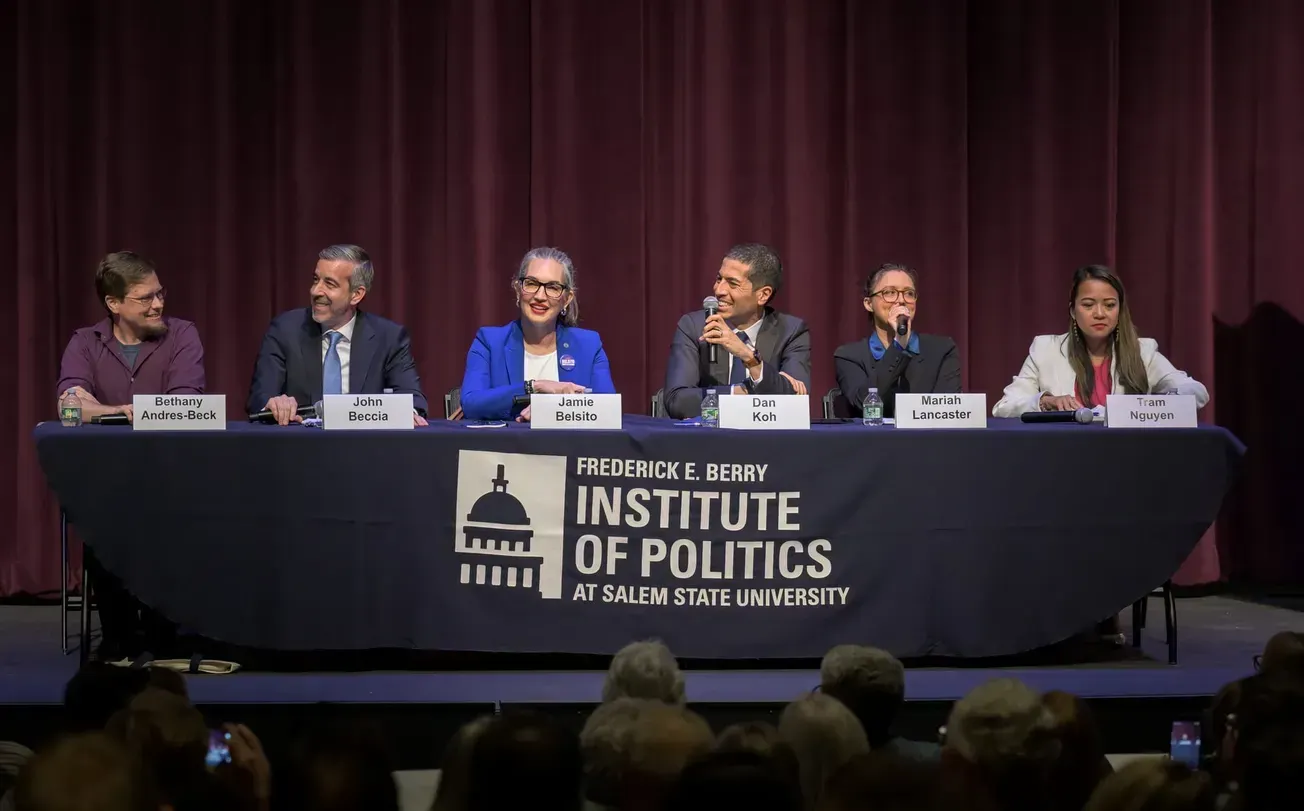
For most of 90 minutes on a June stage at Salem State University, the six Democrats running to succeed U.S. Rep. Seth Moulton agreed on nearly everything. They would all abolish Immigration and Customs Enforcement. None would raise the Social Security retirement age. Then they got to money — and who had too much of it.
The clash sat atop the most lopsided ledger in the race. Federal campaign finance reports, filed with the Federal Election Commission through March 31, show a contest far less crowded than the six-way forum suggests: one campaign built by institutional money, one floated by a candidate's own fortune, one anchored almost entirely in the district and several others struggling to assemble the machinery a congressional race demands. One Democrat has $3 million in the bank. Another has $9,535.
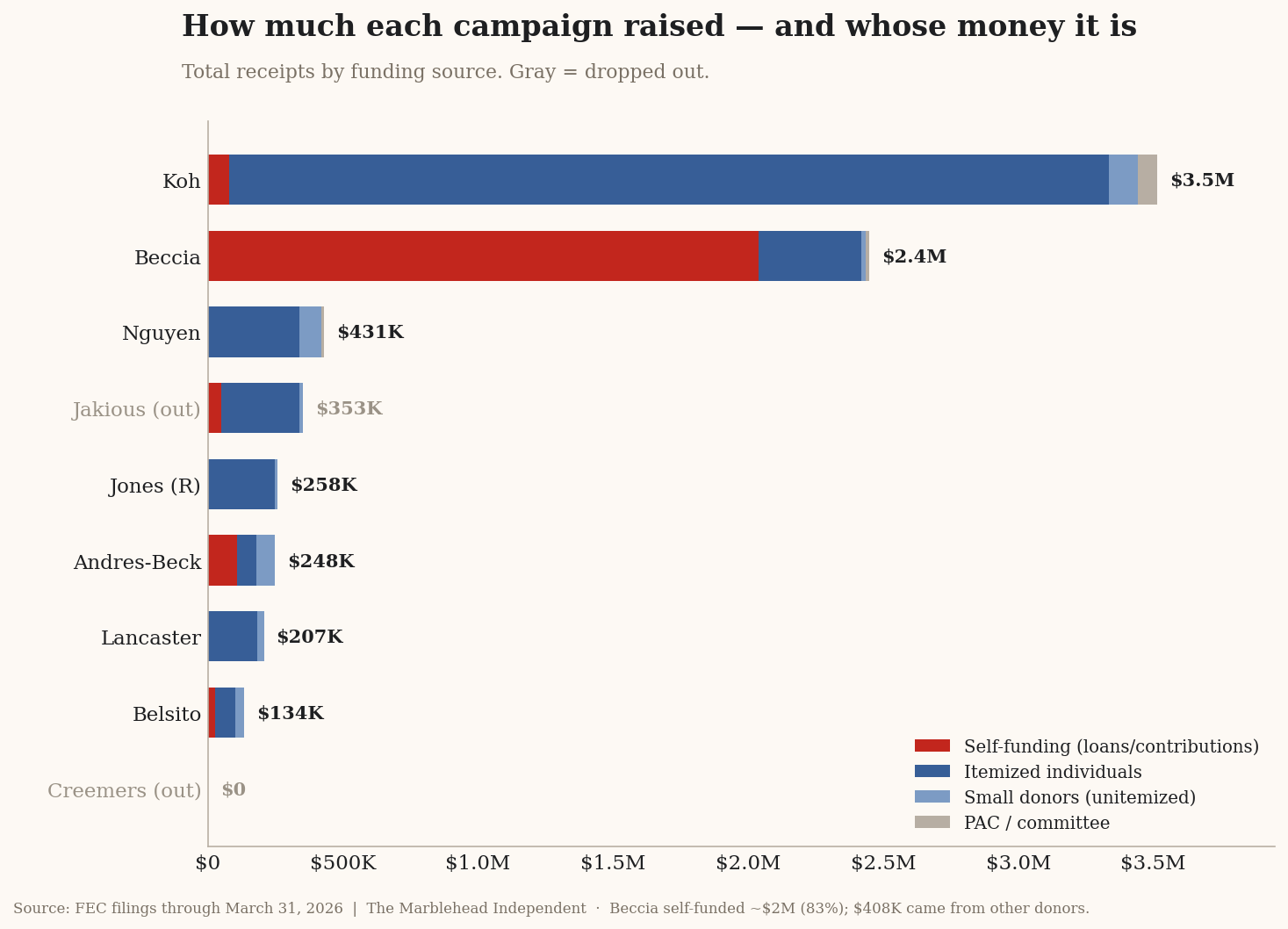
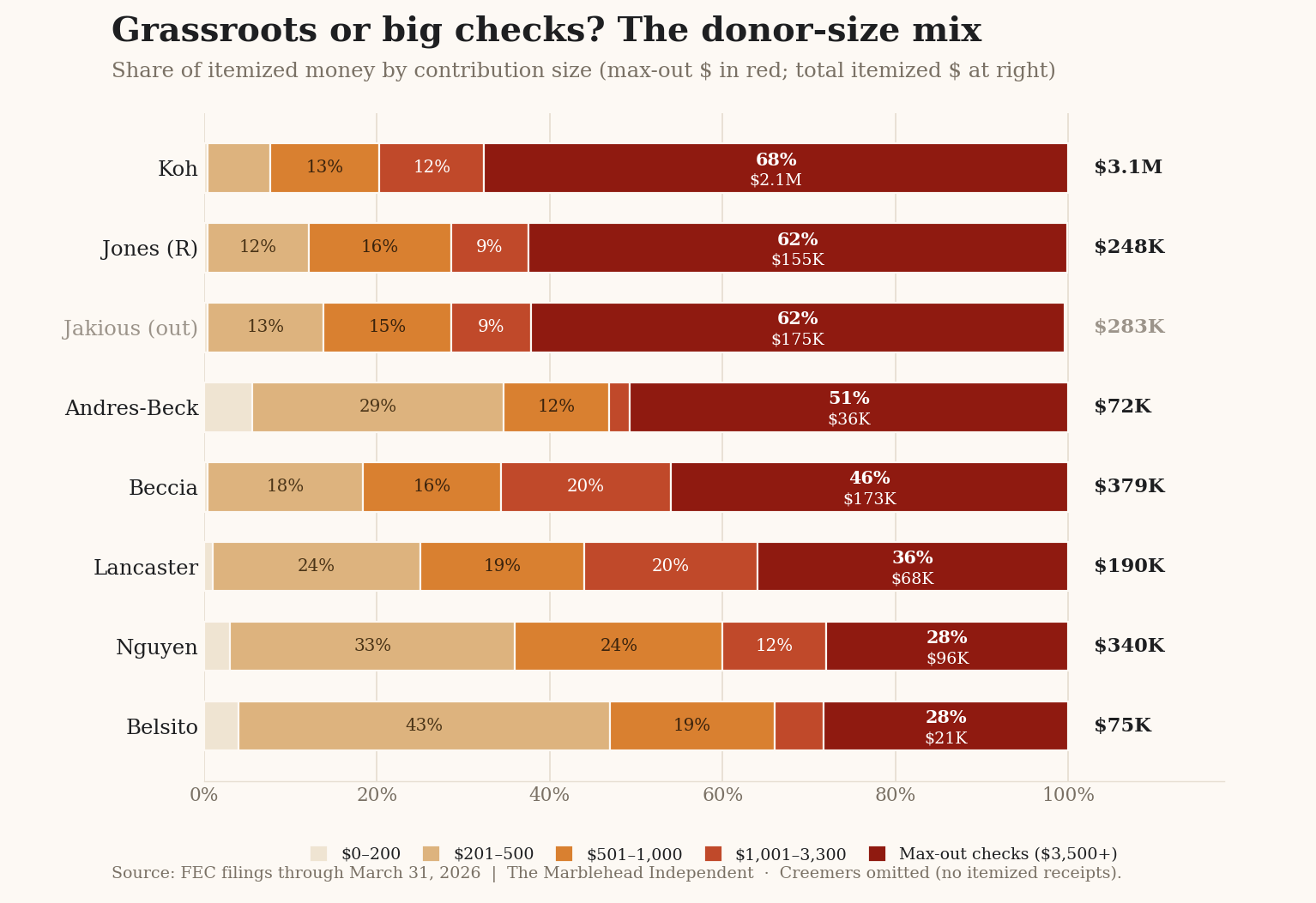
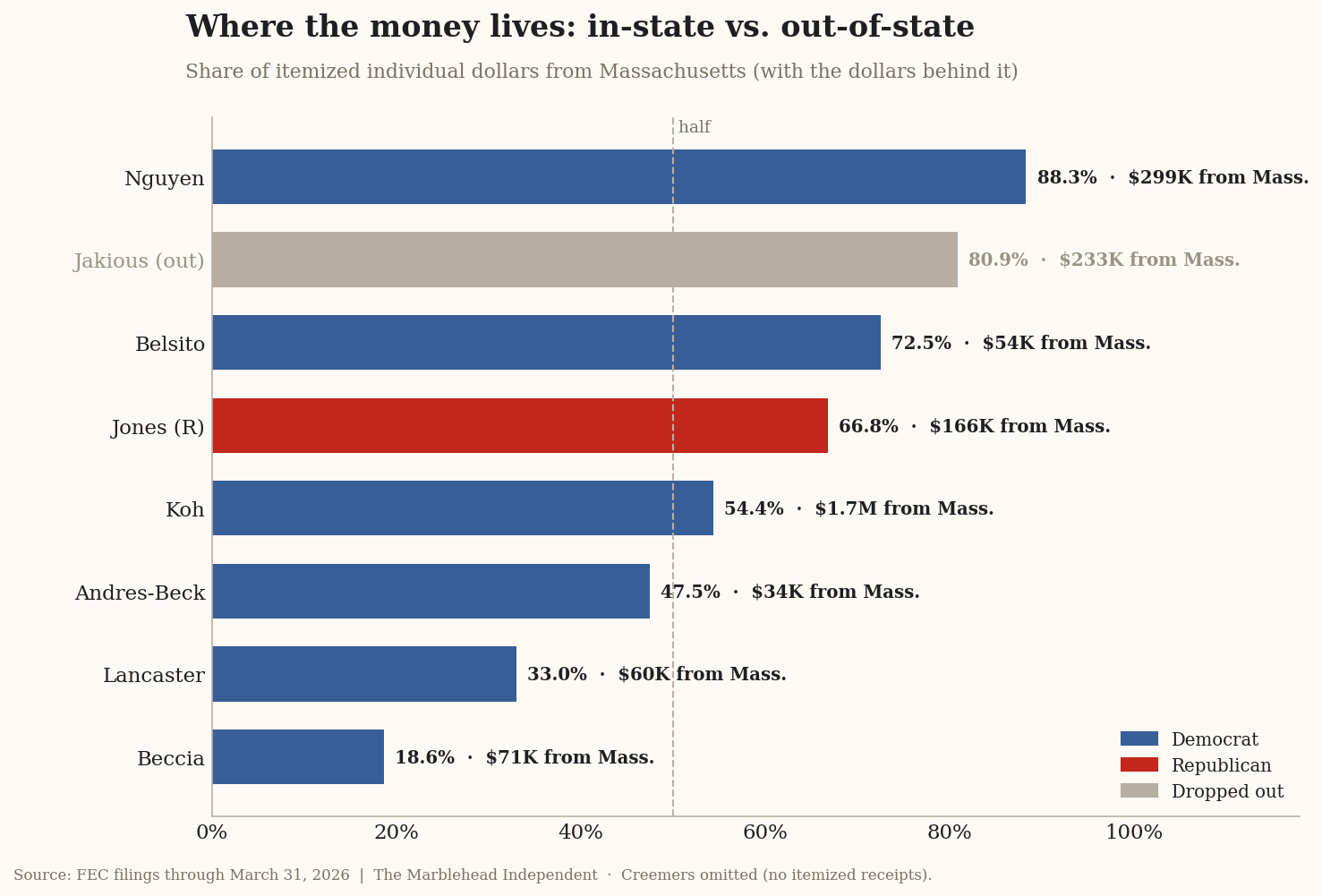
Koh, an Andover native and former aide in President Joe Biden's White House, has built the institutional campaign on both counts, money and endorsements. He reported $3.5 million raised and $3 million in cash — more than the rest of the active field holds combined — and spent only about $506,000 getting there. The shape of the money matches the résumé. Roughly $2.1 million of his itemized individual contributions came in checks of $3,500 or more, at or above the per-election limit; the donors too small to itemize, those giving under $200, supplied just 3 percent of his haul. His biggest single-state hauls came from New York and California, not Massachusetts — clusters of attorneys, investors and finance executives whose checks add up to nearly $800,000, against about $1.7 million from home.
Onstage, Koh recited the rest of his advantage: endorsements from Biden, former Vice President Kamala Harris and, he said, more than 70 unions and local officials. Former U.S. Rep. John Tierney, who held the seat 18 years and has endorsed him, watched from the audience. Koh has also been endorsed by End Citizens United, a group that campaigns against the influence of big money in politics, a tension his own donor file, among the most top-heavy and most national in the race, states plainly.
John Beccia's $2.4 million looks like the second-strongest haul until the source is separated out. About $2 million of it, roughly 83 percent, is his own money, loaned to the campaign by a financial technology executive from Lynnfield whose disclosures report assets in the tens of millions. He said he was "betting on myself," brushing off the attacks on self-funding. The filings show what the bet rests on. Only about $408,000 came from other donors, and most of it came from outside Massachusetts: just $70,582 of his itemized individual money, 18.6 percent, came from in-state addresses. Of the roughly $385,000 he has spent, the largest pieces were payroll, about $81,000; fundraising consultants, about $97,000, led by the firms Authentic Campaigns and Lawlor Strategies; and polling and research, about $49,000 — a campaign investing to raise more money and measure itself, with comparatively little aimed directly at voters.
Get our free local reporting delivered straight to your inbox. No noise, no spam — just clear, independent coverage of Marblehead. Sign up for our once-a-week newsletter.
Tram Nguyen owns the opposite end of the map. A state representative from Andover who came to the United States as a refugee from Vietnam and grew up in public housing, she raised about $431,000 without a dollar of her own money and almost nothing from political action committees — and 88 percent of her itemized money came from Massachusetts. Her average gift, about $623, is less than half the size of Koh's, and her file runs to retirees, attorneys and a long tail of small donors rather than out-of-state max-out checks. No one else in the field comes close to that local concentration. Her constraint is the mirror of Beccia's: unmistakably hers, and far shallower than the leaders' accounts.
The other three Democrats are crowded into the same small-dollar, in-district lane, with uneven results. Mariah Lancaster, a Salem veterinarian who once worked at the State Department, raised about $207,000 but drew only a third of her itemized money from in-state — among the least locally funded campaigns in the race. Belsito raised about $134,000, roughly $26,000 of it her own, and kept nearly three-quarters of her itemized money local. Bethany Andres-Beck, a Middleton software engineer who entered the race first and has spent the most freely, put about $106,000 of her own money into a $248,000 campaign and built the strongest small-donor base in the field — and then nearly spent it dry. She has $9,535 left after disbursing $175,470, most of it on a staff she may no longer be able to keep.
Burn rate — the share of money raised that a campaign has already spent — divides the field as cleanly as anything. Koh has gone through about 14 percent of his haul and Beccia 16 percent, each leaving most of his money untouched. Nguyen has spent roughly 41 percent, Belsito 49, Lancaster 51, Andres-Beck 71. A high burn rate isn't failure on its own — early organizing pays off later — but paired with a thin account, it marks the campaigns with the least room left for an expensive finish.
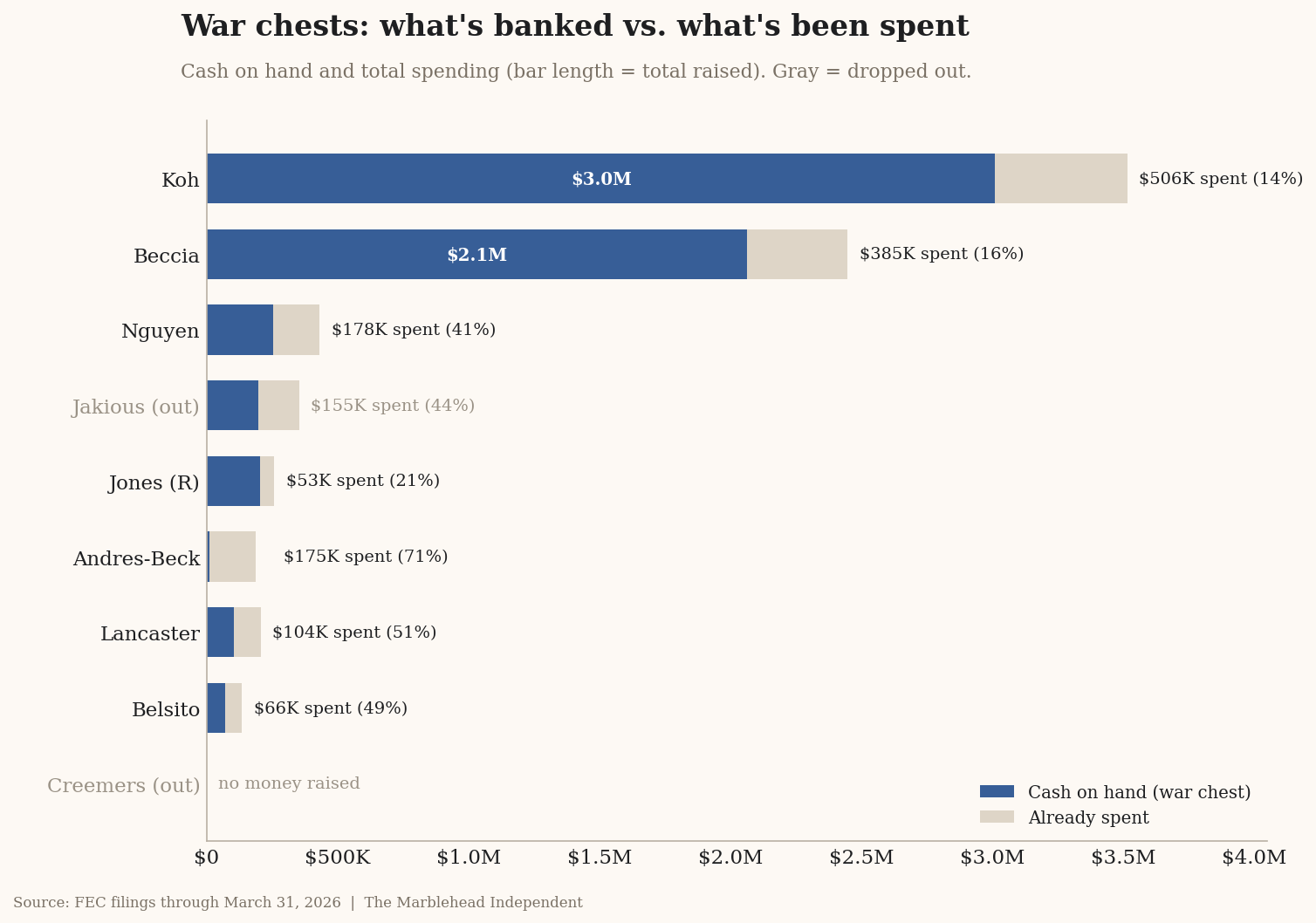
The spending tells the rest. Koh's largest single cost was the credit-card processing on his online fundraising — about $121,000 to ActBlue — followed by payroll, digital consulting and the quiet infrastructure of compliance and voter-file software, the profile of an operation that has barely touched its reserves. Nguyen poured most of her spending into fundraising and consultants. Andres-Beck's went to payroll and a $43,750 data contract, with under $4,000 on the advertising that actually puts a name in front of voters — a staff without an audience.
That math decides what each campaign can do before Sept. 1. Sustained television, which can run into seven figures across the district's media market, is within reach only for Koh and Beccia, and Beccia's reach is a function of his own balance rather than donor demand. Nguyen and the Republican have cash for targeted mail and field organizing; Lancaster and Belsito have enough for one or the other; Andres-Beck, without new money, has little left for paid voter contact at all. The candidate who leaves the summer with both a bank account and a local base, rather than one or the other, will enter the fall with an advantage the forums cannot confer.
The money behind the 6th District race
Pick a measure; the candidates re-rank from highest to lowest.
Source: FEC filings through March 31, 2026 · The Marblehead Independent · Creemers (dropped out) reported $0.
Micah Jones, the only Republican in the race and its nominee in all but name, will meet the Democratic winner Nov. 3 with the most disciplined balance sheet in the field: $258,000 raised, $53,440 spent, $204,512 banked. With no primary to fight, he has been free to hoard. His money looks more like Koh's than the progressives', built largely on max-out checks. But in a district the Cook Political Report rates 11 points more Democratic than the national average, his cash is less a weapon than a cushion for a general election that starts uphill. The field has already shed two Democrats: Rick Jakious, former Moulton chief of staff and a nonprofit executive who raised about $353,000 — more than three of the six still running — before dropping out, and Rachel Creemers, who reported nothing raised.
The argument the forum kept circling was not policy, where the daylight was thin, but lineage, who in a field this aligned gets to claim the working families all of them want to send to Washington. Belsito, who framed the contest as class warfare, told the room to watch what goes into the candidates' accounts. The reports she pointed to name no winner. They show which campaigns can still pay for the race they're selling, and which are running short of the money to finish it. The next filings, due in mid-July, will be the last full accounting before voters settle it on Sept. 1.