Table of Contents
Get our free local reporting delivered straight to your inbox. No noise, no spam — just clear, independent coverage of Marblehead. Sign up for our once-a-week newsletter.
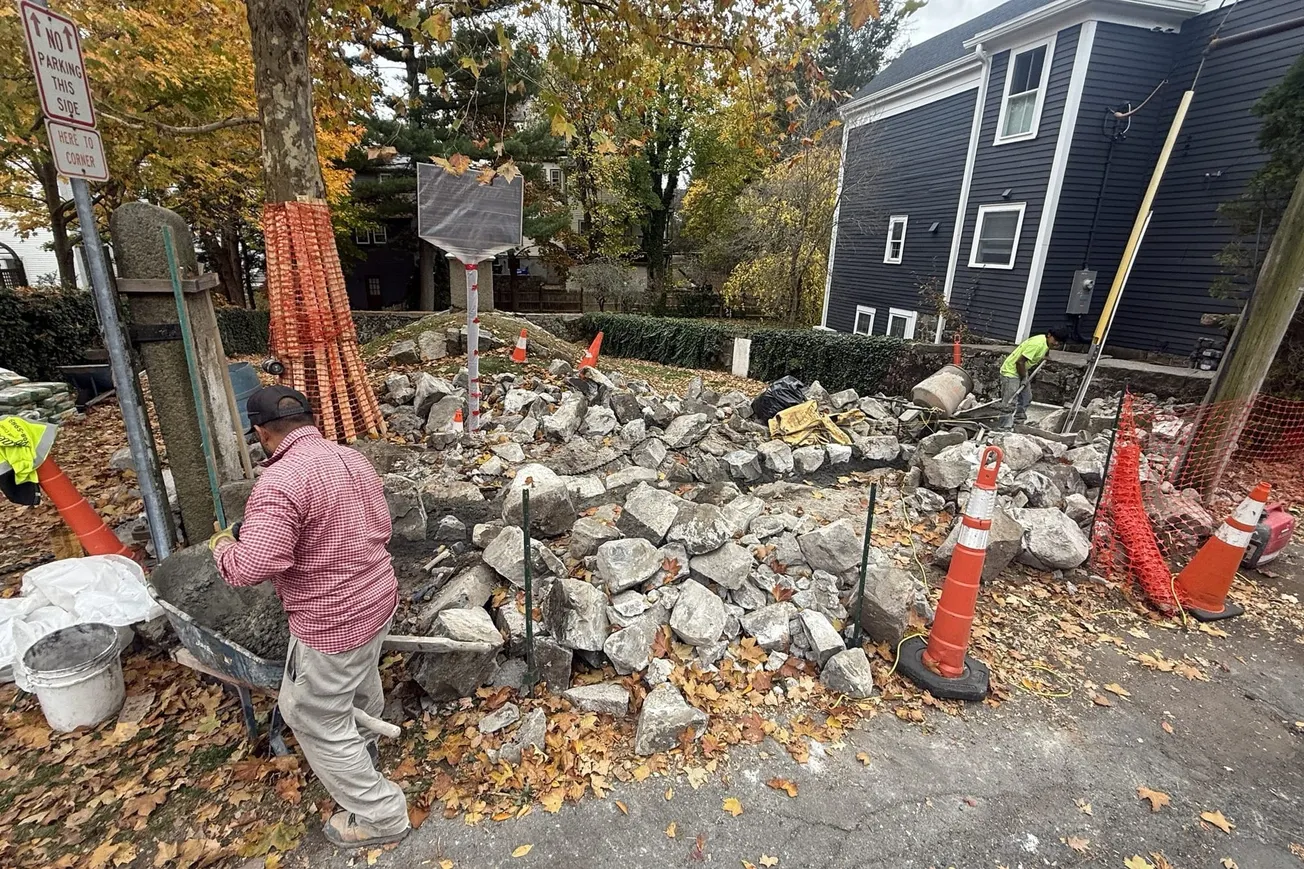
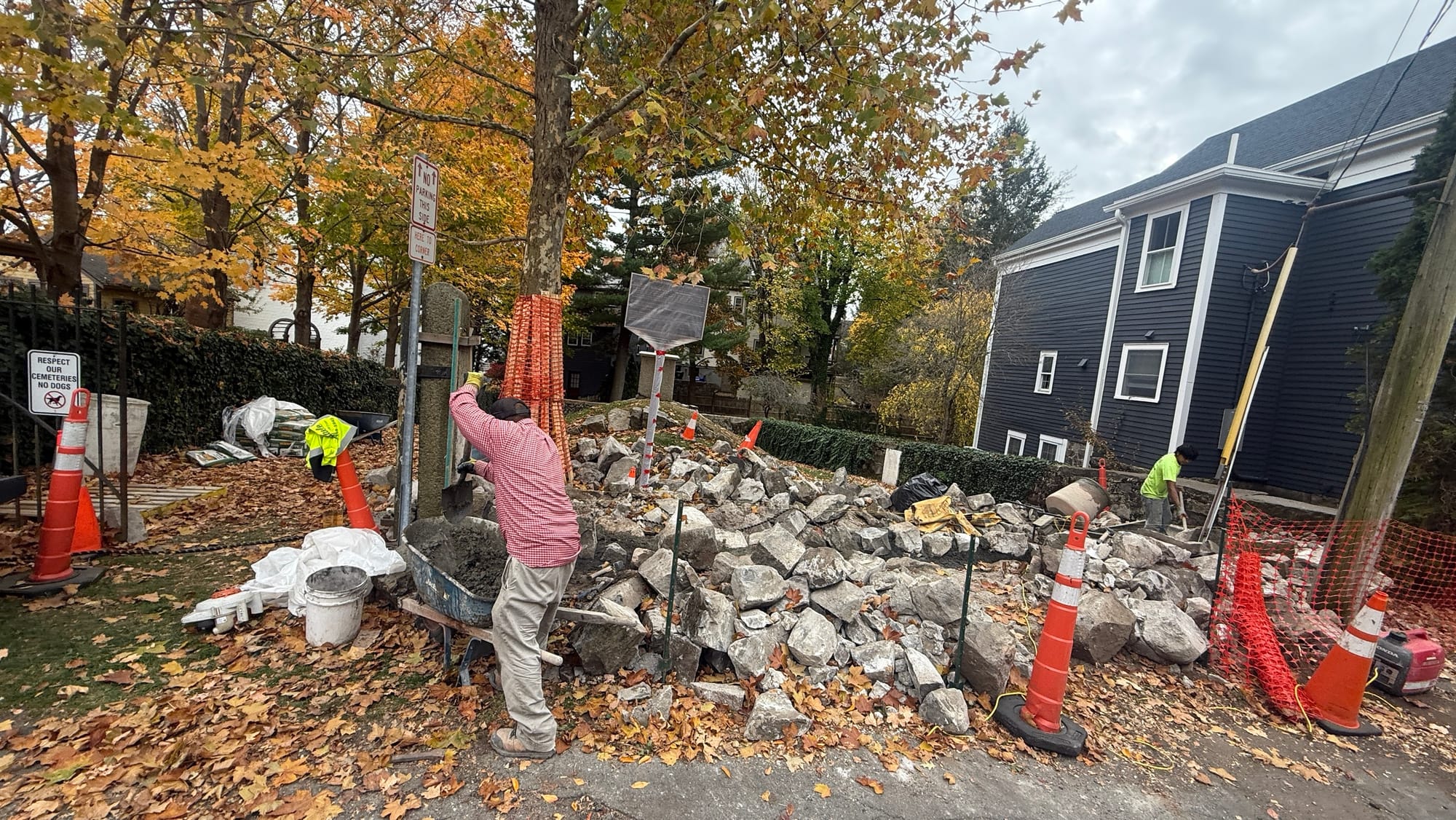
The plan called for patching the collapsed wall at the Hooper Tomb from partway up. Armando Velasquez, the taller of two brothers laying stone on Harris Street this week, started pulling pieces Wednesday and changed the plan.
“I see all the way in the ground. It’s crazy. It was no good,” Velasquez told a Marblehead Independent reporter Thursday. “So I say we have to build from the ground up. We moved everything.”
Now he and his brother Marvin, working for Raffaele Construction, are rebuilding the wall around the small Hooper family burial plot at 27 Harris St. from the foundation up. No new stone was brought in, Velasquez said. He had explained the change to David Bittermann, who chairs the Harris Street Cemeteries Oversight Committee, and expected the job to take three or four days.
Traffic cones fence off the sidewalk. The cold, gritty stones come off the pile one at a time, a wheelbarrow rumbles over the pavement, and trowels scrape mortar into the joints as autumn leaves gather at the foot of the new courses. Across Harris Street stand the wall and headstones of the larger Harris Street Cemetery.
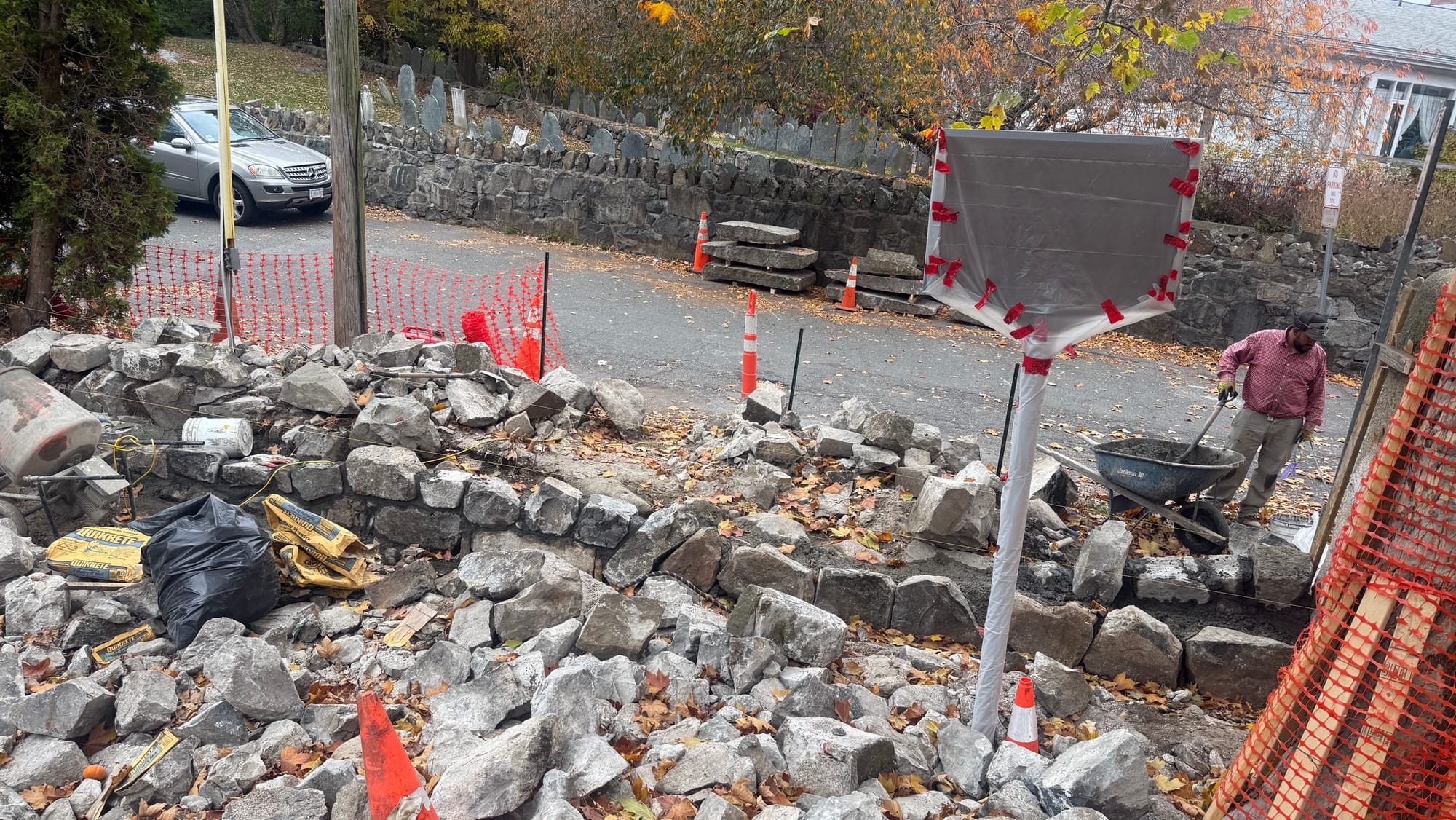
It is the first visible work after seven years of decline.
Bought from Pedrick’s heirs
The plot traces to 1805, when Robert Hooper purchased land from Pedrick’s heirs for a family cemetery. It is separate from Harris Street Cemetery, the former Pedrick Cemetery established in 1762, and from the nearby Captain Martin Tomb, established in 1827. The Committee oversees all three.
A 2005 Massachusetts Heritage Landscape Reconnaissance Report describes a small family plot with two tombs and names Capt. John Glover Hooper. Documented connections also include Robert Hooper, a Revolutionary War patriot baptized July 12, 1741, who died Jan. 20, 1814. Edward O. Nilsson, who sits on the Committee, has noted that one Hooper was a major benefactor of St. Michael’s Church who helped pay for its complete renovation in 1833.
No one has a verified count of who lies there. Unmarked burials, believed to number about two dozen inside the tomb, are the subject of a ground-penetrating radar survey the Committee has discussed separately from the wall.
Seven years to a bid
Signs of stress showed near one corner of the wall around 2019, Bittermann has said, and by about 2022 there was a hole. The wall later collapsed and became dilapidated. The Historical Commission asked that the original stones stay on site so the wall could be rebuilt from them.
The Select Board created the five-member Committee on Sept. 11, 2024. Bittermann, a Harris Street resident and retired National Park Service preservation architect, chairs it.
In March, Bittermann and Historical Commission Chair Pam Peterson met with Alison Jenkins, the town’s chief procurement officer, who agreed that phasing the work was sound. This spring the Historical Commission received $55,000 from the Shattuck Fund, Peterson said: $40,000 for the wall and $15,000 to print its book “Mapping Marblehead.”
The town advertised the job in August as “Hooper Cemetery Wall Replacement,” with a $40,000 estimate and an Aug. 27 bid opening. Two bids fell within budget, Bittermann told the Historical Commission at its September meeting. The town issued a notice of intent to award the work to Raffaele for $37,450, pending votes by the Historical Commission and the Cemetery Commission. The Historical Commission approved it that day.
Half a wall, for now
The first phase called for repointing the lower sections that survived, building the wall back to about half its height in the middle and reincorporating a gate post and its hanging strap at the east end and the surviving capstone at the west end.
Those last two were “the two instabilities that we wanted to address right away, regardless,” Bittermann said.
The full restoration is estimated at $80,000, Peterson has said, and the Historical Commission expects to return to the Shattuck Fund next year for about $40,000 more, less any private gifts.
Before the masons could reach the stones, Bittermann and volunteers cut down what he called a “mountainous forsythia,” 12 feet high and as wide. The clearing drew attention.
“People are wanting to know what was going on, and one of the neighbors that came by offered to make another donation,” Bittermann said.
Peterson said donors respond when they can see a project is “worth giving money to because it’s going to actually get done.”
On Thursday, that proof was rising course by course on Harris Street. When the Velasquez brothers finish, the wall will — as noted above — stand at about half its old height, its top still waiting on the next $40,000.
BEFORE YOU GO … Our reporting remains free and open to all. It is sustained by readers who choose to support it — by contributing so that routine, document-based local reporting continues without paywalls or promotional framing. Right now, 133 readers support The Marblehead Independent with monthly or annual contributions. Click here to become an Independent member.