Table of Contents
Get our free local reporting delivered straight to your inbox. No noise, no spam — just clear, independent coverage of Marblehead. Sign up for our once-a-week newsletter.
Marblehead school officials had already built a level-funded fiscal year 2027 budget when they were told they may need to cut roughly another $1.5 million as part of the town’s response to a broader budget deficit.
The additional reduction had surfaced earlier in the town’s budget discussions. Finance Committee members Alec Goolsby and Molly Teets came before the School Committee to explain how town officials calculated the figure and why it had been assigned to the school side of the budget.
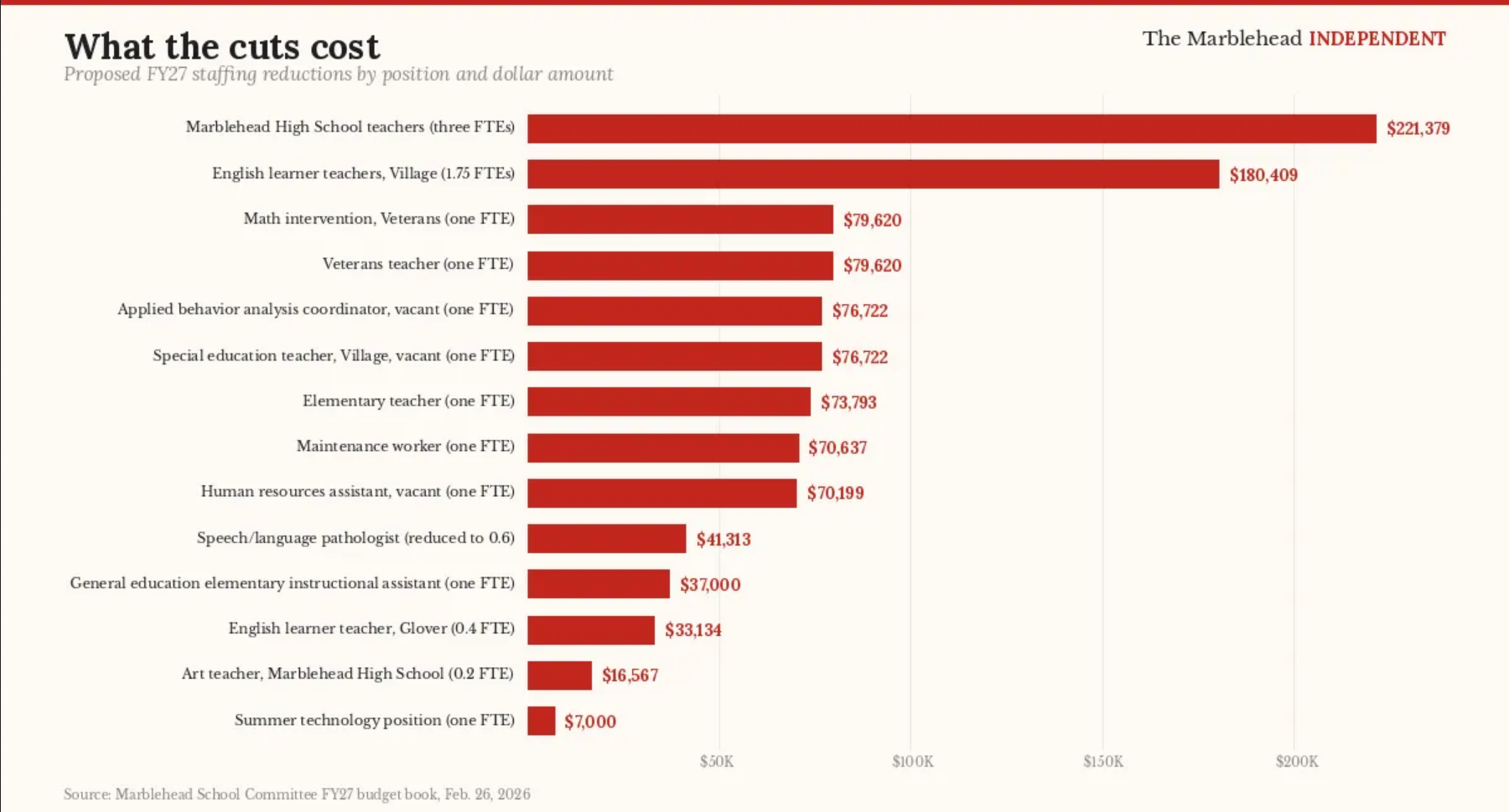
School officials said the timing of the request created immediate tension. The district had already presented a level-funded budget proposal after making substantial reductions, including eliminating 14.75 full-time-equivalent positions.
Superintendent John Robidoux told the committee that building another round of cuts around uncertain numbers could have direct consequences for staff and students.
“I’m still not convinced that number is the right number,” Robidoux said.
“I don’t want to create a scenario having to figure out how to come up with $1.5 million if that $1.5 million ends up being 900 or 1.2 and that’s real money, that’s real people.”
He added that additional reductions would directly affect classrooms.
“This will 100% impact classrooms. It will 100% impact students.”

Finance Committee explains shared-cost analysis
Goolsby told the committee his presentation attempted to clarify how certain benefit costs are distributed between the town and the school department.
Some expenses tied to school employees — including health insurance, retiree health benefits and other benefit-related obligations — appear on the municipal side of the budget rather than in the school department’s operating budget. Goolsby said his analysis attempted to allocate those costs more directly to the school side.
He said the exercise began by comparing last year’s operating budgets, which he said totaled about $49.1 million for the schools and about $48 million for town departments, excluding debt service and enterprise funds.
He then incorporated updated revenue projections and estimated the townwide deficit at roughly $7.7 million, though he said that number included several figures still being refined.
From there, Goolsby said he examined several benefit-related lines that appear in the town’s “other general government” category. Those lines include pension obligations, annual required contributions, active employee health insurance, life insurance, retiree health insurance and Medicare reimbursements for retirees.
He said reallocating those costs produced a different picture of how the overall deficit was distributed.
“That is where that number came from,” Goolsby said, referring to the roughly $1.5 million additional reduction being discussed for the school department.
He also cautioned that the model depended on the accuracy of the underlying assumptions.
“The spreadsheet’s outcome is only as good as its inputs,” Goolsby said. “I did not audit those percentages hard.”
Under the analysis he presented, Goolsby said the schools’ portion of the broader deficit was about $3.2 million. Because the district had already reduced its budget by about $1.7 million to reach a level-funded proposal, he said the remaining gap was “a little north of $1.5 million.”

School officials question data and timing
While several School Committee members said the framework itself was understandable, the discussion quickly shifted to whether the underlying numbers were reliable enough to support further cuts.
Kate Schmeckpeper said the structure of the analysis was logical if the inputs proved accurate.
“I think this makes a lot of sense,” Schmeckpeper said.
At the same time, she questioned whether the committee was being asked to adopt a new budgeting framework in the middle of a crisis without knowing whether the approach would remain consistent in future years.
School administrators focused their concerns on the assumptions behind the health insurance and pension calculations.
A school finance official told the committee he rebuilt the district’s health insurance projection using the district’s employee roster and newly released Group Insurance Commission rates. His estimate came in about $350,000 lower than the figure used in the town’s spreadsheet.
He also said he believed the model included an additional cushion of roughly $350,000.
“Bad data is bad data problems,” he said, adding that he could not recommend the approach if he did not trust the numbers behind it.
School officials also questioned how pension costs were divided between the town and the schools, noting that many licensed educators participate in the Massachusetts Teachers’ Retirement System rather than the town’s pension system.
Goolsby acknowledged that some assumptions would need further review and said the school and town finance teams would need to examine the figures together.
Committee weighs collaboration against impact
As the meeting continued, members of the School Committee wrestled with the broader question of how the schools should respond to the town’s budget crisis.
Member Jenn Schaeffner said the committee’s responsibility was to advocate for the schools while still recognizing the need for cooperation with town government.
“Our job is to advocate for the schools,” Schaeffner said.
Schmeckpeper said the committee also had to consider how its budget decisions fit into the town’s larger financial strategy.
“Asking for $1.5 million more than the town has allocated without a clear path towards funding is a symbolic gesture, not a long-term governing strategy,” she said.
She added that any successful override effort would likely require close coordination between the School Committee and Select Board.
“This is one town,” Schmeckpeper said.
Teets said the town could avoid similar conflicts in the future by creating a more formal process for discussing shared costs earlier in the budget cycle. She said representatives from the Select Board, Finance Committee and School Committee should meet at the beginning of the process to establish common assumptions before the budget reaches its final stages.
Several speakers noted that earlier coordination could have changed the tone of the conversation.
Robidoux said discussions about shared assumptions months earlier in the process might have prevented the current dispute.
Next step: reconcile the numbers
By the end of the meeting, the committee did not attempt to settle the size of the potential reduction.
Instead, members agreed that the underlying numbers needed to be reviewed collaboratively.
Schaeffner moved to direct school administrators to work with the town’s finance director to reconcile the figures used in the shared-cost analysis and return to the committee with a revised presentation and updated budget proposal.
The motion passed 5-0.
Select Board Chair Dan Fox, speaking from the town side, said the number presented to the schools was $1.5 million and emphasized that the town was not seeking additional reductions beyond that figure.
“I’m not asking for more,” Fox said, adding that he was committed to continuing the work collaboratively. “You have my commitment to work with you as one town.”
BEFORE YOU GO … Our reporting remains free and open to all. It is sustained by readers who choose to support it — by contributing so that routine, document-based local reporting continues without paywalls or promotional framing. Right now, 101 readers support The Marblehead Independent with monthly or annual contributions. Click here to become an Independent member.